Number of Bitcoins in Self-Custody by Investors Named

cryptonews.ruPublished on 2026-08-18Last updated on 2026-08-18

Abstract

The article reports on the ownership structure of Bitcoin, based on analysis by River. Key findings include: * **Self-custody:** A total of 7.95 million BTC (37.9% of supply) is held in active wallets by investors. * **Lost coins:** An estimated 1.62 million BTC (7.7%) is considered permanently lost, with over 90% lost before 2012. * **Institutional and exchange holdings:** Centralized exchanges hold 2.91 million BTC (13.9%), third-party custodial services control 4.66 million (22.2%), ETFs own 1.51 million (7.2%), and public companies hold 1.05 million (5%). * **Dominance of self-custody:** Analysts attribute the prevalence of self-custody to Bitcoin's early history, as over half of all BTC was mined before exchanges were widespread. Over 12 million BTC haven't moved in the past year, and over 6 million have been inactive for at least five years. * **Shifting custody landscape:** The share of Bitcoin controlled by exchanges among custodial intermediaries has dropped from over 50% in 2021 to 38% now, with specialized custody services gaining share. Nearly half of the BTC on exchanges is backed by publicly verifiable reserves. * The article notes separate data from Santiment indicating the share of Bitcoin on centralized exchanges has fallen to a six-year low of 5.6% of total supply.

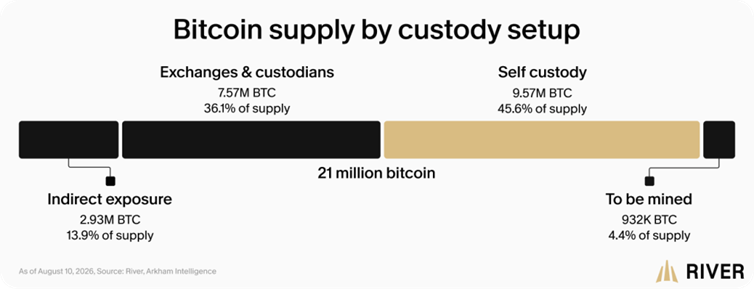
Out of the total volume of self-custody, analysts at River categorized 7.95 million bitcoins, or 37.9% of the supply, as coins held in active wallets. Another 1.62 million $BTC (7.7%) are considered by on-chain experts to be irretrievably lost. Over 90% of these losses occurred up to and including 2011.

Centralized cryptocurrency exchanges currently hold 2.91 million $BTC (13.9%), while third-party custodial services control 4.66 million coins (22.2%). Exchange-traded funds (ETFs) own 1.51 million $BTC (7.2%), and public companies hold 1.05 million bitcoins (5%).

The prevalence of self-custody was linked by River representatives to the ownership structure of the asset. More than half of all bitcoins were mined before the widespread adoption of crypto exchanges. Over 12 million $BTC have not moved in the past year, and more than 6 million bitcoins have remained immobile for at least five years.

Simultaneously, the market for custodial services is changing. In 2021, exchanges controlled more than half of the bitcoins held by intermediaries, but now their share is only 38%. The remaining volume is predominantly concentrated with specialized cryptocurrency storage services. Meanwhile, almost half of the coins on trading platforms are backed by publicly verifiable reserves, River specialists reported.

Earlier, analysts from the on-chain platform Santiment reported that the share of the first cryptocurrency on centralized crypto exchanges has fallen to a six-year low — 5.6% of the asset's total supply.

Trending Cryptos

Related Questions

QAccording to the article, how many bitcoins are in self-custody and what percentage of the total supply does this represent?

AInvestors hold 7.95 million bitcoins in self-custody, representing 37.9% of the total supply.

QWhat percentage of the total Bitcoin supply is considered permanently lost, and what period accounts for over 90% of these losses?

A7.7% of the total supply, or 1.62 million bitcoins, are considered permanently lost. Over 90% of these losses occurred up to and including the year 2011.

QHow have the shares of bitcoins held on centralized exchanges versus third-party custodial services changed since 2021 according to River analysts?

ASince 2021, the share of bitcoins controlled by centralized exchanges has fallen from over half of all coins held by intermediaries to just 38%. The remaining volume is now predominantly held by specialized cryptocurrency custody services.

QWhat is one key reason given by River analysts for the prevalence of self-custody among Bitcoin holders?

AThe prevalence of self-custody is linked to the asset's ownership structure, as over half of all bitcoins were mined before the widespread adoption of cryptocurrency exchanges.

QWhat did on-chain analysts from Santiment report earlier regarding the amount of Bitcoin on centralized exchanges?

AAnalysts from Santiment reported that the share of Bitcoin on centralized exchanges has decreased to 5.6% of the total supply, which is a six-year low.

Related Reads

3-Month Loss of $10 Billion, DAT Companies Begin to Return to Rationality

During the recent earnings season, major Digital Asset Treasury (DAT) companies reported staggering combined losses of approximately $10 billion for Q2 and over $30 billion for the first half, primarily due to markdowns on their bitcoin holdings. However, contrary to expectations, their stock prices have rebounded from June lows, indicating the market had already priced in these losses. The key shift is a collective return to rationality. Companies like Strategy, Sharplink, and Metaplanet are now prioritizing a new core metric: increasing the amount of crypto assets per share. This marks a departure from last year's aggressive growth-at-all-costs narrative. To achieve this, they are adopting disciplined capital allocation—issuing stock to buy crypto when trading at a premium, and halting dilution or initiating buybacks when at a discount. Some, like Strategy, have even broken "never sell" pledges to uphold this discipline. A major tool enabling this strategy is the STRC model—perpetual preferred shares offering high dividends (e.g., 12-13%) to raise fixed-income capital for purchasing bitcoin. Strive, Bitmine, and Metaplanet have launched their own variants. Sharplink pursues a different path, staking its vast Ethereum holdings to generate native yield. While the premium of DAT stocks over their underlying crypto asset value has declined and may not fully return, the model is evolving rather than ending. Stripped of hype, DAT firms are becoming actively managed, leveraged thematic funds. Their survival through massive losses and continued institutional investment (with major funds adding billions to positions during downturns) suggests the industry is maturing into a more calculated, long-term business focused on compounding crypto per share.

marsbit3m ago

3-Month Loss of $10 Billion, DAT Companies Begin to Return to Rationality

marsbit3m ago

PI Price Forecast Remains Stable at $0.086 as Pi Network Reforms App Economy

PI price forecast remains stable around $0.086 as it continues to trade below a key descending trendline from April. The token has been consolidating in a narrow range between $0.078 and $0.086 throughout August, with major EMAs positioned above the price indicating bearish pressure. Key resistance levels are identified at the 20-day EMA ($0.08772) and the SuperTrend indicators around $0.09-$0.10. Support sits at the current price and the August range low of $0.070. Fundamentally, Pi Network announced a major change to its App Studio pricing model, set for August 24, 2026. The fixed, subsidized rate of 0.25 Pi for app creation/editing will shift to a usage-based model reflecting actual AI service costs. Subsidized rates will remain for apps demonstrating genuine user adoption. Separately, the mandatory node protocol upgrade has reached version 26.1, with only version 27.1 remaining to complete the sequence. On-chain activity shows increased transaction volume, including patterns of repeated 0.03 Pi transfers, potentially related to testing following the protocol upgrade. The bullish scenario targets a break above the $0.08772-$0.09000 resistance cluster, opening a path toward the 50-day EMA at $0.09560. The bearish risk is a breakdown below the consolidation range, potentially testing the $0.070 support level. The conclusion notes that while fundamental developments are progressing, the price chart remains technically constrained until it can decisively break above the persistent downtrend line and key moving averages.

cryptonews.ru6m ago

PI Price Forecast Remains Stable at $0.086 as Pi Network Reforms App Economy

cryptonews.ru6m ago

"We have long ceased to be a crypto company": Tether CEO made a statement after KPMG audit

Stablecoin giant Tether has engaged Big Four auditor KPMG to verify its reserves, including a physical count of roughly 150 tons of gold in a Swiss vault. The audit confirmed the gold is present and that Tether's total reserves exceed its liabilities by $6.8 billion. CEO Paolo Ardoino described the process as "a physically heavy exercise" in an interview with Fortune. The audit aimed to address a long-standing conspiracy theory in the crypto world that USDT is not properly backed and could face a mass default. In a significant statement, Ardoino declared, "We haven't considered ourselves a crypto company for a long time. I think we are a digital dollar and digital gold company." He noted Tether has over 650 million users globally, with a strong focus in Africa and South America, where demand for stable digital assets is high due to recurring currency devaluations. Beyond financial services, Tether has been investing in decentralized communications, agriculture, and solar-powered kiosk networks for low-cost autonomous electricity. The company's next strategic move is to provide basic AI services to its user base in developing countries. Ardoino emphasized that even in the poorest nations, most people have a mobile phone capable of running simple AI models. The goal is to offer affordable, fundamental tools in sectors like healthcare, finance, and sports for a few dollars per month, payable via Tether or other digital payments. Ardoino expressed concern about societal inequality transforming from a wealth gap into a deeper "intellectual gap."

cryptonews.ru6m ago

"We have long ceased to be a crypto company": Tether CEO made a statement after KPMG audit

cryptonews.ru6m ago

Smartphones and Computers Will Become More Expensive: Ministry of Industry and Trade Plans to Collect 136 Billion Rubles from Electronics Buyers

Russia's Ministry of Industry and Trade plans to introduce a new mandatory "technological levy" on imported and domestically produced electronics, starting December 1, 2026. Unlike earlier proposals, a previously planned 5,000-ruble cap per device has been removed from the draft rules, which could lead to significantly higher charges. The ministry estimates the levy will raise 136 billion rubles over six years, with funds earmarked to support the domestic microelectronics industry. The levy applies to electronic components and finished products like smartphones, computers, and telecommunications equipment. While businesses will formally pay the fee, the cost is expected to be passed on to consumers through higher retail prices, potentially most affecting budget devices. This move may also reduce the variety of products available if importing certain models becomes unprofitable. The plan has raised concerns. A legal conflict exists as the current law still includes the 5,000-ruble cap. Additionally, the specific rates and calculation method for devices like smartphones remain unclear. Experts compare it to a similar levy on vehicles, where rates and exemptions were frequently revised. The collected funds will supplement, not replace, other state and private investments in the microelectronics sector. The levy's ultimate impact on device affordability and industry support will depend on final regulations and implementation.

cryptonews.ru9m ago

Smartphones and Computers Will Become More Expensive: Ministry of Industry and Trade Plans to Collect 136 Billion Rubles from Electronics Buyers

cryptonews.ru9m ago

Trading

Spot

Hot Articles

What is $BITCOIN

DIGITAL GOLD ($BITCOIN): A Comprehensive Analysis Introduction to DIGITAL GOLD ($BITCOIN) DIGITAL GOLD ($BITCOIN) is a blockchain-based project operating on the Solana network, which aims to combine the characteristics of traditional precious metals with the innovation of decentralized technologies. While it shares a name with Bitcoin, often referred to as “digital gold” due to its perception as a store of value, DIGITAL GOLD is a separate token designed to create a unique ecosystem within the Web3 landscape. Its goal is to position itself as a viable alternative digital asset, although specifics regarding its applications and functionalities are still developing. What is DIGITAL GOLD ($BITCOIN)? DIGITAL GOLD ($BITCOIN) is a cryptocurrency token explicitly designed for use on the Solana blockchain. In contrast to Bitcoin, which provides a widely recognized value storage role, this token appears to focus on broader applications and characteristics. Notable aspects include: Blockchain Infrastructure: The token is built on the Solana blockchain, known for its capacity to handle high-speed and low-cost transactions. Supply Dynamics: DIGITAL GOLD has a maximum supply capped at 100 quadrillion tokens (100P $BITCOIN), although details regarding its circulating supply are currently undisclosed. Utility: While precise functionalities are not explicitly outlined, there are indications that the token could be utilized for various applications, potentially involving decentralized applications (dApps) or asset tokenization strategies. Who is the Creator of DIGITAL GOLD ($BITCOIN)? At present, the identity of the creators and development team behind DIGITAL GOLD ($BITCOIN) remains unknown. This situation is typical among many innovative projects within the blockchain space, particularly those aligning with decentralized finance and meme coin phenomena. While such anonymity may foster a community-driven culture, it intensifies concerns about governance and accountability. Who are the Investors of DIGITAL GOLD ($BITCOIN)? The available information indicates that DIGITAL GOLD ($BITCOIN) does not have any known institutional backers or prominent venture capital investments. The project seems to operate on a peer-to-peer model focused on community support and adoption rather than traditional funding routes. Its activity and liquidity are primarily situated on decentralized exchanges (DEXs), such as PumpSwap, rather than established centralized trading platforms, further highlighting its grassroots approach. How DIGITAL GOLD ($BITCOIN) Works The operational mechanics of DIGITAL GOLD ($BITCOIN) can be elaborated on based on its blockchain design and network attributes: Consensus Mechanism: By leveraging Solana’s unique proof-of-history (PoH) combined with a proof-of-stake (PoS) model, the project ensures efficient transaction validation contributing to the network's high performance. Tokenomics: While specific deflationary mechanisms have not been extensively detailed, the vast maximum token supply implies that it may cater to microtransactions or niche use cases that are still to be defined. Interoperability: There exists the potential for integration with Solana’s broader ecosystem, including various decentralized finance (DeFi) platforms. However, the details regarding specific integrations remain unspecified. Timeline of Key Events Here is a timeline that highlights significant milestones concerning DIGITAL GOLD ($BITCOIN): 2023: The initial deployment of the token occurs on the Solana blockchain, marked by its contract address. 2024: DIGITAL GOLD gains visibility as it becomes available for trading on decentralized exchanges like PumpSwap, allowing users to trade it against SOL. 2025: The project witnesses sporadic trading activity and potential interest in community-led engagements, although no noteworthy partnerships or technical advancements have been documented as of yet. Critical Analysis Strengths Scalability: The underlying Solana infrastructure supports high transaction volumes, which could enhance the utility of $BITCOIN in various transaction scenarios. Accessibility: The potential low trading price per token could attract retail investors, facilitating wider participation due to fractional ownership opportunities. Risks Lack of Transparency: The absence of publicly known backers, developers, or an audit process may yield skepticism regarding the project's sustainability and trustworthiness. Market Volatility: The trading activity is heavily reliant on speculative behavior, which can result in significant price volatility and uncertainty for investors. Conclusion DIGITAL GOLD ($BITCOIN) emerges as an intriguing yet ambiguous project within the rapidly evolving Solana ecosystem. While it attempts to leverage the “digital gold” narrative, its departure from Bitcoin's established role as a store of value underscores the need for a clearer differentiation of its intended utility and governance structure. Future acceptance and adoption will likely depend on addressing the current opacity and defining its operational and economic strategies more explicitly. Note: This report encompasses synthesised information available as of October 2023, and developments may have transpired beyond the research period.

1.9k Total ViewsPublished 2025.05.13Updated 2025.05.13
What is $BITCOIN

Discussions

Welcome to the HTX Community. Here, you can stay informed about the latest platform developments and gain access to professional market insights. Users' opinions on the price of BTC (BTC) are presented below.

活动图片