"No Questions Asked, Cash Accepted": A Record of Cryptocurrency Street Trading in Montenegro

marsbitPublished on 2025-12-10Last updated on 2025-12-10

Abstract

In Montenegro, cryptocurrency transactions operate in a regulatory vacuum, with unverified intermediaries facilitating anonymous cash-for-crypto exchanges on the streets of Podgorica. A BIRN investigation documented a typical transaction: 70 USDT swapped for €60 cash in minutes, with no questions asked about fund origins. These over-the-counter (OTC) deals, often arranged via Telegram groups, bypass banks and legal oversight. Blockchain analysis revealed one trader’s wallet handled millions in transactions over a year, with a quarter flagged as medium-to-high risk—including ties to frozen or sanctioned funds. Traders include locals and foreigners from Russia, Ukraine, and Turkey, who rely on cash exchanges due to banking access barriers. Despite 2025 anti-money laundering amendments requiring KYC checks for transactions over €1,000, enforcement remains absent. Montenegro’s EU-aligned crypto laws are pending, aiming to regulate service providers and enable tax oversight. For now, the gray market thrives, unregistered and unchecked.

In Montenegro, cryptocurrency trading remains in a regulatory vacuum. People conduct transactions through offline cash dealings and unverified intermediaries to circumvent legal oversight.

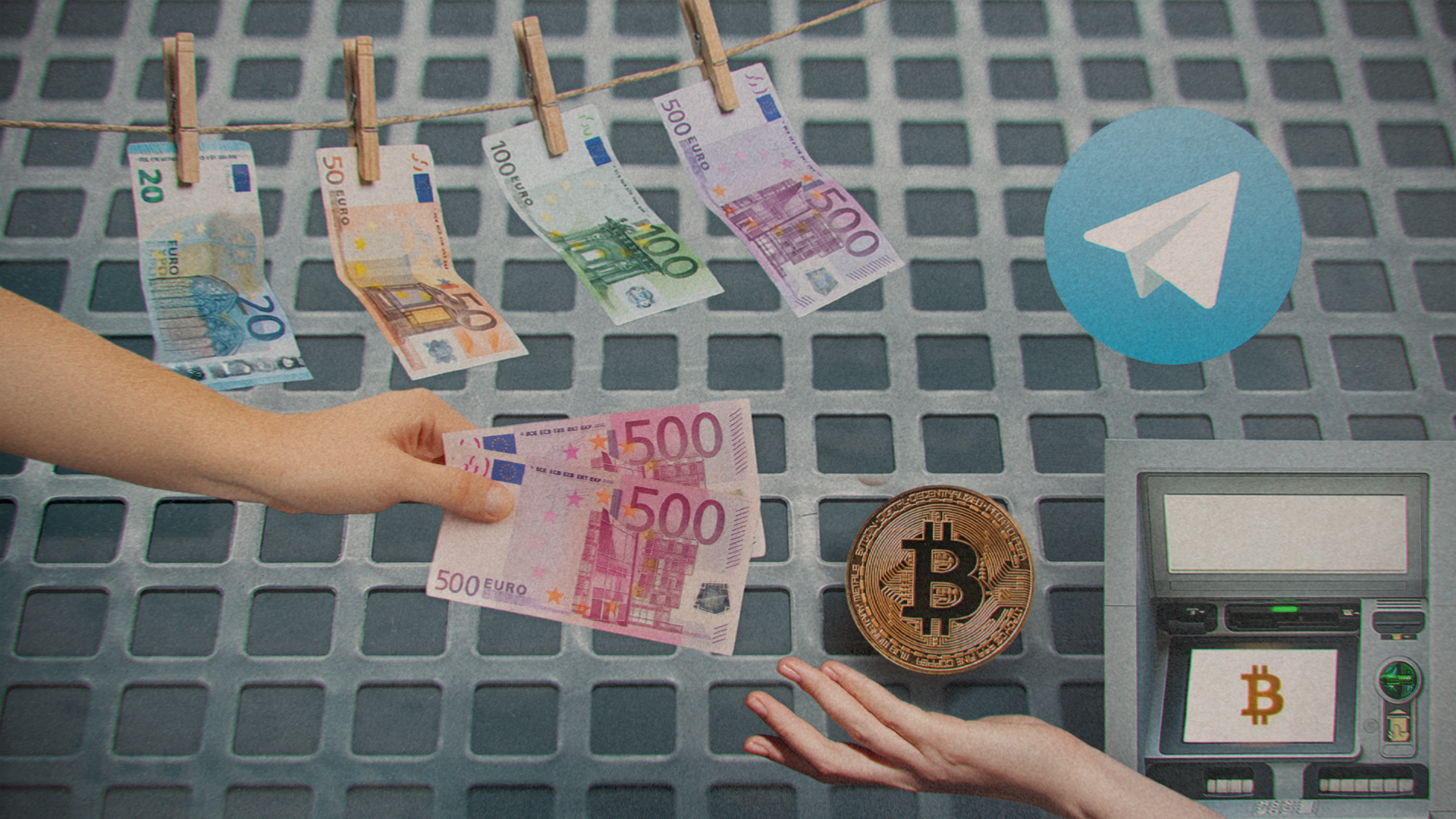
A trader posts an advertisement on social media, and both parties arrange the transaction details via chat software—within just a few minutes, 70 USDT is transferred from one crypto wallet to another, while 60 euros in cash are exchanged on the bustling streets of Podgorica (the capital of Montenegro). A fee of 5 euros is charged, with no questions asked and no inquiries about the source of funds.

After the transaction is completed, both parties quickly shake hands and depart. The trader mentions that he has other clients waiting for his services.

This scene is a true portrayal of Montenegro's cryptocurrency "gray area": cryptocurrencies are exchanged for cash outside the purview of legal regulation, with undercurrents flowing.
Anonymity, Cash, and High Risks

In fact, although Montenegro has promised to enact digital asset regulatory laws since 2020, they have yet to materialize.

While transferring funds from bank accounts to crypto trading platforms is not illegal in itself, cryptocurrencies cannot be converted into fiat currency through banks or registered exchange institutions.

At this point, intermediary platforms, Telegram groups, and online forums become the main channels for transactions—so-called "over-the-counter" (OTC) trading. Transactions are typically completed offline, with cryptocurrencies and cash exchanged directly and without any identity verification.

According to statistics from the blockchain forensics and crypto risk assessment platform "Global Ledger," the crypto wallet address involved in BIRN's transaction handled transactions worth millions of euros between October 2024 and October 2025. The largest single incoming transaction was $440,000, while the largest outgoing transaction exceeded $500,000.

Most of these transactions were conducted through well-known crypto platforms such as Binance and Gate.io, with about 75% of the activity occurring on low-risk platforms. However, a quarter of the transactions were classified as medium to high risk, including dealings with "frozen funds" (assets linked to frozen or sanctioned wallets) and entities sanctioned by the U.S. Financial Crimes Enforcement Network (FinCEN). Global Ledger rated the risk level of the trader's crypto wallet as "medium."

"In Podgorica, ask anyone involved in cryptocurrencies—everyone has their own 'dealer,'" said Ivan Jolicic, developer of Montenegro's digital currency Perper and a crypto expert. These dealers are not only locals but also include many expatriates from Russia, Ukraine, and Turkey.

"Participants include local crypto investors as well as foreigners, especially Russians, Ukrainians, and Turks. For them, this is the only way to make a living in Montenegro," Jolicic told BIRN. "They need to cover their living expenses in Montenegro, but banks are either unwilling or outright refuse to open accounts for them."

Another crypto trader active in the Balkans declined a request from a journalist to exchange 70 euros for Bitcoin, stating that their transaction threshold was "no less than 10,000 euros per transaction."

Russian-Language Telegram Groups Become Trading Hubs

BIRN's investigation found that multiple Telegram channels and online forums operate crypto exchange services in the Balkans or specifically for Montenegro. These groups range from a few dozen to several thousand members, with content including exchange amounts, rates, fees, and specific transaction locations.

A Russian-language Telegram group named "Обмен Валют Montenegro" (Montenegro Currency Exchange) has over 7,000 members and specializes in direct exchanges of cryptocurrencies for cash.
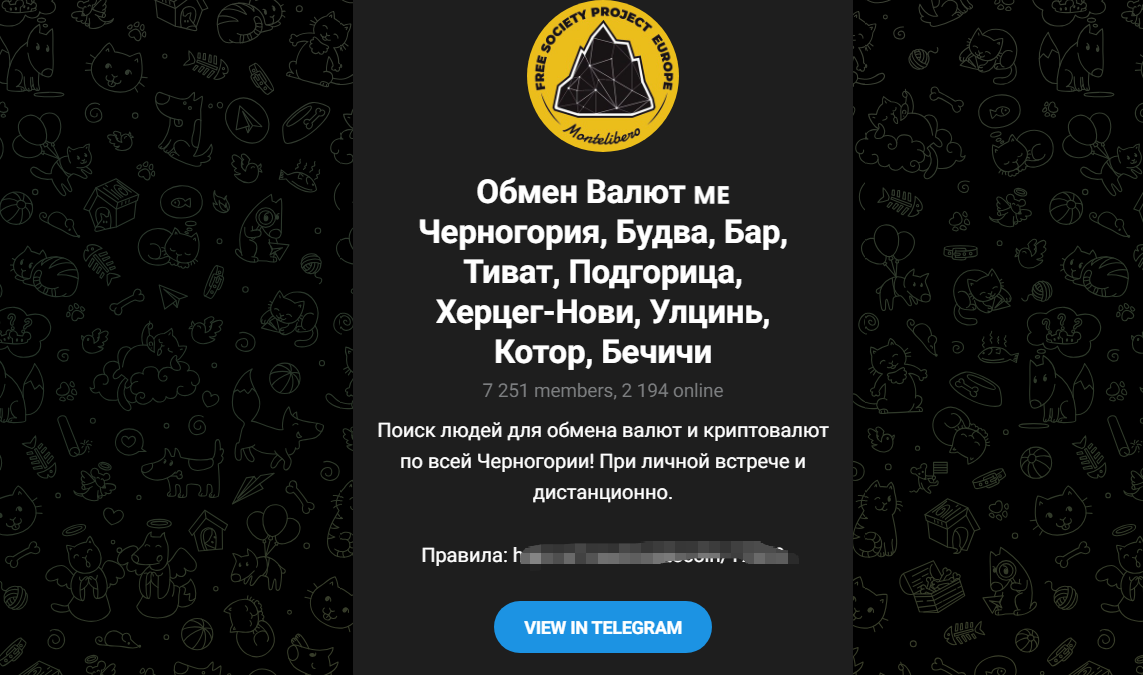
The group advises users to "only conduct transactions in person in public places and take necessary precautions," but also allows transactions through verified traders—these traders must submit passport information for group verification to receive a certified badge.

The group's logo and administrator usernames include the "Montelibero" community symbol. This community, located in Pecurice near the port city of Bar in Montenegro, was established by Russians in 2021. It claims to be a "free society" based on anarcho-capitalist principles and has issued its own cryptocurrency, EURMTL.

Victor Korb, a member of the Montelibero community council, denied any association between the community and the Telegram group: "Questions about others using the Montelibero project identifier should be directed to the users themselves."

Montenegro's tax authorities stated that, due to the lack of a legal basis, they are unable to tax such transactions.

"Until digital assets and their transactions are regulated by law, we cannot take any action," responded the Montenegrin Tax Authority. "Once the legal framework is established, the tax authorities will take all measures within their jurisdiction."

Although the process is slow, there has been preliminary progress.

In February 2025, the parliament passed an amendment to the "Anti-Money Laundering and Counter-Terrorist Financing Law," adding a "Register of Crypto-Asset Service Providers" and requiring "Know Your Customer" (KYC) verification for every crypto transaction exceeding 1,000 euros.

The Montenegrin Capital Market Committee (an independent securities and capital market regulatory body) was required to establish the register by mid-December 2025.

"Individuals or entities providing cryptocurrency-to-cash exchange services through social media operate in an unregulated 'gray area,'" the committee stated. "If service providers are unregistered and do not comply with the law, their activities may be deemed illegal—especially if there is suspicion of money laundering, unauthorized provision of financial services, or evasion of regulatory measures."

However, Jolicic remains skeptical. He believes that the registration requirements contradict the logic of the current gray market operations: "Those engaged in over-the-counter crypto trading must register and perform KYC verification for every client—but currently, no one is doing this. The law remains vague, and I believe these activities are inherently suspect under anti-money laundering regulations."

Legislative Revisions Imminent

BIRN previously exposed cases in Montenegro where cryptocurrencies were used to purchase real estate and vehicles, but such transactions were not incorporated into the tax or legal systems.

Due to the lack of a legal framework, authorities cannot even accurately track crypto assets held by public officials.

In mid-2023, the European Commission, the executive body of the EU, adopted the "Markets in Crypto-Assets Regulation" (MiCA), establishing a unified framework for digital asset regulation in the EU.

In September 2025, Montenegrin Prime Minister Milojko Spajic announced plans to draft digital asset laws in line with EU standards, and the Ministry of Finance has initiated public consultations on the relevant draft.

The proposed amendment to the "Credit Institutions Law" will, for the first time, define the concept of "digital assets," allowing credit institutions to provide crypto-related services (including digital token custody, trading platform operation, and transaction intermediation). The amendment to the "Tax Administration Law" will align Montenegrin law with the EU's "Directive on Automatic Exchange of Information on Crypto-Assets."

The Ministry of Finance stated that this will enable Montenegrin tax authorities to automatically exchange digital asset information with EU member states and other countries. Crypto service providers will need to collect and maintain user data (including accounts, transactions, and crypto income) and submit formal reports to the national service provider register.

"Regarding the taxation of crypto assets, we emphasize that once the digital asset regulatory law takes effect, the Ministry of Finance will amend tax laws to clarify the tax treatment of digital assets," the ministry responded.


Trending Cryptos

Related Questions

QWhat is the current regulatory status of cryptocurrency transactions in Montenegro?

ACryptocurrency transactions in Montenegro exist in a regulatory vacuum, with no specific digital asset laws yet implemented, allowing unregulated over-the-counter (OTC) cash exchanges to operate outside legal oversight.

QHow do OTC cryptocurrency transactions typically occur on the streets of Podgorica?

AOTC transactions involve parties agreeing on details via chat apps, transferring crypto between wallets, and exchanging cash in person on busy streets—often with no identity verification or questions about fund origins, completed within minutes.

QWhat risks are associated with the unregulated crypto-to-cash exchanges in Montenegro?

ARisks include medium-to-high risk wallet activities (per Global Ledger analysis), potential ties to frozen/sanctioned funds, anonymity enabling money laundering, and lack of consumer protection or legal recourse.

QWhich group facilitates a significant portion of crypto exchanges in Montenegro via Telegram?

ARussian-language Telegram groups like 'Обмен Валют Montenegro' (with 7,000+ members) serve as key hubs, offering crypto-cash exchanges often linked to foreign nationals (e.g., Russians, Ukrainians, Turks) who face banking access barriers.

QWhat legislative steps is Montenegro taking to regulate digital assets?

AMontenegro amended its Anti-Money Laundering Law in February 2025 to require KYC for transactions over €1,000 and plans EU-aligned laws (e.g., MiCA standards) to define digital assets, establish crypto service provider registries, and enable tax information exchange with the EU.

Related Reads

Stocks Fell Even More Violently Than Crypto, Where Did the Money Go?

From June to late July 2026, global stock markets, particularly technology and semiconductor stocks, experienced severe declines, with South Korea's KOSPI index facing historic circuit breakers and shedding 40% from its June peak. Key catalysts included SK Hynix's earnings miss despite record profits and competitive pressures from China's CXMT IPO. A global forced deleveraging event unfolded, devastating highly leveraged instruments like the 2x leveraged SK Hynix ETF, which lost over 80% of its value. Surprisingly, Bitcoin showed relative stability during this period, rising roughly 15% from its July low. The article clarifies this wasn't due to an inflow of equity flight capital but because Bitcoin had already undergone a significant correction in May and June, with U.S. spot Bitcoin ETFs seeing record outflows. True safe-haven flows went to gold, severing Bitcoin's short-term "digital gold" narrative. The sell-off is characterized not as an AI story collapse but a liquidity-driven清算 of crowded leveraged positions, potentially halfway through according to some analysts. For substantial capital to return to Bitcoin, the article cites necessary conditions: eased global liquidity pressure, a soft-landing Fed rate cut, and regulatory clarity from the stalled U.S. CLARITY Act. The conclusion is that Bitcoin is not a current safe haven but a pre-cleared asset. Its decoupling from tech stocks highlights its potential future role as a non-correlated asset for institutional portfolios, positioning it favorably for when global capital reallocates post-crisis.

marsbit7m ago

Stocks Fell Even More Violently Than Crypto, Where Did the Money Go?

marsbit7m ago

"The Final Phase Before the New Cycle". What Will Happen to Bitcoin in August

"Bitcoin Faces Crucial Test in August: Experts Predict Consolidation or Further Decline" The price of Bitcoin (BTC) is expected to remain under pressure in August, with experts anticipating either consolidation within a narrow range or a potential drop below $60,000. Despite a double-digit recovery from its July low near $58,000, BTC ended the month trading around $63,500, still roughly 50% below its October 2025 peak of $126,200. Analysts cite several headwinds: a challenging macroeconomic environment with high US interest rates and persistent inflation, which makes fixed-income assets more attractive than speculative ones like crypto. Furthermore, competition for capital is intense, with many investors favoring AI-related stocks. This is reflected in significant outflows from US spot Bitcoin ETFs, with a record $4.5 billion leaving in June and a net outflow of $5.4 billion for the first half of the year. Historically, August is a weak month for crypto, with a median return of -7.49% from 2013 to 2025. Experts also note regulatory uncertainty in the US, particularly the stalled CLARITY Act, as a dampening factor. Despite the bearish near-term outlook, several experts view the current phase as the "last phase before a new Bitcoin cycle" begins, potentially in Q4 2024. This makes it a favorable time for accumulating Bitcoin for the long term. Key price levels to watch are support at $60,000-$61,000, with a break below $58,000 potentially leading to $53,000-$55,000. A move above $67,000 could target $70,000-$75,000, though this is considered a lower probability scenario.

cryptonews.ru13m ago

"The Final Phase Before the New Cycle". What Will Happen to Bitcoin in August

cryptonews.ru13m ago

What Structural Changes Have Occurred in the Cryptocurrency Industry by 2026?

By 2026, the crypto industry is undergoing profound structural shifts, moving beyond price speculation towards deeper integration with the real-world economy. Major changes are driven by four key areas. First, stablecoins, now a $300B+ market, are evolving from crypto-native trading tools into real-world payment and B2B settlement backbones, extending business chains and creating complex accounting and tax obligations. Second, global regulation is maturing. Frameworks like the EU's MiCA are moving from legislation to active enforcement, determining market access. Anti-money laundering rules, such as the Travel Rule, see wider adoption but face enforcement and cross-border challenges. Third, AI Agents are emerging as autonomous transaction entities. Protocols like Coinbase's x402 enable machine-to-machine micropayments using stablecoins, necessitating new frameworks for transaction authorization, tax attribution, and audit trails. Finally, tax transparency is entering an implementation phase. Initiatives like the OECD's CARF, EU's DAC8, and the US Form 1099-DA are shifting reporting burdens to platforms, requiring them to reconcile on-chain data with user identity and tax residency information. Collectively, these trends signify that crypto compliance is becoming foundational infrastructure, requiring consistent data and control systems to meet cross-border operational, regulatory, and audit demands.

marsbit34m ago

What Structural Changes Have Occurred in the Cryptocurrency Industry by 2026?

marsbit34m ago

Trading

Spot

Hot Articles

How to Buy DATA

Welcome to HTX.com! We've made purchasing DATA Network (DATA) simple and convenient. Follow our step-by-step guide to embark on your crypto journey.Step 1: Create Your HTX AccountUse your email or phone number to sign up for a free account on HTX. Experience a hassle-free registration journey and unlock all features.Get My AccountStep 2: Go to Buy Crypto and Choose Your Payment MethodCredit/Debit Card: Use your Visa or Mastercard to buy DATA Network (DATA) instantly.Balance: Use funds from your HTX account balance to trade seamlessly.Third Parties: We've added popular payment methods such as Google Pay and Apple Pay to enhance convenience.P2P: Trade directly with other users on HTX.Over-the-Counter (OTC): We offer tailor-made services and competitive exchange rates for traders.Step 3: Store Your DATA Network (DATA)After purchasing your DATA Network (DATA), store it in your HTX account. Alternatively, you can send it elsewhere via blockchain transfer or use it to trade other cryptocurrencies.Step 4: Trade DATA Network (DATA)Easily trade DATA Network (DATA) on HTX's spot market. Simply access your account, select your trading pair, execute your trades, and monitor in real-time. We offer a user-friendly experience for both beginners and seasoned traders.

1.1k Total ViewsPublished 2026.07.01Updated 2026.07.01

How to Buy DATA

What is ANSEM

I. Project IntroductionThe Black Bull ($ANSEM) is a transparent, community-driven memecoin on Solana built around one creed: charge forward no matter what. The project is frontend-first and fully verifiable — its website reads live on-chain and market data directly from Solana, including price, liquidity, volume, market cap, and holder distribution, so anyone can audit the claims with no login and no user-data collection. Beyond the token, it offers an Ansem-call Radar, non-custodial community liquidity Pods on PumpSwap, and a browser-based meme terminal. $ANSEM is a standard Pump.fun SPL token (6 decimals) trading against SOL and USDC.II. Token InformationToken Symbol: ANSEM(The Black Bull)III. Related LinksWebsite:https://www.blackbullsol.com/X: https://x.com/blknoiz06Contract Address: https://solscan.io/token/9cRCn9rGT8V2imeM2BaKs13yhMEais3ruM3rPvTGpumpNote: The project introduction comes from the materials published or provided by the official project team, which is for reference only and does not constitute investment advice. HTX does not take responsibility for any resulting direct or indirect losses.

2.9k Total ViewsPublished 2026.07.01Updated 2026.07.01

What is ANSEM

How to Buy ANSEM

Welcome to HTX.com! We've made purchasing The Black Bull (ANSEM) simple and convenient. Follow our step-by-step guide to embark on your crypto journey.Step 1: Create Your HTX AccountUse your email or phone number to sign up for a free account on HTX. Experience a hassle-free registration journey and unlock all features.Get My AccountStep 2: Go to Buy Crypto and Choose Your Payment MethodCredit/Debit Card: Use your Visa or Mastercard to buy The Black Bull (ANSEM) instantly.Balance: Use funds from your HTX account balance to trade seamlessly.Third Parties: We've added popular payment methods such as Google Pay and Apple Pay to enhance convenience.P2P: Trade directly with other users on HTX.Over-the-Counter (OTC): We offer tailor-made services and competitive exchange rates for traders.Step 3: Store Your The Black Bull (ANSEM)After purchasing your The Black Bull (ANSEM), store it in your HTX account. Alternatively, you can send it elsewhere via blockchain transfer or use it to trade other cryptocurrencies.Step 4: Trade The Black Bull (ANSEM)Easily trade The Black Bull (ANSEM) on HTX's spot market. Simply access your account, select your trading pair, execute your trades, and monitor in real-time. We offer a user-friendly experience for both beginners and seasoned traders.

1.2k Total ViewsPublished 2026.07.01Updated 2026.07.01

How to Buy ANSEM

Discussions

Welcome to the HTX Community. Here, you can stay informed about the latest platform developments and gain access to professional market insights. Users' opinions on the price of A (A) are presented below.

活动图片