Mt. Gox Ex-CEO Wants Bitcoin’s Rules Rewritten To Claw Back $5B In Stolen Coins

bitcoinistPublished on 2026-02-28Last updated on 2026-02-28

Abstract

Former Mt. Gox CEO Mark Karpelès has proposed a hard fork of the Bitcoin network to recover approximately 80,000 BTC (worth over $5 billion) stolen in the 2014 collapse of the exchange. The coins remain untouched in a single wallet for over 15 years. Karpelès argues this change is necessary to break a deadlock with the trustee overseeing creditor repayments, who refuses to act without community support for such a rule change. The proposal has faced swift criticism, with opponents warning it would undermine Bitcoin’s core principle of immutability and set a dangerous precedent for future interventions. The long-awaited recovery for thousands of creditors remains unresolved after more than a decade.

Twelve years is a long time to wait. For thousands of people who lost their Bitcoin when the Mt. Gox exchange collapsed in 2014, the wait has stretched on with little hope of getting everything back.

Now, the man who ran the exchange is pushing for an extraordinary solution — one that would require changing Bitcoin itself.

A Proposal That Shakes Bitcoin’s Foundation

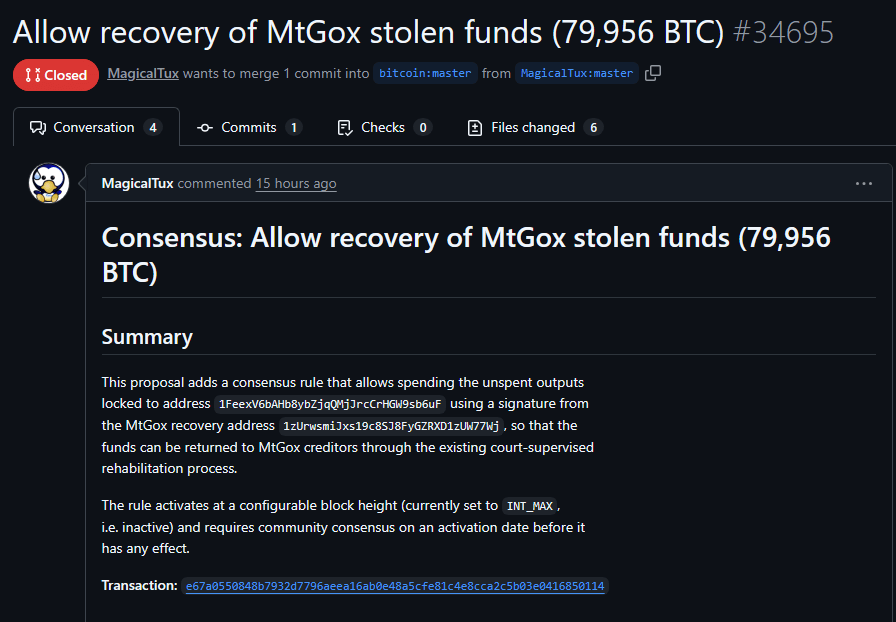
Mark Karpelès, Mt. Gox’s former boss, submitted a formal proposal on GitHub last Friday calling for a hard fork — a fundamental change to Bitcoin’s rules — that would allow nearly 80,000 Bitcoin, currently worth more than $5 billion, to be moved to a recovery address without needing the original private key.

Reports say those coins have not budged from a single wallet in over 15 years, making them one of the most-watched and well-documented addresses in all of crypto.

Source: GitHub

Karpelès was blunt about what he was asking for. He did not try to soften or disguise the idea. “This is a hard fork,” he reportedly wrote in the proposal. “It makes a previously invalid transaction valid.”

Image: it boltwise

His reasoning centers on a deadlock that has developed between two key parties. The Mt. Gox trustee overseeing creditor repayments has refused to pursue any on-chain recovery without some guarantee that the Bitcoin community would actually adopt such a rule change.

But the community cannot seriously weigh that idea without a concrete proposal in front of them. Karpelès says his GitHub submission breaks that stalemate.

Critics Say It Opens A Dangerous Door

The pushback came fast. On the Bitcoin forum Bitcointalk, members lined up to argue the proposal would cause serious damage to one of Bitcoin’s most important qualities — the idea that transactions, once confirmed, are permanent and cannot be reversed by anyone.

BTCUSD now trading at $64,044. Chart: TradingView

One user warned that approving a rule change like this would set a template for every future hack victim to demand the same treatment. Another raised concerns about outside governments gaining influence over what Bitcoin can and cannot do.

Those concerns are not unreasonable. Bitcoin’s value, at least in part, rests on the belief that no single person, court, or government can reach in and move coins without the proper key. Break that rule once, even for a sympathetic reason, and the rule is no longer a rule.

Creditors Still Waiting After More Than A Decade

Mt. Gox was once enormous. At its height, it processed roughly 70% of all Bitcoin transactions happening anywhere in the world.

Hackers exposed weaknesses in its security systems as early as 2011, draining thousands of coins over time in a theft that went unnoticed for years.

By February 2014, the exchange filed for bankruptcy in Tokyo after reporting losses of 750,000 customer Bitcoin and 100,000 of its own — worth around $500 million at the time.

Featured image from Unsplash, chart from TradingView

Related Questions

QWho is proposing a hard fork to recover the stolen Bitcoin from Mt. Gox, and what is the estimated value of the coins?

AMark Karpelès, the former CEO of Mt. Gox, is proposing the hard fork. The estimated value of the 80,000 Bitcoin is over $5 billion.

QWhat is the main argument against the proposed hard fork, according to critics in the article?

ACritics argue that the hard fork would seriously damage one of Bitcoin's most important qualities: the immutability and permanence of confirmed transactions. They warn it would set a dangerous precedent for future hack victims and could allow outside governments to gain influence over the network.

QWhat is the stalemate that Mark Karpelès claims his proposal breaks?

AThe stalemate is between the Mt. Gox trustee, who refuses to pursue on-chain recovery without a guarantee the Bitcoin community would adopt the rule change, and the community, which cannot seriously consider the idea without a concrete proposal. Karpelès' GitHub submission provides that concrete proposal.

QHow long have the 80,000 Bitcoin in question remained unmoved, and what was Mt. Gox's significance before its collapse?

AThe 80,000 Bitcoin have not moved from a single wallet in over 15 years. Before its collapse, Mt. Gox was once the world's largest Bitcoin exchange, processing roughly 70% of all global Bitcoin transactions at its height.

QWhat alternative solution to a hard fork was suggested by a critic on Twitter?

ALuke Dashjr suggested on Twitter that the court should order the thief to turn over the private key instead of changing Bitcoin's protocol rules.

Related Reads

The More Lifelike the Robot, the More Terrifying? Unveiling the 'Uncanny Valley Effect' in the Era of Humanoid Robots

As humanoid robots become increasingly lifelike, they confront a significant psychological barrier known as the "Uncanny Valley Effect," a concept proposed by Japanese roboticist Masahiro Mori in 1970. This phenomenon describes a dip in human comfort and acceptance when robots appear almost, but not perfectly, human. Minor imperfections in facial expressions, eye movements, or skin texture trigger a subconscious sense of unease, as the brain detects something trying, yet failing, to mimic a person. Examples range from the controversial human-like robot Sophia to animated characters in films like *The Polar Express*. The effect poses a key design challenge for robotics companies. Some, like Boston Dynamics, avoid it entirely by creating highly capable but visibly mechanical robots. Others, like Hanson Robotics, push for greater human likeness despite the risk. For consumer robots, especially in homes, most manufacturers opt for stylized or clearly mechanical designs to ensure broader acceptance. While the Uncanny Valley remains a powerful force, its impact may diminish over time through technological advancements that achieve near-perfect realism or through generational familiarity as people grow accustomed to interacting with humanoid machines. Ultimately, navigating this psychological frontier requires as much understanding of human perception as of robotics technology itself.

marsbit2m ago

The More Lifelike the Robot, the More Terrifying? Unveiling the 'Uncanny Valley Effect' in the Era of Humanoid Robots

marsbit2m ago

WeChat Agent Issues a 'Heroic Summons,' Half of the Internet Responds

WeChat AI Agent is on the horizon. The WeChat Open Platform has issued a guide for developers, offering them ways to integrate into the WeChat AI ecosystem. This will enable mini-programs to be discovered and invoked by the AI. Meituan has already announced its integration, allowing users to access services like food delivery through WeChat AI. Other platforms like Ctrip and Tongcheng have followed suit. Furthermore, WeChat is collaborating with major smartphone manufacturers to enable their native AI assistants to perform actions within WeChat, such as initiating calls or sending messages, through a controlled protocol called Agent-to-Agent (A2A). Reports indicate the WeChat AI Agent will be accessible by swiping right on the main interface. It aims to understand user intent within the rich context of chats, groups, and past interactions, then automatically call upon relevant mini-programs to complete tasks like ordering coffee or booking restaurants. This positions it as a potential "super app" with direct access to WeChat's vast ecosystem of services, social connections, and payment systems. Technically, this is a complex endeavor. It requires advanced natural language understanding, a "world model" to predict interactions within mini-programs (UI-Oceanus), multi-model orchestration for cost efficiency, and careful coordination with millions of third-party service providers. Tencent's development follows a "Co-Design" approach, where product teams and the Hunyuan model team collaborate closely, allowing capabilities honed in other AI products (like Yuanbao for chat, ima for search, WorkBuddy for office tasks) to be transferred to the WeChat Agent. Tencent is strategically opting for the A2A protocol over GUI-based automation (which it has blocked in the past), maintaining control over its ecosystem. To manage the immense scale and cost of serving 1.4 billion monthly active users, Tencent is deepening its ties with DeepSeek, known for its cost-effective training, to secure a low-cost inference backbone. The ultimate goal is to solve practical, everyday problems for users within the WeChat ecosystem, moving beyond technical benchmarks to deliver real utility, which Tencent sees as the key to winning in the long-term AI game.

marsbit1h ago

WeChat Agent Issues a 'Heroic Summons,' Half of the Internet Responds

marsbit1h ago

Trading

Spot
Futures

Hot Articles

Discussions

Welcome to the HTX Community. Here, you can stay informed about the latest platform developments and gain access to professional market insights. Users' opinions on the price of S (S) are presented below.

活动图片