Original | Odaily Planet Daily (@OdailyChina)
Author | Asher (@Asher_ 0210)

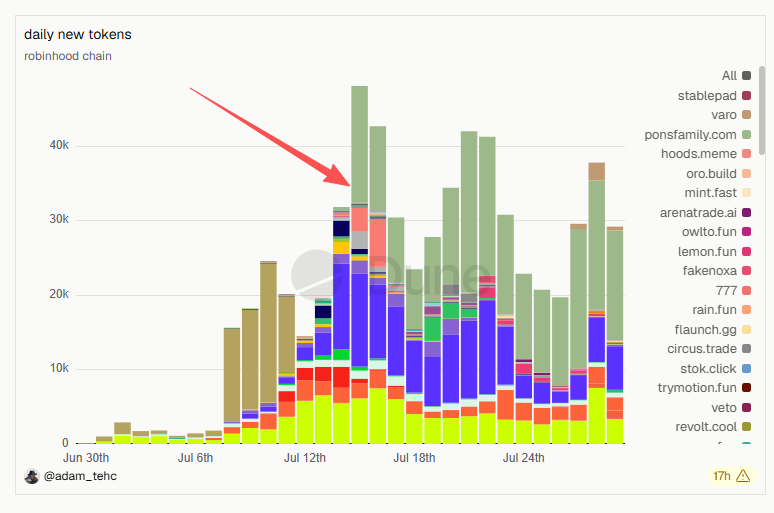
After NOXA ceased launching new tokens, the first to capture the Robinhood Chain token launch traffic was Flap. On July 14, Flap created over 11,000 tokens in a single day, accounting for more than 35% of the chain's token launches that day, with Bankr, Klik, and trench.today also taking a share of the traffic.
Two weeks later, the outcome of this free-for-all has become clearer.
Dune data shows that on July 15, Pons launched over 15,000 tokens in a single day, rising to the top spot among Robinhood Chain token launch platforms for the first time. Since then, Pons has maintained the lead in daily token launches, gradually widening the gap with Flap and other platforms.
In addition to the daily number of token launches, the trading volume of tokens on the Pons platform also began to grow rapidly from mid-July. On July 18, Pons' daily trading volume reached $40.7 million, surpassing NOXA's $37.4 million for the first time, and has remained in the top spot since. To date, the cumulative trading volume on the Pons platform has exceeded $1.5 billion.
On July 26 alone, Pons accounted for 77.1% of the total trading volume among Robinhood Chain token launch platforms, while the second-place NOXA accounted for only 6.6%. Pons is not only the platform with the most token launches but also commands the vast majority of trading volume on Robinhood Chain's token launch platforms.
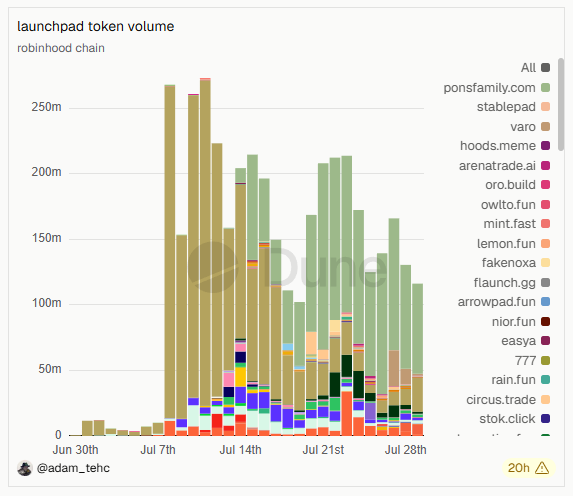
From Flap first capturing the demand after NOXA's exit to Pons overtaking in both launch volume and trading volume, a new leader among Robinhood Chain token launch platforms has emerged.
No Bonding Curve, No Migration: Pons Streamlines the Token Launch Process to the Minimum
Pons is a token launch and trading platform specifically built around Robinhood Chain, operated by Pons Labs, and is not an official Robinhood product. Users can create and trade tokens within the platform, with all operations completed via personal wallet signatures; Pons does not custody user assets.
Currently, the total supply of each new token on Pons is fixed at 1 billion, with a creation cost of only 0.0005 ETH. The platform charges a 1% fee on trades. Creators only need to fill in the token name, ticker, image, and social links to complete the launch.
Unlike the common bonding curve model seen on Pump.fun or Four.meme, the current version of Pons deploys the token contract and a Uniswap V3 liquidity pool in a single transaction, with liquidity locked immediately upon deployment. The token becomes tradable directly against WETH upon launch, eliminating the need to wait for a bonding curve to sell out or for a subsequent migration to an external DEX.
Once the paired WETH in the trading pool reaches the default threshold of 4.2 ETH, the token is marked as "graduated", but the original trading pool remains unchanged, and users continue buying and selling within the same pool. Pons also has a protection period for the first two blocks after a new token launches, limiting the buy amount and holding ratio per wallet to reduce the risk of a few addresses sweeping up tokens during the opening phase.
Pons' mechanism isn't overly complex or innovative; its advantage lies in being simple enough. Creators don't need to prepare initial liquidity or worry about post-bonding curve migration; traders can complete token discovery, buying, and selling all within the same platform.
In the early stages of Robinhood Chain's launch, low cost, fast launches, and instant trading were precisely what many projects and traders sought. By compressing the path from token creation to open trading into a single on-chain transaction, Pons laid the foundation for rapidly attracting launchers, bots, and short-term capital.
Surge of Over 15x: PONS Fuels Rising Platform Hype
The key factor enabling Pons to quickly distance itself from other platforms might be the explosive surge of its platform token, PONS, alongside its product and data growth.
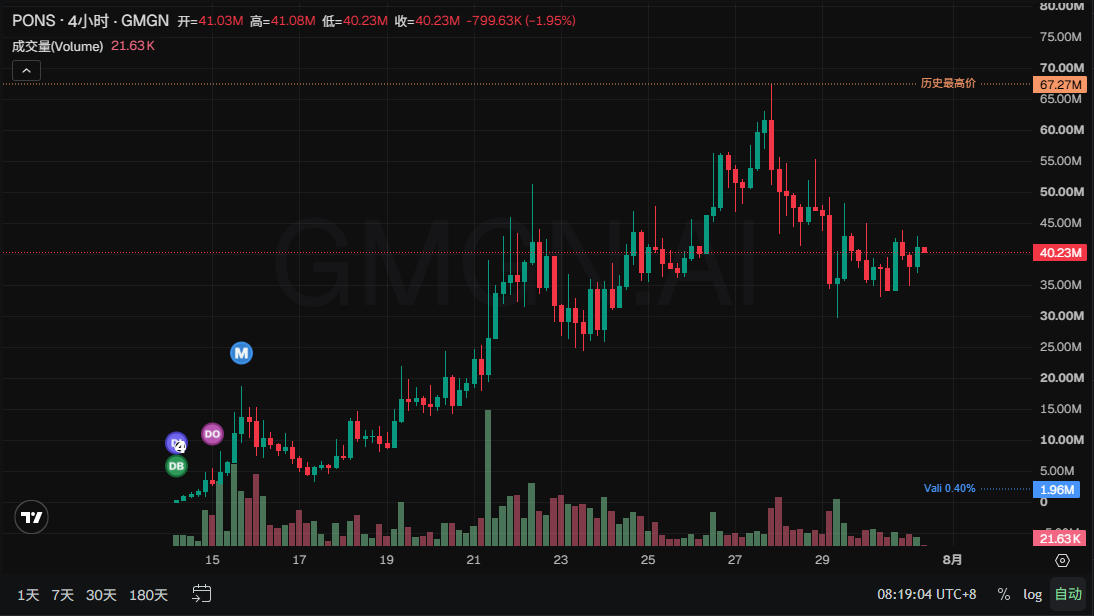
According to GMGN data, on July 16, the market cap of PONS was less than $5 million. It then rapidly increased, peaking at over $67 million at one point, representing a gain of more than 15 times during that period. The price has since retraced, with the current market cap around $40 million.
Currently, for tokens launched via Pons' new contract version, the trading fee is split 70% to the creator and 30% to the protocol (the old contract split 90%/10%). Of the protocol's share, 80% is used to market-buy and burn PONS, with the remaining 20% allocated to infrastructure and team operations. On July 28, the official announcement stated that 22% of the total PONS token supply had been burned.
Compared to launching tens of thousands of new tokens daily, PONS more easily becomes a unified target for the market to identify and trade the Pons narrative. As the PONS price continued to rise, more capital began paying attention to its underlying launch platform and entered Pons to seek new projects. The growth in platform trading volume, in turn, generated more fees and buyback funds, further strengthening PONS's price performance.
For Pons, PONS is not just a platform token; it has also become a crucial gateway for attracting new capital and users.
From Meme to RWA: The Positioning Upgrade of Pons V2
What truly distinguishes Robinhood Chain from other public chains are its stock tokens and on-chain finance. Pons' upcoming V2, currently in development, is beginning to extend in this direction. According to official disclosures, the platform will in the future support payment of trading fees to token creators and CTO operators in ETH, USDG, or RWA assets.
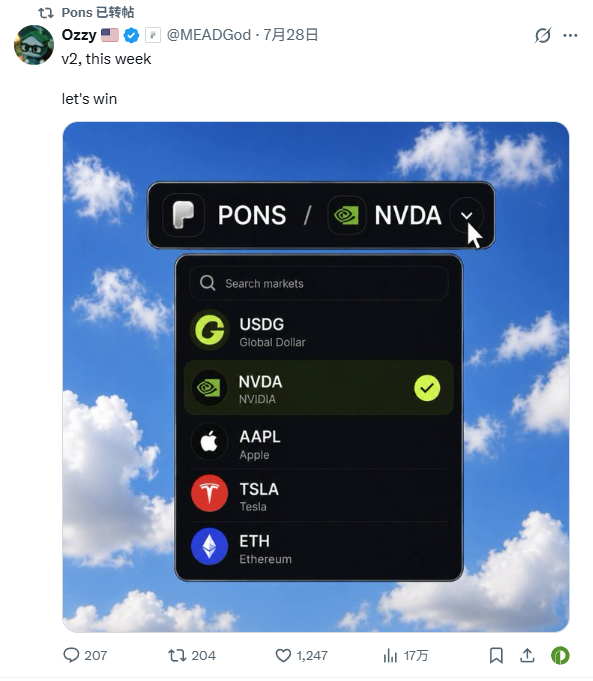
Pons initially gained a large user base and trading volume through Meme tokens launched on its platform. V2 now attempts to connect this launch mechanism with Robinhood Chain's stablecoins and RWA assets. For Pons, this signifies an evolution in its positioning from a simple token launch platform towards encompassing more asset types and revenue settlement scenarios.