Michael Saylor Says Bitcoin Could Grow 100x but Warns Against Protocol Changes

TheNewsCryptoPublished on 2026-07-29Last updated on 2026-07-29

Abstract

With growing institutional investment, Bitcoin's focus is shifting from market competition to its future governance and protocol stability. Michael Saylor, emphasizing Bitcoin's established role, warns against altering its core consensus rules, which he calls its "constitutional basis." He argues such changes could harm Bitcoin's economic system by affecting miner incentives, validation costs, transaction processing, and block space scarcity. While Saylor believes Bitcoin has 100x growth potential and could underpin international capital markets, this future depends on maintaining the current monetary and governance framework. As mining rewards decline, governance will be crucial for network security, miner incentives via transaction fees, and stability for all stakeholders, including institutions, miners, and developers.

With the increase in institutional interest in Bitcoin, the focus has now moved from competition in the market to issues regarding the future governance of the Bitcoin network. According to Michael Saylor, Bitcoin is now well-established as a major digital currency. But will face increasing questions about how to make protocol changes going forward.

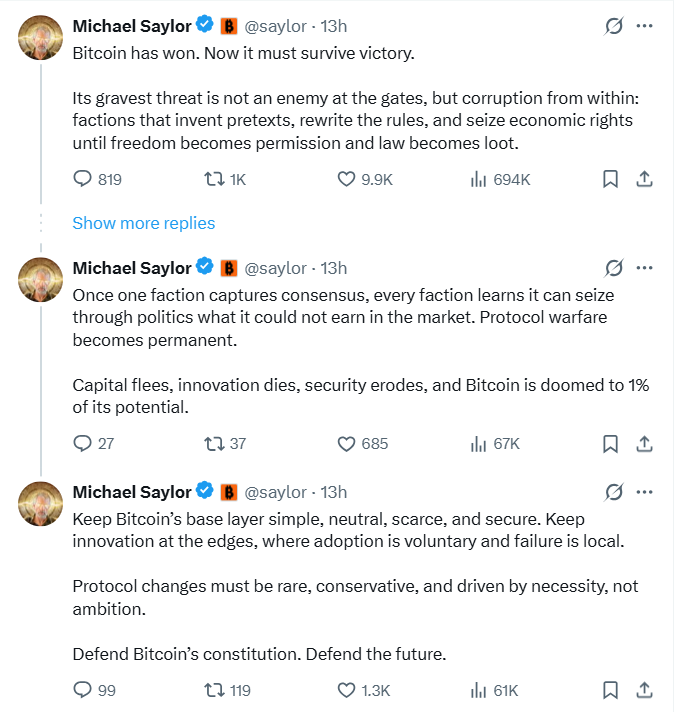
In several X tweets on July 28, Saylor stated that the rules of consensus of Bitcoin guarantee its scarcity, ownership, settlement, and security. He called these rules the constitutional basis of Bitcoin and said that any change to these rules would harm the economic system of Bitcoin.
Consensus Rules Remain Important for Bitcoin’s Future

As per Saylor, Bitcoin may become capable of increasing its price up to 100x while becoming the base of international capital markets. However, all that will happen only in case the existing monetary system and governance remain unchanged. As Saylor argues, changes introduced today may impact some technologies, financial markets, and economic opportunities.

Saylor believes that protocol changes may influence miner incentives, validation cost, transaction processing, and scarcity of block space. Saylor states that bigger blocks will lower the scarcity while increasing the operating cost of the network validator. Additionally, he notes that covenant systems can add complexity and create additional attack surfaces for the Bitcoin network. Also, restrictions on transaction selection will reduce miners’ flexibility in verifying network transactions.

Institutional Growth Raises Governance Stakes

With institutional investments in Bitcoin continuing to grow, network stability is now as essential as its performance. Michael Saylor thinks that governance will be as critical for determining Bitcoin’s future as adoption and price gains. He has stated that with mining rewards reducing, transaction costs will be more significant for helping the miners stay incentivized as well as keeping the network secure.

According to Saylor, the governance issues can influence miners, exchanges, custodians, developers, institutional investors, as well as companies holding Bitcoin. Furthermore, he has expressed his concerns about the politics around consensus alterations being a problem for the governance, capital investment, innovation, and network security of Bitcoin.

Highlighted Crypto News:
HKMA Warns Hong Kong Banks Lag on Quantum Security as 2030 Readiness Goal Takes Shape


TagsBitcoinBitcoin (BTCBitcoin (BTC)BlockchainBTCCryptocurrencyMichael SaylorMichael Saylor #Bitcoin price #MicrostrategyMichaelSaylorMicheal Saylor

Trending Cryptos

Related Questions

QAccording to Michael Saylor, what is the potential price growth he mentions for Bitcoin?

AMichael Saylor says Bitcoin could grow up to 100x in price.

QWhat does Michael Saylor refer to as the 'constitutional basis' of Bitcoin?

AHe refers to the rules of consensus of Bitcoin that guarantee its scarcity, ownership, settlement, and security as its constitutional basis.

QWhat are some of the specific elements Michael Saylor warns could be negatively impacted by protocol changes?

AHe warns that protocol changes could impact miner incentives, validation cost, transaction processing, and the scarcity of block space.

QWhy does Michael Saylor believe governance is becoming critically important for Bitcoin's future?

AHe believes governance is as critical as adoption and price gains because, with institutional investment growing, network stability is essential, and future decisions will impact various stakeholders and network security.

QWhat does Saylor suggest will become more significant for miners as mining rewards decrease?

AHe states that transaction costs will become more significant for helping miners stay incentivized and keeping the network secure as mining rewards reduce.

Related Reads

Stocks of Companies in Bitcoin Mining and AI Infrastructure Soar, Short Sellers Face Losses

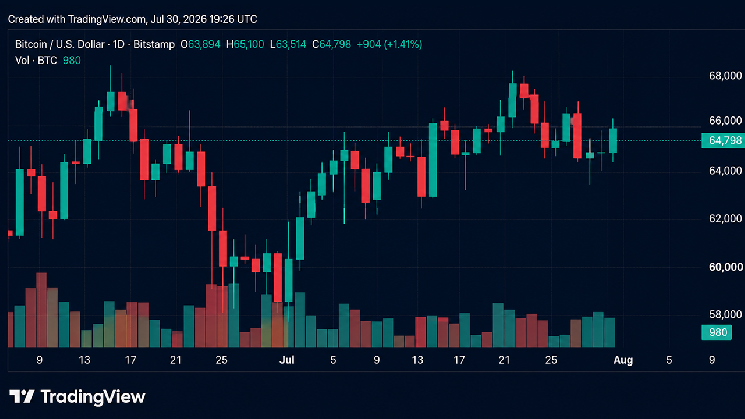
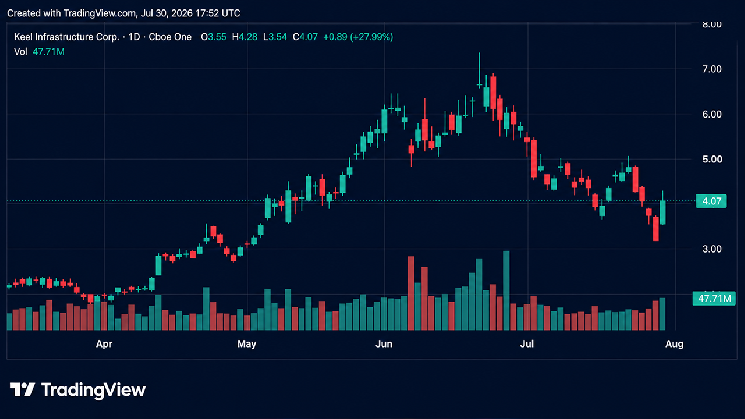
Shares of companies involved in Bitcoin mining and AI infrastructure surged, causing losses for short sellers. On Thursday, July 30, 2026, Keel Infrastructure (formerly Bitfarms) led the gains, rising 29.13%, followed by Nebius Group, Cipher Digital, and IREN Limited with jumps over 27%. Other notable gainers included Riot Platforms, Bitdeer, Core Scientific, Hut 8, and Cleanspark, with increases mostly ranging from 17% to 24%. The rally was attributed to a short squeeze triggered by a hedge fund's forced liquidation of its holdings, which were largely bought by Citadel. Additionally, Bitcoin trading above $64,000 and strong Microsoft earnings, highlighting AI's profitability, boosted market sentiment. Coreweave also announced a deal to provide AI cloud services for U.S. defense and intelligence agencies. This surge reflects a broader, longer-term trend of Bitcoin miners pivoting to AI data centers, leveraging their existing energy infrastructure and land. Recent multi-billion dollar deals by companies like Hut 8, IREN, and Terawulf for AI cloud services underscore this strategic shift. Other gainers, including Sandisk, Micron, Bloom Energy, and Cerebras, are suppliers critical to the AI infrastructure build-out. While the rally provided relief after July's losses, questions remain about capital expenditures, power availability, and long-term AI demand. The sustainability of these gains depends on these companies successfully converting their energy contracts and AI service deals into stable revenue streams.

cryptonews.ru31m ago

Stocks of Companies in Bitcoin Mining and AI Infrastructure Soar, Short Sellers Face Losses

cryptonews.ru31m ago

Trading

Spot

Hot Articles

What is $BITCOIN

DIGITAL GOLD ($BITCOIN): A Comprehensive Analysis Introduction to DIGITAL GOLD ($BITCOIN) DIGITAL GOLD ($BITCOIN) is a blockchain-based project operating on the Solana network, which aims to combine the characteristics of traditional precious metals with the innovation of decentralized technologies. While it shares a name with Bitcoin, often referred to as “digital gold” due to its perception as a store of value, DIGITAL GOLD is a separate token designed to create a unique ecosystem within the Web3 landscape. Its goal is to position itself as a viable alternative digital asset, although specifics regarding its applications and functionalities are still developing. What is DIGITAL GOLD ($BITCOIN)? DIGITAL GOLD ($BITCOIN) is a cryptocurrency token explicitly designed for use on the Solana blockchain. In contrast to Bitcoin, which provides a widely recognized value storage role, this token appears to focus on broader applications and characteristics. Notable aspects include: Blockchain Infrastructure: The token is built on the Solana blockchain, known for its capacity to handle high-speed and low-cost transactions. Supply Dynamics: DIGITAL GOLD has a maximum supply capped at 100 quadrillion tokens (100P $BITCOIN), although details regarding its circulating supply are currently undisclosed. Utility: While precise functionalities are not explicitly outlined, there are indications that the token could be utilized for various applications, potentially involving decentralized applications (dApps) or asset tokenization strategies. Who is the Creator of DIGITAL GOLD ($BITCOIN)? At present, the identity of the creators and development team behind DIGITAL GOLD ($BITCOIN) remains unknown. This situation is typical among many innovative projects within the blockchain space, particularly those aligning with decentralized finance and meme coin phenomena. While such anonymity may foster a community-driven culture, it intensifies concerns about governance and accountability. Who are the Investors of DIGITAL GOLD ($BITCOIN)? The available information indicates that DIGITAL GOLD ($BITCOIN) does not have any known institutional backers or prominent venture capital investments. The project seems to operate on a peer-to-peer model focused on community support and adoption rather than traditional funding routes. Its activity and liquidity are primarily situated on decentralized exchanges (DEXs), such as PumpSwap, rather than established centralized trading platforms, further highlighting its grassroots approach. How DIGITAL GOLD ($BITCOIN) Works The operational mechanics of DIGITAL GOLD ($BITCOIN) can be elaborated on based on its blockchain design and network attributes: Consensus Mechanism: By leveraging Solana’s unique proof-of-history (PoH) combined with a proof-of-stake (PoS) model, the project ensures efficient transaction validation contributing to the network's high performance. Tokenomics: While specific deflationary mechanisms have not been extensively detailed, the vast maximum token supply implies that it may cater to microtransactions or niche use cases that are still to be defined. Interoperability: There exists the potential for integration with Solana’s broader ecosystem, including various decentralized finance (DeFi) platforms. However, the details regarding specific integrations remain unspecified. Timeline of Key Events Here is a timeline that highlights significant milestones concerning DIGITAL GOLD ($BITCOIN): 2023: The initial deployment of the token occurs on the Solana blockchain, marked by its contract address. 2024: DIGITAL GOLD gains visibility as it becomes available for trading on decentralized exchanges like PumpSwap, allowing users to trade it against SOL. 2025: The project witnesses sporadic trading activity and potential interest in community-led engagements, although no noteworthy partnerships or technical advancements have been documented as of yet. Critical Analysis Strengths Scalability: The underlying Solana infrastructure supports high transaction volumes, which could enhance the utility of $BITCOIN in various transaction scenarios. Accessibility: The potential low trading price per token could attract retail investors, facilitating wider participation due to fractional ownership opportunities. Risks Lack of Transparency: The absence of publicly known backers, developers, or an audit process may yield skepticism regarding the project's sustainability and trustworthiness. Market Volatility: The trading activity is heavily reliant on speculative behavior, which can result in significant price volatility and uncertainty for investors. Conclusion DIGITAL GOLD ($BITCOIN) emerges as an intriguing yet ambiguous project within the rapidly evolving Solana ecosystem. While it attempts to leverage the “digital gold” narrative, its departure from Bitcoin's established role as a store of value underscores the need for a clearer differentiation of its intended utility and governance structure. Future acceptance and adoption will likely depend on addressing the current opacity and defining its operational and economic strategies more explicitly. Note: This report encompasses synthesised information available as of October 2023, and developments may have transpired beyond the research period.

1.1k Total ViewsPublished 2025.05.13Updated 2025.05.13

What is $BITCOIN

Discussions

Welcome to the HTX Community. Here, you can stay informed about the latest platform developments and gain access to professional market insights. Users' opinions on the price of BTC (BTC) are presented below.

活动图片