Loopring Ends Its Pioneer zk-Rollup DEX After Years of Limited User Adoption

TheNewsCryptoPublished on 2026-06-29Last updated on 2026-06-29

Abstract

Loopring has officially shut down its decentralized exchange, ending one of Ethereum's earliest zk-rollup platforms. The project, which raised $45 million in 2017, pioneered scaling solutions but ultimately failed to achieve significant user adoption. The team cited several reasons for the closure: the platform's lack of a virtual machine limited developer innovation, business execution was insufficient, and new zkEVM networks like zkSync and StarkNet surpassed its technology. User funds remain safe, with a two-week balance verification period before direct distribution to wallets begins. This follows the discontinuation of its wallet services in 2025, marking Loopring's complete exit from the DEX business.

Loopring officially shut down its decentralized exchange, marking the end of one of Ethereum’s earliest zk-rollup platforms. All trading functionalities were immediately stopped, and the relayer was turned off right after the official announcement made via Loopring’s X account.

The shutdown ends a project that once demonstrated how zero-knowledge rollups could efficiently scale Ethereum. Loopring raised $45 million through its initial coin offering in 2017.

Despite its technical merits, Loopring acknowledged that users never adopted the platform on a meaningful scale. The team pointed out that the lack of a virtual machine on the platform did not allow developers to compose and develop more advanced real-world applications. Without payment use cases and an evolving ecosystem, Loopring found it difficult to compete with new infrastructure built for blockchain technology.
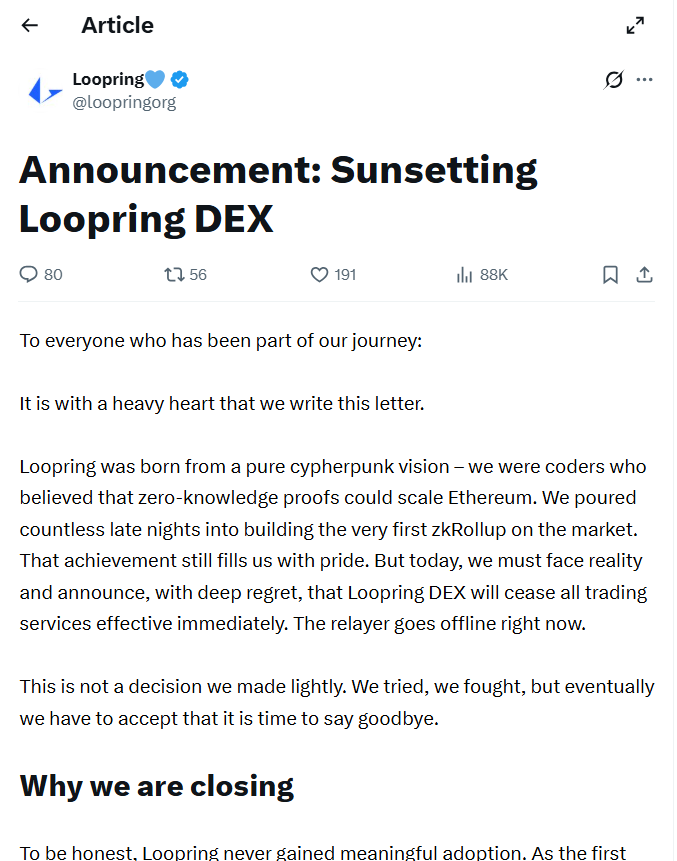
Source: X Article

Additionally, Loopring admitted it was good at the software but failed to build the business acumen needed to drive adoption. Furthermore, it mentioned that the delisting of the LRC token throughout 2026 only worsened the problems.

New zkEVM Networks Outperformed Loopring’s Technology

Finally, the development team admitted that modern zkEVM-based networks were able to surpass its proprietary technology. New projects such as zkSync, Scroll, and StarkNet created Ethereum-based environments that allowed deploying smart contracts more easily and developing a decentralized applications ecosystem.

The team admitted that it simply did not make sense anymore to continue working on Loopring. This is why the exchange was closed down in an orderly fashion. The project had earlier ended wallet services in July 2025 owing to scaling issues. The latest update marks Loopring’s eventual exit from the original decentralized exchange business.

Direct Distribution of Assets by Team

The Loopring team made assurances that all user funds are still safe despite the imminent closure. Final balances will be computed, an inventory of assets provided, and two weeks allocated to check balances before any distribution can take place.

Distributions will follow after the two-week period, whereby the Loopring team will distribute assets directly to the wallets in batches. The team will automatically convert liquidity pool holdings to the respective token, take care of all gas fees, and undertake the whole process without the need for Merkle proofs.

Highlighted Crypto News:

$3M Exploit Hits Polymarket: Users to Receive Full Refunds After Third-Party Breach

TagsBlockchainCryptocurrencyDEXETHEREUMEthereum (ETH)LoopringZK-rollupszkrollup

Trending Cryptos

Related Questions

QWhat was the official reason given by Loopring for shutting down its decentralized exchange?

ALoopring officially shut down its DEX due to years of limited user adoption. The team acknowledged a lack of business acumen to drive growth, the technical limitation of not having a virtual machine for advanced applications, and the inability to compete with newer zkEVM-based networks like zkSync, Scroll, and StarkNet.

QAccording to the article, what key technological feature did newer zk-rollup projects have that Loopring lacked?

ANewer zk-rollup projects like zkSync, Scroll, and StarkNet are based on zkEVM (Zero-Knowledge Ethereum Virtual Machine) technology. This allowed them to create environments where developers could easily deploy smart contracts and build a decentralized applications ecosystem, surpassing Loopring's proprietary technology which did not include a virtual machine.

QHow will the Loopring team handle the distribution of user assets after the shutdown?

AThe Loopring team will compute final user balances, provide an asset inventory, and allow a two-week period for balance verification. After this, they will distribute assets directly to user wallets in batches. They will automatically convert liquidity pool holdings, cover all gas fees, and conduct the process without requiring Merkle proofs.

QWhat earlier service did Loopring end in July 2025, and why?

ALoopring ended its wallet services in July 2025 due to scaling issues.

QHow much funding did Loopring raise in its 2017 initial coin offering (ICO)?

ALoopring raised $45 million through its initial coin offering (ICO) in 2017.

Related Reads

Anthropic's Latest Report Reveals Global Workers' Patterns: Seeking Sleep at 5 AM, Asking for Recipes at 6 PM

A new report from Anthropic analyzes millions of hourly user interactions with Claude AI, revealing detailed patterns in daily life and work. The data shows distinct rhythms: people most frequently ask about sleep help around 5 AM, seek news at 7 AM, and search for dinner recipes at 6 PM—the day's single largest query spike. Usage sharply diverges between weekdays and weekends. Workdays are dominated by professional tasks like business emails and coding (backend, APIs). Weekends see a surge in personal use—nearly 50% of conversations—focused on emotional support, creative writing (especially fan fiction), medical advice, and side projects like AI agent design or game development. Weekend "entrepreneurial" queries peak globally, while job-hunting activity drops. The report introduces "artifact" analysis, finding 93% of conversations produce a tangible output (explanation, document, code, etc.). Blog posts are 81% work-related, while creative writing is over 80% personal. High-wage professionals (e.g., marketing managers, programmers) use Claude more intensively outside work hours, with longer conversations, more tokens consumed, and greater use of deep thinking features compared to lower-wage roles. Interestingly, Claude's responses typically register at a higher reading level than user prompts (by about one educational year on average), except for audience-focused writing like emails or blogs where the gap nearly disappears. The data also captures specific cultural moments, like an 8x spike in tax-related queries on the U.S. filing deadline. Precise hourly data transforms fragmented queries into a collective diary of modern life—mapping not just economic activity, but also cycles of anxiety, creativity, and daily rhythm, with AI acting as both a productivity tool and an intimate, always-available confidant.

marsbit9m ago

Anthropic's Latest Report Reveals Global Workers' Patterns: Seeking Sleep at 5 AM, Asking for Recipes at 6 PM

marsbit9m ago

Margin Exhausted, "Brother Huang Li Cheng" Begins Selling Monkeys at a Loss

Taiwanese crypto whale "Machi Big Brother" Jeffrey Huang has been forced to sell his prized Bored Ape Yacht Club (BAYC) NFTs at significant losses to cover mounting losses from a highly leveraged ETH long position on Hyperliquid. Over the past month, Huang sold 34 BAYC NFTs for 326 ETH (approx. $514,000), realizing a loss of 399 ETH (approx. $631,000). The proceeds were transferred to Hyperliquid to replenish margin for his perpetual contract trades. One ape, BAYC #6057, bought for 76.84 ETH four years ago, was sold for just 7.65 ETH, a 90% loss in ETH terms. Huang began his high-leverage (25-40x) ETH long strategy in September 2025 when ETH was around $4,700. While his account once showed over $45 million in unrealized profit, the subsequent crash of ETH to the $1,600 range erased all gains. As of June 26, his cumulative losses on Hyperliquid reached $33.85 million, with over 335 liquidations earning him the community nickname "King of Liquidations." With conventional funds depleted, Huang's once-valuable NFT collection, which at its peak included around 200 BAYCs and was worth tens of millions, has become a lifeline. His remaining ~150 BAYCs, valued at roughly $1.6 million at current floor prices, provide only limited runway for his persistent high-stakes trading. Huang rose to prominence in crypto as a key figure in popularizing BAYC NFTs in Asia during the 2021 bull market. His pivot to perpetual contracts has now led to a cycle where his iconic "monkeys" are being sold to fund a failing trading strategy.

Foresight News52m ago

Margin Exhausted, "Brother Huang Li Cheng" Begins Selling Monkeys at a Loss

Foresight News52m ago

Quantum Computing Approaches "Q-Day": How Encryption Policy, Investment Logic, and Risk Management Are Reshaping the Landscape

Quantum Computing Nears 'Q-Day': Shaping Encryption Policy, Investment Logic, and Risk Management Quantum technology is increasingly intersecting with cryptocurrency policy and cybersecurity discussions as the potential 'Q-Day'—when quantum computers could break current encryption—approaches. While summer brings fast-paced crypto market dynamics, new U.S. legislation, and AI debates, the emerging dimension is how quantum advancements will reshape the digital asset landscape. The next phase of crypto investment is being shaped by two converging forces: clearer regulatory frameworks and cryptographic evolution driven by quantum computing. Investors stand to benefit from reduced uncertainty, but must also recognize that quantum readiness is becoming a core risk factor. Public blockchains rely on cryptography for security, and sufficiently advanced quantum machines could undermine these foundations. This does not mean imminent network collapse, but investors can no longer dismiss the timeline as irrelevant. Key questions now include whether projects have identified their cryptographic dependencies, formulated migration plans to post-quantum cryptography, and established governance for upgrades. For policymakers, the link is clear. Effective crypto policy must look beyond token classification and disclosure to address the underlying infrastructure. As stablecoins, tokenized assets, and blockchain payments integrate deeper into finance, cryptographic resilience becomes a systemic issue. Failure to prepare could lead to investor losses, operational failures, and legal disputes. Policy should encourage risk disclosure, require major intermediaries to maintain upgrade and response plans, and foster coordination across the ecosystem—rather than impose a single technical fix. The sustainability of cryptocurrencies will increasingly depend on their security infrastructure's ability to adapt to these accelerating technological pressures.

Foresight News1h ago

Quantum Computing Approaches "Q-Day": How Encryption Policy, Investment Logic, and Risk Management Are Reshaping the Landscape

Foresight News1h ago

Bitcoin's Five-Wave Adjustment Nears End, Opportunities Emerge in HYPE Support Zone | Invited Analysis

**Bitcoin's Five-Wave Adjustment Nears End, HYPE Support Zone Presents Opportunity | Guest Analysis** This week, Bitcoin (BTC) is in the final stage of a five-wave corrective structure. The formation of 'Endpoint 44' is key: a level above $58,110 suggests a high probability of a technical rebound, leading likely to wide-range consolidation. A break below $58,110 without bullish divergence warrants caution for further downside. Mid-term bearish positions are maintained at 20%, with 30% of capital reserved for short-term scalping opportunities based on predefined support/resistance levels and three scenario-based plans (A/B/C). Simultaneously, HYPE has entered the 55-56 segment of its own five-wave correction from its $76.94 high. If 'Endpoint 56' forms above the prior low (Endpoint 54), creating a double-bottom pattern, a rebound is significantly likely. A light long position (under 30% allocation) can be considered upon stabilization in the support zone. Last week's BTC short-term strategy, guided by proprietary quantitative models, successfully executed two short trades (1x leverage), yielding a total return of approximately 6.21%. The market move validated the prior weekly forecast of a retest towards the $59,100 support. **Core Trading Views Summary:** * **BTC:** Focus on the formation of 'Endpoint 44'. A scenario above $58,110 allows for tentative longs. Key resistances: $60,900-$62,300, ~$65,500, $67,300-$69,500. Key supports: ~$58,100, ~$55,000. * **HYPE:** Monitor the final position of 'Endpoint 56'. Key resistances: ~$65.5, ~$71.5. Key supports: ~$58.5, $52-$54 zone. Strategy favors buying on dips upon stabilization in support areas with confirmed model signals, with strict position control. **Risk Disclaimer:** Financial markets are volatile. All analysis, models, and strategies herein are based on personal technical analysis for journaling purposes only, not investment advice. Trade at your own risk.

Odaily星球日报1h ago

Bitcoin's Five-Wave Adjustment Nears End, Opportunities Emerge in HYPE Support Zone | Invited Analysis

Odaily星球日报1h ago

Trading

Spot

Hot Articles

How to Buy ZK

Welcome to HTX.com! We've made purchasing ZKsync (ZK) simple and convenient. Follow our step-by-step guide to embark on your crypto journey.Step 1: Create Your HTX AccountUse your email or phone number to sign up for a free account on HTX. Experience a hassle-free registration journey and unlock all features.Get My AccountStep 2: Go to Buy Crypto and Choose Your Payment MethodCredit/Debit Card: Use your Visa or Mastercard to buy ZKsync (ZK) instantly.Balance: Use funds from your HTX account balance to trade seamlessly.Third Parties: We've added popular payment methods such as Google Pay and Apple Pay to enhance convenience.P2P: Trade directly with other users on HTX.Over-the-Counter (OTC): We offer tailor-made services and competitive exchange rates for traders.Step 3: Store Your ZKsync (ZK)After purchasing your ZKsync (ZK), store it in your HTX account. Alternatively, you can send it elsewhere via blockchain transfer or use it to trade other cryptocurrencies.Step 4: Trade ZKsync (ZK)Easily trade ZKsync (ZK) on HTX's spot market. Simply access your account, select your trading pair, execute your trades, and monitor in real-time. We offer a user-friendly experience for both beginners and seasoned traders.

3.2k Total ViewsPublished 2024.06.17Updated 2026.06.02

How to Buy ZK

Discussions

Welcome to the HTX Community. Here, you can stay informed about the latest platform developments and gain access to professional market insights. Users' opinions on the price of ZK (ZK) are presented below.

活动图片