JPMorgan: Saylor’s Strategy Could Buy $30 Billion In Bitcoin This Year

bitcoinistPublished on 2026-05-08Last updated on 2026-05-08

Abstract

JPMorgan analysts estimate that Michael Saylor's MicroStrategy could purchase around $30 billion worth of Bitcoin in 2026 if its current acquisition pace continues, a significant acceleration from previous years. This follows the company's addition of 145,834 BTC worth approximately $11 billion so far in 2026, much of it bought below an estimated average cost of $75,000. JPMorgan notes the company has accelerated purchases again in April, pursuing an opportunity-driven strategy sensitive to market conditions. MicroStrategy's ability to raise capital is key to this strategy. Its stock trades at a ~26% premium to net asset value, facilitating equity or debt issuance to fund further Bitcoin buys. As of May 3, the company holds 818,334 BTC. Its CFO highlighted the success of its "Digital Credit" preferred equity platform, with over $13.5 billion outstanding, used to service dividends and fund Bitcoin acquisitions. However, this aggressive strategy increases obligations. The company reported a Q1 net loss of $12.54 billion, driven by an unrealized loss on digital assets. Its perpetual preferred stock dividends create a long-term payment commitment, with CEO Michael Saylor acknowledging the potential need to sell some Bitcoin for dividends, while emphasizing the core directive to "Buy more bitcoin than you sell."

Michael Saylor’s Strategy could buy roughly $30 billion worth of bitcoin this year if its current acquisition pace holds, according to JPMorgan analysts, marking a potential acceleration beyond the company’s already aggressive treasury playbook.

The estimate comes after Strategy added 145,834 BTC so far this year, worth around $11 billion, with JPMorgan noting that much of the buying occurred while BTC traded below the company’s estimated average cost of roughly $75,000. At the current annualized pace, the bank said Strategy’s 2026 purchases would exceed the approximately $22 billion it bought in each of 2024 and 2025.

JPMorgan Sees Bitcoin Buying Spree Reacceleration

The latest call centers on the speed of Strategy’s buying, not merely the size of its balance sheet. JPMorgan analysts led by Nikolaos Panigirtzoglou said the company “appears to have accelerated its Bitcoin purchases again in April,” extending what they described as an opportunity-driven pattern this year.

“Strategy appears to have accelerated its Bitcoin purchases again in April,” the analysts said, according to summaries of the note. “The company is pursuing an opportunity-driven buying strategy throughout 2026, sensitive to market conditions and funding opportunities.”

That framing is important. Strategy is not simply buying on a fixed schedule. JPMorgan’s read is that the company has been using price weakness and available financing windows to expand its bitcoin stack, while its stock-market premium gives it a capital-raising mechanism that most corporate bitcoin holders do not have.

Strategy’s premium to net asset value has expanded to around 26% over the past two months, according to reports citing JPMorgan. A larger premium can make equity or debt issuance more attractive, because the company can raise capital above the implied value of the bitcoin it already holds and recycle proceeds into additional BTC purchases.

Strategy’s Balance Sheet Keeps Growing

Strategy said on May 5 that it held 818,334 BTC as of May 3, representing 22% year-to-date growth. The company also reported $11.68 billion raised year to date, while STRC alone had raised $5.58 billion and cumulative dividends declared and paid on preferred stock had reached $692.5 million.

The company’s own commentary emphasizes the funding side of the model. CEO Phong Le said, “Adoption of Bitcoin continues to grow in 2026. Digital Credit, highlighted by STRC, has been a big success. STRC has shown strong demand, high liquidity, and low volatility.” He added that Strategy raised $5.6 billion in year-to-date STRC gross proceeds and cited growing bitcoin activity from major banks including Morgan Stanley, Goldman Sachs and Citi.

CFO Andrew Kang framed the preferred-equity platform as a core part of the company’s capital structure. “Strategy is the dominant issuer of Digital Credit in the world, with over $13.5 billion of preferred equity outstanding, supported by a fortress Bitcoin balance sheet,” he said. “We continue to extend our track record of servicing our dividends, having now met our payment obligations on time and in full across 23 consecutive distributions, totaling over $693 million since the launch of our preferred equity products in early 2025.”

The Trade-Off: Bigger Purchases, Bigger Obligations

The same structure that enables larger bitcoin purchases also increases Strategy’s ongoing obligations. The company reported a first-quarter net loss of $12.54 billion, or $38.25 per share, driven by a $14.46 billion unrealized loss on digital assets. Strategy’s filings also state that perpetual preferred stock dividends must be paid in perpetuity, and that future obligations could require the company to sell common stock or bitcoin.

That tension has become harder to ignore after Saylor signaled that Strategy could sell some bitcoin to pay preferred dividends, even as he later summarized the firm’s stance in a six-word post: “Buy more bitcoin than you sell.”

At press time, BTC traded at $79,934.
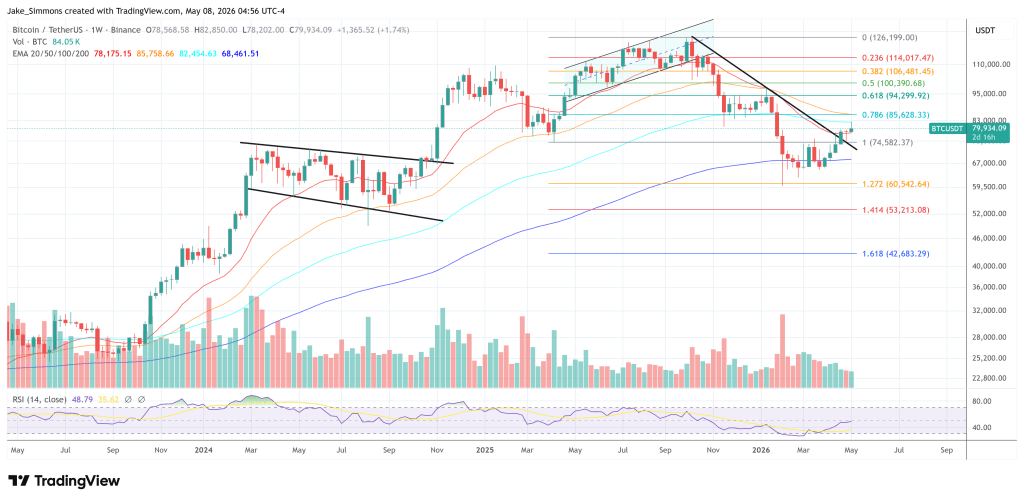
BTC bulls eye the 0.786 Fib, 1-week chart | Source: BTCUSDT on TradingView.com

Trending Cryptos

Related Questions

QWhat is the total value of Bitcoin that JPMorgan analysts estimate MicroStrategy could potentially buy by the end of the year based on its current pace?

AJPMorgan analysts estimate MicroStrategy could buy roughly $30 billion worth of Bitcoin this year if its current acquisition pace holds.

QAccording to JPMorgan, what is a key characteristic of MicroStrategy's Bitcoin purchasing strategy in 2026?

AAccording to JPMorgan, MicroStrategy is pursuing an opportunity-driven buying strategy sensitive to market conditions and funding opportunities, rather than buying on a fixed schedule.

QHow does MicroStrategy's stock-market premium facilitate its Bitcoin acquisition strategy, according to the article?

AMicroStrategy's premium to its net asset value, which had expanded to around 26%, makes equity or debt issuance more attractive. This allows the company to raise capital above the implied value of its Bitcoin holdings and recycle the proceeds into additional purchases.

QWhat was the primary driver behind MicroStrategy's reported first-quarter net loss of $12.54 billion?

AThe primary driver behind MicroStrategy's reported first-quarter net loss of $12.54 billion was a $14.46 billion unrealized loss on digital assets.

QWhat potential trade-off does the article highlight regarding MicroStrategy's strategy for funding large Bitcoin purchases?

AThe trade-off is that the same structure (like issuing perpetual preferred stock) that enables larger Bitcoin purchases also increases MicroStrategy's ongoing obligations, such as perpetual dividend payments that may eventually require the sale of common stock or Bitcoin to meet.

Related Reads

Token Buyback Volumes Continue to Rise, But Price Lows Keep Falling

The volume of token buybacks continues to grow, but the minimum price level is constantly declining, according to an internal memo by Bitwise CIO Matt Hogan. He argues that most crypto tokens, except Bitcoin, are undervalued as investors are unaware of the revenue now being returned to holders. He highlights the example of Hyperliquid, which has bought back and burned $1.3 billion worth of its $HYPE token. Hogan posits that tokens are beginning to trade based on revenue, similar to stocks and bonds, marking the end of an era where scaling networks provided little token utility. He links token valuation to strengthening protocol revenue, noting that Hyperliquid has earned over $800 million in the past year and spends nearly all fees on $HYPE buybacks. Following this model, protocols like Uniswap and Aave have implemented fee mechanisms to buy back and burn their own tokens. The trend has also affected base chains like Solana and Aptos, which have proposed or enacted higher fee burns. However, the memo acknowledges that reducing token supply has not reliably boosted prices. A Cryptopolitan report found many tokens with regular buybacks still underperformed the market. Even Hyperliquid's upward trend broke, and Pump.fun conducted significant buybacks near token lows. Hogan cautions that token buybacks differ from stock buybacks due to the lack of contractual claims on profits or assets, as governance rules can always be rewritten.

cryptonews.ru45m ago

Token Buyback Volumes Continue to Rise, But Price Lows Keep Falling

cryptonews.ru45m ago

NullReceiver abandons the recording address that made EtherHiding easy to detect

**Sonatype Research Labs has uncovered six malicious npm packages that retrieve command-and-control server addresses from an attacker's Ethereum wallet.** Three of the packages are legitimate, popular libraries that were compromised: `@kolbo/mcp`, `agentgui`, and `godot-kit`. The other three are purely malicious packages: `envpack-conf`, `postcss-initial-provider`, and `tailwindcss-motion-advanced`. All six deploy the same payload. The malware loader queries the Ethereum blockchain for the latest outgoing transaction from a specific wallet. It extracts bytes from the recipient field of that transaction, converts them into two IPv4 addresses, and uses these as primary and backup command-and-control servers. After connecting, it fetches, decodes, and executes a second-stage payload using `eval()` or by spawning a child process. This method, dubbed **"NullReceiver,"** is an evolution of the earlier "EtherHiding" technique. While EtherHiding hid data in transaction fields and sent funds to a fixed "burner" address (creating a monitoring point), NullReceiver sends no funds and generates unique, dynamic receiver addresses, making detection harder. OpenSourceMalware has linked this activity to the North Korean Lazarus group's "Contagious Interview" campaign. Sonatype advises developers to remove the affected package versions immediately and check their systems for signs of secondary payload execution.

cryptonews.ru47m ago

NullReceiver abandons the recording address that made EtherHiding easy to detect

cryptonews.ru47m ago

Trading

Spot

Hot Articles

Discussions

Welcome to the HTX Community. Here, you can stay informed about the latest platform developments and gain access to professional market insights. Users' opinions on the price of S (S) are presented below.

活动图片