Japan’s Rate Hike In Focus: Bitcoin’s Past Reactions Make Traders Nervous

bitcoinistPublished on 2025-12-15Last updated on 2025-12-15

Abstract

Bitcoin traders are growing nervous as the Bank of Japan prepares for a potential interest rate hike on December 18–19, which would bring rates to 0.75%—the highest since 1995. Historical patterns show that previous BOJ rate hikes in 2024 and early 2025 were followed by significant Bitcoin sell-offs, with declines ranging from 20% to over 30%. Analysts like 0xNobler and AndrewBTC warn that if the pattern repeats, Bitcoin could drop toward $70,000. However, not all outlooks are bearish. Analyst Ted Pillows notes that Bitcoin is currently testing a key technical support level, the monthly EMA-21, which has historically acted as a launchpad for rallies. He suggests a near-term rise to $100,000–$105,000 is possible before any major correction. The outcome of the BOJ decision may determine Bitcoin’s trajectory for the rest of the year.

Bitcoin is heading into a critical window as the Bank of Japan prepares what could be its most consequential policy move in decades. The central bank is widely expected to raise interest rates by 25 basis points to 0.75% at its December 18-19 meeting, a level not seen since 1995 and a clear signal that Japan is continuing its exit from ultra-loose monetary policy.

This upcoming event is causing a few conversations among crypto traders because similar policy moves from Japan have repeatedly coincided with the start of Bitcoin price crashes.

Japan’s Rate Hikes And The Repeating Bitcoin Sell-Off Pattern

Crypto market observers have been quick to highlight an uncomfortable pattern relating to Bitcoin and the BOJ. Each time the bank has raised rates since 2024, Bitcoin’s price action has experienced a deep and relatively fast correction.

For example, March 2024 saw Bitcoin fall by about 23% following Japan’s first rate hike since 2007. A similar rate spike move in July was followed by a drop of around 26%, while the January 2025 hike preceded a steeper decline of more than 30%.

Crypto analyst 0xNobler expressed concern, noting that if this historical trend repeats itself, Bitcoin could be headed below the $70,000 level shortly after the upcoming December decision. The chart he shared illustrates how each rate hike has aligned with a local market top, followed by a pronounced leg lower. The consistency of these moves has turned what might otherwise be dismissed as coincidence into a data point many traders are now taking seriously.
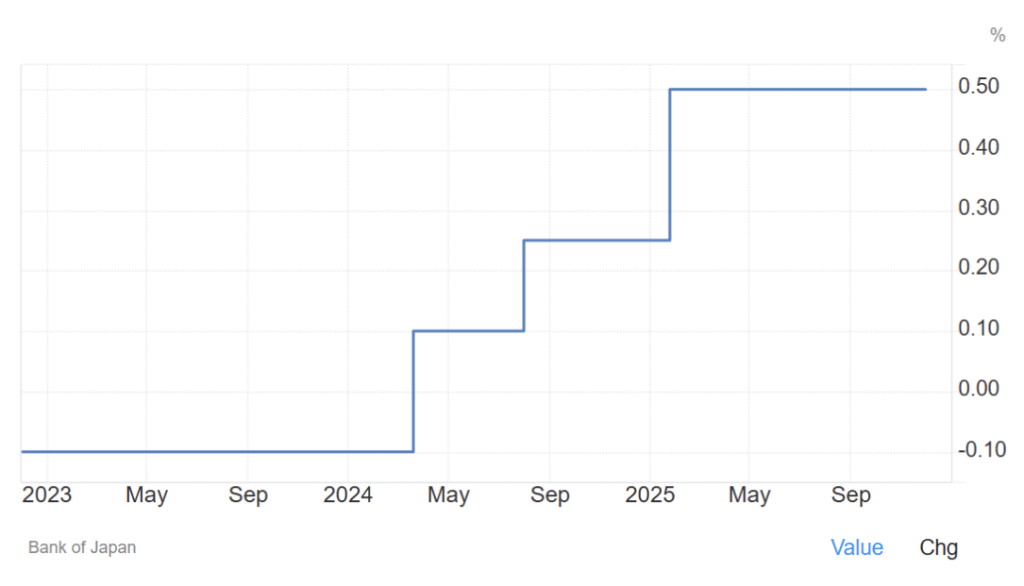
Japan’s interest rate

The pressure extends beyond reactions by the crypto industry alone. Japan is the largest foreign holder of US government debt, and any tightening from the Bank of Japan reverberates across global liquidity markets. Higher Japanese rates strengthen the yen, and this, in turn, reduces excess capital that might otherwise flow into risk assets.

Echoing this view, another crypto commentator known as AndrewBTC pointed to Bitcoin’s repeated 20% to 31% declines following each BOJ hike since 2024. He warned that another rate increase in December could produce a similar outcome and also identified $70,000 as the possible downside target if the pattern repeats itself.
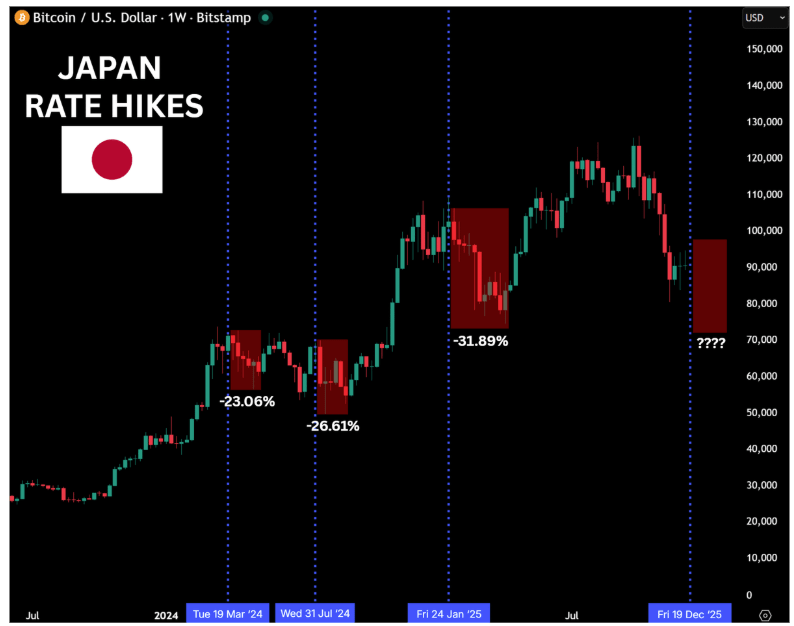
Bitcoin/US Dollar. Source: @cryptoctlt On X

Bitcoin Above Long-Term Support: Not Everyone Is Bearish

Despite the growing anxiety towards the Bank of Japan’s rate increase, the outlook for Bitcoin is not universally negative. For instance, analyst Ted Pillows pointed out that Bitcoin is currently interacting with its monthly EMA-21, a level that has always acted as a launchpad in prior cycles.

BTCUSD now trading at $90,162. Chart: TradingView

Based on this structure, Pillows predicted that Bitcoin could still surge to between the $100,000 and $105,000 range in the near term before there’s another price dump.

As the December meeting approaches, Bitcoin finds itself caught between a troubling pattern and a resilient technical support. Whether Japan’s next rate hike leads to another immediate sell-off or allows for a temporary upside push may define how Bitcoin and the rest of the crypto market close out the year.
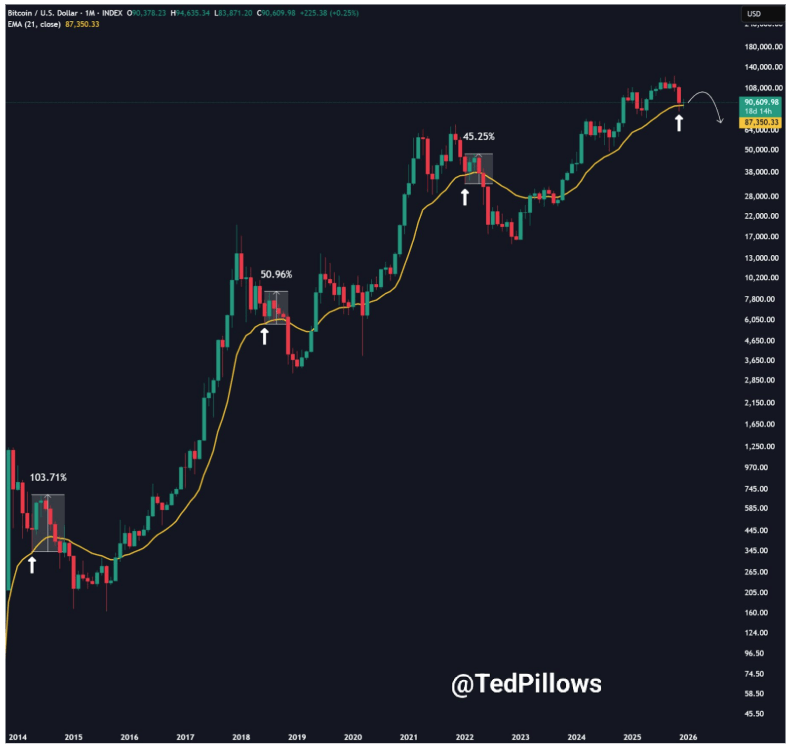
Bitcoin / U.S. Dollar. Source: @TedPillows on X

Featured image from Unsplash, chart from TradingView

Related Reads

Conversation with Arthur Hayes: AI Has Drained Market Liquidity, BTC Will Be Below 100k by Year-End

In this June 2026 podcast interview, BitMEX co-founder Arthur Hayes explains his decision to sell his major crypto holdings (HYPE, NEAR, Worldcoin, Zcash). His rationale is based on a macro view linking oil prices, the Iran conflict, US politics, and an impending AI bubble burst. Hayes argues that high oil prices, driven by the ongoing war, will pressure domestic US inflation. To salvage the Republican Party's chances in the midterm elections, he believes Donald Trump may pivot to a populist, anti-AI stance—advocating for taxes and regulation—which would deflate the AI investment narrative. He sees the AI sector, particularly massive capital expenditure on data centers, as having absorbed nearly all excess market liquidity (around $1.5 trillion in debt issuance since 2025), starving other assets like Bitcoin. He highlights the upcoming SpaceX IPO at a ~$1.8 trillion valuation and 100x price-to-sales ratio as a potential tipping point. If these hyped IPOs underperform, it could shatter market confidence in AI. In such a scenario, all risk assets, including crypto, would fall together as correlations converge to 1 during a broad correction. Hayes has moved his portfolio into Treasuries and energy stocks (like ExxonMobil), predicting Bitcoin will be below $100k by year-end. He sees a potential crypto bull market only after the AI frenzy cools, liquidity stops flowing exclusively into AI, and possibly after a significant market downturn prompts new monetary stimulus.

marsbit3m ago

Conversation with Arthur Hayes: AI Has Drained Market Liquidity, BTC Will Be Below 100k by Year-End

marsbit3m ago

Fed's Internal Doves Flock to Hawkish Stance, Warsh's Debut "Between a Rock and a Hard Place"

U.S. Federal Reserve officials who previously advocated for rate cuts, including Governor Christopher Waller, have recently shifted their stance, with many now not ruling out the possibility of future rate hikes. This sets a challenging stage for new Fed Chair Kevin Warsh's first policy meeting. Appointed by President Trump based on his dovish views, Warsh now faces a committee where the debate has pivoted from "when to cut" to "whether to hike," driven by persistent inflation above 3%, a strong labor market, and supply-side pressures from AI infrastructure demands and geopolitical tensions. Key figures illustrate the shift. Governor Waller, once concerned about employment, now says data has pushed him toward considering rate increases. Even moderate voices like Governor Lisa Cook, while expecting inflation to ease, have indicated readiness to hike if it fails to do so. Long-time hawks such as regional Fed presidents Beth Hammack, Lorie Logan, and Neel Kashkari have grown more vocal, arguing that the real policy rate is effectively falling and that action may soon be needed. The upcoming Fed meeting is expected to keep rates steady but will likely remove the "easing bias" from its statement, signaling a neutral stance between cuts and hikes. The quarterly "dot plot" is anticipated to show most officials projecting no cuts this year, with some potentially indicating hikes. Chair Warsh, a critic of the Fed's reliance on forward guidance like the dot plot, must navigate communicating this pivot using tools he has questioned, all while steering policy in a direction counter to the preferences of the president who appointed him. The consensus suggests the Fed's next move could well be a rate increase.

marsbit1h ago

Fed's Internal Doves Flock to Hawkish Stance, Warsh's Debut "Between a Rock and a Hard Place"

marsbit1h ago

The Trillion-Yuan Market Cap 'Yi Zhong Tian': Who is the True Value King?

The article analyzes the three leading Chinese optical module companies, collectively nicknamed "Yi Zhong Tian": Xinyisheng, Zhongji Innolight, and TFC Optical Communication. It evaluates their "cost-performance" not by current stock price, but through three lenses: PEG ratio (growth vs. valuation), earnings quality, and premium/discount for certainty. Xinyisheng shows the most attractive PEG ratio and high profitability, but its valuation reflects discounts for risks like high customer concentration and reliance on overseas markets. Zhongji Innolight, the most expensive, commands a premium for its market leadership, dominant share in key products like 800G/1.6T modules, and higher earnings certainty, though it faces geopolitical risks. TFC Optical, as an upstream component supplier ("water seller"), has the highest gross margin and bets on the long-term CPO/NPO architecture trend, but trades at a high valuation with more stable, less explosive growth. The core argument is that while these companies dominate module assembly, the true profit pool and technological moat lie upstream in laser and switch chips, currently controlled by U.S. firms like Lumentum and Coherent. The long-term "cost-performance" for these Chinese leaders hinges on whether the domestic industry, exemplified by companies like Yuanjie Technology, can successfully move up the value chain into high-power laser chips. Otherwise, their high growth may remain confined to the lower-margin assembly segment.

marsbit1h ago

The Trillion-Yuan Market Cap 'Yi Zhong Tian': Who is the True Value King?

marsbit1h ago

Has the Crypto Market Bottomed? Here's What Institutions Think

The crypto market is in a period of significant debate, with leading institutions offering differing views on whether a bottom has been reached. Three prominent firms have published detailed analyses: * **Galaxy Digital** argues Bitcoin has **not yet bottomed**. Their analysis of 13 historical indicators across six dimensions (valuation, profit-taking, miner pressure, etc.) shows only four are fully met. They project a potential bottom range between $30k and $54k. * **NYDIG** states a bottom is **possible but not likely**. While metrics are close to historic bear market extremes, they note the absence of a classic panic-selling event. They also suggest increased institutional adoption may have structurally altered the market cycle, potentially leading to a shallower downturn. * **Standard Chartered Bank** asserts the **bottom has already occurred** at around $59k. They cite two key factors: potential US-Iran diplomatic progress and the anticipated SpaceX IPO, which they believe absorbed capital and caused ETF selling pressure that is now subsiding. They forecast a year-end price target of $100k. Despite the surface-level disagreement, the reports share critical common ground more valuable for long-term investors: 1. All three believe the market bottom will form **within this year**. 2. All agree the current price is **closer to the bottom than to previous highs**. 3. All maintain a **bullish long-term outlook** for Bitcoin and a new cycle. The core takeaway is that while the exact bottom price ($40k, $50k, or $60k) is debated, the consensus is that a bottom is imminent. For long-term holders, the primary focus should not be pinpointing the absolute low, but on the future potential for prices to reach $100k, $200k, or higher. The fundamental thesis for Bitcoin—sovereign debt accumulation, inflation, declining trust in centralized institutions, global digitization, and improved accessibility—remains intact and is arguably strengthening. The overall landscape is viewed as more favorable than in previous crypto winters.

marsbit1h ago

Has the Crypto Market Bottomed? Here's What Institutions Think

marsbit1h ago

Trading

Spot
Futures

Hot Articles

Discussions

Welcome to the HTX Community. Here, you can stay informed about the latest platform developments and gain access to professional market insights. Users' opinions on the price of S (S) are presented below.

活动图片















