Japan’s ‘Digital Year’: Finance Minister Eyes Crypto Integration Into Stock Exchanges

bitcoinistPublished on 2026-01-06Last updated on 2026-01-06

Abstract

Japan's Finance Minister Satsuki Katayama has declared 2026 as the nation's "Digital Year," endorsing the integration of crypto assets and blockchain technology into financial markets. She emphasized the role of stock exchanges in providing public access to digital assets and supporting the transition from savings to investment. Katayama expressed support for crypto-based investment products, similar to US ETFs, and highlighted the importance of robust governance for sector growth. Additionally, a 2026 tax reform proposal plans to reclassify crypto as financial products and introduce a separate 20% flat tax rate, replacing the current progressive tax of up to 55%.

Japan’s Finance Minister has shared her stance on crypto assets and the importance of stock exchanges in supporting the transition to a growth-oriented economy that opens up public access to digital assets.

Japan Enters Its ‘Digital Year’

On Monday, Japan’s Minister of Finance Satsuki Katayama endorsed the country’s efforts to integrate crypto assets and blockchain technology into the local financial markets, outlining her policy stance to support Japan’s development as an asset management nation, asserting that “there is still room for growth in shifting from savings to investment.”

In her New Year’s address at the Tokyo Stock Exchange’s (TSE) Grand Opening Ceremony, celebrated on January 5, Katayama declared that 2026 would be the “Digital Year” for the nation.

The Finance Minister pointed out that 2026 “is a turning point” for overcoming deflation, emphasizing the “importance of responsible, proactive fiscal policy and concentrated investment in growth sectors.”

Notably, Katayama has previously shared a positive approach to crypto and the Web3 sectors, the reports added. Last year, she declared that “with robust governance, the crypto asset and Web3 sectors can develop significantly, and the future is very bright.”

Local news media outlets reported that the Finance Minister expressed her support for integrating crypto assets into stock exchanges on Monday, highlighting the importance of existing financial infrastructure to increase exposure to crypto-related services.

“For citizens to benefit from digital assets and blockchain-based assets, the role of commodity and securities exchanges is crucial,” she stated.

During the New Year’s address, she also discussed the future of crypto-related investment products in Japan, underscoring how “In the U.S., ETFs (exchange-traded funds) are expanding as a means for citizens to hedge against inflation.”

Despite the success of US spot ETFs, Japanese regulators have been cautious about digital asset-based funds. The Financial Services Agency (FSA) has repeatedly expressed reservations about the investment products.

Nonetheless, Katayama suggested that similar initiatives to those of the US would be pursued in Japan, signaling a potential launch of crypto-based investment products this year.

She concluded her statement by declaring her support for the efforts carried out by exchanges in Japan to develop trading environments “utilizing such cutting-edge fintech and technology.”

2026 Framework To Reshape Local Crypto Landscape

Over the past few years, Japanese authorities have been working to review their regulatory system and develop policies for customer fund safety and innovation in a more reliable industry.

In December, the Liberal Democratic Party and the Japan Innovation Party published their upcoming FY2026 Tax Reform. As reported by Bitcoinist, the 2026 tax reform will introduce significant changes to the existing taxation system.

These changes, long requested by Japanese investors, are set to address the categorization and regulation of crypto assets, reclassifying them as financial products.

The proposal signals a shift from the assets’ previous treatment as speculative assets by Japanese financial authorities. Based on this, the reform is also studying the introduction of a separate taxation system for crypto income.

The current progressive tax system, where digital asset gains can be taxed at up to 55%, would be replaced with a system like the one used for stocks, with a flat 20% tax on crypto income.
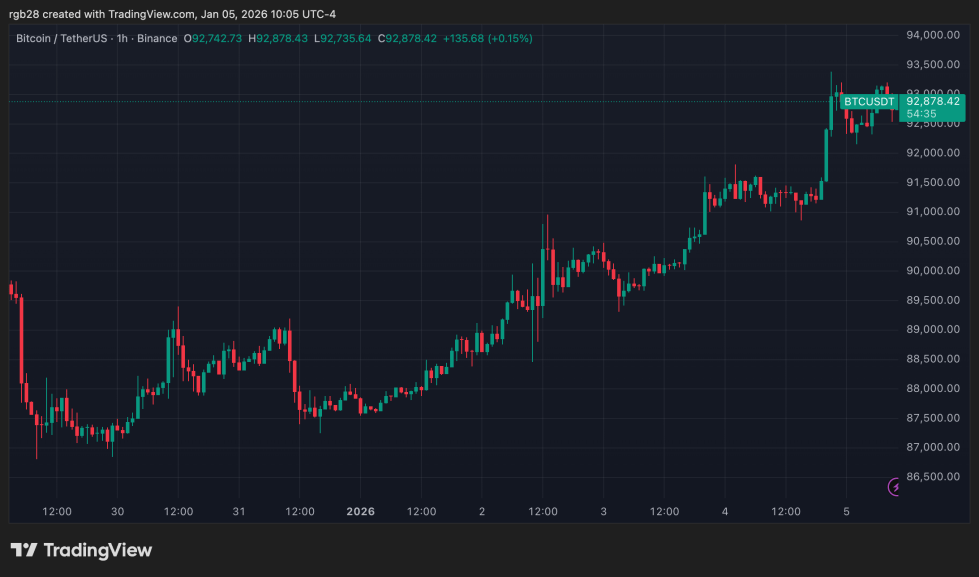
Bitcoin (BTC) trades at $92,876 in the one-week chart. Source: BTCUSDT on TradingView


Related Questions

QWhat did Japan's Finance Minister declare as the country's 'Digital Year' and when was this announced?

AJapan's Finance Minister Satsuki Katayama declared 2026 as the country's 'Digital Year' during her New Year's address at the Tokyo Stock Exchange's Grand Opening Ceremony on January 5.

QAccording to the Finance Minister, what is the crucial role of commodity and securities exchanges in the context of digital assets?

AThe Finance Minister stated that the role of commodity and securities exchanges is crucial for citizens to benefit from digital assets and blockchain-based assets.

QHow does the current Japanese tax system treat crypto gains, and what change is being studied for the 2026 tax reform?

AThe current progressive tax system taxes digital asset gains at up to 55%. The 2026 tax reform is studying the introduction of a separate taxation system with a flat 20% tax on crypto income, similar to the system used for stocks.

QWhat significant change to the categorization of crypto assets is proposed in the 2026 tax reform?

AThe 2026 tax reform proposes to reclassify crypto assets from their previous treatment as speculative assets to being categorized as financial products.

QDespite the success of US spot ETFs, what has been the stance of Japanese regulators towards digital asset-based funds?

AJapanese regulators, specifically the Financial Services Agency (FSA), have been cautious and have repeatedly expressed reservations about digital asset-based investment products.

Related Reads

Only a 50% Chance of Passing This Year, Can the CLARITY Bill Succeed Before the Midterm Elections?

The CLARITY Act, which passed the House in July 2025 with strong bipartisan support (294-134), faces a critical juncture in the Senate. The Senate Banking Committee is expected to hold a markup soon, but key issues remain unresolved, including stablecoin yield provisions, DeFi regulations, and securing full Republican committee support. Other contentious points involve the Blockchain Regulatory Certainty Act (BRCA), ethics amendments for government officials, and SEC-related matters. The legislative calendar is tight, with limited time before the midterm elections. If the committee markup is delayed beyond mid-May, the chances of passage in 2026 drop significantly. Senator Cynthia Lummis has warned that failure this year could delay comprehensive crypto market structure legislation until 2030 or later. Galaxy estimates the probability of the CLARITY Act becoming law in 2026 is only about 50%. The bill provides crucial regulatory clarity by defining jurisdictional boundaries between the SEC and CFTC, establishing a path for decentralization, and bringing digital commodity intermediaries under federal regulation. Its passage is seen as vital before potential power shifts in the next Congress, which could bring less favorable leadership to key committees. The timeline is compressed, and the bill must compete for floor time with other priorities like Iran authorization and DHS appropriations. Key hurdles include finalizing the stablecoin yield compromise text, addressing law enforcement concerns about BRCA, and navigating political dynamics around SEC nominations. The outcome of the Banking Committee markup and the level of bipartisan support will be critical indicators of its future success.

marsbit18m ago

Only a 50% Chance of Passing This Year, Can the CLARITY Bill Succeed Before the Midterm Elections?

marsbit18m ago

Only a 50% Chance of Passing This Year, Can the CLARITY Bill Succeed Before the Midterm Elections?

The CLARITY Act, which passed the U.S. House in July 2025 with strong bipartisan support (294-134), faces a critical juncture in the Senate. The Senate Banking Committee is expected to hold a markup soon, but key issues remain unresolved, including stablecoin yield provisions, DeFi regulations, and securing full Republican committee support. Additional challenges involve the Blockchain Regulatory Certainty Act (BRCA), ethics amendments for government officials, and SEC-related concerns. Galaxy estimates only a 50% chance of the bill becoming law in 2026. The tight legislative calendar, competing priorities like Iran military authorization and DHS appropriations, and the impending midterm elections create significant time pressure. If the bill is not passed before the new Congress convenes in 2027, comprehensive crypto market structure legislation could be delayed until 2030 or later, especially if leadership changes result in less favorable committee chairs. The act provides crucial regulatory clarity by defining the jurisdictional boundaries between the SEC and CFTC, establishing a path for decentralized networks to be classified as non-securities, and bringing digital commodity intermediaries under federal regulation. The outcome of ongoing Senate negotiations, particularly the release of revised text on stablecoin yields, will be a key indicator of its future prospects.

Odaily星球日报28m ago

Only a 50% Chance of Passing This Year, Can the CLARITY Bill Succeed Before the Midterm Elections?

Odaily星球日报28m ago

Four-Dimensional Resonance: Hong Kong Web3 Carnival Sub-Forum Co-Creates Blueprint for Global Financial New Infrastructure

The "Four-Dimensional Resonance: 2026 Global Financial New Infrastructure" forum, a core event of the Hong Kong Web3 Festival, was successfully held at the Hong Kong Convention and Exhibition Centre. Co-hosted by Web3Labs and DeShang Singularity Tech, with joint support from Bitroot, Injective, Microsoft, and Z Oracle, the event gathered policymakers, industry leaders, and investors to explore the integration and innovation of global financial infrastructure, focusing on RWA, AI, DeFi, and compliant payments. Policy speakers, including Hong Kong Legislative Council Member Mr. Wu Jiezhuang, South Korean National Assembly Member Mr. Min Byung-duk, and ACED Chairman Mr. Yun Seok-hun, emphasized the importance of cross-border regulatory collaboration and an open policy environment for fintech innovation. Web3Labs CEO Caspar and DeShang Singularity Tech CEO Chang Shuai highlighted Hong Kong’s role as a financial innovation center and the approaching "singularity moment" for global financial infrastructure. Technical insights were shared by MagnetX, Bitroot, Microsoft, and Injective on topics including AI Agent economies, the evolution of public blockchains, and AI’s transformative role in finance. Key partnerships and initiatives were launched: - GWDC 2026 Korea collaboration between Hong Kong and South Korea. - A strategic agreement between Web3Labs and Microsoft. - The launch of a public anti-fraud alliance by Z Oracle and partners. - The "Injective Rising Star" program to support AI and Web3 projects. Panel discussions delved into AI-driven smart payments, compliant cross-border transactions, and the fusion of RWA and DeFi. Participants agreed that integrating RWA with DeFi is crucial for the next stage of financial infrastructure, enabling a shift from physical to digital finance. The forum underscored Hong Kong’s pivotal role in advancing a globalized and sustainable Asian fintech ecosystem.

marsbit36m ago

Four-Dimensional Resonance: Hong Kong Web3 Carnival Sub-Forum Co-Creates Blueprint for Global Financial New Infrastructure

marsbit36m ago

Trading

Spot
Futures
活动图片