Is Trump using the CLARITY Act as leverage in broader negotiations?

ambcryptoPublished on 2026-07-01Last updated on 2026-07-01

Abstract

The July 4 deadline for the CLARITY Act's passage appears set to lapse without approval, following nearly a year of delays since the House passed it in July 2025. The current holdup stems from President Donald Trump using the bill as leverage in broader negotiations. He recently called off the signing ceremony for the bipartisan 21st Century ROAD to Housing Act, having previously stated he would not sign other bills until Republicans pass the SAVE America Act. This creates a Senate scheduling crunch, squeezing the CLARITY Act's chances before the August recess. Despite Trump's move, Senator Tim Scott and others express hope for advancing the crypto market structure bill quickly, citing a bipartisan Senate Banking Committee proposal. The urgency is driven by concerns that prolonged regulatory uncertainty could push the crypto ecosystem to other nations. However, the bill risks losing momentum if Republicans cannot secure the required 60 votes before the recess, potentially delaying it until 2027. Galaxy Research has consequently lowered its outlook for the Act's passage from 60% to 50%.

The July 4 deadline for the CLARITY Act’s passage looks set to lapse without approval. Nearly a year has already passed since the U.S. House of Representatives approved the bill in July 2025.

Since then, it has encountered numerous obstacles in Congress. This includes opposition from the stablecoin industry regarding rewards and ethical concerns from lawmakers. Interestingly, the current delay is because the bill is now being used as leverage in larger negotiations by U.S. President Donald Trump.

Trump’s move sent shockwaves

According to the latest update, President Trump called off the signing ceremony for the 21st Century ROAD to Housing Act.

The bill featured a ban on a central bank digital currency (CBDC) and was supported by both parties in both chambers of Congress. In March, Trump had declared that he would “not sign other bills” until Republicans in Congress passed the SAVE America Act.

This has created a Senate scheduling crunch, directly squeezing the CLARITY Act’s chances of passage before the August recess.
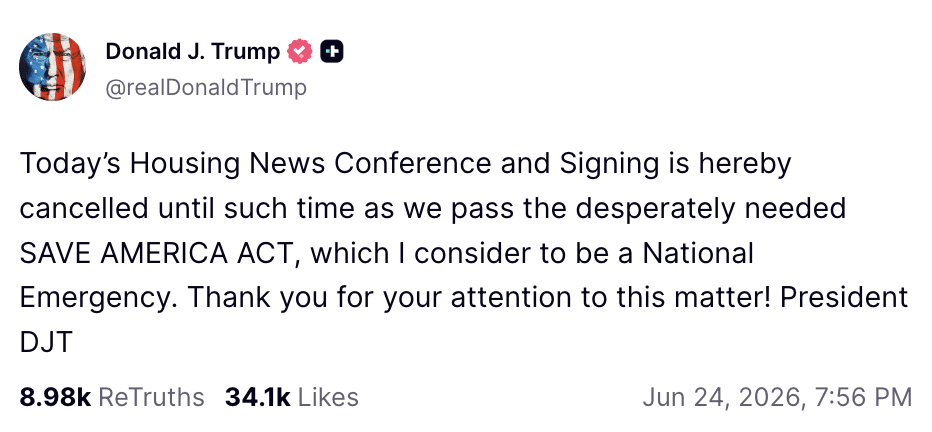
Source: Truth Social

Senators are hopeful of the CLARITY Act

Even though Trump has retreated, Senator Tim Scott has stated his support for advancing the bill as soon as possible.
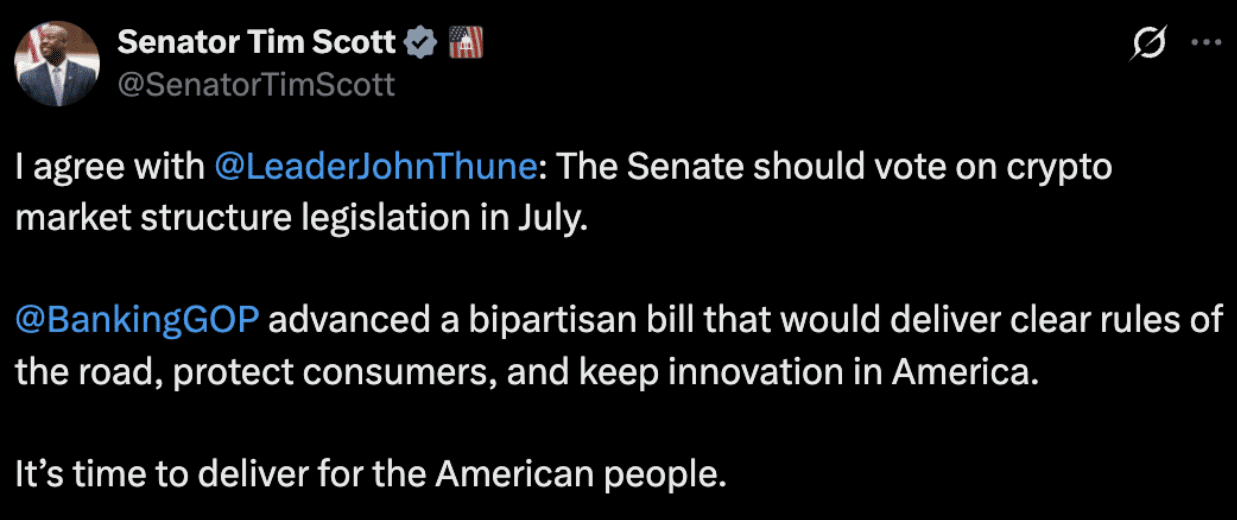
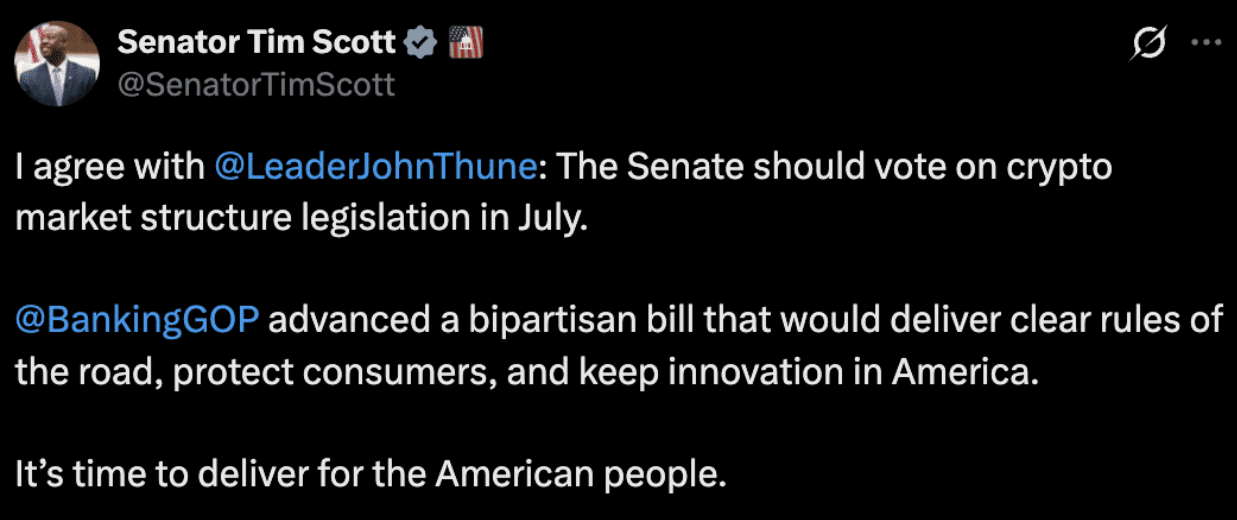
Source: Senator Tim Scott/X

The push also comes from the fact that Republicans on the Senate Banking Committee have already put forward a bipartisan proposal.

Taken together, the urgency stems from worries that extended regulatory ambiguity may push crypto’s ecosystem to nations with more defined legal systems. Because of this, Scott contends that the Senate should move quickly to pass the legislation.

Is the 4th July deadline realistic?

That said, the bill might also lose steam if Republicans are unable to obtain the required sixty votes before the Senate’s August recess. It’s possible that congressional priorities will shift as a result of many lawmakers refocusing on reelection campaigns. This, in turn, would delay the CLARITY Act’s consideration until the following session of Congress in 2027.

Galaxy Research has lowered its outlook for the CLARITY Act from 60% to 50%. This marks a sharp contrast to early June, when optimism was high, even within the White House, that the crypto market structure bill would be passed by its original July 4 deadline.


Final Summary

  • Donald Trump called off the signing ceremony for the 21st Century ROAD to Housing Act.
  • With this blocker, the 4th of July deadline looks dicey for the approval of the CLARITY Act.

Trending Cryptos

Related Questions

QWhat is the primary reason the CLARITY Act is now unlikely to meet its July 4 deadline for passage?

AThe primary reason is that U.S. President Donald Trump is using the CLARITY Act as leverage in broader negotiations, particularly by calling off the signing ceremony for the 21st Century ROAD to Housing Act and creating a Senate scheduling crunch.

QWhich other bill's cancellation by President Trump directly impacted the CLARITY Act's timeline?

AThe cancellation of the signing ceremony for the 21st Century ROAD to Housing Act, a bipartisan bill featuring a ban on a central bank digital currency (CBDC), directly impacted the CLARITY Act's timeline.

QAccording to the article, what is one major concern driving the urgency for passing the CLARITY Act?

AOne major concern is that extended regulatory ambiguity may push the cryptocurrency ecosystem to nations with more defined legal systems.

QWho has publicly stated support for advancing the CLARITY Act as soon as possible despite the current delays?

ASenator Tim Scott has stated his support for advancing the CLARITY Act as soon as possible.

QAccording to Galaxy Research, how has the outlook for the CLARITY Act's passage changed?

AGalaxy Research has lowered its outlook for the CLARITY Act's passage from 60% to 50%.

Related Reads

'The Idea of Catching the Absolute Bottom Is Wrong': Experts on a New Phase of Bitcoin Capitulation

Analysts from CryptoQuant advise investors against trying to pinpoint the exact bottom of Bitcoin's price. Their data shows the percentage of the Bitcoin supply in profit has fallen to 51.4%, a level historically associated with capitulation phases followed by accumulation. This means approximately 48.6% of circulating coins are held at an unrealized loss. The metric, based on UTXO analysis comparing a coin's last moved price to its current market value, last neared this level in early 2023 when Bitcoin traded between $16,000 and $20,000. CryptoQuant states that the idea of catching the "absolute bottom" is flawed. The decline in the average cost basis during a bear market reflects coins transferring from weak hands to stronger, long-term holders. While some investors realize losses, others may use the decline for gradual accumulation. The accumulation window may last longer than many expect, even as fear drives some participants away. Historically, a supply in profit below 55% has been linked to re-accumulation periods. Separately, Swan Bitcoin CEO Cory Klippsten offered a forecast, suggesting Bitcoin could form a bottom in October 2026, followed by a recovery towards approximately $130,000 ahead of the 2028 halving. This aligns with the historical pattern of local lows forming about 12 months after bull market peaks; Bitcoin hit its all-time high above $126,000 in early October 2025. However, Klippsten cautioned against over-relying on past cycles due to limited historical data.

cryptonews.ru5m ago

'The Idea of Catching the Absolute Bottom Is Wrong': Experts on a New Phase of Bitcoin Capitulation

cryptonews.ru5m ago

How Does FalconX Bring Institutional Lending On-Chain? Deep Dive into the FALX Operational Mechanism

FALX is a structured credit facility that brings institutional prime brokerage loans on-chain as fixed-income assets. It works by having FalconX originate overcollateralized loans to institutional clients (e.g., quant funds, market makers). These loan exposures enter a bankruptcy-remote SPV. The Pareto protocol provides the on-chain credit vault infrastructure, while M11 Credit acts as the credit curator, administrative agent, and collateral agent. Platforms like Plume, Ethereum, and Solana serve as distribution channels for investors. Investors deposit USDC into the vault, receiving an estimated ~7.4% net yield (after a 10% performance fee). This yield represents a premium over low-risk on-chain alternatives (like tokenized Treasuries at ~4%) to compensate for risks including FalconX operational risk, collateral liquidation risk, SPV legal risk, M11's execution risk, a 31-day redemption notice period, and potential contagion from DeFi re-collateralization. The structure incorporates multiple risk mitigations: overcollateralized underlying loans, a first-loss capital contribution from FalconX, and independent oversight by M11. However, challenges remain, such as scaling investor demand (current AUM is ~$148M against a ~$1B potential capacity), managing redemption liquidity, and addressing new risks from the vault token's use as collateral in DeFi lending protocols like Morpho. FALX demonstrates a pragmatic path for on-chain credit by leveraging existing institutional loan origination and combining it with legal structures, external curation, and blockchain-based distribution.

marsbit6m ago

How Does FalconX Bring Institutional Lending On-Chain? Deep Dive into the FALX Operational Mechanism

marsbit6m ago

AI Isn't Smarter Than Humans, It Can Just Afford to Fail; Fields Medalist Highlights 10 OpenAI Breakthroughs

"AI isn't smarter than humans, it just loses more." This is the core idea from Fields Medalist Timothy Gowers, analyzing OpenAI's ten new mathematical breakthroughs. These results, including disproving the 80-year-old Erdős unit distance conjecture and finding the first non-sofic group, caused a "Deep Blue moment" among mathematicians, prompting some to question their future role. Gowers argues the distinction between finding counterexamples and proving theorems is artificial. The real difference lies in the search strategy. AI excels in problems with well-defined, data-rich search paths where it can afford countless failed attempts—it "can lose." Its strengths are breadth of knowledge, speed, and resilience in brute-force exploration. However, AI currently struggles with problems requiring deep "pruning" of a vast decision tree—the intuitive judgment of which paths are fruitless. This is because training data consists of polished final proofs, lacking the crucial "natural friction" of human reasoning that highlights difficult steps. As Terence Tao noted, AI often misallocates emphasis, smoothing over this informative friction. True AI breakthrough, per Gowers, will arrive not when it solves isolated hard problems, but when it produces a method so novel and generative that it immediately redirects the research of an entire human mathematical community—like the cap-set problem solution did in 2016. For now, AI's advantage is stamina, not genius.

marsbit12m ago

AI Isn't Smarter Than Humans, It Can Just Afford to Fail; Fields Medalist Highlights 10 OpenAI Breakthroughs

marsbit12m ago

Looking Back at Information Hiding in the GenAI Era from Claude's Invisible Watermark: How Can Embedded Watermarks Ensure Losslessness?

On August 11, 2026, Anthropic announced that its new Claude models will embed invisible, machine-readable watermarks into generated text, allowing AI-generated content to be traced even after copying and redistribution, without affecting semantic quality or readability. This move follows global initiatives to watermark AI outputs, highlighted by the World Economic Forum and futurist Kevin Kelly. A core challenge is ensuring watermarking does not degrade model performance, leading to the key research goal of "provably lossless" generation. The theoretical foundation lies in provably secure steganography, which requires that watermarked data be indistinguishable from normal data in distribution. Early theoretical work was limited by the inability to precisely sample natural data distributions. The rise of generative AI models around 2018 provided a breakthrough, as these models learn and sample from explicit distributions. Pioneering work by a University of Science and Technology of China (USTC) team proposed frameworks for provably secure steganography using generative models, mapping encrypted messages to drive content generation. Subsequent research expanded the practicality of these techniques. Advancements include public-key steganography for asymmetric extraction, "box-less" extraction where the receiver doesn't need the original model, and "grey-box" scenarios for resource-constrained devices. A key innovation, SyncPool, resolved tokenization ambiguities in LLMs to ensure reliable message recovery. The principles of provably secure steganography directly enable "provably lossless" watermarks. If a watermark can be embedded without altering the model's sampling distribution, generation quality remains mathematically guaranteed. USTC's system, applied in platforms like Spark AI, offers plug-and-play watermarking for robust detection and model attribution. Internationally, research on "unbiased" or "distortion-free" watermarks for LLMs has accelerated, with work from Stanford, University of Maryland, and others. In the image domain, techniques like Gaussian Shading (CVPR 2024) embed watermarks by randomizing them into the latent space of diffusion models, proving no performance loss. Follow-up works enhanced robustness and addressed issues like parameter variation. The concept of "losslessness" has also been extended to model watermarking itself, using cryptographic constructs to ensure the watermark doesn't interfere with normal model use. The field has thus evolved from "empirical security" to "provable security," offering a theoretical guarantee against quality degradation from watermarking. The watermarking ecosystem involves an ongoing arms race between embedding and removal attempts, where the constraint of preserving content quality is a shared pursuit for both defenders and attackers, making the cost of removal a central part of the security博弈.

marsbit12m ago

Looking Back at Information Hiding in the GenAI Era from Claude's Invisible Watermark: How Can Embedded Watermarks Ensure Losslessness?

marsbit12m ago

Trading

Spot

Hot Articles

How to Buy 4

Welcome to HTX.com! We've made purchasing 4 (4) simple and convenient. Follow our step-by-step guide to embark on your crypto journey.Step 1: Create Your HTX AccountUse your email or phone number to sign up for a free account on HTX. Experience a hassle-free registration journey and unlock all features.Get My AccountStep 2: Go to Buy Crypto and Choose Your Payment MethodCredit/Debit Card: Use your Visa or Mastercard to buy 4 (4) instantly.Balance: Use funds from your HTX account balance to trade seamlessly.Third Parties: We've added popular payment methods such as Google Pay and Apple Pay to enhance convenience.P2P: Trade directly with other users on HTX.Over-the-Counter (OTC): We offer tailor-made services and competitive exchange rates for traders.Step 3: Store Your 4 (4)After purchasing your 4 (4), store it in your HTX account. Alternatively, you can send it elsewhere via blockchain transfer or use it to trade other cryptocurrencies.Step 4: Trade 4 (4)Easily trade 4 (4) on HTX's spot market. Simply access your account, select your trading pair, execute your trades, and monitor in real-time. We offer a user-friendly experience for both beginners and seasoned traders.

5.2k Total ViewsPublished 2025.10.20Updated 2026.06.02

How to Buy 4

Discussions

Welcome to the HTX Community. Here, you can stay informed about the latest platform developments and gain access to professional market insights. Users' opinions on the price of 4 (4) are presented below.

活动图片