Is AI Killing Bitcoin Mining? Here’s The Truth

bitcoinistPublished on 2026-03-16Last updated on 2026-03-16

Abstract

A new debate suggests AI data centers, as richer buyers of electricity, could threaten Bitcoin mining by outbidding for power. Crypto influencer Ran Neuner argued AI has "killed Bitcoin" by competing for scarce energy, citing higher revenue per megawatt ($200–$500 for AI vs. $57–$129 for Bitcoin) and miner pivots to AI. However, analysts push back. Willy Woo emphasizes Bitcoin’s adaptive difficulty adjustment: if high-cost miners exit, the network adjusts, maintaining security. Daniel Batten calls the claim "nonsense," arguing AI may actually depend on Bitcoin mining for energy monetization during data center construction, using stranded energy, and smoothing demand patterns. He stresses mining economics are nuanced, involving variable costs, heat recycling, and renewable energy opportunities. The article concludes that AI may reshape mining but won’t kill Bitcoin.

A new fault line is opening in the Bitcoin mining debate as AI data centers emerge as a far richer buyer of electricity than traditional miners. But the argument over whether that dynamic threatens Bitcoin’s long-term security is drawing a sharp pushback from market and energy specialists who say the headline claim misses how mining economics actually work.

The flashpoint came from Crypto Banter co-founder Ran Neuner, who framed the issue in stark terms. “AI has killed Bitcoin forever. It became Bitcoin mining’s biggest competitor. Not another crypto. AI,” he wrote on X, arguing that both sectors are chasing the same scarce input: power.

Neuner’s basic math is simple and provocative. He claimed BTC mining generates roughly $57 to $129 of revenue per megawatt, while AI data centers can make $200 to $500 per megawatt from that same electricity.

“That’s why miners are starting to pivot,” he wrote, pointing to Core Scientific’s AI hosting deal, Hut 8’s $7 billion AI infrastructure agreement, and Cipher Mining’s decision to cut hashrate 51% to focus on AI compute. From there, he pushed the key question: if AI becomes the highest bidder for power, what happens to Bitcoin?

That framing resonates because it captures something real: miners are no longer competing only with other miners. In certain markets, they are competing with hyperscale-style compute demand that may support a much higher revenue profile. For listed mining firms, especially those already sitting on power infrastructure, the temptation to repurpose capacity for AI is obvious.

Why AI Won’t Kill Bitcoin Mining

But on-chain analyst Willy Woo argued that Neuner’s conclusion confuses miner competition with network-level economics. “What the BTC network is willing to pay for its security is set the BTC price and network use,” Woo wrote. “The price of electricity is irrelevant, that only impacts competition between miners. Study BTC’s difficulty adjustment – it’s a fundamental cornerstone of understanding BTC.”

That is the core rebuttal. Bitcoin does not require every miner to remain profitable at every electricity price. It adjusts. If higher-cost operators drop off because AI outbids them for power, mining difficulty can fall, allowing the remaining miners to continue operating under a new equilibrium. In Woo’s reading, AI may reshuffle who mines and where, but it does not automatically “kill” Bitcoin unless it permanently breaks the relationship between price, usage, and the network’s security budget.

Climate-focused venture capitalist Daniel Batten pushed back even harder, calling the thesis “Nonsense” and arguing that the relationship may increasingly run in the other direction. “It’s the other way around: the evidence tells us that AI is dependent upon Bitcoin for its expansion,” he wrote. “For example, bitcoin mining can be used alongside AI for strategic advantages including monetizing energy during AI datacenter construction, using forward-purchased energy that would otherwise be wasted, [and] smoothing demand patterns of AI load.”

Batten’s broader point is that blanket claims about mining profitability flatten a business with highly variable inputs and revenue streams. He argued that miners in high-cost regions can still operate because heat recycling may be the primary revenue source and BTC the byproduct. Others increasingly own generation assets, mine on intermittent power, or tap stranded energy from oil, gas, and landfills at roughly 1 cent per kilowatt-hour in exchange for higher upfront capex. Demand response programs, FCAS, RECs, and carbon credits can further change the economics.

He also stressed that negative power prices during renewable surpluses create openings that generalized “AI beats mining” comparisons fail to capture. “Be very skeptical of any claims such as ‘Bitcoin mining is unprofitable beyond this threshold’ or ‘AI is killing Bitcoin’,” Batten wrote. “Not only is it more nuanced than that, but the research tells us that AI datacenters increasingly need Bitcoin mining.”

At press time, BTC traded at $73,329.
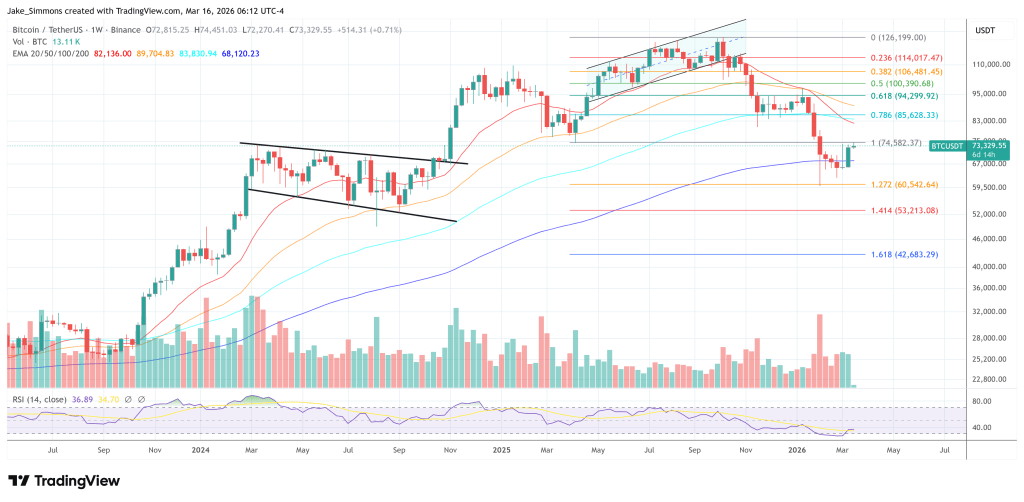
BTC must break above the 1.0 Fib level, 1-week chart | Source: BTCUSDT on TradingView.com

Related Questions

QAccording to the article, what is the core rebuttal to the claim that AI will kill Bitcoin mining?

AThe core rebuttal is that Bitcoin's difficulty adjustment mechanism ensures network security. If high-cost miners drop out due to AI competition, the mining difficulty decreases, allowing remaining miners to operate profitably at a new equilibrium. AI may change who mines and where, but it doesn't break the fundamental relationship between Bitcoin's price, usage, and security budget.

QWhat specific financial comparison did Ran Neuner make between Bitcoin mining and AI data centers?

ARan Neuner claimed that Bitcoin mining generates roughly $57 to $129 of revenue per megawatt, while AI data centers can make $200 to $500 per megawatt from the same electricity.

QHow does Daniel Batten argue the relationship between AI and Bitcoin mining actually works?

ADaniel Batten argues the relationship runs the other way: AI is dependent upon Bitcoin mining for its expansion. He states Bitcoin mining can help AI by monetizing energy during data center construction, using forward-purchased energy that would otherwise be wasted, and smoothing the demand patterns of AI load.

QWhat examples of miner pivots to AI does the article provide?

AThe article points to Core Scientific's AI hosting deal, Hut 8's $7 billion AI infrastructure agreement, and Cipher Mining's decision to cut its hashrate by 51% to focus on AI compute as examples of miners pivoting towards AI.

QBeyond electricity costs, what other factors did Daniel Batten mention that can change Bitcoin mining economics?

ADaniel Batten mentioned that factors like heat recycling as a primary revenue source, owning generation assets, mining on intermittent power, tapping stranded energy, and participating in demand response programs, FCAS, RECs, and carbon credits can all significantly change mining economics.

Related Reads

First Batch of Keynote Speakers and Partners Announced! Web2+3 Summit: Defining the Next Generation of Digital Economy

Web2+3 Summit: Defining the Next Generation of Digital Economy The 6th BEYOND International Technology Innovation Expo (BEYOND Expo 2026), Asia's largest tech and ecosystem exhibition, is launching a dedicated Web2+3 stage for the first time. Co-hosted by BEYOND Expo and ChainNeXT Group, the Web3 Summit will take place from May 28–30, 2026. Against the backdrop of accelerating global tech integration, the boundaries between Web2 and Web3 are rapidly blurring. With clearer global regulations for blockchain-driven internet (Web3) and the special issuance of a Hong Kong dollar stable币 license by the Hong Kong SAR government on April 10, 2026, Web3's decentralized principles are quickly merging with traditional industries (Web2) such as e-commerce, finance, and artificial intelligence. Focused on blockchain-driven digital economy elements, the summit will center on three core principles—implementability, commercial viability, and compliance. It will bring together top Web3 experts to discuss key integration areas like stablecoin payment finance (PayFi), real-world asset tokenization (RWA), and decentralized AI (DeAI), unveiling new opportunities for industrial innovation. The first wave of confirmed speakers includes Jack Kong (Director of Hong Kong Cyberport, Chairman of Nano Labs), Yat Siu (Chairman of Animoca Brands), Michael Wu (Co-founder & CEO of Amber Group), Michael Heinrich (Co-founder & CEO of 0G), and Art Abal (Co-founder of Vana). More Web3 ecosystem pioneers, AI, and fintech experts will be announced soon. Core forum topics include: - Web2+DeAI: New AI Paradigms Driven by Decentralized Infrastructure - Web2+RWA: Real-World Asset Tokenization and Global Liquidity - Web2+PayFi: Cross-Border Payments and Financial Innovation Powered by Crypto Infrastructure - Web2+3 AI: Autonomous Agents and the Crypto Economy - Web2+3 Wealth: On-Chain and Off-Chain Integrated Investment Ecosystems - Web2+3 Commerce: A New Landscape for Global Trade Driven by Stablecoins Additional agenda details will be released in the near future.

marsbit2h ago

First Batch of Keynote Speakers and Partners Announced! Web2+3 Summit: Defining the Next Generation of Digital Economy

marsbit2h ago

Trading

Spot
Futures

Hot Articles

What is $BITCOIN

DIGITAL GOLD ($BITCOIN): A Comprehensive Analysis Introduction to DIGITAL GOLD ($BITCOIN) DIGITAL GOLD ($BITCOIN) is a blockchain-based project operating on the Solana network, which aims to combine the characteristics of traditional precious metals with the innovation of decentralized technologies. While it shares a name with Bitcoin, often referred to as “digital gold” due to its perception as a store of value, DIGITAL GOLD is a separate token designed to create a unique ecosystem within the Web3 landscape. Its goal is to position itself as a viable alternative digital asset, although specifics regarding its applications and functionalities are still developing. What is DIGITAL GOLD ($BITCOIN)? DIGITAL GOLD ($BITCOIN) is a cryptocurrency token explicitly designed for use on the Solana blockchain. In contrast to Bitcoin, which provides a widely recognized value storage role, this token appears to focus on broader applications and characteristics. Notable aspects include: Blockchain Infrastructure: The token is built on the Solana blockchain, known for its capacity to handle high-speed and low-cost transactions. Supply Dynamics: DIGITAL GOLD has a maximum supply capped at 100 quadrillion tokens (100P $BITCOIN), although details regarding its circulating supply are currently undisclosed. Utility: While precise functionalities are not explicitly outlined, there are indications that the token could be utilized for various applications, potentially involving decentralized applications (dApps) or asset tokenization strategies. Who is the Creator of DIGITAL GOLD ($BITCOIN)? At present, the identity of the creators and development team behind DIGITAL GOLD ($BITCOIN) remains unknown. This situation is typical among many innovative projects within the blockchain space, particularly those aligning with decentralized finance and meme coin phenomena. While such anonymity may foster a community-driven culture, it intensifies concerns about governance and accountability. Who are the Investors of DIGITAL GOLD ($BITCOIN)? The available information indicates that DIGITAL GOLD ($BITCOIN) does not have any known institutional backers or prominent venture capital investments. The project seems to operate on a peer-to-peer model focused on community support and adoption rather than traditional funding routes. Its activity and liquidity are primarily situated on decentralized exchanges (DEXs), such as PumpSwap, rather than established centralized trading platforms, further highlighting its grassroots approach. How DIGITAL GOLD ($BITCOIN) Works The operational mechanics of DIGITAL GOLD ($BITCOIN) can be elaborated on based on its blockchain design and network attributes: Consensus Mechanism: By leveraging Solana’s unique proof-of-history (PoH) combined with a proof-of-stake (PoS) model, the project ensures efficient transaction validation contributing to the network's high performance. Tokenomics: While specific deflationary mechanisms have not been extensively detailed, the vast maximum token supply implies that it may cater to microtransactions or niche use cases that are still to be defined. Interoperability: There exists the potential for integration with Solana’s broader ecosystem, including various decentralized finance (DeFi) platforms. However, the details regarding specific integrations remain unspecified. Timeline of Key Events Here is a timeline that highlights significant milestones concerning DIGITAL GOLD ($BITCOIN): 2023: The initial deployment of the token occurs on the Solana blockchain, marked by its contract address. 2024: DIGITAL GOLD gains visibility as it becomes available for trading on decentralized exchanges like PumpSwap, allowing users to trade it against SOL. 2025: The project witnesses sporadic trading activity and potential interest in community-led engagements, although no noteworthy partnerships or technical advancements have been documented as of yet. Critical Analysis Strengths Scalability: The underlying Solana infrastructure supports high transaction volumes, which could enhance the utility of $BITCOIN in various transaction scenarios. Accessibility: The potential low trading price per token could attract retail investors, facilitating wider participation due to fractional ownership opportunities. Risks Lack of Transparency: The absence of publicly known backers, developers, or an audit process may yield skepticism regarding the project's sustainability and trustworthiness. Market Volatility: The trading activity is heavily reliant on speculative behavior, which can result in significant price volatility and uncertainty for investors. Conclusion DIGITAL GOLD ($BITCOIN) emerges as an intriguing yet ambiguous project within the rapidly evolving Solana ecosystem. While it attempts to leverage the “digital gold” narrative, its departure from Bitcoin's established role as a store of value underscores the need for a clearer differentiation of its intended utility and governance structure. Future acceptance and adoption will likely depend on addressing the current opacity and defining its operational and economic strategies more explicitly. Note: This report encompasses synthesised information available as of October 2023, and developments may have transpired beyond the research period.

363 Total ViewsPublished 2025.05.13Updated 2025.05.13

What is $BITCOIN

Discussions

Welcome to the HTX Community. Here, you can stay informed about the latest platform developments and gain access to professional market insights. Users' opinions on the price of BTC (BTC) are presented below.

活动图片