Intraday Quantitative Sentiment Fluctuation Analysis Report — December 26, 2025

marsbitPublished on 2025-12-26Last updated on 2025-12-26

Abstract

BTC Market Sentiment Analysis Report — 2025.12.26 Over the past 24 hours, BTC market sentiment exhibited a V-shaped pattern, starting stable, then declining, before rebounding. Overall sentiment was negative, with the CED (Crypto Emotion Index) dropping from an initial 12.27 to a low of -15.14, with a slight recovery to -13.05 by the end of the session. Key情绪时段 (Emotional Phases): - Morning (09:45–12:00): High volatility in sentiment (CED 12.27 → 7.12) with narrow price fluctuations. - Afternoon to Evening (12:00–20:00): Sustained weakening of sentiment (CED 7.12 → -5.64), accompanied by a gradual price decline. - Night (20:00–04:00): Intense sentiment swings (CED -5.64 ↔ 4.28) alongside significant price oscillations. - Early Morning to Open (04:00–09:45): Sentiment plunged deeply (CED 1.86 → -13.05), resulting in a breakdown in price. Extreme Sentiment and Price Correlation: - Periods of extreme negative sentiment (CED < -10) showed a significantly higher probability of price declines, with an average drop of 0.12%. - Neutral sentiment ranges (|CED| ≤ 10) showed minimal directional bias, with a slight average increase of 0.03%. - Extreme sentiment phases often signal potential price reversals, particularly rebounds following intense negative sentiment. Summary and Conclusions: - Market sentiment remains deeply negative (CED = -13.05), reflecting severe lack of investor confidence. - Emotional momentum has noticeably weakened, suggesting a possible consolidation or botto...

Over the past 24 hours, the BTC market sentiment exhibited a V-shaped pattern of initial stability followed by a decline and then a rebound. The overall sentiment was negative, with the CED dropping continuously from an initial 12.27 to a low of -15.14, before slightly recovering to -13.05 by the end of the session.

Analysis of Extreme Sentiment Periods (|CED| > 10)
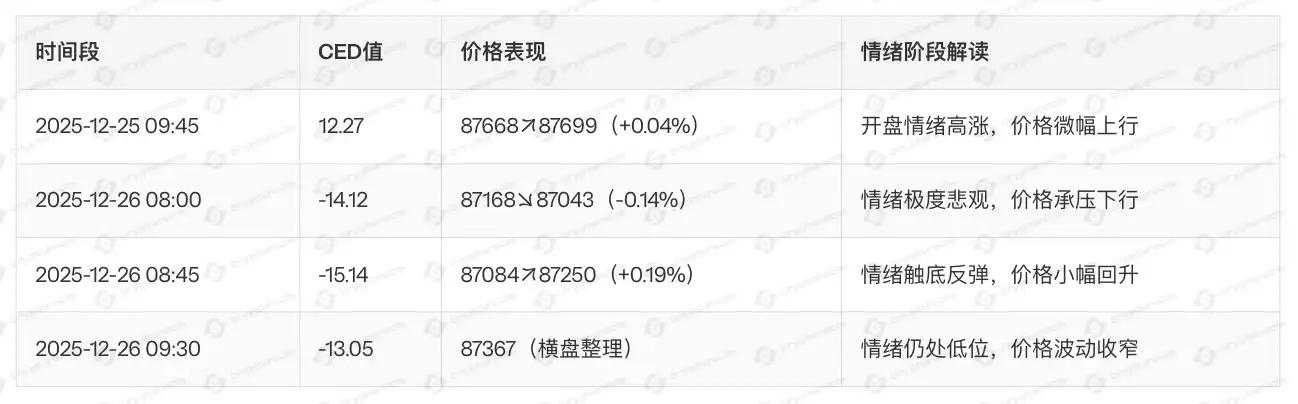
Intraday Sentiment Rhythm

  • Morning (09:45-12:00): High sentiment volatility (CED 12.27→7.12) with narrow price fluctuations
  • Afternoon to Evening (12:00-20:00): Sentiment continued to weaken (CED 7.12→-5.64) with a gradual price decline
  • Night (20:00-04:00): Intense sentiment fluctuations (CED -5.64↔4.28) accompanied by significant price volatility
  • Early Morning to Opening (04:00-09:45): Sentiment plunged deeply (CED 1.86→-13.05) with a breakout price drop

II. Relationship Between Extreme Sentiment Zones and Market Trends
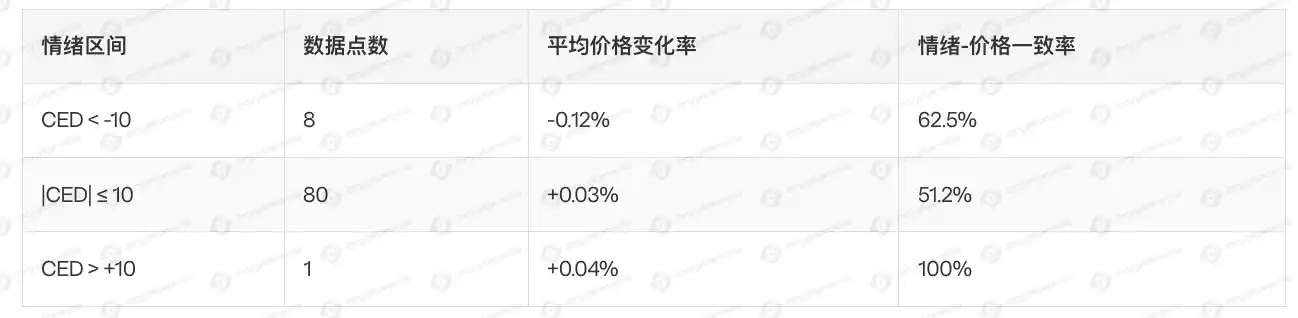
Trend Conclusions:

  • Extreme negative sentiment zones (CED<-10) show significantly higher probability of price decline, with an average drop of 0.12%
  • Neutral sentiment zones (|CED|≤10) show unclear price directionality, with a slight overall increase of 0.03%
  • Periods of extreme sentiment often indicate potential price reversal opportunities, particularly rebounds after extreme negative sentiment

III. Summary of Current Market Conditions
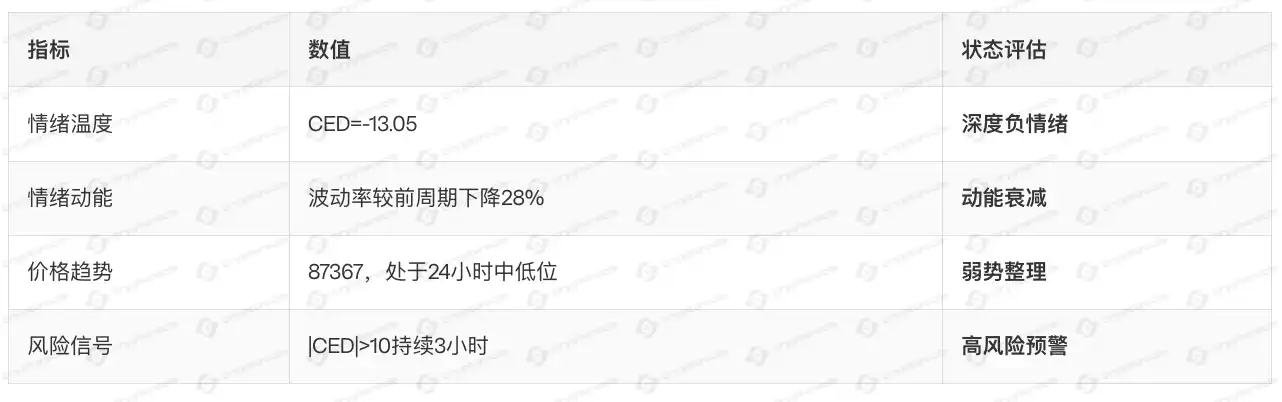
IV. Key Conclusions

  • Market sentiment is in a deeply negative zone (CED=-13.05), reflecting severely insufficient investor confidence
  • Sentiment momentum has noticeably weakened, suggesting a possible short-term consolidation and bottoming phase
  • Prices have formed short-term support in the 87000-87400 range; the strength of sentiment recovery needs monitoring
  • The prolonged duration of extreme negative sentiment warrants caution against further downside risks


Trending Cryptos

Related Questions

QWhat was the overall pattern of BTC market sentiment over the past 24 hours according to the report?

AThe BTC market sentiment showed a V-shaped pattern, starting stable, then declining, and finally rebounding. The overall trend was negative, with the CED dropping from an initial 12.27 to a low of -15.14, with a slight recovery to -13.05 by the end of the session.

QDuring which time period did the most significant emotional fluctuations and large price swings occur?

AThe most significant emotional fluctuations and large price swings occurred during the night session, from 20:00 to 04:00.

QWhat is the reported relationship between extreme negative sentiment (CED < -10) and price movement?

AThe report states that the extreme negative sentiment interval (CED

QWhat is the core conclusion regarding the current state of the market sentiment?

AThe core conclusion is that market sentiment is in a deep negative zone (CED = -13.05), reflecting severely insufficient investor confidence, and it may be entering a phase of volatile bottoming.

QWhat potential risk is highlighted due to the prolonged period of extreme negative sentiment?

AThe prolonged period of extreme negative sentiment highlights the risk of a further price breakdown.

Related Reads

The Once-Niche Field of Philosophy Becomes a Hot Topic in "Governing" AI

"Cold" Philosophy Becomes Hot in Taming AI This article explores the rising prominence of philosophical inquiry at the World Artificial Intelligence Conference (WAIC), highlighting a shift from purely technical discussions to deeper questions about AI's nature and impact. A key theme is the foundational question of intelligence itself. Philosopher Sun Ning argued that true, grounded intelligence requires embodiment, environment, interaction with others, and historical context, summarized as "Before intelligence, there is a world. Before mind, there is relationship." The forum then examined AI's expanding role in science. Researchers presented AI systems that can autonomously generate scientific papers and mathematical proofs, raising critical questions about evaluation, attribution of discovery, and potential misuse. The proposed solution is a collaborative framework: AI expands the search space, humans define value and provide rigorous constraints, and machines handle verification. As AI models begin to simulate human societies and behaviors for research, new risks emerge. Simulations can inherit and amplify societal biases from their training data, and their outputs risk being mistaken for genuine social signals. This necessitates robust governance focused on auditability, bias correction, and clear human oversight—ensuring people retain intervention, correction, and explanation rights ("human-in-the-loop"). The discussion extended to industry, where AI integrates with wet labs for bio-manufacturing. Here, challenges involve bridging the digital-physical gap and adapting regulatory and business models from process-based to outcome-based partnerships, fundamentally altering production relationships. The convergence of philosophers, scientists, and entrepreneurs at WAIC signals a broader trend: as AI permeates knowledge creation and social systems, technical progress is increasingly intertwined with urgent questions of ethics, governance, economic distribution, and public policy. The core challenge becomes not just what AI *can* do, but what we *should* ask it, trust from it, and guide it towards.

marsbit37m ago

The Once-Niche Field of Philosophy Becomes a Hot Topic in "Governing" AI

marsbit37m ago

After six years of pie-in-the-sky fundraising, 90% of funds used to replenish cash flow: The illusion and reality of L'CI Technology's silicon carbide "industrialization"|TMTPost Deep Dive

After six years and raising approximately 3.2 billion yuan through two private placements, Luxshare Technology has officially terminated its two major SiC wafer projects. Only about 7.75% of the raised funds were actually invested in SiC construction and R&D, with the remaining 90% redirected to replenish working capital and repay loans. Despite previous ambitious plans for a 10-billion-yuan SiC industrial park and public assurances of progress, the company's actual SiC capacity remains unclear, with its subsidiary recording significant losses. The article details a pattern of chasing market trends, from electric vehicles and photovoltaics to the current focus on SiC. However, its SiC entry was late; while peers like Tianke Heda and Tianyue Advanced have moved from mass-producing 6-inch to 8-inch and even 12-inch wafers, Luxshare is still struggling with its 6-inch plans and now promises to develop larger sizes with its own funds. Key concerns include unclear disclosures about the status of its chief scientist, Chen Zhizhan, and significantly lower R&D investment compared to competitors. Financially, since its 2011 IPO, the company has raised over 7 billion yuan but generated only 221 million yuan in cumulative net profit. Meanwhile, the controlling shareholder family has cashed out nearly 2 billion yuan since 2018. The article positions Luxshare as a case study of a listed company focused more on financing and capital operation around hot topics than on substantive industrial development.

marsbit1h ago

After six years of pie-in-the-sky fundraising, 90% of funds used to replenish cash flow: The illusion and reality of L'CI Technology's silicon carbide "industrialization"|TMTPost Deep Dive

marsbit1h ago

ChatGPT Finally Can 'Search Itself': Nearly Four Years of Conversations, Retrieved with One Click

ChatGPT, nearly four years old, has long lacked a functional way for users to search their own accumulated history. This changed on July 14th, when OpenAI launched a comprehensive "Unified Search" feature across all platforms and plans. This new search allows users to find and instantly access past conversations, uploaded documents, generated images, and projects within their own ChatGPT account, all from a single sidebar entry. This update signifies a major shift in ChatGPT's role, transforming it from a transient chat tool into a personal knowledge base or "file system" for users' AI-generated content. It completes a critical missing piece as OpenAI expands ChatGPT's capabilities with features like Projects, Memory, Work, and Sites, aiming to make it a central hub for work and creativity. The ability to easily retrieve years of personal data makes that data more valuable as a unique, irreplaceable asset in the AI era. However, it also highlights the increasing weight and potential sensitivity of this data, given default settings that allow conversations to be used for model training and legal precedents involving user logs. While a significant improvement over the previous ineffective search, this move is seen as addressing an industry-wide oversight. As the competition between AI assistants (ChatGPT, Gemini, Claude) moves beyond raw model power, the new battleground is becoming which platform can best organize, retain, and leverage the valuable data co-created by users and AI.

marsbit1h ago

ChatGPT Finally Can 'Search Itself': Nearly Four Years of Conversations, Retrieved with One Click

marsbit1h ago

7-Year-Olds Starting Companies? 9-Year-Olds Making Movies? Post-90s Parents Are Raising 'AI Prodigies'

"AI Genius Kids: A New Wave or a Parental Anxiety Trap?" The article examines the recent surge in AI-focused educational camps and programs in China, heavily marketed to parents of young children with sensational claims like "7-year-olds start companies" and "9-year-olds make movies." These programs promise rapid, practical AI skills—from creating agents and business plans to generating content—often for significant fees, capitalizing on parental anxieties about the AI-dominated future. It contrasts this trend with earlier, more foundational AI education, arguing current offerings prioritize superficial, immediate application over deep learning. The author critiques this approach as premature for children still in basic education, suggesting it fosters a shortcut mentality and may even teach improper use, like using AI to cheat on homework. The driving force behind this trend is identified as the profound anxiety of the current generation of parents—largely professionals in tech or related fields—who are witnessing firsthand how AI disrupts and replaces jobs. This workplace fear translates into a desperate desire to equip their children with perceived competitive advantages from an extremely young age, viewing AI proficiency as a magical key to success. The piece also casts a skeptical eye on the phenomenon of real "AI child prodigies," citing examples like Australian teen Alby Churven, whose ventures attract media buzz but little serious investment. It suggests that beyond the hype, the business world remains wary of child-led enterprises. True advancement, the article implies, still relies on solid, traditional education and foundational knowledge, not just early exposure to tools. Ultimately, it frames the AI camp boom less as a legitimate educational movement and more as a reflection of societal pressure and a potentially expensive exploitation of parental fears in a rapidly changing technological landscape.

marsbit1h ago

7-Year-Olds Starting Companies? 9-Year-Olds Making Movies? Post-90s Parents Are Raising 'AI Prodigies'

marsbit1h ago

Trading

Spot

Hot Articles

What Is TradFi

TradFi (Traditional Finance) refers to a centralized financial system dominated by banks, securities exchanges, asset management firms, and regulatory institutions.

39.2k Total ViewsPublished 2026.07.01Updated 2026.07.01

What Is TradFi

HTX Learn: Learn TradFi to Share 1000 USDT in HTX​

To enhance your understanding of TradFi, we are rolling out various rewarding events. Join them now and bring home generous rewards through learning and trading.

40.0k Total ViewsPublished 2026.07.01Updated 2026.07.01

HTX Learn: Learn TradFi to Share 1000 USDT in HTX​

How to Buy DATA

Welcome to HTX.com! We've made purchasing DATA Network (DATA) simple and convenient. Follow our step-by-step guide to embark on your crypto journey.Step 1: Create Your HTX AccountUse your email or phone number to sign up for a free account on HTX. Experience a hassle-free registration journey and unlock all features.Get My AccountStep 2: Go to Buy Crypto and Choose Your Payment MethodCredit/Debit Card: Use your Visa or Mastercard to buy DATA Network (DATA) instantly.Balance: Use funds from your HTX account balance to trade seamlessly.Third Parties: We've added popular payment methods such as Google Pay and Apple Pay to enhance convenience.P2P: Trade directly with other users on HTX.Over-the-Counter (OTC): We offer tailor-made services and competitive exchange rates for traders.Step 3: Store Your DATA Network (DATA)After purchasing your DATA Network (DATA), store it in your HTX account. Alternatively, you can send it elsewhere via blockchain transfer or use it to trade other cryptocurrencies.Step 4: Trade DATA Network (DATA)Easily trade DATA Network (DATA) on HTX's spot market. Simply access your account, select your trading pair, execute your trades, and monitor in real-time. We offer a user-friendly experience for both beginners and seasoned traders.

619 Total ViewsPublished 2026.07.01Updated 2026.07.01

How to Buy DATA

Discussions

Welcome to the HTX Community. Here, you can stay informed about the latest platform developments and gain access to professional market insights. Users' opinions on the price of A (A) are presented below.

活动图片