Interop Roadmap Accelerates: After Fusaka Upgrade, Ethereum Interoperability May Take a Key Leap

marsbitPublished on 2025-12-11Last updated on 2025-12-11

Abstract

Recent Ethereum Fusaka upgrade, while primarily focused on Blob capacity expansion, introduced the underappreciated EIP-7825, a critical enabler for Ethereum's zero-knowledge (ZK) and interoperability roadmap. This proposal sets a hard per-transaction gas limit (~16.78 million gas), preventing "mega-transactions" from monopolizing a block. This change transforms block proof generation from a sequential logic problem into a parallelizable computational task, making real-time ZK proofs an engineering feasibility rather than a theoretical impossibility. This foundational shift is pivotal for the L1 zkEVM vision, where Ethereum itself generates verifiable proofs for its state transitions. L1 zkEVM acts as a universal "trust anchor," allowing Layer 2s (L2s) to instantly and trustlessly verify the mainnet's state without waiting for challenge periods. This eliminates the speed-trust decentralization trade-off, enabling near-instant, decentralized cross-chain interoperability. Concurrently, ZK technology is evolving from EVM-compatible zkEVMs to more efficient, ZK-optimized zkVMs. EIP-7825's parallelizable environment allows these zkVMs to operate at peak efficiency, drastically reducing proof generation cost and time. The convergence of EIP-7825, L1 zkEVM, and advanced zkVMs paves the way for the final stage of interoperability (Interop)—abstracting away chain boundaries to deliver a single-chain user experience where cross-chain actions are seamless, secure, and instantaneous.

Author: imToken

In previous articles of the Interop series, we discussed OIF (Intent Framework) and EIL (Interoperability Layer), which respectively address the standardization of cross-chain intents (making the entire network understand what you want to do) and the execution channel problem (enabling funds to move in a standardized manner).

However, achieving a perfect "single-chain experience" still involves a trade-off between speed and trust. After all, in the current interoperability experience, one must either endure slowness (such as Optimistic Rollup requiring a 7-day challenge period to confirm finality) or sacrifice decentralization (relying on the trust assumptions of multi-signature bridges).

To break this "impossible triangle," it is essential to have a foundational capability that spans the "acceleration" and finalization of Ethereum's interoperability roadmap—the "real-time proof" brought by ZK technology (extended reading: "Ethereum Interop Roadmap: How to Unlock the 'Last Mile' of Mass Adoption").

And the recently activated Fusaka upgrade, with its inconspicuous EIP-7825, has cleared the biggest engineering obstacle for this ultimate goal.

I. Behind the Fusaka Upgrade: The Underestimated EIP-7825

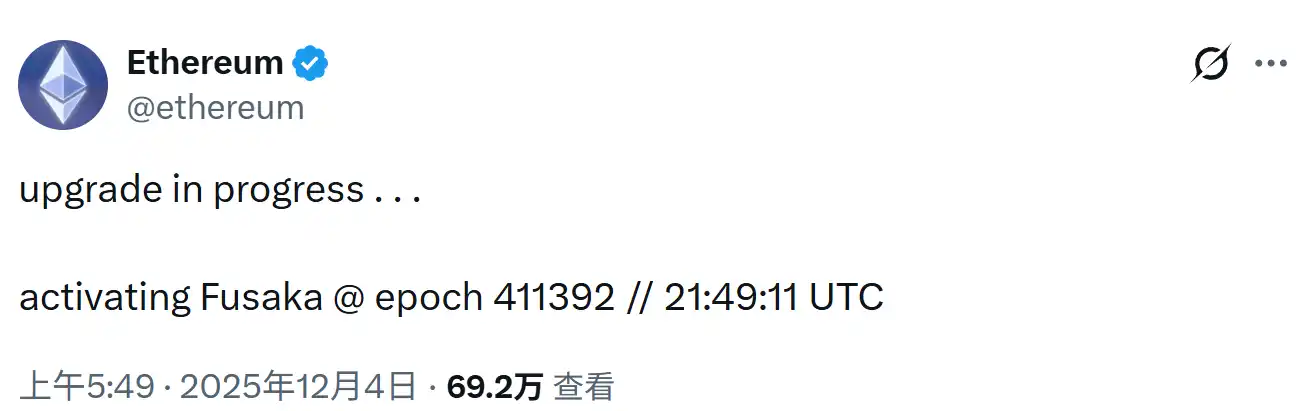
On December 4, the Ethereum Fusaka upgrade was officially activated on the mainnet. Unlike the fanfare of the Dencun upgrade, the market spotlight was largely focused on Blob scaling and PeerDAS, with much discussion about the further reduction of L2 data costs.

But beyond this buzz, there was actually a low-profile proposal, EIP-7825, which removed the biggest obstacle to achieving L1 zkEVM and real-time proof for Ethereum, and can even be said to be quietly paving the way for the ultimate goal of Interop.

In this Fusaka upgrade, the focus was almost entirely on scaling: Blob capacity expanded by 8 times, combined with PeerDAS random sampling verification, making the cost narrative of the DA (Data Availability) track a thing of the past.

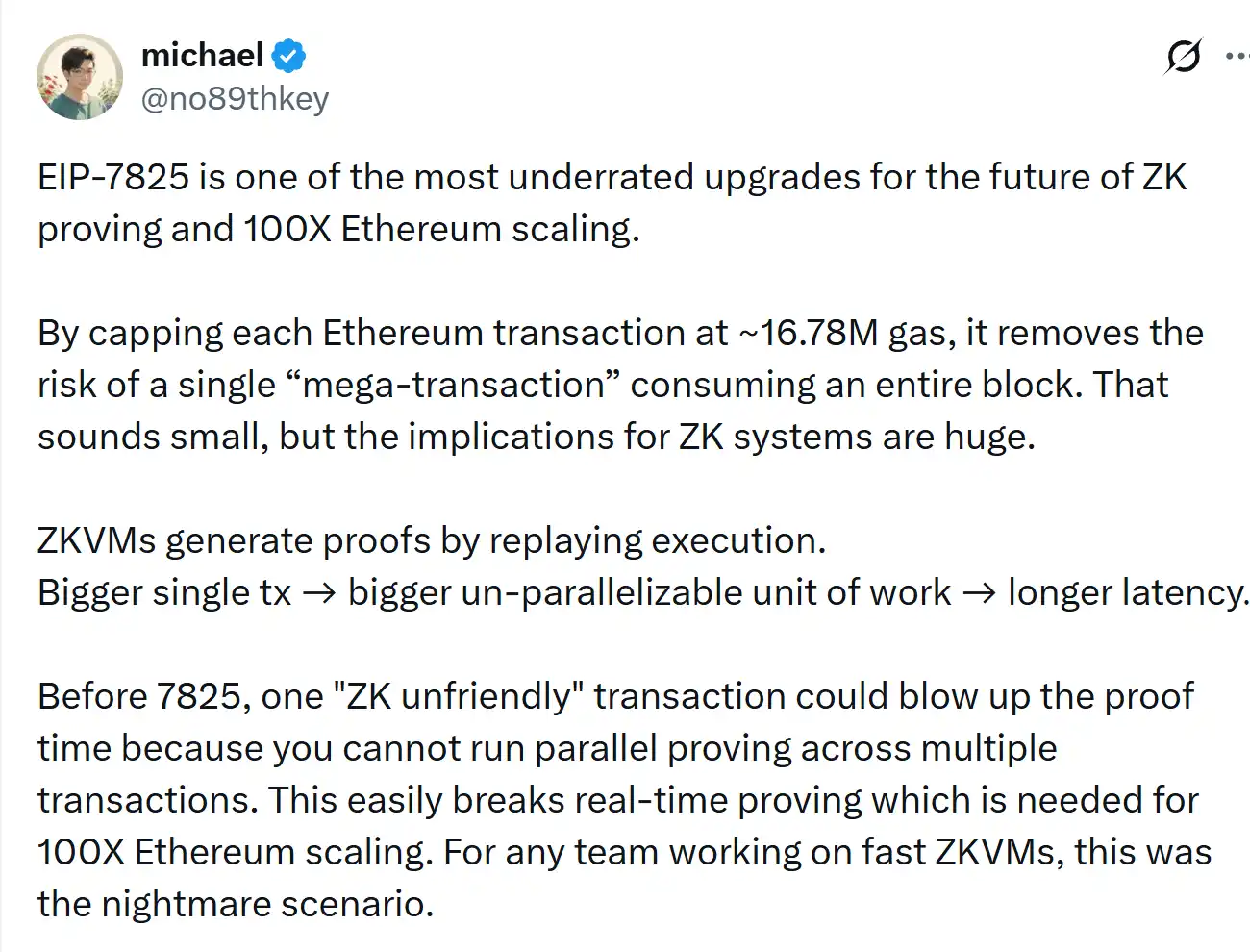
Indeed, cheaper L2s are a good thing, but for Ethereum's long-term ZK roadmap, EIP-7825 is the real game-changer because it sets a Gas limit for a single transaction on Ethereum (about 16.78 million Gas).

As we all know, Ethereum's block Gas Limit was increased to 60 million this year. But even as the upper limit continues to rise, theoretically, if they were willing to pay an extremely high Gas Price, someone could send a super-complex "Mega-Transaction" that directly occupies the entire block's 60 million Gas capacity, thereby clogging the entire block.

This was allowed before, but EIP-7825 introduces a new restriction: no single transaction can consume more than 16.78 million Gas, regardless of the block size.

So why limit the size of a single transaction? This change actually has no impact on ordinary user transfers, but for ZK Provers (proof generators), it is a matter of life and death, and it is also closely related to how ZK systems generate proofs.

To give a simple example, before EIP-7825, if a block contained a "Mega-Transaction" consuming 60 million Gas, the ZK Prover had to run this extremely complex transaction sequentially—it couldn't be split or parallelized. This is like a single-lane highway where a giant, extremely slow truck is in front, and all the cars behind (other transactions) have to wait for it to pass.

This would undoubtedly sentence "real-time proof" to death—because the time to generate the proof would be completely unpredictable, potentially taking dozens of minutes or even longer.

After EIP-7825, even if the block capacity expands to 100 million Gas in the future, since each transaction is forcibly limited to within 16.78 million Gas, each block is broken down into predictable, bounded, and parallelizable "small task units." This means that Ethereum's proof generation has changed from a tricky "logical puzzle" to a pure "money problem":

As long as enough parallel computing power is invested, we can process these split small tasks simultaneously in an extremely short time, thereby generating ZK proofs for huge blocks.

As Michael, co-founder and CEO of Brevis, said, EIP-7825 is the most underestimated upgrade on the future path of ZK and 100x scaling for Ethereum. It turns "real-time proof" from "theoretically impossible" to "engineerably schedulable." As long as we can solve the computing power problem through parallel computation, even a 200 million Gas block could achieve second-level proof. This is not only a breakthrough for ZK technology but also the physical foundation for Ethereum's Interoperability Layer (EIL) to achieve second-level cross-chain settlement.

So this upgrade might not seem like the main event, but it is actually a huge breakthrough for the ZK roadmap and Ethereum's scaling future in 2026.

II. L1 zkEVM: The "Trust Anchor" for Ethereum Interoperability

However, although EIP-7825 paves the physical path (parallelizability) for real-time proof by limiting single transaction size, this is only one side of the coin. The other side is how the Ethereum mainnet itself utilizes this capability?

This involves the most hardcore narrative in Ethereum's roadmap—L1 zkEVM.

For a long time, zkEVM has been regarded as the "holy grail" for scaling Ethereum, not only because it can solve performance bottlenecks but also because it redefines the trust mechanism of blockchain. Its core idea is to enable the Ethereum mainnet to generate and verify ZK proofs.

In other words, in the future, after each Ethereum block is executed, it can output a verifiable mathematical proof, allowing other nodes (especially light nodes and L2s) to confirm the correctness of the result without repeating the calculation—if the ability to generate ZK proofs is directly written into the Ethereum protocol layer (L1), the proposer packs a block and generates a ZK proof, and validating nodes no longer need to rerun the transactions; they only need to verify this tiny mathematical proof.

What does this mean for interoperability?

In the context of Interop, the significance of L1 zkEVM far exceeds scaling itself. It can be said to be the "trust anchor" for all L2s. After all, if Ethereum L1 can generate proofs in real time, it means all L2s can read L1's final state in real time and trustlessly. This will bring about two qualitative changes:

  • Eliminate the Challenge Period: The confirmation time between chains will be compressed from "7 days (OP mechanism)" to "seconds (ZK mechanism)";
  • Decentralized Interconnection: Cross-chain will no longer require trust in third-party multi-signature bridges but will trust the mathematical truth of the Ethereum mainnet;

This is also the physical foundation we mentioned in the previous article for EIL (Interoperability Layer) to truly work—without real-time finality from L1, interoperability between L2s will never escape the shadow of "delay."

The goal is set (L1 zkEVM), and the physical limitation is removed (EIP-7825). So what about the specific implementation tools?

This leads to the subtle evolution happening in the ZK technology stack: from zkEVM to zkVM.

III. Fusaka & EIP-7825: The Interoperability Roadmap is Liberated

If EIP-7825 provides a "parallelizable hardware environment" for ZK by limiting single transaction size, then the evolution of the ZK technology stack is to find a "more efficient software architecture." This might sound like a tongue twister, but the difference is significant and represents two stages of ZK development.

The first stage is naturally zkEVM, which can be seen as the compatibility faction or the reformist faction.

The logic is to strive to imitate every instruction of the Ethereum EVM, allowing developers to deploy Solidity code directly, reducing migration costs and barriers.

In other words, the biggest advantage of zkEVM is its compatibility with existing Ethereum applications, greatly reducing the workload for Ethereum ecosystem developers. They can reuse most of the existing infrastructure and tools (including execution clients, block explorers, debugging tools, etc.).

However, precisely because of this, since the EVM was not designed with ZK-friendliness in mind, for the sake of compatibility, zkEVM's proof efficiency often has a ceiling, and proof times are much slower, burdened by historical baggage.

zkVM, on the other hand, belongs to the radical revolutionary faction, directly building a virtual machine that is extremely friendly to ZK proofs (such as based on RISC-V or WASM) to speed up proof time and achieve better execution speed and performance.

But it also loses compatibility with many EVM features and the ability to use existing tools (like low-level debuggers). However, a clear trend is that more and more L2 projects are shedding their baggage,极致 optimizing proof speed and cost, and exploring architectures based on zkVM.

So why is the Fusaka upgrade the unlocker?

After all, before EIP-7825, whether zkEVM or zkVM, once they encountered a Mega-Transaction on Ethereum, the proof generation time would skyrocket due to the inability to split the task.

Now, EIP-7825 forcibly breaks down transactions into predictable small units. With a parallelizable environment, an efficient architecture like zkVM can exert its maximum power. Even complex Ethereum blocks, when placed in a zkVM and combined with parallel computing power, can achieve real-time proof.

What does this mean for interoperability? The proliferation of zkVM combined with EIP-7825 means the cost of generating proofs will drop significantly. When the cost of generating a cross-chain proof is low enough to be negligible, and the speed is as fast as sending an email, traditional "cross-chain bridges" will completely disappear, replaced by underlying universal message protocols.

In Conclusion

As repeatedly mentioned in previous articles of the Interop series, the ultimate goal of Interop is not just asset "cross-chain," nor is it limited to the concept of "asset bridges" anymore. It is a comprehensive set of system-level capabilities, including cross-chain data communication, cross-chain logic execution, cross-chain user experience, cross-chain security, and consensus.

From this perspective, Interop can be understood as the universal language between future Ethereum ecosystem protocols. Its significance lies not only in transferring value but also in sharing logic. ZK's role in this is to guarantee execution correctness and support real-time state verification, making cross-domain calls "dare to do, able to do." It can even be said that without real-time ZK, there can hardly be truly usable Interop UX.

So when EIP-7825 was quietly activated in the Fusaka upgrade, and as L1 zkEVM gradually becomes a reality, we are getting closer to that ultimate goal: execution, settlement, and proof are completely abstracted in the background, and users are completely unaware of the chain's existence throughout the process.

This is the Interop endgame we all look forward to in the future.

Trending Cryptos

Related Questions

QWhat is the significance of EIP-7825 in the Fusaka upgrade for Ethereum's interoperability?

AEIP-7825 introduces a gas limit per transaction (approximately 16.78 million gas), which prevents a single complex 'mega-transaction' from blocking an entire Ethereum block. This allows for parallel processing of transactions, making it feasible to generate ZK proofs in real-time. This is a critical engineering enabler for Ethereum's ZK roadmap and interoperability, as it transforms proof generation from a logical challenge into a solvable computational problem, paving the way for near-instant cross-chain settlements.

QHow does L1 zkEVM serve as a 'trust anchor' for Ethereum interoperability?

AL1 zkEVM integrates the ability to generate and verify ZK proofs directly into the Ethereum protocol layer. This means every block produced on Ethereum L1 can be accompanied by a verifiable mathematical proof. For interoperability, this allows all L2s to read the final state of L1 in real-time without trust. It eliminates the need for long challenge periods (e.g., the 7-day wait in Optimistic Rollups) and enables decentralized cross-chain communication without relying on trusted multi-signature bridges, as chains can trust the mathematical truth of Ethereum's mainnet.

QWhat is the key difference between zkEVM and zkVM in the context of ZK technology evolution?

AzkEVM focuses on full compatibility with the Ethereum Virtual Machine (EVM), allowing developers to deploy existing Solidity code with minimal changes. However, this compatibility often results in slower proof generation due to EVM's design not being ZK-friendly. In contrast, zkVM is a more radical approach that builds a new virtual machine (e.g., based on RISC-V or WASM) optimized for ZK proof efficiency and execution speed. While zkVM sacrifices some EVM compatibility and existing tooling, it offers significantly faster proof generation and better performance, which is crucial for real-time interoperability.

QHow does the combination of EIP-7825 and zkVM architecture enhance Ethereum's interoperability capabilities?

AEIP-7825 ensures that Ethereum transactions are broken down into small, predictable units that can be processed in parallel. This eliminates the problem of 'mega-transactions' causing unpredictable proof generation times. When combined with the efficient architecture of zkVM, which is designed for speed and low cost, it becomes possible to generate ZK proofs for complex Ethereum blocks in real-time. This drastically reduces the cost and increases the speed of cross-chain proof generation, making traditional cross-chain bridges obsolete and enabling seamless,底层通用消息协议 for interoperability.

QWhat is the ultimate goal of Interop (interoperability) in the Ethereum ecosystem, as described in the article?

AThe ultimate goal of Interop is not just cross-chain asset transfers but a comprehensive system-level capability that includes cross-chain data communication, logic execution, user experience, security, and consensus. It aims to create a universal language for protocols within the Ethereum ecosystem, enabling not only value transfer but also logic sharing. ZK technology ensures execution correctness and real-time state verification, making cross-domain interactions feasible and user-friendly. The end vision is a fully abstracted backend where users are unaware of the underlying chains, experiencing seamless interoperability.

Related Reads

Stocks Fell Even More Violently Than Crypto, Where Did the Money Go?

From June to late July 2026, global stock markets, particularly technology and semiconductor stocks, experienced severe declines, with South Korea's KOSPI index facing historic circuit breakers and shedding 40% from its June peak. Key catalysts included SK Hynix's earnings miss despite record profits and competitive pressures from China's CXMT IPO. A global forced deleveraging event unfolded, devastating highly leveraged instruments like the 2x leveraged SK Hynix ETF, which lost over 80% of its value. Surprisingly, Bitcoin showed relative stability during this period, rising roughly 15% from its July low. The article clarifies this wasn't due to an inflow of equity flight capital but because Bitcoin had already undergone a significant correction in May and June, with U.S. spot Bitcoin ETFs seeing record outflows. True safe-haven flows went to gold, severing Bitcoin's short-term "digital gold" narrative. The sell-off is characterized not as an AI story collapse but a liquidity-driven清算 of crowded leveraged positions, potentially halfway through according to some analysts. For substantial capital to return to Bitcoin, the article cites necessary conditions: eased global liquidity pressure, a soft-landing Fed rate cut, and regulatory clarity from the stalled U.S. CLARITY Act. The conclusion is that Bitcoin is not a current safe haven but a pre-cleared asset. Its decoupling from tech stocks highlights its potential future role as a non-correlated asset for institutional portfolios, positioning it favorably for when global capital reallocates post-crisis.

marsbit1m ago

Stocks Fell Even More Violently Than Crypto, Where Did the Money Go?

marsbit1m ago

"The Final Phase Before the New Cycle". What Will Happen to Bitcoin in August

"Bitcoin Faces Crucial Test in August: Experts Predict Consolidation or Further Decline" The price of Bitcoin (BTC) is expected to remain under pressure in August, with experts anticipating either consolidation within a narrow range or a potential drop below $60,000. Despite a double-digit recovery from its July low near $58,000, BTC ended the month trading around $63,500, still roughly 50% below its October 2025 peak of $126,200. Analysts cite several headwinds: a challenging macroeconomic environment with high US interest rates and persistent inflation, which makes fixed-income assets more attractive than speculative ones like crypto. Furthermore, competition for capital is intense, with many investors favoring AI-related stocks. This is reflected in significant outflows from US spot Bitcoin ETFs, with a record $4.5 billion leaving in June and a net outflow of $5.4 billion for the first half of the year. Historically, August is a weak month for crypto, with a median return of -7.49% from 2013 to 2025. Experts also note regulatory uncertainty in the US, particularly the stalled CLARITY Act, as a dampening factor. Despite the bearish near-term outlook, several experts view the current phase as the "last phase before a new Bitcoin cycle" begins, potentially in Q4 2024. This makes it a favorable time for accumulating Bitcoin for the long term. Key price levels to watch are support at $60,000-$61,000, with a break below $58,000 potentially leading to $53,000-$55,000. A move above $67,000 could target $70,000-$75,000, though this is considered a lower probability scenario.

cryptonews.ru7m ago

"The Final Phase Before the New Cycle". What Will Happen to Bitcoin in August

cryptonews.ru7m ago

What Structural Changes Have Occurred in the Cryptocurrency Industry by 2026?

By 2026, the crypto industry is undergoing profound structural shifts, moving beyond price speculation towards deeper integration with the real-world economy. Major changes are driven by four key areas. First, stablecoins, now a $300B+ market, are evolving from crypto-native trading tools into real-world payment and B2B settlement backbones, extending business chains and creating complex accounting and tax obligations. Second, global regulation is maturing. Frameworks like the EU's MiCA are moving from legislation to active enforcement, determining market access. Anti-money laundering rules, such as the Travel Rule, see wider adoption but face enforcement and cross-border challenges. Third, AI Agents are emerging as autonomous transaction entities. Protocols like Coinbase's x402 enable machine-to-machine micropayments using stablecoins, necessitating new frameworks for transaction authorization, tax attribution, and audit trails. Finally, tax transparency is entering an implementation phase. Initiatives like the OECD's CARF, EU's DAC8, and the US Form 1099-DA are shifting reporting burdens to platforms, requiring them to reconcile on-chain data with user identity and tax residency information. Collectively, these trends signify that crypto compliance is becoming foundational infrastructure, requiring consistent data and control systems to meet cross-border operational, regulatory, and audit demands.

marsbit28m ago

What Structural Changes Have Occurred in the Cryptocurrency Industry by 2026?

marsbit28m ago

Trading

Spot

Hot Articles

How to Buy DATA

Welcome to HTX.com! We've made purchasing DATA Network (DATA) simple and convenient. Follow our step-by-step guide to embark on your crypto journey.Step 1: Create Your HTX AccountUse your email or phone number to sign up for a free account on HTX. Experience a hassle-free registration journey and unlock all features.Get My AccountStep 2: Go to Buy Crypto and Choose Your Payment MethodCredit/Debit Card: Use your Visa or Mastercard to buy DATA Network (DATA) instantly.Balance: Use funds from your HTX account balance to trade seamlessly.Third Parties: We've added popular payment methods such as Google Pay and Apple Pay to enhance convenience.P2P: Trade directly with other users on HTX.Over-the-Counter (OTC): We offer tailor-made services and competitive exchange rates for traders.Step 3: Store Your DATA Network (DATA)After purchasing your DATA Network (DATA), store it in your HTX account. Alternatively, you can send it elsewhere via blockchain transfer or use it to trade other cryptocurrencies.Step 4: Trade DATA Network (DATA)Easily trade DATA Network (DATA) on HTX's spot market. Simply access your account, select your trading pair, execute your trades, and monitor in real-time. We offer a user-friendly experience for both beginners and seasoned traders.

1.1k Total ViewsPublished 2026.07.01Updated 2026.07.01

How to Buy DATA

What is ANSEM

I. Project IntroductionThe Black Bull ($ANSEM) is a transparent, community-driven memecoin on Solana built around one creed: charge forward no matter what. The project is frontend-first and fully verifiable — its website reads live on-chain and market data directly from Solana, including price, liquidity, volume, market cap, and holder distribution, so anyone can audit the claims with no login and no user-data collection. Beyond the token, it offers an Ansem-call Radar, non-custodial community liquidity Pods on PumpSwap, and a browser-based meme terminal. $ANSEM is a standard Pump.fun SPL token (6 decimals) trading against SOL and USDC.II. Token InformationToken Symbol: ANSEM(The Black Bull)III. Related LinksWebsite:https://www.blackbullsol.com/X: https://x.com/blknoiz06Contract Address: https://solscan.io/token/9cRCn9rGT8V2imeM2BaKs13yhMEais3ruM3rPvTGpumpNote: The project introduction comes from the materials published or provided by the official project team, which is for reference only and does not constitute investment advice. HTX does not take responsibility for any resulting direct or indirect losses.

2.9k Total ViewsPublished 2026.07.01Updated 2026.07.01

What is ANSEM

How to Buy ANSEM

Welcome to HTX.com! We've made purchasing The Black Bull (ANSEM) simple and convenient. Follow our step-by-step guide to embark on your crypto journey.Step 1: Create Your HTX AccountUse your email or phone number to sign up for a free account on HTX. Experience a hassle-free registration journey and unlock all features.Get My AccountStep 2: Go to Buy Crypto and Choose Your Payment MethodCredit/Debit Card: Use your Visa or Mastercard to buy The Black Bull (ANSEM) instantly.Balance: Use funds from your HTX account balance to trade seamlessly.Third Parties: We've added popular payment methods such as Google Pay and Apple Pay to enhance convenience.P2P: Trade directly with other users on HTX.Over-the-Counter (OTC): We offer tailor-made services and competitive exchange rates for traders.Step 3: Store Your The Black Bull (ANSEM)After purchasing your The Black Bull (ANSEM), store it in your HTX account. Alternatively, you can send it elsewhere via blockchain transfer or use it to trade other cryptocurrencies.Step 4: Trade The Black Bull (ANSEM)Easily trade The Black Bull (ANSEM) on HTX's spot market. Simply access your account, select your trading pair, execute your trades, and monitor in real-time. We offer a user-friendly experience for both beginners and seasoned traders.

1.2k Total ViewsPublished 2026.07.01Updated 2026.07.01

How to Buy ANSEM

Discussions

Welcome to the HTX Community. Here, you can stay informed about the latest platform developments and gain access to professional market insights. Users' opinions on the price of A (A) are presented below.

活动图片