How Solana’s rising network activity can drive SOL’s breakout above $82

ambcryptoPublished on 2026-06-30Last updated on 2026-06-30

Abstract

Solana's on-chain activity has surged, with daily active wallets reaching a record 4.51 million, driven by growth in tokenized equities, xStocks, and DeFi. This rising network usage is now supporting SOL's price. SOL gained 7.48% recently, testing the key $78-$82 resistance zone after nine consecutive monthly declines. A sustained breakout above $82 could signal renewed bullish control and target $92, while holding above $72 support is crucial. The network's recovery hinges on whether this increased activity and capital inflow persist beyond short-term speculation.

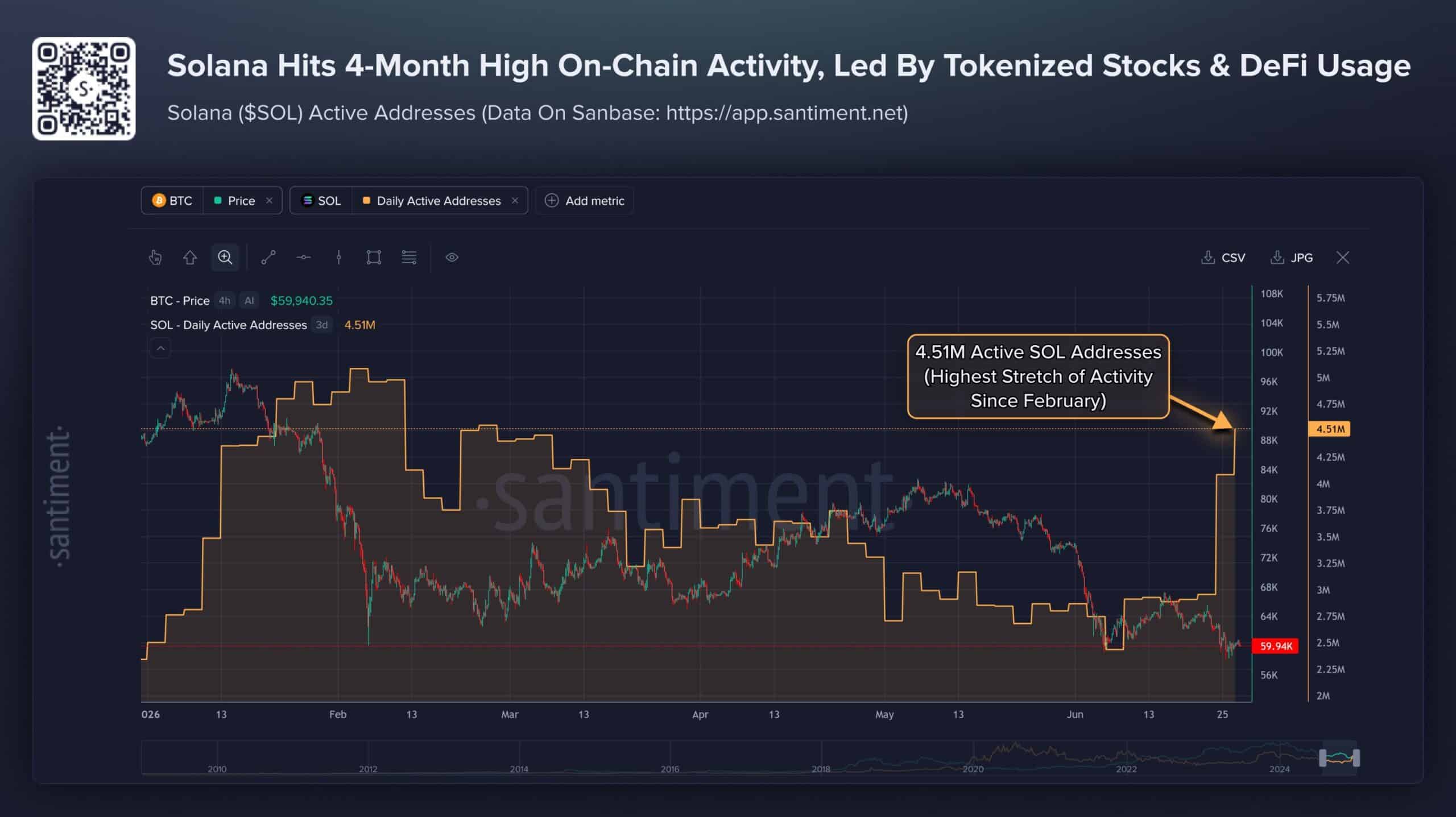
Solana’s on-chain activity has accelerated sharply, with network participation reaching its strongest level in months. The daily number of active wallets climbed to an all-time high, sitting at 4.51 million, in terms of how long this peak lasted since February as well.

The increase in activity was due to the rapid rise of tokenized equity, the surge in xStocks activity, and the resurgence in DeFi activity. With the user base returning, Solana [SOL] regained important technical points.
Source: Santiment

This indicates that the Solana network is now supporting prices through growing usage, not just because prices are increasing. However, continued adoption of the network will be dependent upon whether new users continue to utilize the platform after the rally subsides.

Continued increases in the number of new users utilizing the platform will create a more solid foundation for Solana’s recovery. A short-lived increase in use and then a decline would indicate a temporary use increase by users.

Tokenized equities expand Solana’s utility

That renewed network activity is increasingly being supported by expanding real-world financial applications rather than speculative trading alone. There are increasing numbers of users for tokenized equities on Solana.

Stablecoin supply remains high, and continued increases in net bridge inflows, TVL, and DEX trading volume suggest that the capital flowing into the Solana ecosystem is remaining in place rather than rapidly flowing out.

The continued acceleration of the adoption rate for tokenized assets would likely reinforce long-term network growth. Conversely, it is possible that Solana network activity momentum may be reduced or even slowed down if capital inflow slows.

Recovery faces its biggest test

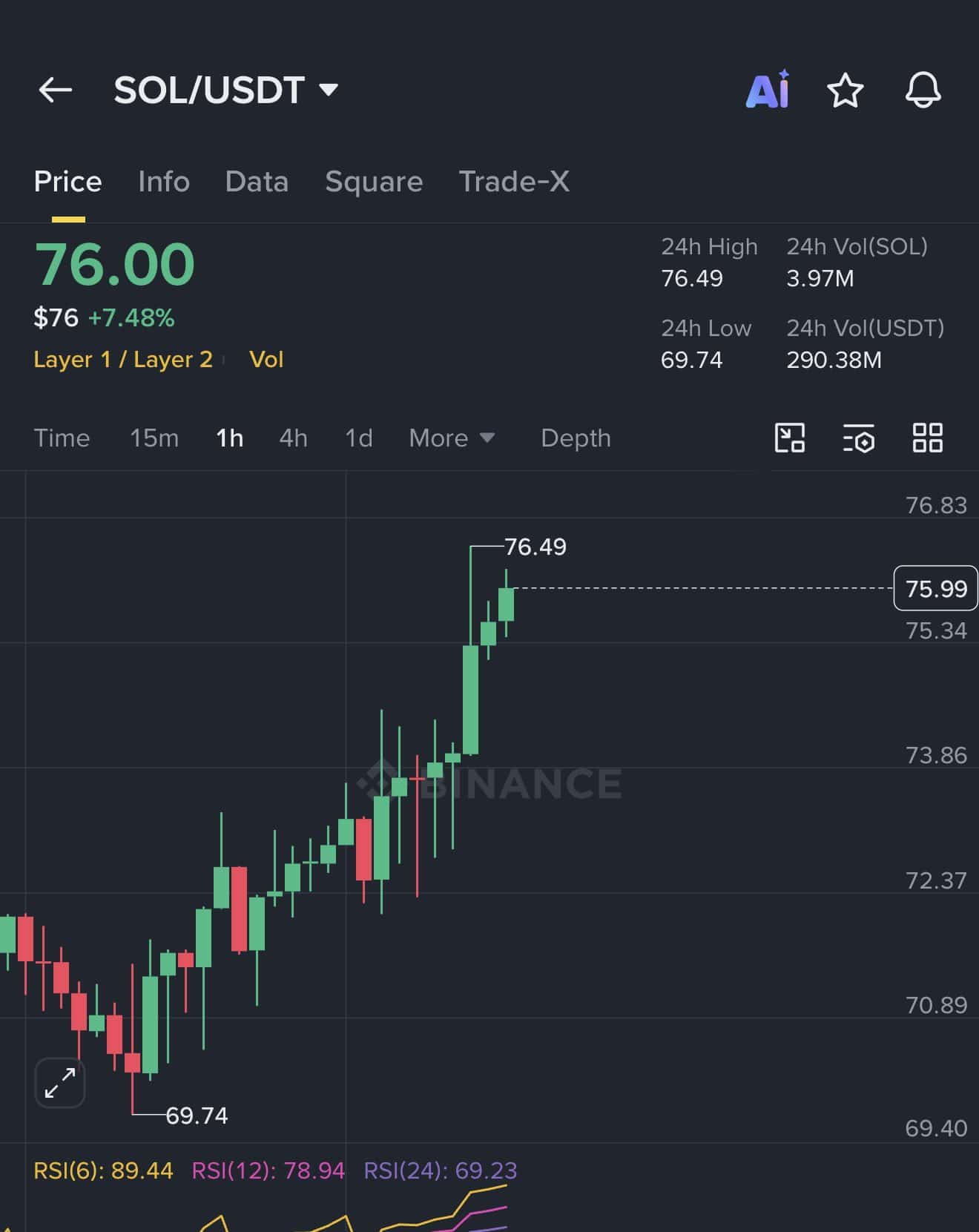
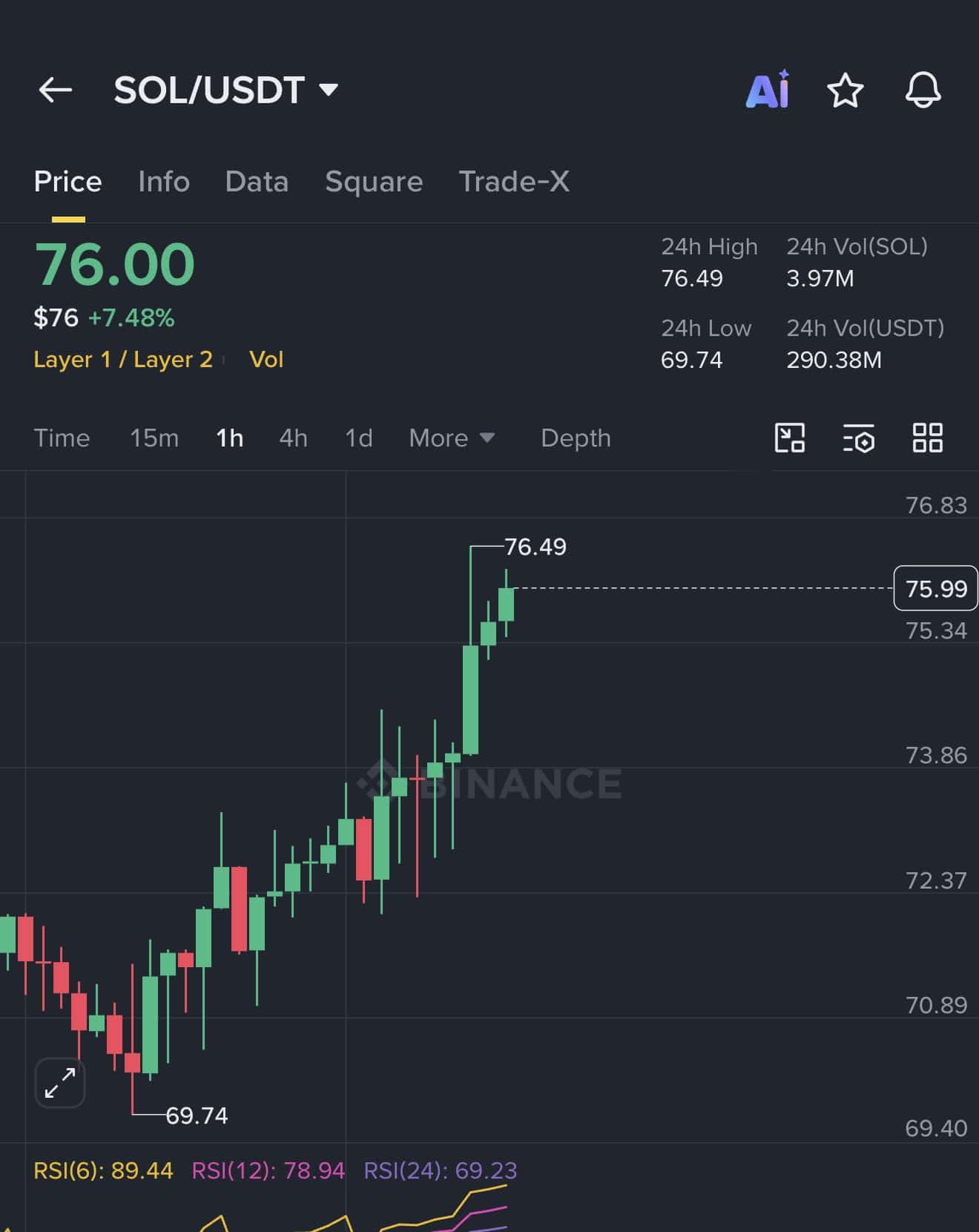
Solana’s latest rebound is increasingly testing whether its prolonged downtrend is finally losing momentum. SOL gained 7.48% on Monday, the 29th of June, climbing from $69.74 to a session high of $76.49. The altcoin later retraced to $73 as of press time.

The recovery also leaves Solana close to printing its first green monthly candle after nine consecutive red months, signaling improving buyer confidence. Even so, the $78–$82 resistance zone remains the market’s biggest test after rejecting several previous rallies.
Source: X

A breakout above that range would suggest buyers are regaining long-term control and could open the path toward $92. However, $72 remains the level bulls must defend.

Holding above it would reinforce the developing higher-high, higher-low structure. Otherwise, another rejection could signal the broader recovery still lacks lasting conviction.



Final Summary

Trending Cryptos

Related Questions

QWhat factors contributed to the sharp increase in Solana's on-chain activity?

AThe increase was due to the rapid rise of tokenized equity, the surge in xStocks activity, and the resurgence in DeFi activity.

QWhat is a key indicator that capital flowing into the Solana ecosystem is remaining in place?

AContinued increases in net bridge inflows, TVL (Total Value Locked), and DEX trading volume suggest the capital is staying rather than rapidly flowing out.

QWhat is the significance of Solana potentially printing its first green monthly candle after nine consecutive red months?

AIt signals improving buyer confidence in the market.

QWhat price range is identified as the biggest test for Solana's recovery?

AThe $78–$82 resistance zone is identified as the market's biggest test, as it has rejected several previous rallies.

QWhat two outcomes are suggested for Solana's price depending on whether it holds above or falls below the $72 level?

AHolding above $72 would reinforce the developing higher-high, higher-low structure. A fall below could signal that the broader recovery still lacks lasting conviction.

Related Reads

$2 Trillion: Countdown to AI's Largest IPO in History

The countdown for the largest IPO in AI history, a potential $2 trillion listing for Anthropic, is underway for October. The staggering valuation, reportedly projected by several investors, contrasts with the company's own internal restraint on setting a public target. Founded five years ago by former OpenAI core members, Anthropic's growth has been meteoric. Annual recurring revenue (ARR) surged from ~$9B in late 2025 to $47B by May 2026, with Q2 2026 revenue of $11.5B marking a 14x year-over-year increase. Bank valuations are even based on internal 2028 revenue forecasts of $190-200B. A key growth driver is Claude Code, its AI coding assistant. Its ARR quintupled in five months to $2.5B by February 2026, now constituting nearly 20% of total revenue. Surveys indicate Anthropic commands roughly 40% of enterprise LLM spending, doubling OpenAI's share in programming-specific use. However, alongside this explosive growth, reports detail significant internal cultural strife. Critics describe a divisive "priesthood" of PhD executives, led by CEO Dario Amodei, who promote a "save humanity" narrative that some employees find cult-like and alienating. This has reportedly created a demoralized workforce and a covert "underground network" of dissent among engineers torn between lucrative pre-IPO equity and a toxic work environment. Anthropic now faces a pivotal paradox: pursuing its mission of "safe" AI requires immense capital for compute, yet that capital demands relentless commercial growth. As it approaches its historic IPO, the company must navigate intense regulatory scrutiny, soaring operational costs, and internal tensions—any of which could destabilize its post-listing trajectory, much like SpaceX's significant post-IPO stock drop. The stage is set for a defining moment in tech history.

marsbit2h ago

$2 Trillion: Countdown to AI's Largest IPO in History

marsbit2h ago

AI Boosting Efficiency and Cutting Costs Makes VC Increasingly Expensive

"AI for Cost Reduction Makes VC Funding More Expensive" Despite the "cost-reduction and efficiency" narrative of AI, venture capital (VC) investment in the AI sector is becoming increasingly costly. While AI tools lower the initial costs for many startups—with team sizes shrinking across funding stages—the market is polarizing. For top-tier AI teams, especially those from leading companies like Google and OpenAI, funding rounds are now larger and valuations are higher than ever at the seed and early stages. For example, new ventures by prominent researchers are securing billions in funding with valuations reaching tens of billions before having a mature product. This creates a "barbell" market: lightweight startups need less capital, while elite AI firms attract massive investments early on. This dynamic raises the cost for VCs to acquire and maintain meaningful ownership stakes. As valuations soar early, securing the same equity percentage requires significantly larger capital commitments. VCs must now invest more upfront and reserve substantial funds for follow-on rounds to avoid dilution, prompting large firms like Accel and a16z to raise massive new funds. Consequently, capital is concentrating intensely in a few perceived winners like OpenAI and Anthropic, widening the gap between large and small VC funds. While high valuations bake in future growth expectations, they also compress potential returns, demanding that portfolio companies achieve unprecedented scale. For major VCs, the core strategy is clear: secure early positions in potential winners and maintain the capital to keep investing as valuations rapidly escalate.

marsbit3h ago

AI Boosting Efficiency and Cutting Costs Makes VC Increasingly Expensive

marsbit3h ago

Trading

Spot

Hot Articles

Discussions

Welcome to the HTX Community. Here, you can stay informed about the latest platform developments and gain access to professional market insights. Users' opinions on the price of S (S) are presented below.

活动图片