Here’s Why Bitcoin Could Feel The Pressure From Surging US Equity Shorts

bitcoinistPublished on 2026-05-28Last updated on 2026-05-28

Abstract

Bitcoin's recent pullback toward $75,000 may face further downside pressure due to developments in the U.S. stock market. An analyst warns that surging short interest in U.S. equities, now at historically high levels, could significantly impact Bitcoin. This activity reflects a complex market structure where institutional investors are increasing hedges while maintaining long positions, leading to high leverage. Concentration in AI mega-cap stocks is leaving other sectors vulnerable. Historically, Bitcoin has moved with U.S. equities during risk-off events, like the 2020 COVID crash. While it showed correlation with the S&P 500 from 2020-2022, a divergence has emerged since 2025. Bitcoin's recent volatility has been driven by its own factors like spot buying pressure and ETF inflows, suggesting it may be evolving into a hybrid asset class with its own market dynamics. However, it remains sensitive to broader macro liquidity conditions.

After a recovery to nearly $78,000, Bitcoin witnessed another sudden pullback as the market turned highly bearish, bringing it closer to the $75,000 price mark once again. Meanwhile, due to recent developments in the US Stock market, the leading crypto asset could be set to experience more downside pressure in the upcoming sessions.

Mounting Short Interest In Equities Impacting Bitcoin

Despite being struck by heightened volatility and selling activity, Bitcoin continues to face the possibility of a continued downside pressure. One of the things that poses a serious threat to the asset is the activity in the United States stock market, which is undergoing a major change.

A market pundit with the nickname XWIN Japan on the CryptoQuant platform has warned that the recent increase in short positions across U.S. stocks may have a considerably more significant effect on Bitcoin, contrary to what many investors now believe.

Currently, short positions on US equity have surged to historically high levels, but the market structure behind it is more complex than a simple bearish signal. Instead of outright pessimism, institutional investors seem to be increasing their hedges while maintaining large long positions. This is creating a highly leveraged gross-up environment across Wall Street.
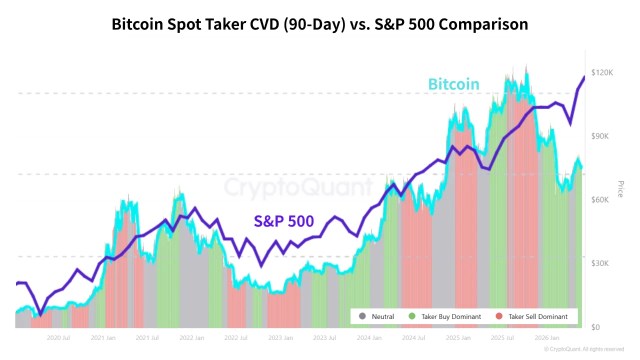
Source: Chart from CryptoQuant on X

According to recent market data, hedge fund gross leverage has climbed near 293% while Days-to-Cover metrics and dollar-based short exposure in the S&P 500 have reached record territory. When leverage reaches this level, it often suggests that investors are becoming increasingly defensive beneath the surface.

The development may be attributed to several factors, but one major factor stands out the most, and that is the concentration into AI-related mega-cap stocks. Capital continues to move into a small group of dominant names, with weaker sectors and smaller-cap equities experiencing rising short activity. As a result, the market index may exhibit stability even as internal fragility grows.

Why It Matters For BTC And Its Market

In the research, XWIN Japan has taken the opportunity to explain why this is important for Bitcoin and its market. Historically, BTC has been observed to move alongside US equities during major risk-off events. During the 2020 COVID crash, Bitcoin fell sharply along wth stocks, failing to behave like a traditional safe haven.

Furthermore, the attached chart shows that from 2020 to 2022, BTC and the S&P 500 largely moved in the same direction. However, there has been a crucial divergence between the assets since 2025.

While the S&P 500 has remained relatively stable, BTC has demonstrated large price swings backed by robust Spot Taker CVD buy pressure and ETF inflows. This wave of buying and inflows indicates that Bitcoin is increasingly influenced by its own liquidity cycle, leverage dynamics, and institutional demand.

It also signals that the crypto may be evolving from a pure risk asset into a hybrid asset class still sensitive to macro liquidity. However, the shift is capable of following its own market structure. If future conditions include Federal Reserve (Fed) easing, weaker dollar conditions, and renewed ETF inflows, BTC could turn into a secondary liquidity destination rather than a correlated tech-like asset.

BTC trading at $75,909 on the 1D chart | Source: BTCUSDT on Tradingview.com

Trending Cryptos

Related Questions

QWhat is the main reason mentioned for Bitcoin possibly facing more downside pressure?

AThe main reason is the surging short interest in U.S. equity markets, creating a highly leveraged environment and signaling increasing defensive positioning by institutional investors, which historically impacts Bitcoin during risk-off events.

QAccording to the analyst XWIN Japan, what recent development in the U.S. stock market could significantly impact Bitcoin?

AXWIN Japan warns that the recent surge in short positions on U.S. stocks to historically high levels could have a significant impact on Bitcoin, contrary to what many investors believe.

QWhat does the chart from 2020 to 2022 show about the relationship between Bitcoin and the S&P 500?

AThe chart shows that from 2020 to 2022, Bitcoin and the S&P 500 largely moved in the same direction, indicating a correlation during that period.

QWhat key divergence between Bitcoin and the S&P 500 has occurred since 2025?

ASince 2025, a key divergence has emerged: while the S&P 500 has remained relatively stable, Bitcoin has demonstrated large price swings, driven by its own factors like Spot Taker CVD buy pressure and ETF inflows.

QUnder what future conditions could Bitcoin become a 'secondary liquidity destination' according to the article?

AAccording to the article, if future conditions include Federal Reserve (Fed) easing, weaker dollar conditions, and renewed ETF inflows, Bitcoin could turn into a secondary liquidity destination rather than a correlated tech-like asset.

Related Reads

9.42 Million Retail Investors Compete for Changxin Technology, Who Got Allotted?

Evergreen Technology's IPO subscription results are now available. On July 20, the domestic memory chip giant announced the offline preliminary allotment results and online lottery results for its IPO. A total of approximately 9.43 million retail investors participated in the online subscription, generating 770,000 winning lots with a final winning rate of about 0.4714%, setting a record for new shares on the STAR Market. After triggering a clawback mechanism from institutional to retail investors, the online retail allocation was significantly increased to 3.851 billion shares. Simultaneously, 285 institutional investors participated in the offline subscription, ultimately receiving 2.173 billion shares at an allotment rate of approximately 0.1756%. Leading insurers and public funds were among the major recipients. Notably, Liang Wenfeng, founder of the major AI model company DeepSeek, through his quantitative investment firms Ningbo Huanfang Quantitative and Zhejiang Jiuzhang Asset, secured the largest share among private funds, with a total allotment worth approximately 175 million yuan. Estimates suggest potential profits could reach 730 million yuan if Evergreen Technology's market capitalization reaches 3 trillion yuan post-listing. The company is expected to list on July 27 and could become the highest-valued tech stock on the A-share market, with various brokerages providing valuations ranging from 1 trillion to over 4 trillion yuan. However, recent significant corrections in global tech stocks may impact its post-listing performance. (Character count: 1,196)

marsbit3m ago

9.42 Million Retail Investors Compete for Changxin Technology, Who Got Allotted?

marsbit3m ago

L2 'Recalibration': When L1 Becomes Its Own Rollup, What Is Ethereum's Endgame?

The article discusses the evolving relationship between Ethereum's Layer 1 (L1) and Layer 2 (L2) solutions, moving beyond the initial "L2 for scaling" model. As Ethereum L1 itself scales (increasing Gas Limit, statelessness, zkEVM), the unique value proposition of L2s shifts from merely providing cheap execution to offering differentiated features like application-specific optimization, privacy, and flexible governance. The piece explores three key themes: 1. **L2's New Role:** L2s are transitioning from a pure scaling technology to a spectrum of execution environments with varying degrees of security inheritance from Ethereum L1. 2. **Interoperability as State Trust:** Solving L2 fragmentation is less about cross-chain bridges and more about enabling faster, trust-minimized state verification between environments. This involves initiatives like faster L1 finality, intent-based architectures (Open Intents Framework), and native account abstraction. 3. **Blurring Layers:** With the potential integration of zk-proofs into L1 validation (making L1 akin to its own "Rollup") and the concept of "Native Rollups," the rigid boundary between L1 and L2 may fade. The future could be a unified system with multiple execution domains (for DeFi, gaming, privacy, etc.) sharing a common security, settlement, and state framework. In conclusion, Ethereum's goal is not to abandon L2s or re-centralize everything on L1, but to re-integrate the fragmented user experience—liquidity, accounts, applications—while preserving the scaling benefits of a multi-environment ecosystem. The endgame is a cohesive "one chain" feeling for users, powered by diverse but securely interconnected execution layers.

marsbit45m ago

L2 'Recalibration': When L1 Becomes Its Own Rollup, What Is Ethereum's Endgame?

marsbit45m ago

Trading

Spot

Hot Articles

Discussions

Welcome to the HTX Community. Here, you can stay informed about the latest platform developments and gain access to professional market insights. Users' opinions on the price of S (S) are presented below.

活动图片