Here’s How The Largest XRP Treasury Company Has Fared In 2025

bitcoinistPublished on 2025-12-25Last updated on 2025-12-25

Abstract

Evernorth's large-scale XRP treasury experiment in 2025 has resulted in significant paper losses, testing institutional crypto strategies. The company accumulated 388.7 million XRP, reaching a peak value of $947 million with a $71 million gain. However, as XRP's price fell from $2.60 to around $1.80, the position dropped below its cost basis, resulting in an unrealized loss of approximately $220–225 million by late December. Despite the drawdown, Evernorth has not sold any assets. The case highlights concentration risks in single-asset crypto treasuries and the divergence between direct holdings and institutional ETF inflows, which continued despite the price decline. The outcome underscores the importance of endurance in long-term crypto investment strategies.

Evernorth’s decision to build one of the largest known XRP treasuries has become one of the most closely watched institutional crypto experiments of 2025. What began as a high-conviction accumulation strategy has since evolved into a stress test of timing, volatility management, and long-term positioning in a market that has repeatedly punished short-term optimism.

A High-Conviction XRP Treasury Meets Market Reality

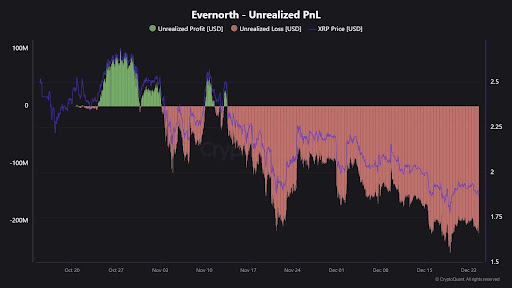
Evernorth accumulated approximately 388.7 million XRP between late October and late December 2025, deploying capital aggressively as XRP traded in a strong uptrend. At its peak, the position was valued at roughly $947 million and briefly generated a gain of about $71 million. This early performance reinforced the thesis that institutional-scale XRP exposure could deliver meaningful upside if market momentum held.

However, that momentum did not persist. As XRP’s price slid from the $2.60 region toward the $1.80 range, Evernorth’s treasury position moved decisively below its aggregate cost basis. What was once a profitable allocation quickly turned into a substantial unrealized drawdown. By late December, the paper loss had expanded to roughly $220–225 million, according to on-chain and price-based estimates.

Importantly, this outcome was not driven by forced selling or liquidation. The losses remain unrealized, meaning Evernorth has not exited its position. Instead, the situation reflects a classic mark-to-market recalibration, where exposure size and price volatility intersect unfavorably. Moreover, a chart shared by market watcher JA_Maartun in relation to Evernorth’s treasury illustrates a clear progression, with early profit zones giving way to sustained loss territory as XRP’s price trend weakened over time.

Source: CryptoQuant

What Evernorth’s Performance Signals For Institutional Strategy

Beyond the headline loss figure, Evernorth’s 2025 performance highlights several structural realities about institutional crypto exposure. First, concentration risk is non-trivial. A treasury strategy centered on a single volatile asset amplifies sensitivity to short- and medium-term price swings, regardless of long-term conviction. Even disciplined accumulation can be undermined by unfavorable macro and market timing.

Second, Evernorth’s experience underscores the disconnect that can exist between price action and broader institutional interest. While the altcoin’s spot price declined, XRP-linked exchange-traded products reportedly continued to attract steady inflows, pushing total ETF-held XRP value to around $1.25 billion. This divergence suggests that some institutional participants are expressing exposure through structured vehicles rather than direct balance-sheet holdings, potentially mitigating volatility risk.

In practical terms, Evernorth’s XRP treasury has so far delivered a sobering outcome in 2025: large-scale exposure, significant paper losses, and heightened scrutiny. Yet, the case reframes how success and failure are measured in crypto treasury strategies. The current unrealized loss does not automatically invalidate the strategy, but it does reset expectations. The ability to withstand prolonged drawdowns without triggering exits will determine whether this treasury move is remembered as a misstep or a long-duration bet that simply endured early turbulence.

Price moves downward as bears dominate | Source: XRPUSDT on Tradingview.com

Related Questions

QWhat was the peak value of Evernorth's XRP treasury position in 2025, and what was the gain at that time?

AAt its peak, Evernorth's XRP position was valued at roughly $947 million and briefly generated a gain of about $71 million.

QWhat was the approximate size of the unrealized loss on Evernorth's XRP treasury by late December 2025?

ABy late December 2025, the paper loss on Evernorth's XRP treasury had expanded to roughly $220–225 million.

QAccording to the article, what is one key structural reality about institutional crypto exposure highlighted by Evernorth's performance?

AOne key structural reality is that concentration risk is non-trivial; a treasury strategy centered on a single volatile asset amplifies sensitivity to short- and medium-term price swings.

QDespite the declining spot price of XRP, what continued to happen with XRP-linked exchange-traded products (ETPs)?

ADespite the declining spot price, XRP-linked exchange-traded products reportedly continued to attract steady inflows, pushing total ETF-held XRP value to around $1.25 billion.

QWhat does the article suggest will determine whether Evernorth's treasury move is seen as a misstep or a long-term bet?

AThe ability to withstand prolonged drawdowns without triggering exits will determine whether this move is remembered as a misstep or a long-duration bet that endured early turbulence.

Related Reads

Raising Interest Rates Is Not a Tech Killer, EPS Is: A Strategy for Discarding the Weak and Retaining the Strong After the AI Theme's Sharp Decline

**Summary: Rising Interest Rates Are Not the Killer of Tech; EPS Is: The "Keep the Strong, Ditch the Weak" Strategy After the AI Theme Plunge** The author argues that the sharp sell-off in tech and AI-related stocks, triggered by a strong US jobs report that heightened Fed rate hike fears, represents a "pullback to pick up passengers" rather than a "car crash." The true end of a tech bull market is not determined by an extra 25 basis point hike, but by industry overcapacity and the disproval of earnings per share (EPS) expectations. Historical analysis shows that during past rate hike cycles, the Nasdaq-100 often outperformed, provided EPS growth remained strong. The current phase is seen as a shift from a "broad narrative-driven rally" to a "focused verification stage" for AI. The investment strategy should be to "keep the strong, ditch the weak." * **Retain exposure** to high-conviction AI infrastructure leaders with clear order visibility, stable margins, strong cash flow, and upward EPS revisions (e.g., AI servers, advanced packaging, optical modules, key cloud suppliers). * **Reduce exposure** to high-beta, narrative-driven stocks with unclear profit paths (e.g., some quantum computing, space, or speculative chip stocks), especially on rebounds. Valuation concerns should focus on whether earnings can catch up to high multiples, not on high P/E alone. Crowded positioning signals a concentration into quality assets, not necessarily a market top. The upcoming Q2 earnings season will be a key validation point. The core principle is to hold stocks with proven EPS, while using macro events (CPI data, central bank meetings) to manage timing and risk.

marsbit1h ago

Raising Interest Rates Is Not a Tech Killer, EPS Is: A Strategy for Discarding the Weak and Retaining the Strong After the AI Theme's Sharp Decline

marsbit1h ago

Trading

Spot
Futures

Hot Articles

Discussions

Welcome to the HTX Community. Here, you can stay informed about the latest platform developments and gain access to professional market insights. Users' opinions on the price of S (S) are presented below.

活动图片