Here’s Bitcoin’s Fate If The Strait Of Hormuz Remains Unsettled – Details

bitcoinistPublished on 2026-03-15Last updated on 2026-03-15

Abstract

Recent geopolitical tensions in the Middle East, particularly the potential closure of the Strait of Hormuz by Iran, could significantly impact Bitcoin and global markets. The Strait handles 20% of the world’s oil supply, and its disruption may lead to rising oil prices, higher inflation, and subsequent central bank interest rate hikes. In such conditions, investors tend to favor fiat currencies over volatile assets like Bitcoin, which is often viewed as a risk asset rather than a safe haven during geopolitical stress. If the Strait remains closed, Bitcoin may initially experience outflows. However, the long-term impact depends on broader financial factors, including global liquidity, policy responses, and market leverage. Traders should monitor derivative indicators like Open Interest and Funding Rates to assess market risk. Bitcoin currently trades around $71,600.

The Bitcoin market has experienced some significant price relief in recent weeks. After a series of intense corrections that forced prices to a local bottom of $60,000 in early February, the premier cryptocurrency presently trades around $71,000, reflecting a 7.19% gain in the past month.

Meanwhile, the global markets have been heavily rocked by heightened geopolitical tensions in the Middle East after the US and Israel launched a coordinated attack on Iran. Among many retaliation measures, the Islamic Republic of Iran has initiated a closure of the Strait of Hormuz, a major trade route that controls the passage of 20% of the world’s oil supply.

Blocked Strait of Hormuz Threatens Global Economic Stability

In a QuickTake post on CryptoQuant, the education and analytics page XWIN Research Japan shares key insights on the effects of a potentially prolonged Strait of Hormuz disruption on Bitcoin and the general market. Considering the lack of any equally effective alternatives, Iran’s opposition to trade through the Strait of Hormuz threatens a global energy supply shock. If the current decline in shipping activities persists and oil and gas prices continue to rise, a corresponding rise in inflation is expected, considering the importance of petroleum products in daily activities.

In regard to effects on financial markets, central banks typically respond to these conditions with a financial tightening policy by raising interest rates in an attempt to slow down economic activity. During such environments, investors are likely to move capital into fiat currencies, e.g., US dollars, to take advantage of interest rates to match potential devaluations from inflation. Meanwhile, there is also a significant decline in exposure to volatile assets.

Bitcoin’s Fate Amid Oil Supply Troubles

According to XWIN Research Japan, investors’ behavior towards Bitcoin during geopolitical stress events has shown that they view the cryptocurrency more as a risk asset than a financial haven. Therefore, it’s likely the BTC market experiences high levels of outflows if the Strait of Hormuz remains closed. However, this would only be an initial reaction as market stability is expected to occur later.

Therefore, the impact of the passageway disruption will be driven more by financial ecosystem response rather than the energy shock itself. The key factors in this situation include global liquidity level, policy responses, and general market leverage.
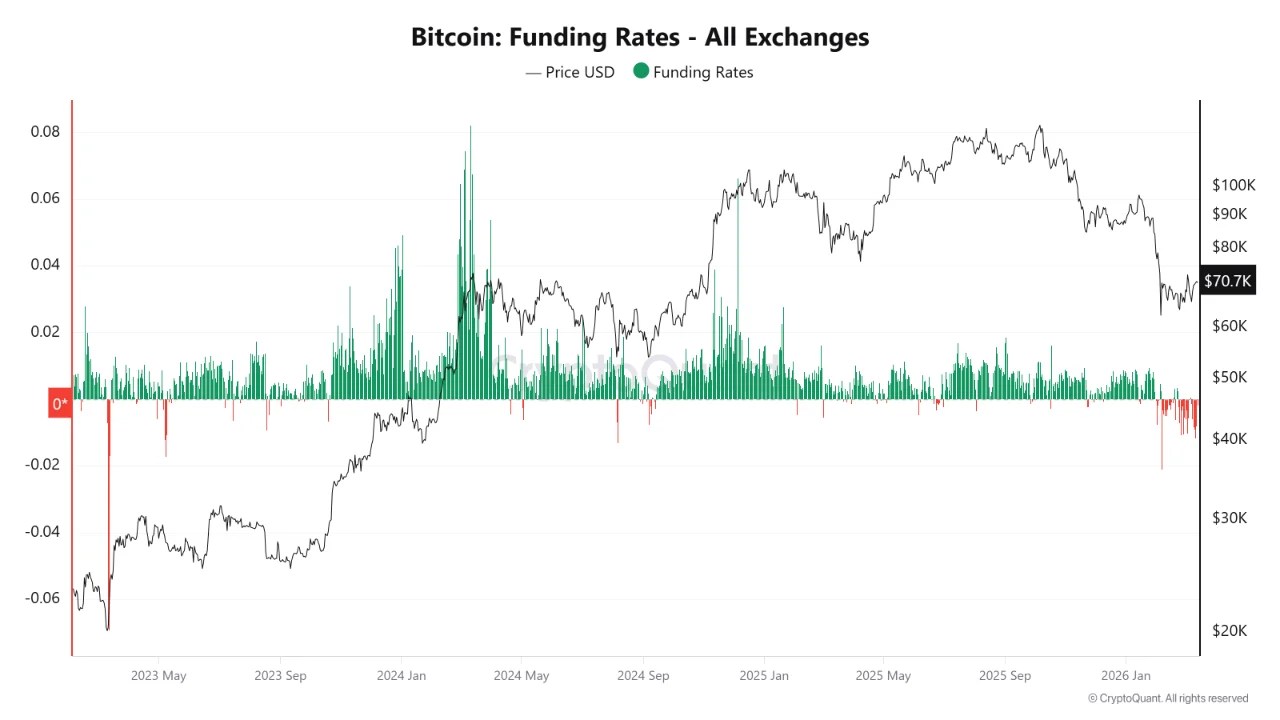
Source: CryptoQuant

It’s also important that investors and traders monitor key derivative indicators such as the Open Interest (OI) and Funding Rates, as both metrics communicate key insights on the market condition. For example, a heightened Open Interest combined with extreme funding rates would signal overcrowded market positioning, which represents a risky market structure if a potential market shock occurred. At press time, Bitcoin trades at $71,639.

BTC trading at $71,542 on the daily chart | Source: BTCUSDT chart on Tradingview.com

Related Questions

QWhat is the potential impact of a prolonged closure of the Strait of Hormuz on global oil supply and inflation?

AA prolonged closure of the Strait of Hormuz, which controls 20% of the world's oil supply, threatens a global energy supply shock. This would lead to rising oil and gas prices, and a corresponding rise in inflation due to the importance of petroleum products in daily activities.

QHow do central banks typically respond to the economic conditions caused by such a geopolitical disruption?

ACentral banks typically respond with a financial tightening policy by raising interest rates in an attempt to slow down economic activity and combat inflation.

QHow do investors view Bitcoin during geopolitical stress events, according to the article?

AAccording to XWIN Research Japan, investors view Bitcoin more as a risk asset than a financial haven during geopolitical stress events.

QWhat is the expected initial reaction in the Bitcoin market if the Strait of Hormuz remains closed?

AThe initial reaction is likely to be high levels of outflows from the Bitcoin market as investors move capital into less volatile assets.

QWhat two key derivative indicators should investors monitor to gauge market risk, as mentioned in the article?

AInvestors should monitor Open Interest (OI) and Funding Rates. A heightened OI combined with extreme funding rates signals overcrowded market positioning, which represents a risky market structure.

Related Reads

$9.4 Billion: The Largest Robotics Funding This Year Has Emerged

Munich-based humanoid robotics company Neura has completed a $1.4 billion (approximately RMB 94.9 billion) Series C funding round, valuing the company at around $7 billion and positioning it among the global leaders in the sector. The investment round is notable not just for its size—reportedly the largest in robotics this year—but also for its strategic backers, which include tech giants like NVIDIA and Amazon, alongside established industrial players such as German engineering firms Bosch and Schaeffler. This mix of investors signals a significant shift in the industry's focus from technological demonstrations and general-purpose narratives toward practical, industrial deployment and commercialization. Neura's approach centers on developing humanoid robots for defined, high-value industrial tasks rather than pursuing a general-purpose model. Its early validation comes from a partnership with BMW, where its robots are being tested on actual production lines. The involvement of Bosch and Schaeffler, companies deeply embedded in global manufacturing, underscores a growing belief that humanoid robots are transitioning from labs to viable factory-floor solutions. The article highlights two converging trends driving investment: advancements in AI and large language models, which enhance robots' perception and decision-making in unstructured environments, and mounting pressure from labor shortages and rising costs in major manufacturing regions. The funding landscape is now bifurcating between companies like Figure AI, focusing on versatile general-purpose robots, and firms like Neura, targeting specific vertical industrial applications with clearer, shorter paths to ROI. While technical hurdles remain, the core challenges for widespread adoption are increasingly seen as engineering and commercial in nature: managing the high integration and customization costs for different factory environments and establishing robust, localized maintenance and service networks. The record investment in Neura, particularly from industrial capital, indicates the industry's growing confidence in moving from proving feasibility to solving the practical problems of scalability, reliability, and building sustainable business models around humanoid robots in real-world settings like automotive manufacturing and hazardous labor environments.

marsbit13h ago

$9.4 Billion: The Largest Robotics Funding This Year Has Emerged

marsbit13h ago

Trading

Spot
Futures

Hot Articles

Discussions

Welcome to the HTX Community. Here, you can stay informed about the latest platform developments and gain access to professional market insights. Users' opinions on the price of S (S) are presented below.

活动图片















