AI in Mathematics, Ushering in a 'Slap-in-the-Face Moment' Similar to What the Go World Experienced a Decade Ago.
Holding a similar view is none other than Demis Hassabis, co-founder of DeepMind, who spearheaded the AlphaGo project ten years ago.
Although Hassabis recently underwent a series of role changes—transitioning from CEO of DeepMind to Google's Chief Scientist and Chairman of DeepMind.
When it comes to how AI is changing human cognition, he remains one of the most authoritative voices.
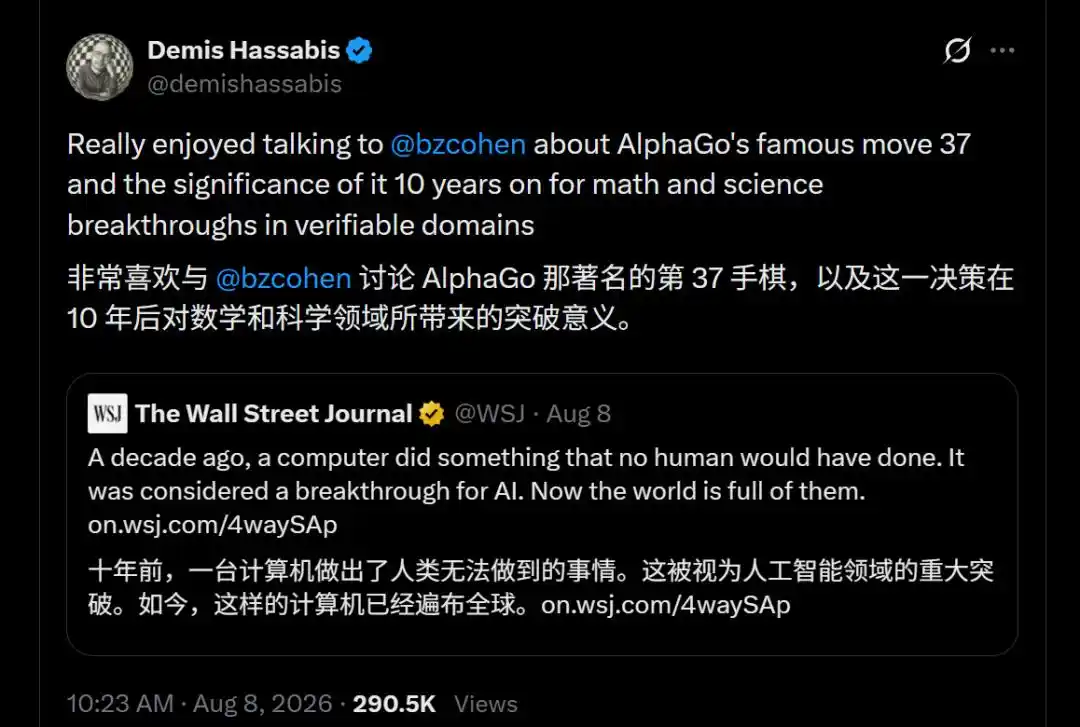
A decade ago, he witnessed AlphaGo's earth-shattering Move 37 defeat legendary Go player Lee Sedol.
A decade later, now at the forefront of AI's push into mathematics and scientific frontiers, he offers another new assessment:
If AI can solve one of the Millennium Prize Problems in mathematics, that would be a 'Move 37-level' breakthrough. At present, it seems to be only a matter of time before AI reaches that level, I see no reason why it wouldn't happen.
Move 37, a moment representing the first time humanity was collectively humbled by AI, is thus remembered by the world.
But few remember that Move 37 was not the only answer left by that man-machine battle.
Two matches later, after losing three games in a row, Lee Sedol played Move 78.
This move also had a probability of only one in ten thousand of being played by a human, yet it successfully disrupted AlphaGo, helping Lee Sedol secure the only human victory in the five-match series.
Looking back at this man-machine battle ten years later, one can't help but marvel:
The relationship between humans and AI is precisely like these two numbers.
One made humanity recognize AI anew, the other made humanity recognize itself anew.
The Face-Slapping Move 37
Turning back the clock to March 2016, the five-match series between AlphaGo and Lee Sedol was taking place in Seoul, South Korea.
In the first game, Lee Sedol lost to AlphaGo, an inauspicious start.
Arriving at the second game, the whole world awaited a counterattack from this legendary player.
Midway through the game, Lee Sedol temporarily left the board, had a cigarette to calm his nerves. But when he returned to the board, a black stone had already been placed.
Move 37.
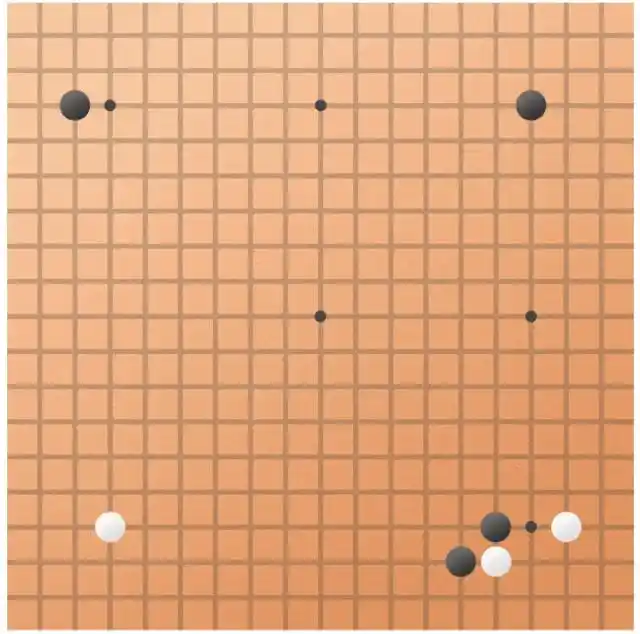
Lee Sedol did not sit down immediately. He stood there staring at the board, hardly able to believe his eyes.
The reason was simple: this move was too inhuman.
AlphaGo placed the stone on the fifth line, deviating from centuries of positional intuition held by professional players. In conventional human Go understanding, stones should occupy higher positions to control the board, but AlphaGo placed it in an area with no immediate fighting.
The live commentators initially even suspected AlphaGo had made a mistake.
Professional 9-dan Michael Redmond, serving as commentator, stared at the black stone for a long time, unable to judge, could only say:
I don't know if this is good or bad, it's very strange.
His co-commentator was more direct:
I thought it was a mistake.
The DeepMind team later calculated the probability of a human player choosing this move at one in ten thousand.
But as the game progressed, people gradually realized this was not a bad move; it was a brilliant move that changed the course of the battle on a larger scale.
About 100 moves later, this seemingly misplaced black stone became the key to AlphaGo's victory in the second game.
Later, this moment of collective human misjudgment was gradually dubbed the 'Slap-in-the-Face Moment'—
Originally thinking AI was wrong, but in the end, it was humans themselves who were wrong.

Beyond the slap, this move also made the world realize for the first time that AI could not only mimic human play, but also make moves humans had never considered.
And just ten years later, 'Move 37' indeed re-emerged, and this time it's linked to an ancient discipline:
Mathematics.
For AI, Go and mathematics share a major commonality: verifiability.
Because the logic and rules of these fields are sufficiently clear, AI can repeatedly run a simple process:
Try an idea, test it, learn from the results, then try again until it succeeds (the reinforcement learning approach).
This mechanism also explains why mathematics is the first discipline to be 'bombarded' by AI's 'Move 37'.
In fields like drug discovery, biology, etc., whether an idea works often requires lengthy experiments to verify.
Mathematics is different; a proof can be checked step by step, right or wrong, so AI can tirelessly search.

And so, as AI capabilities grow stronger, change began accelerating on a yearly basis.
Starting with ChatGPT's birth in 2023, large models still stumbled on basic arithmetic problems; flubs like "Which is larger, 9.11 or 9.9?" once caused amusement.
But by 2024, DeepMind's AlphaProof and AlphaGeometry 2 had already stormed into the International Mathematical Olympiad (IMO).
The two systems solved 4 out of 6 problems, scoring 28 points, reaching silver medal level (just 1 point short of that year's gold medal threshold).
And merely a year later, Gemini Deep Think solved 5 problems within the official contest's 4.5-hour limit, scoring 35 points, reaching IMO gold medal level.
In two years, AI advanced from novice to IMO gold medalist—astonishing speed.
But this was just the exam hall.
What really made the mathematical community feel the tide rushing in was AI starting to move from 'problem-solving' to 'research'.
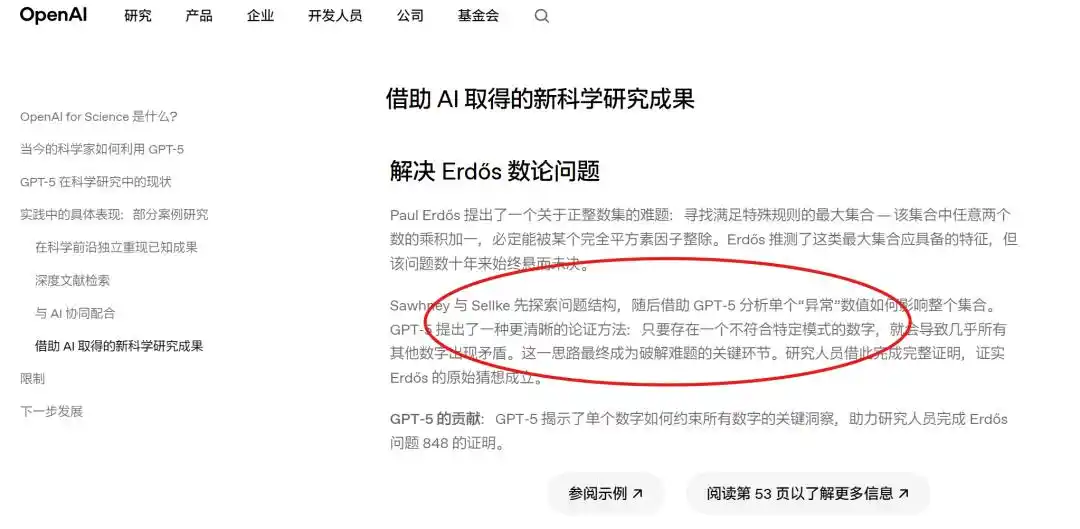
In 2025, GPT-5 participated in solving Erdős Problem 848, proposing a key estimate required for the proof.
Mathematicians refined and tightened it, ultimately completing the full proof.
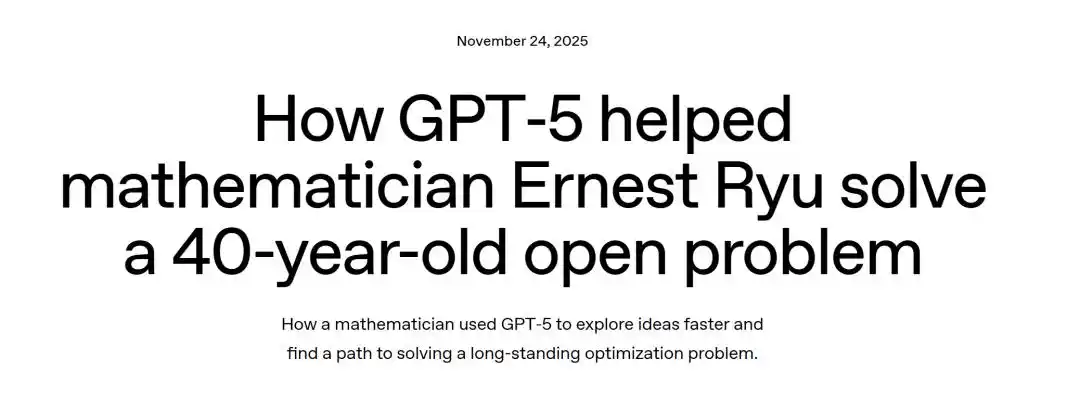
The same year, UCLA mathematician Ernest Ryu used GPT-5 to find a breakthrough for an open problem that had puzzled optimization theory for 40 years.
At this stage, AI was no longer just calculating answers; it began contributing key ideas.
Then, as time came to 2026, a series of major mathematical problems began to see breakthroughs.
Leading the charge with a bombshell was again OpenAI.
An internal general-purpose reasoning model set its sights on the Unit Distance Problem in the plane. Posed by mathematician Paul Erdős in 1946, it asks: given n points placed on a plane, what is the maximum number of pairs of points exactly distance 1 apart.
For nearly 80 years, the mathematical consensus was that constructions like square grids were near-optimal.
But the AI directly borrowed a set of tools from seemingly unrelated algebraic number theory, constructing an entirely new set of points, overturning this long-held conjecture.
The entire proof was subsequently verified by external mathematicians.
OpenAI stated that this was the first time a general-purpose AI autonomously solved an open problem of significant standing in a mathematical subfield.

Following closely, Anthropic also made its move.
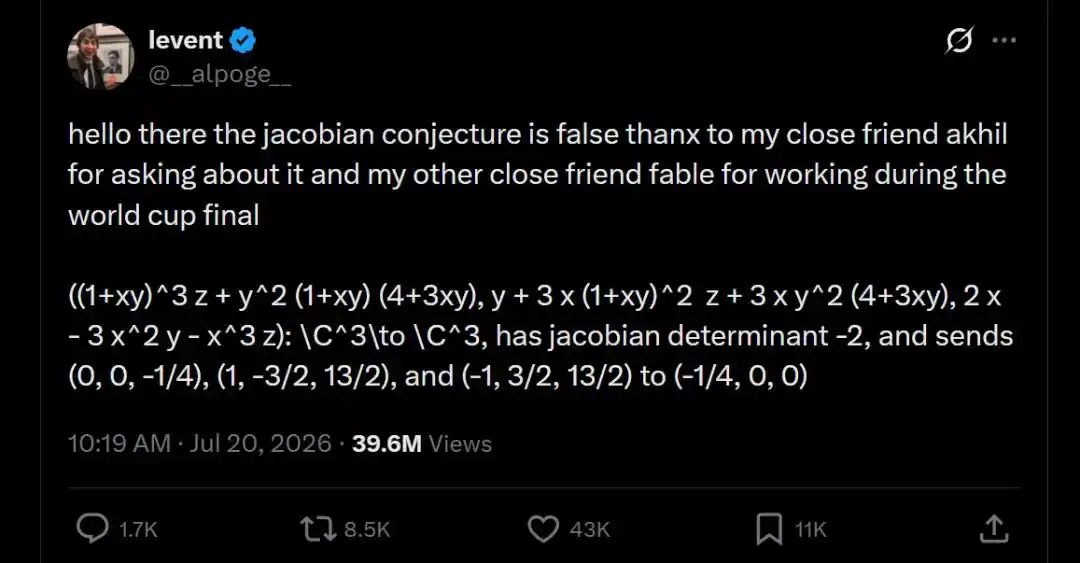
In July 2026, Anthropic mathematician Levent Alpöge, using Claude Fable 5, found an explicit counterexample to the Jacobian Conjecture.
A conjecture that had puzzled mathematicians for 87 years was thus disproven by AI overnight.
There were even instances of OpenAI and Anthropic joining forces.
Just a couple of days ago, GPT-5.6 and Fable 5 teamed up to solve a mathematical puzzle that had been open for 25 years.
(There are plenty of similar stories...)
But perhaps the most astonishing is Google, as DeepMind is turning such breakthroughs into an assembly line.
Its mathematical agent, Aletheia, no longer just generates one answer; it repeatedly proposes proofs, checks for flaws, refutes itself, and then searches for new paths.
DeepMind used it to scan 700 open problems in the Erdős conjecture database.
Among them, AI autonomously solved 4 unsolved problems and contributed to multiple mathematical results of publishable quality.
This attempt demonstrates that AI has begun systematically exploring the blank spaces in the mathematical world.
So it's not hard to imagine:
AI solving more major mathematical problems is truly just a matter of time.
From problem-solving to research, from reiterating known knowledge to proposing unknown answers, Move 37 in mathematics is being played one after another.

Searching for Humanity's Move 78
And facing this moment that is most likely approaching, humanity will undoubtedly confront a soul-searching question:
If AI will keep making novel moves humans have never considered, what should humanity do?
Move 78 from that decade-ago match might be the answer.
In the fourth match of the five-game series, Lee Sedol, having already lost three in a row, wedged a white stone into the center of AlphaGo's formation.
This move was also unconventional; AlphaGo estimated the probability of a human playing it at one in ten thousand.
Subsequently, the machine lost its composure.
Lee Sedol ultimately secured the only human victory, and Move 78 was thus dubbed the 'Hand of God' move.
This victory did not mean humans had overcome AI again.
But it at least showed that humans, after understanding the machine, could find a next step the machine did not anticipate.
This is precisely the lesson Move 78 leaves for today.
As AI becomes increasingly adept at providing answers, human value will shift more towards asking questions, judging direction, and deciding which answers are truly worth seeking.
Borrowing the concept of 'centaur chess' from chess, where human players cooperate with computer engines.
p.s. After IBM's 'Deep Blue' defeated human world champion Garry Kasparov in 1997, Kasparov advocated and organized the first 'Advanced Chess' (Centaur) tournament in 1998 to explore the potential of human-AI collaboration.
Hassabis believes science is entering a similar 'Centaur Era':
We are entering an era of collaboration between humans and computers. I don't know how long this cycle will last. But for very complex fields, it might be quite long. For instance, in drug discovery, biology, chemistry, etc., these fields are highly complex, dynamic, and not everything can be verified. That's where human intuition and insight are needed to decide the direction forward.
Subsequent developments in Go have proven this point.
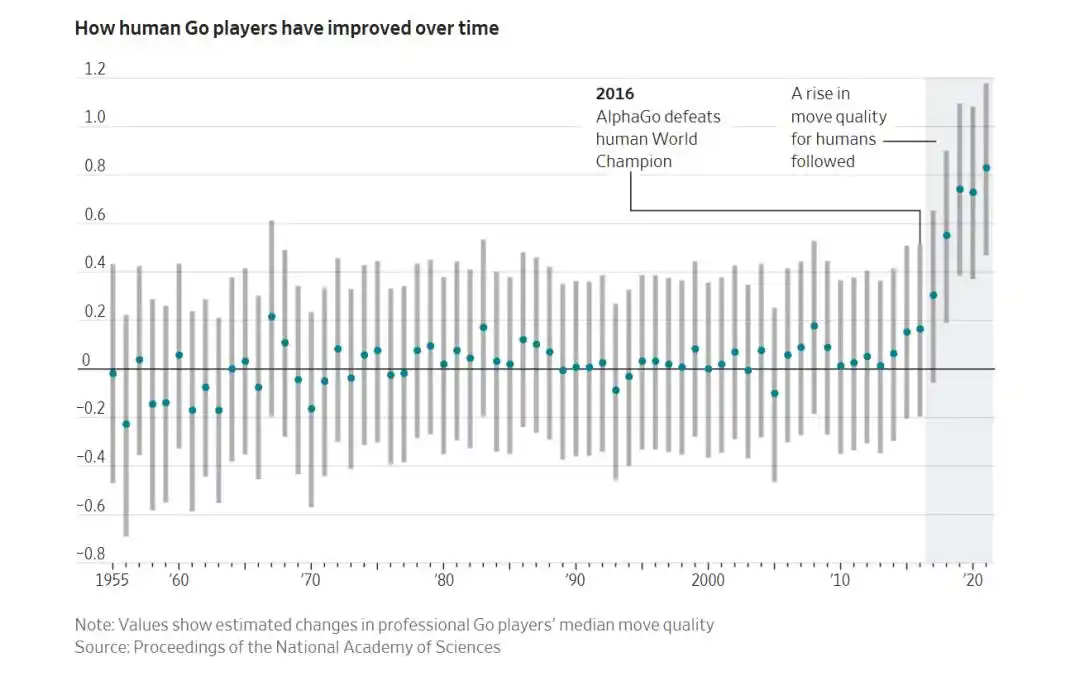
After AlphaGo emerged, AI quickly became a review tool for professional players. Players could use AI to re-examine past joseki, discover which experiences were actually unreliable, and study new moves once deemed unreasonable.
An analysis of over 5.8 million professional move decisions found:
After the advent of superhuman AI, the quality of human players' moves significantly improved, and novel moves also became more frequent.
However, there's another side to the story, namely:
People began relying on AI for answers, gradually losing the ability to judge the answers themselves.
As Lee Sedol said upon retiring, facing an undefeatable opponent made it hard for him to continue enjoying the Go he once loved.
This might be the most cautionary issue in the AI era.
As more fields beyond mathematics are impacted by AI, will more powerful systems make us more creative, efficient, and more human?
Or will they cause people to give up striving?
In the future, AI will keep playing Move 37.
The remaining question is, can humanity find its own Move 78.
Reference links:
[1]https://www.wsj.com/tech/ai/move-37-ai-demis-hassabis-google-deepmind-alphago-ec832a41?st=9XMAjn&reflink=desktopwebshare_permalink
[2]https://x.com/demishassabis/status/2085914742414061886
This article is from the WeChat public account "QbitAI", author: Focus on Frontier Technology