Has Bhutan Stopped Mining Bitcoin? New BTC Moves Fuel Fresh Questions

bitcoinistPublished on 2026-03-19Last updated on 2026-03-19

Abstract

Bhutan's recent Bitcoin transfers, totaling $72.3 million over 24 hours, have raised questions about whether the country has stopped mining BTC. Blockchain analytics firm Arkham noted that the last significant inflow to known Bhutan-linked wallets was over a year ago, suggesting the state-backed mining operation may have slowed or halted. However, alternative explanations exist, such as seasonal hydropower limitations or the use of unidentified wallets for mining rewards. Bhutan has historically framed its Bitcoin strategy as a long-term national commitment rather than speculative trading. The ongoing outflows indicate distribution rather than accumulation, but the true status of Bhutan's mining activities remains uncertain.

Bhutan’s latest Bitcoin transfers have revived one of the market’s more unusual sovereign-BTC questions: is the kingdom still mining, or is it now mainly selling from an older reserve? Arkham said wallets tied to Bhutan moved another $44.44 million in BTC, bringing total transfers from those addresses to $72.3 million over 24 hours, while noting that the last Bhutan-linked inflow above $100,000 was seen more than a year ago.

That detail is what turned a routine wallet movement into a bigger story. If the identified wallets are no longer receiving fresh mining rewards, the obvious interpretation is that Bhutan’s state-backed mining operation may have slowed or stopped. Arkham pushed that line directly, asking whether Bhutan had halted mining after highlighting repeated outbound transfers and the long gap in visible inflows.

The selling pattern itself is not new. Arkham had already flagged another $27.8 million BTC transfer a day earlier and said Bhutan had also moved $11 million last week, with roughly that same amount sent to an address previously used in similar transactions. According to Arkham, Bhutan has periodically sold portions of its Bitcoin in clips of roughly $5 million to $10 million, with a particularly active phase around mid-to-late September 2025.

Has Bhutan Really Stopped Bitcoin Mining?

Still, the on-chain evidence does not settle the question on its own. Bhutan kept its mining activity secret for years. It only became public through investigations tied to the bankruptcies of Celsius and BlockFi. That history leaves open a more cautious interpretation: DHI may still be operating under the radar and routing fresh mining rewards to new, as-yet unidentified wallets. In other words, the absence of inflows to the known addresses does not necessarily prove the mining has ended.

Another possible explanation is seasonality. Bhutan’s mining model is tightly linked to hydropower, and the country’s electricity production is highly dependent on weather patterns and the time of year. During the winter months, lower rainfall and reduced water levels can lead to a marked decline in power generation. In the summer, by contrast, Bhutan produces large energy surpluses. In that case, the absence of fresh inflows could reflect a seasonal drop in the amount of surplus electricity available for mining.

That distinction matters because Bhutan has never presented Bitcoin as a short-term trade. In a public statement tied to Gelephu Mindfulness City, the country said, “Bitcoin is not being held as an object of speculation. It is being set aside with purpose. This is not an experiment. It is a commitment.” Those lines suggested a strategic, state-level view of Bitcoin tied to Bhutan’s broader economic and energy model rather than opportunistic treasury management.

Even so, the recent flows raise legitimate questions about what that strategy now looks like in practice. If Bhutan is still mining, it may simply be doing so through wallets that are no longer publicly linked to the operation. If it is not, then the current transfers look less like portfolio rotation and more like continued reserve monetization from a stockpile accumulated over earlier years of hydro-powered mining.

The deeper point is not just whether Bhutan sold another tranche of BTC. It is that one of the world’s most closely watched sovereign Bitcoin holders has become harder to read at exactly the moment its visible wallets show distribution, not accumulation. Until new inflows appear or new wallet infrastructure is identified, the question Arkham raised will remain open: not whether Bhutan is moving Bitcoin, but whether it is still producing it.

At press time, BTC traded at $70,394.
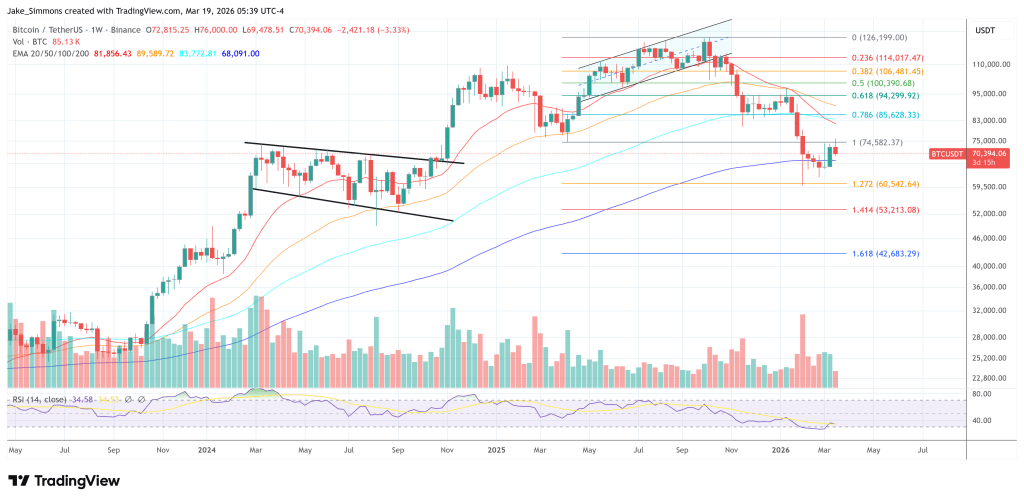
Bitcoin must break above the 1.0 Fib level, 1-week chart | Source: BTCUSDT on TradingView.com

Related Questions

QWhat recent Bitcoin transfers by Bhutan have raised questions about its mining activities?

ABhutan moved $44.44 million in BTC, bringing total transfers to $72.3 million over 24 hours, with no significant inflows to known wallets in over a year.

QAccording to Arkham analysis, what does the absence of recent inflows to Bhutan's known wallets suggest?

AIt suggests that Bhutan's state-backed Bitcoin mining operation may have slowed or stopped, as the wallets are no longer receiving fresh mining rewards.

QWhat are two possible explanations for the lack of visible Bitcoin mining inflows in Bhutan?

A1) Mining may continue through new, unidentified wallets. 2) Seasonal hydropower variations may reduce electricity surplus available for mining during dry winter months.

QHow did Bhutan characterize its Bitcoin strategy in relation to the Gelephu Mindfulness City project?

ABhutan stated Bitcoin is 'not being held as an object of speculation' but is 'being set aside with purpose,' indicating a strategic, long-term commitment rather than short-term trading.

QWhy is the timing of Bhutan's Bitcoin movements particularly significant to observers?

ABecause one of the world's most watched sovereign Bitcoin holders shows distribution patterns rather than accumulation, making its strategy harder to interpret at this moment.

Related Reads

Only a 50% Chance of Passing This Year, Can the CLARITY Bill Succeed Before the Midterm Elections?

The CLARITY Act, which passed the House in July 2025 with strong bipartisan support (294-134), faces a critical juncture in the Senate. The Senate Banking Committee is expected to hold a markup soon, but key issues remain unresolved, including stablecoin yield provisions, DeFi regulations, and securing full Republican committee support. Other contentious points involve the Blockchain Regulatory Certainty Act (BRCA), ethics amendments for government officials, and SEC-related matters. The legislative calendar is tight, with limited time before the midterm elections. If the committee markup is delayed beyond mid-May, the chances of passage in 2026 drop significantly. Senator Cynthia Lummis has warned that failure this year could delay comprehensive crypto market structure legislation until 2030 or later. Galaxy estimates the probability of the CLARITY Act becoming law in 2026 is only about 50%. The bill provides crucial regulatory clarity by defining jurisdictional boundaries between the SEC and CFTC, establishing a path for decentralization, and bringing digital commodity intermediaries under federal regulation. Its passage is seen as vital before potential power shifts in the next Congress, which could bring less favorable leadership to key committees. The timeline is compressed, and the bill must compete for floor time with other priorities like Iran authorization and DHS appropriations. Key hurdles include finalizing the stablecoin yield compromise text, addressing law enforcement concerns about BRCA, and navigating political dynamics around SEC nominations. The outcome of the Banking Committee markup and the level of bipartisan support will be critical indicators of its future success.

marsbit4m ago

Only a 50% Chance of Passing This Year, Can the CLARITY Bill Succeed Before the Midterm Elections?

marsbit4m ago

Only a 50% Chance of Passing This Year, Can the CLARITY Bill Succeed Before the Midterm Elections?

The CLARITY Act, which passed the U.S. House in July 2025 with strong bipartisan support (294-134), faces a critical juncture in the Senate. The Senate Banking Committee is expected to hold a markup soon, but key issues remain unresolved, including stablecoin yield provisions, DeFi regulations, and securing full Republican committee support. Additional challenges involve the Blockchain Regulatory Certainty Act (BRCA), ethics amendments for government officials, and SEC-related concerns. Galaxy estimates only a 50% chance of the bill becoming law in 2026. The tight legislative calendar, competing priorities like Iran military authorization and DHS appropriations, and the impending midterm elections create significant time pressure. If the bill is not passed before the new Congress convenes in 2027, comprehensive crypto market structure legislation could be delayed until 2030 or later, especially if leadership changes result in less favorable committee chairs. The act provides crucial regulatory clarity by defining the jurisdictional boundaries between the SEC and CFTC, establishing a path for decentralized networks to be classified as non-securities, and bringing digital commodity intermediaries under federal regulation. The outcome of ongoing Senate negotiations, particularly the release of revised text on stablecoin yields, will be a key indicator of its future prospects.

Odaily星球日报14m ago

Only a 50% Chance of Passing This Year, Can the CLARITY Bill Succeed Before the Midterm Elections?

Odaily星球日报14m ago

Four-Dimensional Resonance: Hong Kong Web3 Carnival Sub-Forum Co-Creates Blueprint for Global Financial New Infrastructure

The "Four-Dimensional Resonance: 2026 Global Financial New Infrastructure" forum, a core event of the Hong Kong Web3 Festival, was successfully held at the Hong Kong Convention and Exhibition Centre. Co-hosted by Web3Labs and DeShang Singularity Tech, with joint support from Bitroot, Injective, Microsoft, and Z Oracle, the event gathered policymakers, industry leaders, and investors to explore the integration and innovation of global financial infrastructure, focusing on RWA, AI, DeFi, and compliant payments. Policy speakers, including Hong Kong Legislative Council Member Mr. Wu Jiezhuang, South Korean National Assembly Member Mr. Min Byung-duk, and ACED Chairman Mr. Yun Seok-hun, emphasized the importance of cross-border regulatory collaboration and an open policy environment for fintech innovation. Web3Labs CEO Caspar and DeShang Singularity Tech CEO Chang Shuai highlighted Hong Kong’s role as a financial innovation center and the approaching "singularity moment" for global financial infrastructure. Technical insights were shared by MagnetX, Bitroot, Microsoft, and Injective on topics including AI Agent economies, the evolution of public blockchains, and AI’s transformative role in finance. Key partnerships and initiatives were launched: - GWDC 2026 Korea collaboration between Hong Kong and South Korea. - A strategic agreement between Web3Labs and Microsoft. - The launch of a public anti-fraud alliance by Z Oracle and partners. - The "Injective Rising Star" program to support AI and Web3 projects. Panel discussions delved into AI-driven smart payments, compliant cross-border transactions, and the fusion of RWA and DeFi. Participants agreed that integrating RWA with DeFi is crucial for the next stage of financial infrastructure, enabling a shift from physical to digital finance. The forum underscored Hong Kong’s pivotal role in advancing a globalized and sustainable Asian fintech ecosystem.

marsbit22m ago

Four-Dimensional Resonance: Hong Kong Web3 Carnival Sub-Forum Co-Creates Blueprint for Global Financial New Infrastructure

marsbit22m ago

Trading

Spot
Futures

Hot Articles

What is $BITCOIN

DIGITAL GOLD ($BITCOIN): A Comprehensive Analysis Introduction to DIGITAL GOLD ($BITCOIN) DIGITAL GOLD ($BITCOIN) is a blockchain-based project operating on the Solana network, which aims to combine the characteristics of traditional precious metals with the innovation of decentralized technologies. While it shares a name with Bitcoin, often referred to as “digital gold” due to its perception as a store of value, DIGITAL GOLD is a separate token designed to create a unique ecosystem within the Web3 landscape. Its goal is to position itself as a viable alternative digital asset, although specifics regarding its applications and functionalities are still developing. What is DIGITAL GOLD ($BITCOIN)? DIGITAL GOLD ($BITCOIN) is a cryptocurrency token explicitly designed for use on the Solana blockchain. In contrast to Bitcoin, which provides a widely recognized value storage role, this token appears to focus on broader applications and characteristics. Notable aspects include: Blockchain Infrastructure: The token is built on the Solana blockchain, known for its capacity to handle high-speed and low-cost transactions. Supply Dynamics: DIGITAL GOLD has a maximum supply capped at 100 quadrillion tokens (100P $BITCOIN), although details regarding its circulating supply are currently undisclosed. Utility: While precise functionalities are not explicitly outlined, there are indications that the token could be utilized for various applications, potentially involving decentralized applications (dApps) or asset tokenization strategies. Who is the Creator of DIGITAL GOLD ($BITCOIN)? At present, the identity of the creators and development team behind DIGITAL GOLD ($BITCOIN) remains unknown. This situation is typical among many innovative projects within the blockchain space, particularly those aligning with decentralized finance and meme coin phenomena. While such anonymity may foster a community-driven culture, it intensifies concerns about governance and accountability. Who are the Investors of DIGITAL GOLD ($BITCOIN)? The available information indicates that DIGITAL GOLD ($BITCOIN) does not have any known institutional backers or prominent venture capital investments. The project seems to operate on a peer-to-peer model focused on community support and adoption rather than traditional funding routes. Its activity and liquidity are primarily situated on decentralized exchanges (DEXs), such as PumpSwap, rather than established centralized trading platforms, further highlighting its grassroots approach. How DIGITAL GOLD ($BITCOIN) Works The operational mechanics of DIGITAL GOLD ($BITCOIN) can be elaborated on based on its blockchain design and network attributes: Consensus Mechanism: By leveraging Solana’s unique proof-of-history (PoH) combined with a proof-of-stake (PoS) model, the project ensures efficient transaction validation contributing to the network's high performance. Tokenomics: While specific deflationary mechanisms have not been extensively detailed, the vast maximum token supply implies that it may cater to microtransactions or niche use cases that are still to be defined. Interoperability: There exists the potential for integration with Solana’s broader ecosystem, including various decentralized finance (DeFi) platforms. However, the details regarding specific integrations remain unspecified. Timeline of Key Events Here is a timeline that highlights significant milestones concerning DIGITAL GOLD ($BITCOIN): 2023: The initial deployment of the token occurs on the Solana blockchain, marked by its contract address. 2024: DIGITAL GOLD gains visibility as it becomes available for trading on decentralized exchanges like PumpSwap, allowing users to trade it against SOL. 2025: The project witnesses sporadic trading activity and potential interest in community-led engagements, although no noteworthy partnerships or technical advancements have been documented as of yet. Critical Analysis Strengths Scalability: The underlying Solana infrastructure supports high transaction volumes, which could enhance the utility of $BITCOIN in various transaction scenarios. Accessibility: The potential low trading price per token could attract retail investors, facilitating wider participation due to fractional ownership opportunities. Risks Lack of Transparency: The absence of publicly known backers, developers, or an audit process may yield skepticism regarding the project's sustainability and trustworthiness. Market Volatility: The trading activity is heavily reliant on speculative behavior, which can result in significant price volatility and uncertainty for investors. Conclusion DIGITAL GOLD ($BITCOIN) emerges as an intriguing yet ambiguous project within the rapidly evolving Solana ecosystem. While it attempts to leverage the “digital gold” narrative, its departure from Bitcoin's established role as a store of value underscores the need for a clearer differentiation of its intended utility and governance structure. Future acceptance and adoption will likely depend on addressing the current opacity and defining its operational and economic strategies more explicitly. Note: This report encompasses synthesised information available as of October 2023, and developments may have transpired beyond the research period.

363 Total ViewsPublished 2025.05.13Updated 2025.05.13

What is $BITCOIN

Discussions

Welcome to the HTX Community. Here, you can stay informed about the latest platform developments and gain access to professional market insights. Users' opinions on the price of BTC (BTC) are presented below.

活动图片