Grayscale: Ethereum's Staking Model Needs a Revamp

marsbitPublished on 2026-05-13Last updated on 2026-05-13

Abstract

The article discusses potential changes to Ethereum's staking reward model, highlighting two structural issues. First, the shift of activity to Layer 2 networks is reducing transaction fees and token burns on the mainnet, leading to an increase in ETH's net issuance. Second, with withdrawals enabled and the rise of liquid staking tokens (LSTs) and exchange-traded products (ETPs), the friction cost for staking has nearly vanished. This could eventually lead to almost all ETH being staked, which may cause unnecessary dilution and centralization risks. To address this, the Ethereum community is considering a model that caps rewards beyond a certain staking threshold, discouraging excessive staking. Grayscale argues this change would be beneficial for ETH's long-term price by controlling inflation, reducing tail risks, and strengthening ETH's narrative as a store of value. It notes that ETH's price volatility has a much greater impact on returns than staking yields, which are currently around 3% annually.

Author: Zach Pandl, Head of Research, Grayscale

Compiled by: Deep Tide TechFlow

Deep Tide Guide: Zach Pandl, Head of Research at Grayscale, writes that Ethereum's current staking reward model faces two structural problems: L2 scaling is reducing token burn and increasing net issuance; staking friction is approaching zero, potentially locking nearly all ETH into staking. The community is discussing implementing a cap on staking rewards, which Grayscale believes would be beneficial for ETH's price in the long term.

The Ethereum community is considering revising the network's staking reward model, with the core idea being to only incentivize staking up to a certain ratio, with no additional rewards beyond that. If implemented, nominal returns for stakers would decrease. However, Grayscale argues this would be positive for ETH's price long-term for two reasons: controlling ETH inflation and strengthening ETH's narrative as a store-of-value asset.

The discussion for this reform is driven by two overlapping issues.

Diminished Token Burn, Rising Net Issuance

ETH's supply depends on the difference between new issuance and token burn. Currently, Ethereum L1 burns all base transaction fees. High fees mean more ETH is burned, suppressing supply growth.

Changes over the past few years have disrupted this balance. As more activity migrates to L2 networks, L1 transaction fees and token burns decrease, leading to a rise in net issuance.
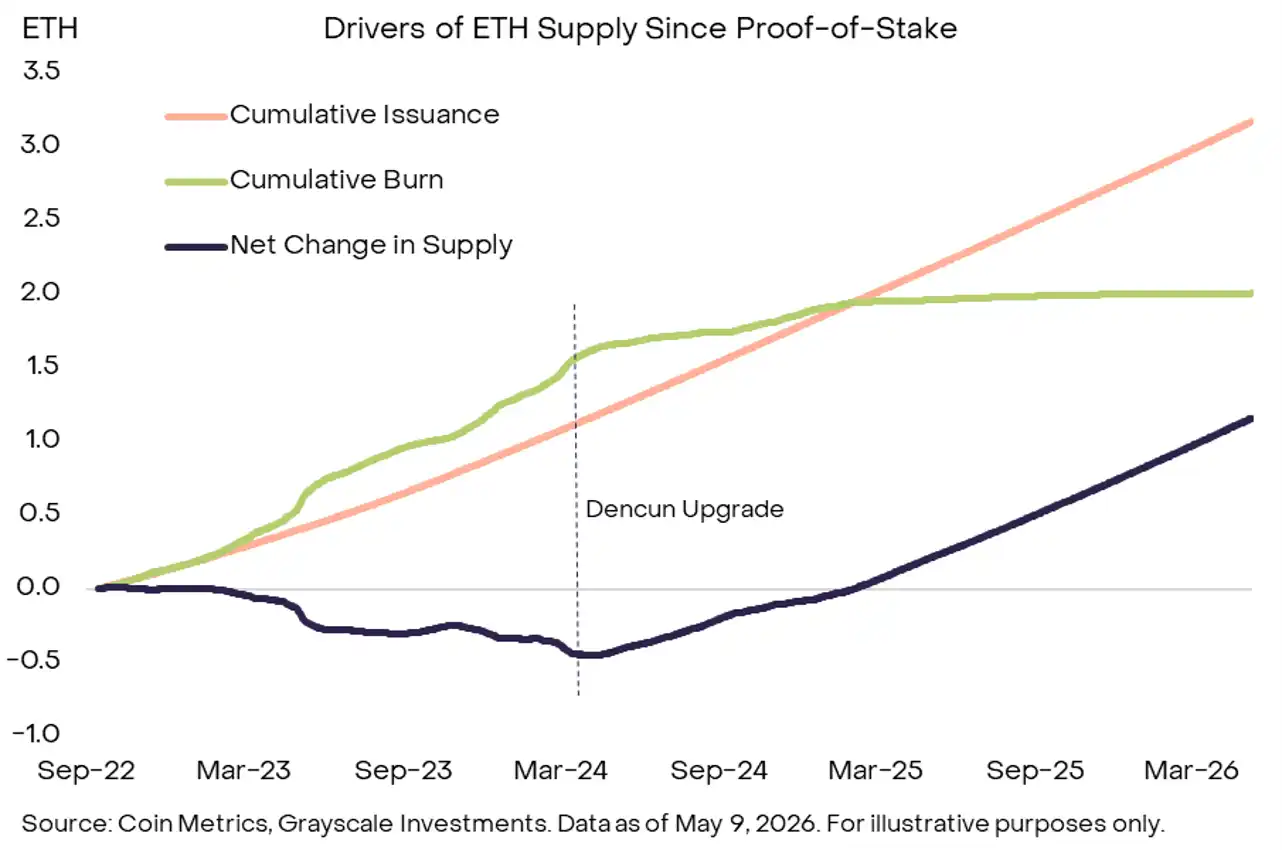
Caption: Exhibit 1 – Drivers of ETH supply changes since PoS. After the Dencun upgrade, cumulative burn (green line) flattened, while cumulative issuance (orange line) continued to rise, causing ETH's net supply change (dark line) to turn positive from negative. Source: Coin Metrics, Grayscale Investments, data as of May 9, 2026

Compounding this issue, Ethereum L1 is now actively choosing to scale to compete with high-throughput chains like Solana. Pandl states directly: L1 transaction fees are likely to remain low for the foreseeable future, token burns will continue to decline, and net supply growth will expand further.

Staking Friction Costs Are Almost Zero

When Ethereum first launched staking, users could not withdraw assets; staked ETH was locked, illiquid, and thus carried a risk premium. Now that withdrawals are enabled, liquidity has greatly improved, and that risk premium has evaporated.

More critically, Liquid Staking Tokens (LSTs), Exchange-Traded Products (ETPs), and corporate ETH treasuries have entered the staking arena. The marginal cost of staking ETH is now close to zero. As long as the network continues to provide marginal rewards to stakers, nearly all ETH could eventually end up staked.

Staking is a necessary condition for the Ethereum protocol to function properly, but an excessively high staking ratio can be counterproductive.

Two risks. First, unnecessary dilution. Rising net issuance without substantially improving network security is like a country overspending on defense with no benefit to national security. Second, the tail risk of centralization where a few institutions dominate staking activity. This possibility exists due to network effects among service providers.

Implementing a Capped Staking Reward Curve

One proposed solution is to transition to a reward model that only incentivizes staking up to a certain level.
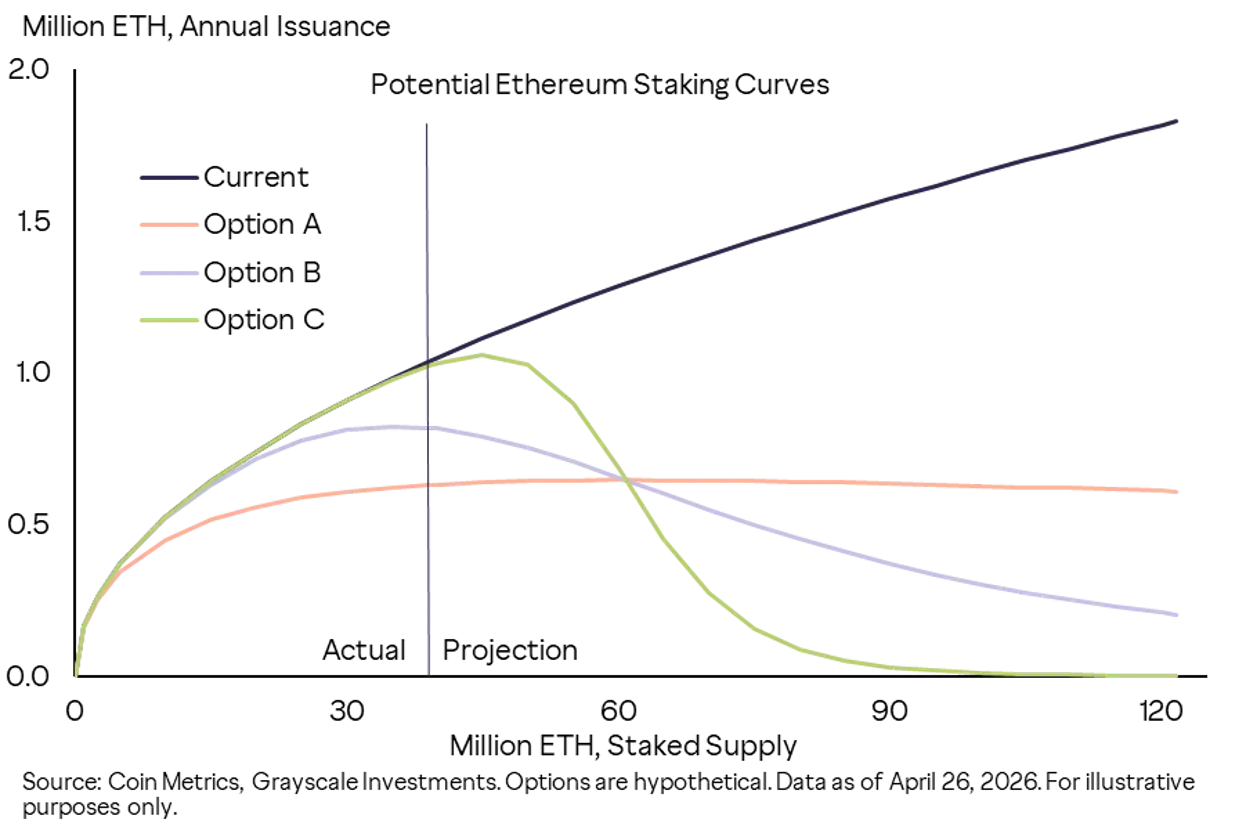
Caption: Exhibit 2 – Potential alternative staking reward curves for Ethereum. Under the current model (dark line), annualized issuance grows linearly with stake; Options A/B/C set caps or inflection points at different staking levels, causing issuance to flatten or even decline after the staking ratio exceeds a certain threshold. Source: Coin Metrics, Grayscale Investments, data as of April 26, 2026, options are hypothetical.

Grayscale believes such a change would be favorable for ETH's market value in the long term. ETH is a functionally useful commodity, not a financial claim like stocks or bonds, and should not be priced based solely on cash flows. Updating the staking reward model would reduce supply growth and enhance ETH's scarcity. For commodities, production cuts are price-positive; the same logic applies to ETH.

Reducing network tail risks, controlling long-term inflation, and it could also boost demand for unstaked ETH as a digital store-of-value asset.

There's another easily overlooked perspective: the impact of ETH's price volatility on investment returns far outweighs staking rewards. The current ~3% annualized staking yield is roughly equivalent to ETH's daily price volatility (annualized volatility over the past 360 days is ~60%, implying a daily volatility of ~3%).

Conclusion: Ethereum may revise its staking reward model to control long-term supply growth and reduce specific tail risks. If implemented, Grayscale believes this would be bullish for ETH's price.


Related Questions

QWhat are the two structural issues with Ethereum's current staking reward model mentioned in the Grayscale article?

AThe two structural issues are: 1) The migration of activity to L2 networks has led to lower L1 transaction fees and token burns, resulting in rising net issuance of ETH. 2) The friction cost for staking has dropped to nearly zero, as withdrawals are now enabled and services like LSTs and ETPs have emerged, which could eventually lead to almost all ETH being staked.

QAccording to the article, what solution is the Ethereum community considering to address the high staking ratio and rising net issuance?

AThe Ethereum community is considering modifying the staking reward model to implement a reward curve with an upper limit or inflection point, which would only incentivize staking up to a certain level. Beyond that threshold, additional staking would not earn extra rewards, thereby controlling long-term supply growth.

QHow does Grayscale view the potential impact of changing Ethereum's staking reward model on the price of ETH?

AGrayscale believes that implementing a capped staking reward curve would be a long-term positive for ETH's price. This is because it would reduce supply growth, enhance ETH's scarcity, and reinforce its narrative as a digital store of value, similar to how reduced production benefits commodity prices.

QWhy has the net issuance of ETH been rising post-Dencun upgrade, according to the article?

AFollowing the Dencun upgrade, net issuance has been rising because L1 transaction fees (which are burned) have declined as more activity migrates to L2 networks. This results in lower token burns while staking issuance continues, causing the cumulative net supply change to turn positive.

QWhat are the two risks associated with an extremely high percentage of ETH being staked, as outlined in the article?

AThe two risks are: 1) Unnecessary dilution of the ETH supply, where increased issuance does not meaningfully enhance network security. 2) A tail risk of centralization, where a few large institutional service providers could dominate the staking activity due to network effects.

Related Reads

Raising Interest Rates Is Not a Tech Killer, EPS Is: A Strategy for Discarding the Weak and Retaining the Strong After the AI Theme's Sharp Decline

**Summary: Rising Interest Rates Are Not the Killer of Tech; EPS Is: The "Keep the Strong, Ditch the Weak" Strategy After the AI Theme Plunge** The author argues that the sharp sell-off in tech and AI-related stocks, triggered by a strong US jobs report that heightened Fed rate hike fears, represents a "pullback to pick up passengers" rather than a "car crash." The true end of a tech bull market is not determined by an extra 25 basis point hike, but by industry overcapacity and the disproval of earnings per share (EPS) expectations. Historical analysis shows that during past rate hike cycles, the Nasdaq-100 often outperformed, provided EPS growth remained strong. The current phase is seen as a shift from a "broad narrative-driven rally" to a "focused verification stage" for AI. The investment strategy should be to "keep the strong, ditch the weak." * **Retain exposure** to high-conviction AI infrastructure leaders with clear order visibility, stable margins, strong cash flow, and upward EPS revisions (e.g., AI servers, advanced packaging, optical modules, key cloud suppliers). * **Reduce exposure** to high-beta, narrative-driven stocks with unclear profit paths (e.g., some quantum computing, space, or speculative chip stocks), especially on rebounds. Valuation concerns should focus on whether earnings can catch up to high multiples, not on high P/E alone. Crowded positioning signals a concentration into quality assets, not necessarily a market top. The upcoming Q2 earnings season will be a key validation point. The core principle is to hold stocks with proven EPS, while using macro events (CPI data, central bank meetings) to manage timing and risk.

marsbit6m ago

Raising Interest Rates Is Not a Tech Killer, EPS Is: A Strategy for Discarding the Weak and Retaining the Strong After the AI Theme's Sharp Decline

marsbit6m ago

The Largest IPO in History Ignites Heated Debate: Is SpaceX Worth $1.77 Trillion?

SpaceX's potential IPO is priced at $135 per share, aiming to raise $75 billion and valuing the company at approximately $1.77 trillion, which would make it the largest IPO in history. This valuation has sparked intense debate among investors. Bullish analysts, including major underwriters Goldman Sachs and Morgan Stanley, argue the valuation is justified by SpaceX's long-term potential. They see it not just as a rocket company but as a future leader in space infrastructure, with key growth drivers being Starlink satellite internet, low-cost rocket launches, and future AI-related ventures. They project revenues reaching hundreds of billions to trillions of dollars by 2030-2040. ARK Invest's model suggests a 2030 enterprise value could reach $2.5 trillion. Bearish analysts from independent research firms like Morningstar, PitchBook, and New Constructs contend the IPO price is excessively high, already pricing in unrealistic future growth. Using DCF and sum-of-the-parts models, they estimate fair value between $780 billion and $1.7 trillion, significantly below the IPO target. They highlight risks such as the speculative nature of AI projections, over-dependence on Elon Musk, high growth expectations, and corporate governance concerns. Trefis set a target price of just $79 per share. While both sides acknowledge SpaceX's unique position in commercial space, the core disagreement centers on whether the $135 share price offers a reasonable margin of safety or is overly optimistic. Despite the valuation controversy, reported strong demand for the IPO indicates significant market interest.

marsbit1h ago

The Largest IPO in History Ignites Heated Debate: Is SpaceX Worth $1.77 Trillion?

marsbit1h ago

After the Passage of the GENIUS Act and the CLARITY Act, What Is the Correct Architecture for On-Chain Yield?

The article discusses the evolution of on-chain credit, distinguishing three markets: overcollateralized crypto lending, unsecured lending (largely unsuccessful), and asset-backed credit (ABC). ABC, backed by identifiable real-world collateral with legal recourse, is identified as the fastest-growing category and the only one credibly addressing adverse selection—the core problem in credit where the riskiest borrowers self-select. Current growth in on-chain Real World Assets (RWAs), particularly tokenized private credit funds (e.g., Maple Finance, Centrifuge), is substantial but often merely "wraps" existing fund structures, inheriting their risks rather than solving adverse selection at the protocol level. The regulatory landscape is a key driver, with the US GENIUS Act (prohibiting stablecoin issuers from paying yield) and the proposed CLARITY Act (closing loopholes on indirect yield) set to redefine permissible yield-bearing products. This makes vaults (like ERC-4626) the critical architecture—they become the primary compliant vehicle for delivering yield, functioning as issuance, disclosure, distribution, and recovery mechanisms. The author's thesis is that the correct post-GENIUS/CLARITY architecture involves building ABC solutions where credit assessment, structure, and recovery are encoded directly into the smart contract vault layer, moving beyond mere tokenized fund wrappers to solve adverse selection fundamentally and ensure regulatory compliance.

Foresight News2h ago

After the Passage of the GENIUS Act and the CLARITY Act, What Is the Correct Architecture for On-Chain Yield?

Foresight News2h ago

Trading

Spot
Futures

Hot Articles

Discussions

Welcome to the HTX Community. Here, you can stay informed about the latest platform developments and gain access to professional market insights. Users' opinions on the price of S (S) are presented below.

活动图片