GPT-5.6 Sol Suddenly Gets Dumber Overnight? Thinking Budget Slashed from 960 to 128, No More Fixed-Intelligence Models?

marsbitPublished on 2026-07-15Last updated on 2026-07-15

Abstract

The article discusses widespread user reports that OpenAI's GPT-5.6 Sol model, specifically its "Max" reasoning tier, has become less capable at complex, deep reasoning tasks. Users noted faster but shallower responses. Community investigation revealed an unpublicized internal parameter called "juice value," representing computational budget for reasoning. Observations indicated this value for the Max tier dropped dramatically from 960 to 128. In response, OpenAI's Thibault Sottiaux stated there was no intentional reduction in model capability ("nerf"). He explained the changes were part of an experiment to investigate unexpected high token usage following GPT-5.6's launch, which introduced features like longer reasoning and larger context windows. The experiment temporarily adjusted the "juice" parameter and rolled back the context window from 372k to 272k tokens to diagnose the usage spike. Sottiaux asserted these settings have been reverted and highlighted ongoing optimizations. The controversy highlights a tension between AI as a reliable, fixed-capability tool and its reality as a cloud service where providers can adjust performance parameters. The article argues that for AI to be trusted enterprise infrastructure, providers need clearer, transparent guarantees about the specific performance boundaries associated with service tiers.

Everyone online says GPT-5.6 Sol's Max tier has become dumber. OpenAI insists there's no nerf, just an "experiment." The knob turned during that experiment slashed the Max tier's budget from 960 down to 128, invisible to users.

Woke up to find GPT-5.6 Sol had become dumber!

A Japanese market research team, not long after starting work in the morning, discovered something off with their Codex Sol MAX. The team leader wrote a long post about the morning's ordeal and posted it on Reddit's r/codex.
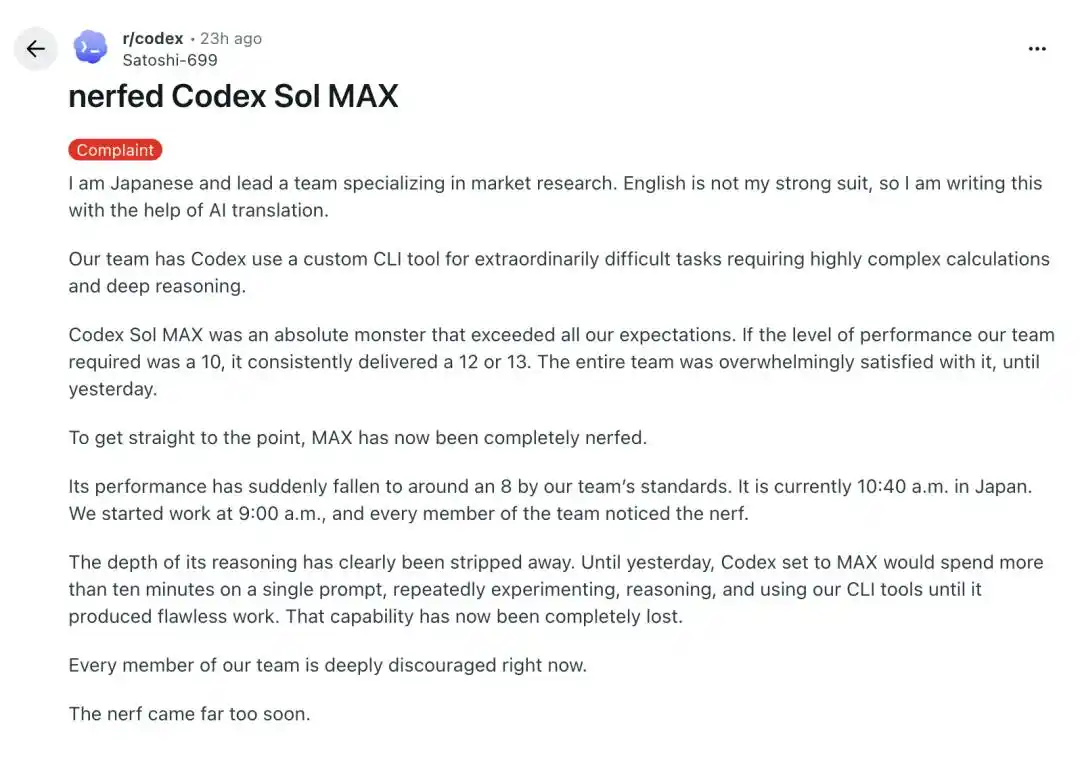
9 AM, the team started work as usual. By 10:40 AM, every single member had noticed the same thing.

They had Codex Sol MAX connected to a self-developed CLI tool, specifically for chewing through jobs requiring extremely complex calculations and deep reasoning.

Initially, Codex Sol MAX lived up to expectations, delivering 12 or 13 points out of a 10-point requirement. It was a "monster that far exceeded expectations," and "everyone was overwhelmingly satisfied with it."

But on this morning, that "monster's" performance suddenly slumped to 8 points.

The depth of reasoning had clearly been stripped away.

Before this, when faced with a prompt, Codex Sol MAX would take over ten minutes, repeatedly trying, reasoning, and calling their tools until the job was done flawlessly.

That capability had "completely vanished" on this very morning.

The Whole Internet Feels It's "Dumber"

The Japanese team's experience was just one example among many in the Codex community these past few days.

The complaints were highly consistent: the model indeed got faster, answers came more briskly, but it was unwilling to dig deep. That old drive to research first, then act, constantly revising itself, was gone.

A user on X summed up everyone's gut feeling:

Everyone's reasoning tier has been collectively downgraded by one level—if you used to run on Extra High, now you have to crank it to Max to get back the same level of effort.
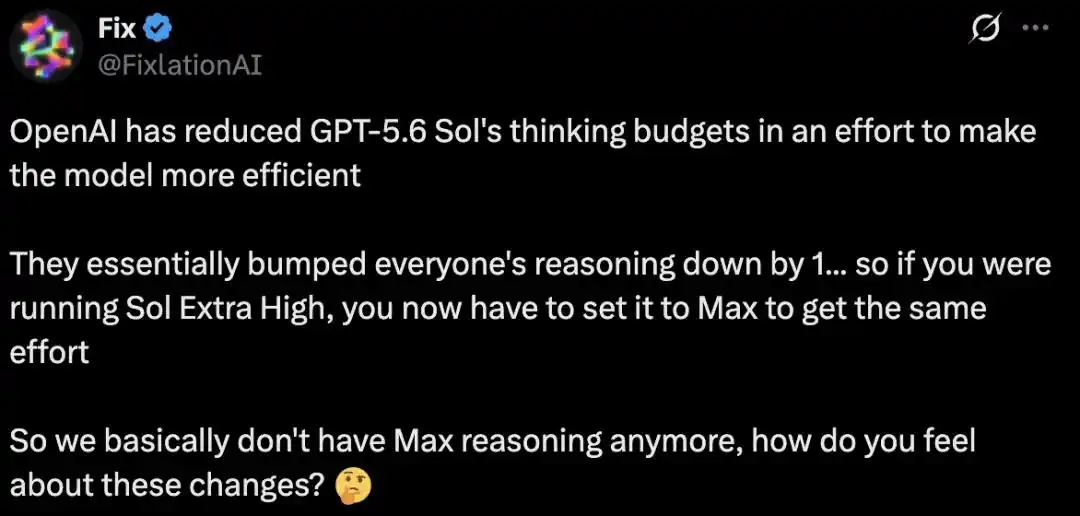
This kind of change is impossible for ordinary users to prove.

You can't see if the model weights were swapped, nor how much computing power the server allocated to you.

All you can perceive are four things: how fast it replies, how long it thinks, whether it reviews itself, and whether it calls upon other agents to help.

These are all indirect signals; none are written on a model card.

So, community users dug into it themselves and unearthed an internal parameter OpenAI never publicly disclosed: the juice value.

A Number Never Mentioned Officially

What OpenAI has publicly talked about are only the reasoning tiers.

At the GPT-5.6 launch on July 9th, the official line was the first-time introduction of max reasoning effort, "giving Sol the most ample time for deep reasoning." There's even an ultra tier above, which by default engages four agents to work in parallel.

In ChatGPT, these translate to those few options in the model selector: Medium, High, Extra High—all running Sol underneath, with the Pro tier running Sol Pro.

The juice value is the layer beneath these tiers: the internal reasoning compute budget. Users can't see it, and OpenAI has never published its values.

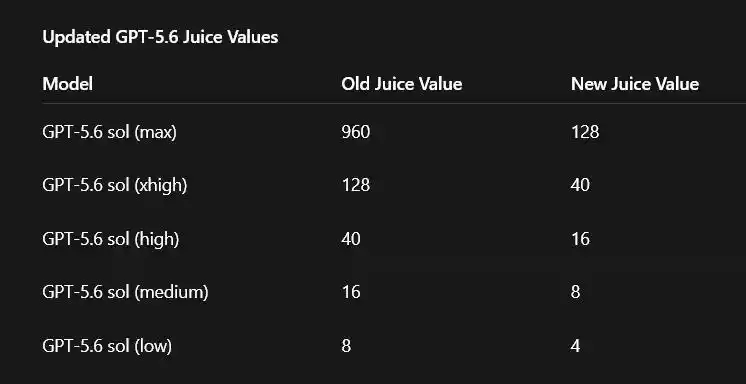
A community user, ns123abc, used a piece of hidden prompt text known as a "model fingerprint" to read a value from the system configuration: juice.

The community had previously observed that Sol's max tier corresponded to 960. This time, the screen showed 128—a drop of nearly 87%.
Almost simultaneously, another set of screenshots began circulating: the usable context for users in the Codex client had dropped from around 372k back to 272k.
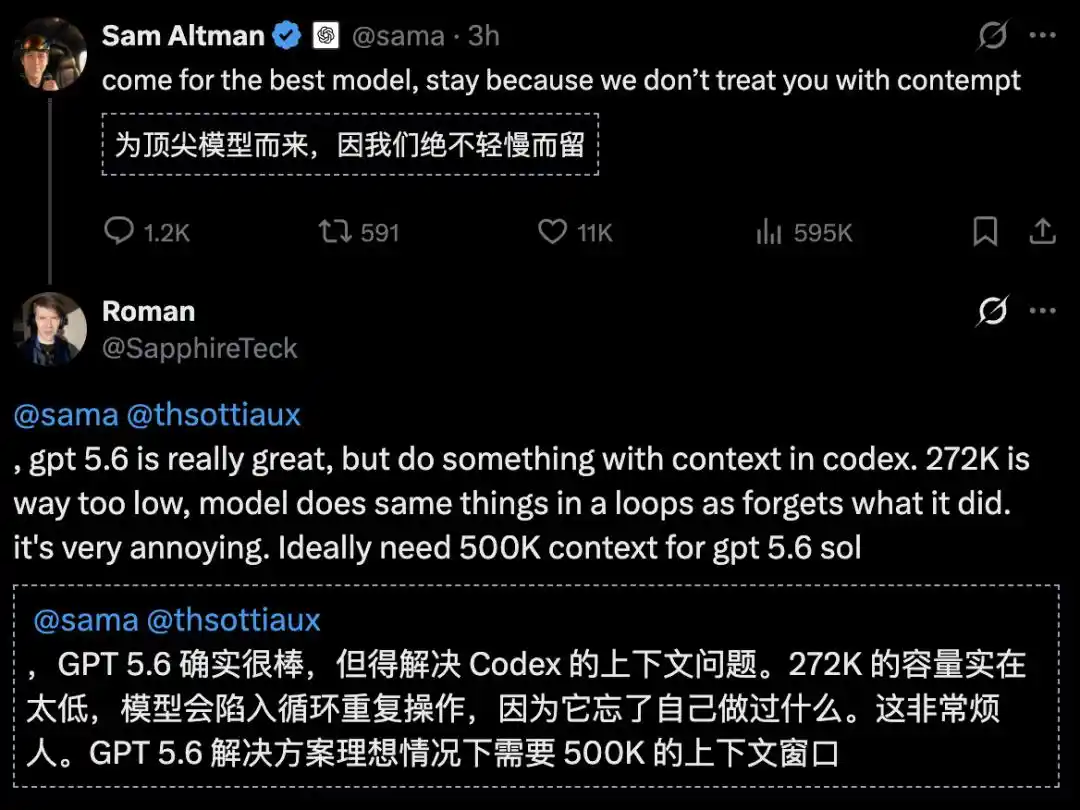
These two numbers quickly ignited the entire community.

Tibo: No Nerf, We're Investigating Usage

That same night, Tibo (Thibault Sottiaux), who leads Codex and ChatGPT Work at OpenAI, stepped up to speak.

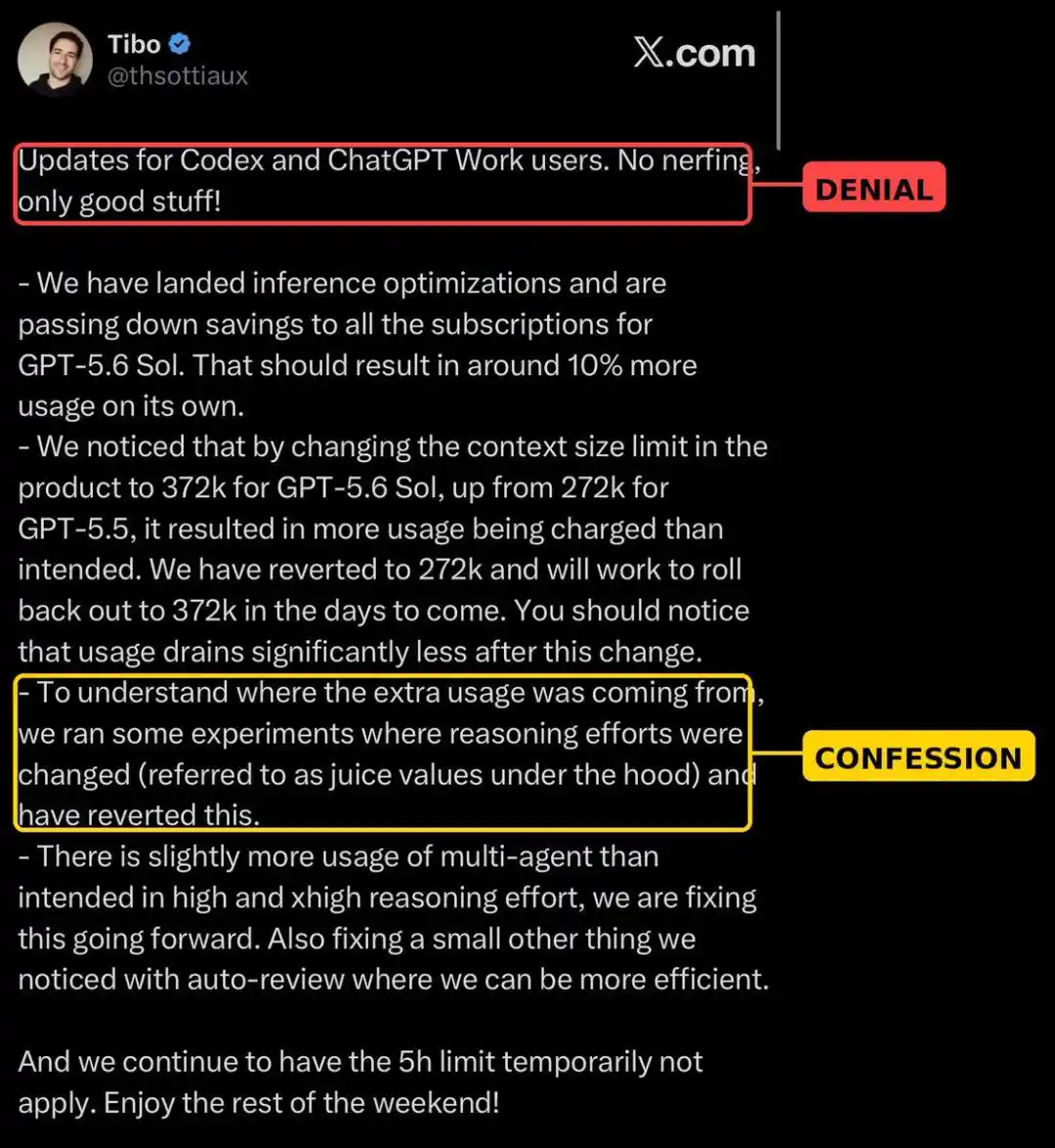
Tibo posted an update on X, starting with: No nerf, only good things.
He then emphasized four points in one breath.

First, reasoning efficiency optimizations have already rolled out. The compute savings are being returned to all subscribers, which alone adds roughly 10% more usage.

Second, Sol's context window was raised from GPT-5.5's 272k to 372k, which resulted in higher-than-expected billing deductions. It has now been rolled back to 272k, with 372k being reintroduced in the coming days.

Third, to figure out where the extra usage was coming from, the team ran some experiments where they tweaked the reasoning effort—internally called "juice values."

This has now been reverted.

Fourth, the invocation of multi-agent for high and xhigh tiers was higher than expected, and there was waste on the auto-review side—both are being fixed.

Tibo's post essentially said: It's not a "nerf," it's "parameter tuning."

He didn't mention whether model weights were touched. But he did admit that the configurations users actually received had indeed been changed.

So what exactly is "juice"? Based on publicly available information, it appears closer to an internal system marker for reasoning resource allocation—roughly speaking, how much reasoning resource the system allows the model to invest in a single task.

While lowering the budget doesn't necessarily mean "the model weakened," it can quietly change many things:

How many paths can be explored in a long-horizon task, how many rounds of comparison between multiple solutions, whether code generation is actively tested after being produced, how many times it's willing to roll back after failure, and the "long-tail capabilities" in extremely difficult tasks that determine success or failure.

Ultimately, it represents how much thought the model is willing to put into a task.

To end this debate requires a strictly controlled experiment: the same model snapshot, the same batch of tasks, the same set of tool environments, changing only the juice variable.

See how much performance drops in complex coding, long-horizon agent tasks, mathematical reasoning, and error recovery.

This evidence remains absent to this day.

Every Token the Vendor Saves, the User Feels

Returning to the experiment Tibo mentioned. How did it come about?

After GPT-5.6 launched, demand surged immediately.

OpenAI temporarily lifted the five-hour usage limit window to handle the overwhelming volume of calls.
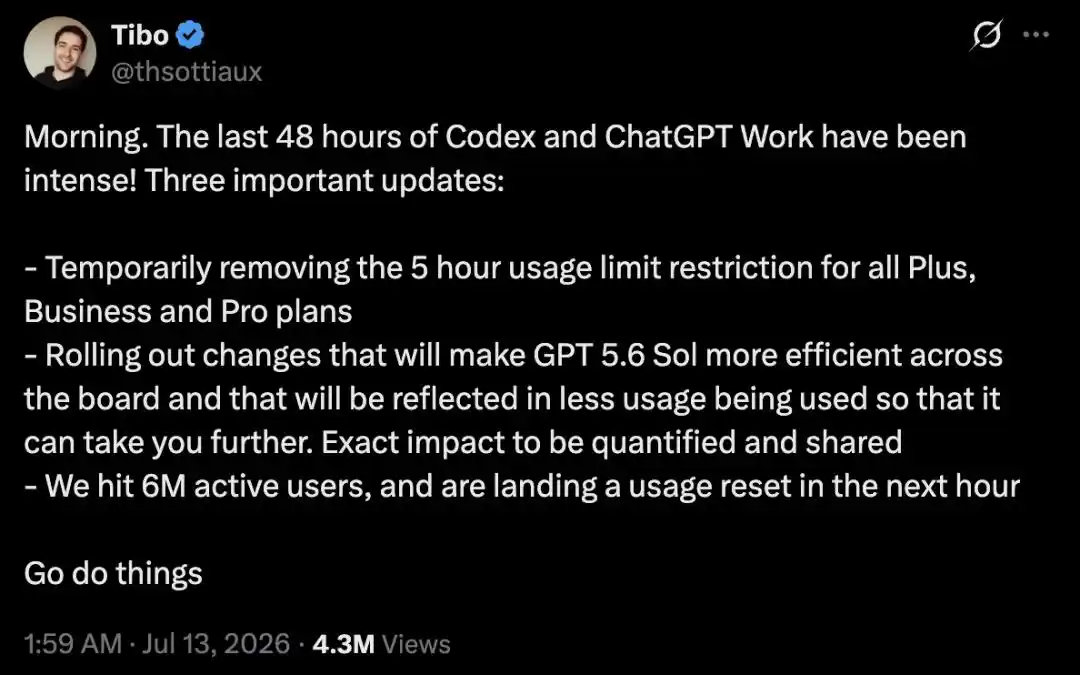
And GPT-5.6's most eye-catching new features—the longer thinking in max tier, ultra defaulting to four parallel agents, the larger context window—are precisely the token-hungry beasts.

The extra usage emerged exactly from here.

Hence, the experiment. To audit the bill, first lower the budget variable to see exactly where the usage goes—this makes perfect engineering sense.

But the problem lies exactly here: when the vendor saves tokens, users perceive it, most directly as the model "unwilling to think."

The variable that was adjusted happens to be the one users can feel.

AI Stops "Performing Miracles," Starts Punching the Clock

Over the past few years, large model companies have fostered a near-religious imagination.

People treated models like oracles, hoping they'd spit out an answer humans hadn't thought of in the dead of night, tolerating slowness, higher costs, occasional craziness.

But lab miracles can afford to ignore costs; once in production as industrial infrastructure, they cannot.

Thus, frontier models like Sol are transitioning from lab prophets who occasionally "perform miracles" into engines that keep running within daily workflows.

This resembles a process of intelligence domestication, and this controversy publicly exposed the process. Simultaneously, users' illusion of "fixed intelligence" is about to end.

Subscribing to a model is more like buying a light bulb: the model is fixed, but the brightness dial has always been in the platform's hands.

This might be the correct commercial choice, but it shouldn't forever remain in a black box.

If AI is truly to become enterprise infrastructure, vendors must provide boundaries more concrete than model names, letting users understand what exactly their paid "Max" tier guarantees.

Otherwise, it's just a price tag.

References:

https://x.com/thsottiaux/status/2076495156757577895

https://x.com/FixlationAI/status/2076469274441380349

https://www.reddit.com/r/codex/comments/1uuy5eq/nerfed_codex_sol_max/

This article is from the WeChat public account "新智元" (New AI Era), author: 元宇 (Yuan Yu)

Trending Cryptos

Related Questions

QWhat is the main change users noticed about GPT-5.6 Sol's performance according to the article?

AUsers noticed that GPT-5.6 Sol, particularly the Max tier, seemed to have become less capable at deep reasoning and complex problem-solving, delivering shallower answers more quickly instead of its previous thorough, iterative approach.

QWhat is the 'juice value' mentioned in the context of the controversy?

AThe 'juice value' is an internal, unpublicized OpenAI parameter representing the computational budget or reasoning effort allocated for a task. The community discovered its value for the Sol Max tier had reportedly dropped from 960 to 128.

QHow did OpenAI's Thibault Sottiaux (Tibo) explain the observed performance changes?

AThibault Sottiaux stated there was no 'nerf' (reduction in intelligence). He explained that the changes resulted from an experiment to investigate unexpected usage spikes after GPT-5.6's launch, during which the internal 'juice values' (reasoning effort) were temporarily adjusted. He asserted the settings had been reverted.

QWhat practical consequence did the temporary reduction in 'juice value' have for users?

AThe reduction in the internal reasoning budget meant the model spent less computational effort on tasks. Users perceived this as the model becoming 'lazy'—providing faster but shallower responses, exploring fewer solution paths, and performing less self-review and error recovery.

QWhat broader implication does the article suggest this incident has for AI as a service?

AThe incident reveals that a user's subscription buys a variable level of service, where key performance parameters like 'reasoning effort' are controlled by the provider and can be adjusted. The article argues that for AI to be trusted enterprise infrastructure, providers must offer clearer, more specific guarantees about what performance tiers actually entail, moving beyond just model names.

Related Reads

Hyperliquid Pre-IPO Contract Priced CXMT at $7.2, Foreign Capital Engaging with China's Storage Narrative via DeFi

Hyperliquid, a blockchain-based perpetual contracts platform, has launched a pre-IPO contract for Chinese memory chipmaker Changxin Technology (CXMT) ahead of its STAR Market debut. Priced at 7.2 USDC (approx. $7.2) per share, the contract implies a market cap of about $500 billion, exceeding the official IPO valuation of roughly $80 billion and sitting at the upper end of analyst estimates. This marks the first time such a crypto derivative has targeted a STAR Market listing. It provides global investors, particularly those unable to meet China's 500,000 yuan ($69,000) investment threshold for the STAR Market, a direct avenue to gain exposure to the "China storage substitution" narrative. The 24/7 tradable, leveraged contract also fills a gap for those seeking to hedge or speculate around the A-share listing, which operates under T+1 settlement and restricts short-selling. Changxin Technology, the world's fourth-largest DRAM supplier, is raising nearly $8 billion in one of Asia's largest IPOs this year, buoyed by a DRAM super-cycle and strategic shifts by major competitors. While the Hyperliquid contract offers a novel parallel pricing mechanism, the lack of direct arbitrage with the underlying A-shares may lead to persistent price divergence. Nevertheless, its emergence underscores significant international interest in China's key semiconductor players.

marsbit16m ago

Hyperliquid Pre-IPO Contract Priced CXMT at $7.2, Foreign Capital Engaging with China's Storage Narrative via DeFi

marsbit16m ago

The 'Great Divergence' of the Crypto Market in 2026: BTC Bear Market, but BlackRock, Franklin Templeton, and JPMorgan Are Simultaneously Doing One Thing

"2026 Crypto Market 'Great Divergence': BTC Bearish, But BlackRock, Franklin, JPMorgan Are Simultaneously Building Infrastructure." In July 2026, amidst BTC struggling at $62K, seven key events signal a profound shift: the 'Great Divergence' between price action and underlying infrastructure development. Franklin Templeton's CIO notes a "big disconnect" between price and fundamentals. Meanwhile, major institutions are advancing real-world blockchain adoption: BlackRock, Goldman Sachs, and JPMorgan join a UK government-backed tokenization taskforce targeting repo and gilts; Hyundai pilotes USDT for cross-border trade settlement; Bolivia considers integrating USDT into its national payment system; and Robinhood's new blockchain sees rapid adoption. This activity represents a quiet infrastructure bull market, driven by institutional strategy and long-term regulatory roadmaps, not short-term crypto price cycles. The core narrative is shifting from speculative price action to foundational utility. Infrastructure development—focused on upgrading traditional finance, enabling real-world payments, and tokenizing assets—is now decoupled from BTC's volatility. Historical parallels (e.g., dot-com bust/AWS birth, 2018 crypto winter/DeFi Summer) show that infrastructure built during downturns often becomes the next cycle's "toll booth." The critical question is no longer "Will BTC drop further?" but "Who will own the tolls when this new infrastructure is complete?" While BTC remains a key liquidity anchor, the valuation logic for crypto's real-world utility is increasingly separate from its most traded asset's price.

marsbit33m ago

The 'Great Divergence' of the Crypto Market in 2026: BTC Bear Market, but BlackRock, Franklin Templeton, and JPMorgan Are Simultaneously Doing One Thing

marsbit33m ago

Scaling Law a One-Size-Fits-All Solution? First Crystal Structure Manipulation Benchmark Shows Top Large Models Falling Short

Scaling Law Hits a Wall: New Benchmark Reveals AI's Struggles with Atomic-Level Material Manipulation A new benchmark called AtomWorld, developed by researchers, reveals a significant limitation in current large language models (LLMs). While powerful at understanding textual scientific knowledge, they perform poorly when tasked with physically manipulating atomic structures based on natural language instructions. The benchmark tests core atomic operations like replacing atoms, rotating structures, and expanding supercells. Results show that simply scaling up model size (Scaling Law) yields only modest and unstable improvements, particularly for tasks requiring strong 3D spatial reasoning and geometric planning. For instance, complex tasks like "rotating around a specific atom" see very low success rates even in top models like Claude Opus. This highlights a critical gap: textual knowledge does not automatically translate to reliable action in a physically constrained 3D space. The study argues that for AI in Science to progress, the focus must shift from just scaling language data (Language Scaling) to also scaling actionable capabilities (Action Scaling). This involves building training loops around "action-feedback-correction" cycles within simulated or real scientific environments. Ultimately, AtomWorld underscores that to become true lab assistants, AI models need to evolve beyond explaining knowledge to reliably executing precise, verifiable scientific actions.

marsbit46m ago

Scaling Law a One-Size-Fits-All Solution? First Crystal Structure Manipulation Benchmark Shows Top Large Models Falling Short

marsbit46m ago

Trading

Spot

Hot Articles

Discussions

Welcome to the HTX Community. Here, you can stay informed about the latest platform developments and gain access to professional market insights. Users' opinions on the price of SOL (SOL) are presented below.

活动图片