Goldman Sachs Partner: Profitability Is the Core Driver, S&P 500 Could Hit New Highs Within the Year

marsbitPublished on 2026-08-04Last updated on 2026-08-04

Abstract

Strong corporate earnings are providing robust support for the U.S. equity market. John Flood, a partner at Goldman Sachs, argues that with market positioning becoming "cleaner," the S&P 500 could set a new all-time high this year, driven fundamentally by corporate profits. According to Goldman Sachs data, the S&P 500's trailing second-quarter EPS growth reached 45% year-over-year, significantly surpassing the initial consensus of 22%. Excluding non-recurring items, such as certain investment-related income, the adjusted EPS growth rate remains a strong 26%, accelerating from Q1 and marking the fastest pace since 2021. This strong performance has led analysts to upwardly revise forward earnings estimates for 2027, with positive revisions breadth across most sectors. Concurrently, market sentiment and positioning have cooled from earlier highs. Goldman's sentiment and positioning indicators have retreated, hedge funds have notably reduced leverage, and retail investor leverage is also moderating. Flood views this "de-foaming" of market positioning as creating a healthier foundation for further market gains. From a valuation perspective, U.S. stocks appear relatively inexpensive compared to other major global markets. Furthermore, Flood notes that the primary benefits of the AI super-cycle have yet to fully materialize. However, a seasonal risk is noted: historical data shows muted median returns for the S&P 500 from early August to Election Day in mid-term election years. G...

Author: Zhao Ying

Strong corporate earnings are providing the most powerful support for the bull market in U.S. stocks. Goldman Sachs partner John Flood believes that, as market positioning becomes "cleaner," the S&P 500 index could set a new all-time high within the year. The core logic driving this view is profitability.

According to Goldman Sachs data, the tracked year-over-year growth rate for S&P 500 earnings per share (EPS) in the second quarter is as high as 45%, far exceeding the market consensus expectation of 22% at the start of the quarter. Even excluding non-recurring items such as the combined approximately $151 billion in "other income" related to equity investments from Alphabet and Amazon, the S&P 500 EPS growth rate still reaches 26%. This not only represents an acceleration from the first quarter but is also the fastest growth rate since 2021. Meanwhile, analysts have begun to raise earnings expectations for 2027, with positive revisions observed across most sectors.

In terms of positioning, Goldman Sachs' sentiment and positioning indicators have retreated from previous highs. Most fast-moving positioning indicators have turned bearish: futures positioning, while still elevated, is no longer at extreme levels; the put/call ratio has declined; investor surveys show waning optimism; and U.S. equity positioning by active management funds (the NAAIM index is at 79.7) has also contracted. John Flood believes that this "cleaner" positioning environment creates conditions for further market upside.

Earnings Beat Expectations with Fastest Growth in Five Years

Goldman Sachs data shows that the tracked year-over-year EPS growth rate for the S&P 500 index reached 45% in the second quarter, significantly surpassing the initial quarter consensus of 22%. Within this, 19 percentage points of growth came from the combined $151 billion in "other income" related to equity investments from Alphabet and Amazon, with Microsoft contributing approximately $3 billion in similar income.
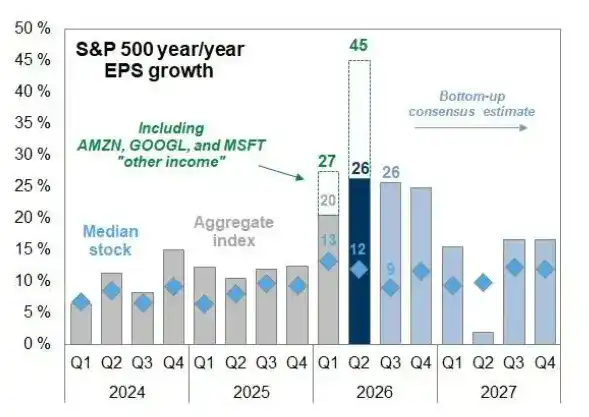
After excluding these non-core income sources, the S&P 500 EPS growth rate remains at 26%, further accelerating from the first quarter and marking the fastest pace since 2021. At the individual stock level, the tracked median EPS growth rate for S&P 500 constituents is 12%, also exceeding the initial quarter consensus of 9%, indicating that the earnings improvement is broad-based and not solely driven by a handful of tech giants.

Forward Estimates Continue to Be Revised Upward, Maintaining Positive Breadth

Strong second-quarter results not only reflect past operating performance but have also prompted analysts to continuously raise forward earnings estimates. Since the start of the third quarter, consensus expectations for the S&P 500's 2027 EPS have been revised upward by approximately 1%, with the energy and financial sectors seeing the largest increases.

In terms of revision breadth, the number of S&P 500 constituent companies with earnings estimates being raised continues to outnumber those being lowered, maintaining a positive revision breadth. Goldman Sachs believes this comprehensive upward revision trend is an important foundation supporting market valuations.

Positioning 'De-Froths,' Clearing Space for Upside

Regarding market sentiment and positioning, Goldman Sachs' sentiment and positioning indicators have fallen to the 53rd percentile, significantly lower than previous highs. Most fast-moving positioning indicators have turned bearish: futures positioning, while still high, is no longer at extreme levels; the put/call ratio has declined; investor surveys show decreased optimism; and U.S. equity positioning by active management funds (the NAAIM index at 79.7) has also contracted.

At the hedge fund level, de-leveraging has been particularly significant—total leverage has given back half of its gains for the year, and net leverage is down from the beginning of the year. For retail investors, leverage levels are starting to cool: South Korean stock market margin balances have retreated from historical highs, Japanese margin buying has started to pull back from its highest level since 1990, and U.S. investor purchases of semiconductor stocks have also moderated.

John Flood believes that this "de-frothing" of positioning signals a healthier market structure with reduced potential selling pressure, creating more favorable conditions for further index gains.

Valuations Relatively Low, AI Cycle Provides Long-Term Support

From a global cross-market comparison, Goldman Sachs data indicates that U.S. stock valuations are currently at a relatively "cheap" level compared to other major markets.

Meanwhile, John Flood points out that the main benefits of the AI super-cycle have not yet been fully realized. The world's largest technology companies continue to increase capital expenditures, driving an expansion in both the breadth and depth of earnings improvement.

However, Goldman Sachs also highlights a noteworthy seasonal risk: in the 13 mid-term election years since 1974, the median return for the S&P 500 from early August to Election Day has been 0%. This means that even if the earnings fundamentals remain strong, the timing of John Flood's call for a new high within the year still carries uncertainty. Goldman Sachs' conclusion is that the earnings picture provides strong support for the bulls, but sustainability remains the key variable.


Trending Cryptos

Related Questions

QAccording to the Goldman Sachs partner John Flood, what is the core driver behind the prediction that the S&P 500 could reach a new record high this year?

AAccording to the Goldman Sachs partner John Flood, the core driver behind the prediction is strong corporate earnings (profit).

QWhat was the tracked year-over-year EPS growth rate for the S&P 500 in Q2, and how did it compare to initial market consensus?

AThe tracked year-over-year EPS growth rate for the S&P 500 in Q2 was 45%, which far exceeded the initial market consensus expectation of 22%.

QWhy does John Flood believe a 'cleaner' positioning environment has been created in the market?

AJohn Flood believes a 'cleaner' positioning environment has been created because sentiment and positioning indicators have cooled from previous highs, rapid positioning indicators have turned more neutral/negative, hedge funds have deleveraged significantly, and retail investor leverage has also begun to cool. This reduces potential selling pressure.

QWhat does the article indicate about the trend of forward earnings expectations for S&P 500 companies for 2027?

AThe article indicates that analysts have started to raise forward earnings expectations for 2027, with the consensus EPS estimate being raised by about 1% since the start of Q3. The breadth of revisions (more companies seeing upgrades than downgrades) remains positive.

QWhat seasonal risk regarding S&P 500 performance does Goldman Sachs mention, based on historical data from mid-term election years?

ABased on historical data since 1974, Goldman Sachs mentions that during mid-term election years, the median return for the S&P 500 from early August to Election Day has been 0%. This introduces uncertainty into the timing of any potential new highs, despite strong fundamentals.

Related Reads

Uniswap Launches Token Issuance Platform Pools.trade, Robinhood Launchpad Ecosystem Reshuffle?

Uniswap is reportedly developing a token launch platform called Pools.trade on Robinhood Chain, as uncovered by community investigation. The discovery followed Uniswap's quiet release of a "Launches" tab for meme coins on Robinhood Chain. Evidence from the Pools.trade website code, including references to "Robinhood Chain" and Uniswap's CCA (Continuous Clearing Auction) system, strongly suggests the project's legitimacy, later confirmed by Uniswap founder Hayden Adams. According to analysis, Pools.trade is expected to feature two launch models: a 4-hour "Crowd Launch" auction and an "Instant Launch" similar to Pump.fun's bonding curve. Both models require a token to reach a $50,000 market cap to migrate to a permanent Uniswap V4 liquidity pool. The move is seen as Uniswap's response to the lucrative revenue generated by existing Robinhood Chain launchpads like Flap and Pons, whose recent earnings have rivaled or surpassed Uniswap's total protocol fees across all chains. Despite dominating DEX volume on Robinhood Chain, Uniswap's revenue share appears disproportionate to its infrastructure role. While Uniswap possesses the technical resources and market position to potentially disrupt the launchpad sector, its success is not guaranteed. A previous CCA integration on the chain saw limited traction. Furthermore, this vertical expansion risks altering Uniswap's relationship with existing launchpad partners, who might reconsider migrating their tokens to Uniswap if they view it as a direct competitor.

marsbit11m ago

Uniswap Launches Token Issuance Platform Pools.trade, Robinhood Launchpad Ecosystem Reshuffle?

marsbit11m ago

For the First Time Since 1955, S&P 500 Profits Exceed Long-Term Trend by 14%

For the first time since 1955, the S&P 500's earnings per share (EPS) have risen approximately 14% above their long-term historical trend channel, according to a recent report. This highlights a significant fundamental shift: strong corporate profits, not just AI narratives or liquidity, are now underpinning the market's high valuations. The strength of current earnings is evidenced on multiple fronts. Actual quarterly results are consistently beating analyst expectations, with the percentage of S&P 500 companies exceeding profit forecasts and the magnitude of sales surprises near multi-year highs. Furthermore, analysts are *raising* future EPS estimates instead of the typical post-quarter downgrades, with full-year 2026 growth expectations revised sharply upwards from ~13% to nearly 28%. This profit growth is broadening beyond the mega-cap "Magnificent Seven" tech stocks. While these giants remain the primary engine, the majority of S&P 500 sectors are contributing, with median company earnings growth around 13.8%. However, this exceptional strength creates a higher bar for future performance. With profit levels already so elevated, merely meeting elevated expectations may not suffice to push stocks higher. Any disappointment in revenue growth, profit margins, or forward guidance could trigger significant pressure on stretched valuations. Therefore, the sustainability of the earnings support will depend on continued sales expansion, stable margins, the payoff from massive AI investments, and, crucially, whether the positive trend of upward earnings revisions can persist.

marsbit51m ago

For the First Time Since 1955, S&P 500 Profits Exceed Long-Term Trend by 14%

marsbit51m ago

Trading

Spot

Hot Articles

Discussions

Welcome to the HTX Community. Here, you can stay informed about the latest platform developments and gain access to professional market insights. Users' opinions on the price of S (S) are presented below.

活动图片