Glassnode on Snowflake: Digital Asset Data Delivered Directly to your Warehouse

insights.glassnodePublished on 2026-06-04Last updated on 2026-06-04

Abstract

Glassnode has launched a data sharing environment on Snowflake, making comprehensive on-chain and market data directly accessible within institutional data warehouses. This eliminates the need for custom API pipelines and ETL management. The offering includes on-chain analytics, derivatives, spot & exchange data, ETF & corporate treasury metrics, with multiple time resolutions. A key feature is point-in-time (PiT) data to ensure historical accuracy and eliminate look-ahead bias in backtesting. Designed for quantitative trading, risk management, and macro research, the integration allows users to query data via SQL alongside other datasets. Access is provisioned through private Snowflake Marketplace listings.

The most sophisticated institutional teams don't just need better data. They need it inside the environments where their research and execution workflows already run.

We've launched Glassnode's Snowflake Data Sharing environment, becoming the first provider to bring comprehensive on-chain analytics into the Snowflake ecosystem.

To get started or learn more about Glassnode Data Shares, talk to our product experts.

Request access

Access Trusted Digital Asset Data Directly in Your Environment

Snowflake is the data warehouse of choice for institutional finance. But until now, integrating digital asset data into these workflows meant building custom API ingestion pipelines, managing ETL jobs, and reconciling data updates. That's engineering overhead that should be spent on alpha generation.

Our Snowflake integration eliminates all of it. Through Snowflake Marketplace private listings, our data shares deliver the full history of every trusted Glassnode metric directly into your environment.

You query it like any other table in your warehouse, because that's exactly what it is.

What's Included

This is the same data that powers the research workflows of the world's leading crypto-native institutions, now accessible without a single API call.

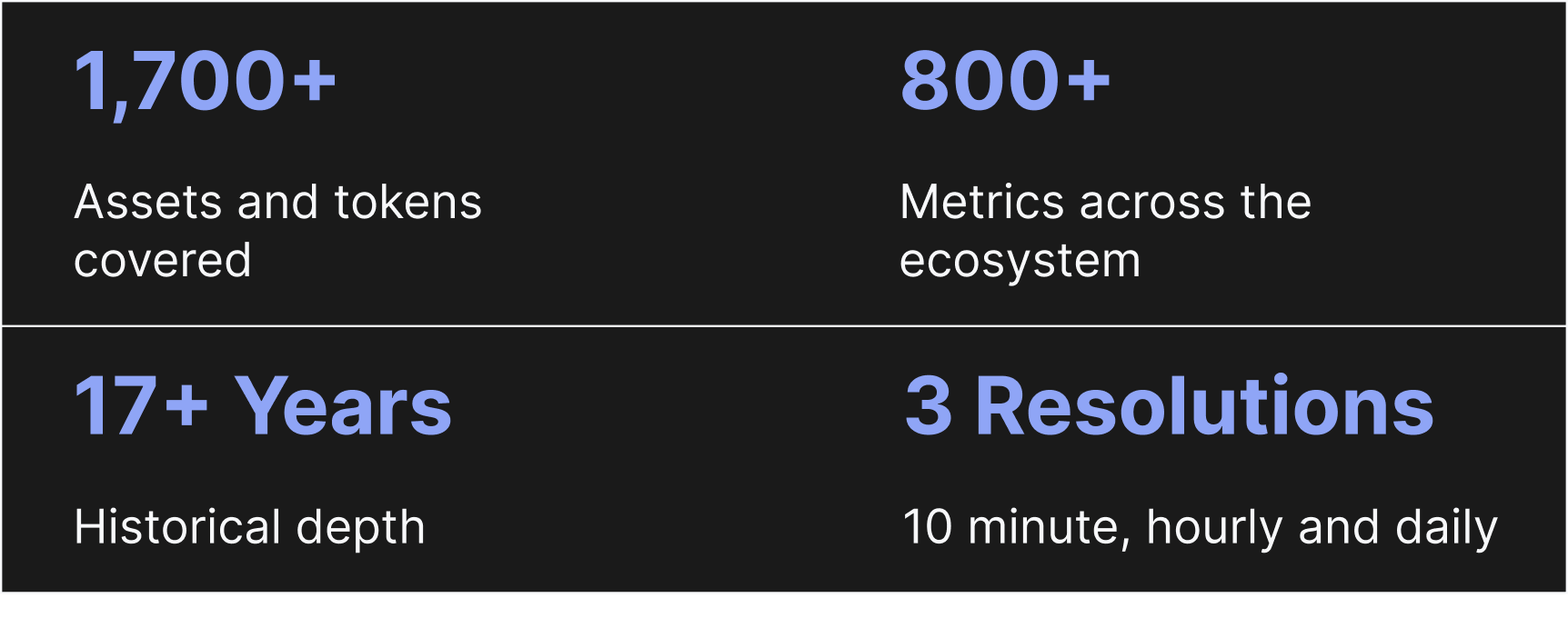
On-Chain Analytics | Address activity, entity behavior, supply dynamics, exchange flows, miner metrics, and advanced clustering-based insights across Bitcoin, Ethereum, and beyond.

Derivatives | Futures open interest, funding rates, liquidations, plus our recently expanded options suite: premiums, taker flows, combo strategies, implied volatility surfaces, and more.

Spot & Exchange Data | Exchange balances, inflow/outflow dynamics, and venue-level breakdowns showing capital rotation in real time.

ETFs & Corporate Treasuries | Bitcoin and Ethereum ETF flows, AUM dynamics, and corporate treasury holdings.

Multiple Resolutions | 10-minute, hourly, and daily granularity for everything from intraday signals to long-horizon macro research.
Built For The Workflows You Run

Quantitative & Systematic Trading | Query the full depth of on-chain, derivatives, and market data in SQL alongside your proprietary signals. PiT variants for backtesting fidelity. Sub-hourly resolution for intraday signals. No rate limits, no pagination.

Risk & Portfolio Construction | A unified view of exchange concentration, leverage dynamics, ETF flows, and supply overhangs. Native Snowflake delivery means direct integration with existing risk dashboards.

Multi-Strategy & Macro Research | Join Glassnode data with equity, fixed income, and macro datasets already in your warehouse. Same query layer, no middleware.

Fund Operations & Compliance | No bespoke pipelines means less operational risk. Snowflake's access controls and audit logging handle governance out of the box. Point-in-time timestamps provide data lineage for regulatory requirements and internal governance.

Eliminate Look-Ahead Bias from Backtests

For quantitative teams, historical data integrity is non-negotiable. Backtesting on retroactively revised data isn't backtesting. It's overfitting.

Glassnode is the first to offer point-in-time (PiT) blockchain data in Snowflake. PiT metrics are append-only and historically immutable. Each data point reflects exactly what was known when it was computed. No retroactive corrections, no look-ahead bias.

This matters because on-chain data is inherently mutable. Clustering improvements, late-reported exchange data, and refined labeling can all trigger revisions to standard metrics. PiT variants freeze the record, so your backtests reflect the information that was actually available to participants at each point in time. Every PiT data point includes a computed_at timestamp for full auditability.

Getting Started

Whether you're building backtested systematic models, integrating crypto into a cross-asset framework, or standing up institutional-grade risk infrastructure, Glassnode on Snowflake is the fastest path from blockchain data to production.

To request a trial or to learn more about Glassnode Data Shares, reach out to our institutional team at sales@glassnode.com.

The setup for Glassnode on Snowflake

  1. Retrieve your Snowflake account identifier via Snowflake's standard process or a simple SQL query.
  2. Share it with the Glassnode team. We provision access through Snowflake Marketplace private listings.
  3. Accept the listing. After initial replication, the data is live in your warehouse.

Data shares are organized by package (on-chain, market, signals, common, metadata), so you subscribe to what you need. Updates flow automatically.

Alternatively, you can initiate a trial via the Snowflake listing.

i️
Find the full setup documentation in Glassnode docs.

Glassnode Delivers the Analytical Depth That Drives Alpha

Coverage alone doesn't differentiate. What sets us apart is analytical depth built over nearly a decade of institutional-grade data engineering.

Proprietary entity adjustment | Our clustering technology identifies real-world entities (exchanges, institutions, long-term holders, miners) rather than raw addresses. Noisy blockchain data becomes actionable intelligence.

Full-stack derivatives | On-chain, futures, options, and spot from a single provider with unified methodology and consistent quality.

Expanding coverage | New chains, instruments, and products get added continuously. Your Snowflake environment reflects every update automatically.

* Default historical data during the trial is limited to 14 days and 1h/24h resolutions - contact sales@glassnode.com to request a trial with higher resolution and extended history.


  • Follow us on X for timely market updates and analysis
  • Join our Telegram channel for regular market insights
  • For on-chain metrics, dashboards, and alerts, visit Glassnode Studio

Related Questions

QWhat problem does the Glassnode Snowflake Data Sharing environment aim to solve for institutional teams?

AIt aims to eliminate the engineering overhead of building custom API ingestion pipelines, managing ETL jobs, and reconciling data updates, allowing institutional teams to access comprehensive on-chain and market data directly within their Snowflake data warehouse for seamless integration into their existing research and execution workflows.

QAccording to the article, what is a key feature of Glassnode's data offering on Snowflake that is specifically important for quantitative backtesting?

AA key feature is the provision of point-in-time (PiT) blockchain data, which is append-only and historically immutable. This eliminates look-ahead bias by ensuring each data point reflects exactly what was known at the time it was computed, with no retroactive corrections.

QWhat types of data categories are included in the Glassnode Data Shares accessible via Snowflake?

AThe data categories include: On-Chain Analytics (address activity, entity behavior, supply dynamics, etc.), Derivatives (futures, options metrics), Spot & Exchange Data (exchange balances, flows), ETFs & Corporate Treasuries data, and data at Multiple Resolutions (10-minute, hourly, daily).

QWhat are the primary institutional use cases or workflows mentioned as being supported by Glassnode on Snowflake?

AThe primary use cases are: Quantitative & Systematic Trading, Risk & Portfolio Construction, Multi-Strategy & Macro Research, and Fund Operations & Compliance. It supports these by allowing direct SQL querying alongside other datasets, providing unified views, and integrating with existing dashboards and governance controls.

QWhat are the initial steps required to set up and access Glassnode Data Shares through Snowflake?

AThe steps are: 1. Retrieve your Snowflake account identifier. 2. Share it with the Glassnode team, who will provision access via Snowflake Marketplace private listings. 3. Accept the listing, after which the data will be live in your warehouse after initial replication. Alternatively, a trial can be initiated directly via the Snowflake listing.

Related Reads

Should You Buy SpaceX Stock at $1.7 Trillion? Here's What the Market Is Worried About

SpaceX is preparing for a massive IPO aiming to raise around $75 billion at a valuation of approximately $1.75 trillion. While its achievements in reusable rockets and the profitable Starlink satellite internet service are clear, the market is concerned about the aggressive valuation. Key issues include: the current $1.75 trillion valuation, which is about 94 times 2025 revenue, seems to price in not just existing businesses but also unproven future ventures like AI infrastructure and orbital data centers. Financially, while Starlink is profitable, the AI division, bolstered by the acquisition of xAI, is incurring massive losses and consuming the majority of capital expenditures. This acquisition also introduced complex related-party financing arrangements and debt onto SpaceX's balance sheet. Furthermore, corporate governance poses a challenge. SpaceX's dual-class share structure ensures founder Elon Musk retains absolute control, limiting ordinary shareholders' influence over high-risk, long-term strategic decisions. The future success of ambitious projects like the Starship rocket—critical for lowering costs and enabling new services—remains a significant variable for the valuation. In summary, the market's apprehension (FUD) centers not on doubting SpaceX's past technological triumphs but on questioning how much premium public investors should pay for a future that combines proven profits with highly speculative and capital-intensive new ventures, all under a governance structure that offers limited shareholder oversight.

marsbit47m ago

Should You Buy SpaceX Stock at $1.7 Trillion? Here's What the Market Is Worried About

marsbit47m ago

Breaking the DeFi Cascading Liquidation Curse: Vitalik Proposes a New Solution

Vitalik Buterin has proposed a new DeFi design to eliminate the automatic liquidation mechanism that causes market instability during sharp downturns. The current system, used by protocols like Aave, triggers forced sales when collateral value falls below a threshold, often exacerbating price drops and creating systemic selling pressure. Buterin's alternative model is based on splitting an asset like ETH into two synthetic option-like tokens, P and N, pegged to a price index. Their combined value always equals one ETH. Instead of sudden liquidation, a position's value gradually drifts from its target peg if the market moves. Users must proactively rebalance their holdings to maintain their desired exposure, transferring the management burden from the protocol to the user or automated tools. A key advantage is the reduced reliance on real-time oracles. Pricing decisions are deferred until contract expiry, allowing for more robust, fault-tolerant oracle designs. This removes a clear liquidation threshold that speculators can target for manipulation or MEV extraction. However, significant challenges remain. Frequent rebalancing could incur high slippage and transaction costs, necessitating new liquidity provider models. The design is better suited for hedging instruments than for stablecoins requiring a rigid 1:1 peg. While not an immediate replacement for existing systems, the proposal challenges the foundational assumption that instantaneous forced liquidation is an unavoidable necessity in DeFi, opening the door for fundamentally different risk management architectures.

marsbit52m ago

Breaking the DeFi Cascading Liquidation Curse: Vitalik Proposes a New Solution

marsbit52m ago

The End of Single-Factor Cryptography

The article "The End of Single-Factor Crypto" posits a fundamental shift in the cryptocurrency ecosystem. It argues the era where crypto asset valuations were predominantly driven by, and correlated with, Bitcoin's price is ending. The space is bifurcating into two distinct economies: endogenous and exogenous. The endogenous economy represents traditional crypto, where token and project values are directly tied to crypto market prices. The emerging exogenous economy comprises projects and businesses that may utilize blockchain technology or tokens but derive their fundamental value from external, non-crypto factors like consumer demand, subscription revenue, or real-world utility. Examples include AI inference platforms like Venice, fintech lenders using blockchain for efficiency, and stablecoin/payment infrastructure companies acquired by giants like Mastercard and Stripe. This shift means investment analysis must change. For exogenous assets, evaluating traditional business fundamentals—such as revenue streams, unit economics, and competitive moats—becomes more critical than tracking Bitcoin charts. While endogenous assets like Bitcoin remain relevant, the growth of the exogenous category is driven by measurable demand independent of crypto price cycles, paving the way for a new, more diversified market phase. Consequently, crypto is evolving from a single-factor, reflexive asset class into a multifaceted ecosystem with varied drivers and investment theses.

marsbit52m ago

The End of Single-Factor Cryptography

marsbit52m ago

Morning Post | Bitmine Plans to Raise $300 Million Through Preferred Stock Issuance; Polymarket Accuses Kalshi of Commercial Espionage

ChainCatcher's Daily Crypto Brief: Key developments from the past 24 hours include significant funding moves, regulatory actions, and market predictions. Bitmine announced a $300 million preferred stock fundraising. Polymarket accused rival prediction platform Kalshi of corporate espionage, citing numerous suspicious coincidences in product launches, a claim Kalshi strongly denied. The U.S. Department of Justice, in a joint "Disruption Week" anti-fraud operation with companies like Coinbase and Meta, froze over $3.8 million in cryptocurrency linked to scams. In infrastructure news, Macau completed its integration with the multi-central bank digital currency bridge, mBridge, aiming to build efficient cross-border payment channels. Cosmos Labs acquired the block explorer Mintscan. Market-wise, Geoffrey Kendrick, Standard Chartered's Head of Digital Assets Research, stated Bitcoin is nearing a bottom around $63,000, maintaining a year-end target of $100,000. He noted stability in U.S. spot Bitcoin ETF holdings. Ahead of SpaceX's anticipated IPO, internal insiders at Rocket Lab (RKLB) sold over $18.41 million in stock. In tokenization, Goldman Sachs partnered with Apex and Archax to launch a tokenized real estate fund. The meme token tracker GMGN reported the top trending tokens: on Ethereum, HEX, SHIB, LINK, PEPE, mUSD; on Solana, TROLL, swarms, WORLDCUP, neet, Buttcoin; and on Base, PEPE, toby, ODDS, ELSA, SKI.

链捕手1h ago

Morning Post | Bitmine Plans to Raise $300 Million Through Preferred Stock Issuance; Polymarket Accuses Kalshi of Commercial Espionage

链捕手1h ago

Trading

Spot
Futures
活动图片