Author: Changan I Biteye Content Team
A strong rally in ZEC has brought the long-dormant privacy sector back to the center of market attention.
Beyond the price increase, more importantly, it has reignited market discussion about the privacy narrative: In today's world of increasingly transparent on-chain data and easily traceable transactions, is privacy still a niche demand?
In the past, privacy was often understood as the anonymity needs of a few users. But as more funds, transactions, and strategies move on-chain, privacy is becoming a more realistic problem: If all behaviors are visible, will on-chain finance truly be safer?
Starting from ZEC's current price action, let's examine what the market is actually discussing behind the renewed focus on the privacy sector.
I. Full On-Chain Transparency: From Cornerstone of Trust to a Targeted Weakness
The open-book risk brought by on-chain transparency first appeared in lending liquidation scenarios.
As early as the last cycle, when institutions or large holders engaged in on-chain lending, their collateral, debt size, health factor, and liquidation prices were almost all publicly visible. By monitoring these addresses, one could clearly see their risk positions.
When a large holder's liquidation price is visible to everyone, other traders might trade around that liquidation line. The price could be pushed into the liquidation range, triggering a margin call, followed by a quick rebound.
Such cases made many realize for the first time that completely public on-chain data also means being targetable.
This issue has become even more pronounced in the current cycle.
With the popularity of on-chain derivatives platforms like Hyperliquid, more whales are opening positions on-chain. Large positions, trade direction, margin changes, and liquidation prices could all be monitored by the market.
-
For ordinary users, transparency might just mean information disclosure.
-
But for large-scale traders, transparency sometimes means exposing their trading intentions and risk positions to all counterparties.
Therefore, the renewed focus on the privacy sector is not just due to the rise of certain tokens, nor is it merely a rotation among legacy privacy coins.
The deeper issue is: Can a fully transparent on-chain environment continue to support larger-scale, more professional on-chain financial activities?
Users need transparency to build trust, but they also need privacy to protect assets, strategies, and trading security.
II. Overview of the Three Core Segments in the Privacy Sector
Judging from this cycle's market action, the privacy sector is no longer just about legacy anonymous coins. It can be roughly divided into three categories: one includes legacy privacy assets like ZEC and XMR; another includes privacy infrastructure represented by Railgun and Aztec; and a third includes projects like Genius, SilentSwap, and 0xBow, which emphasize transaction privacy and compliance.
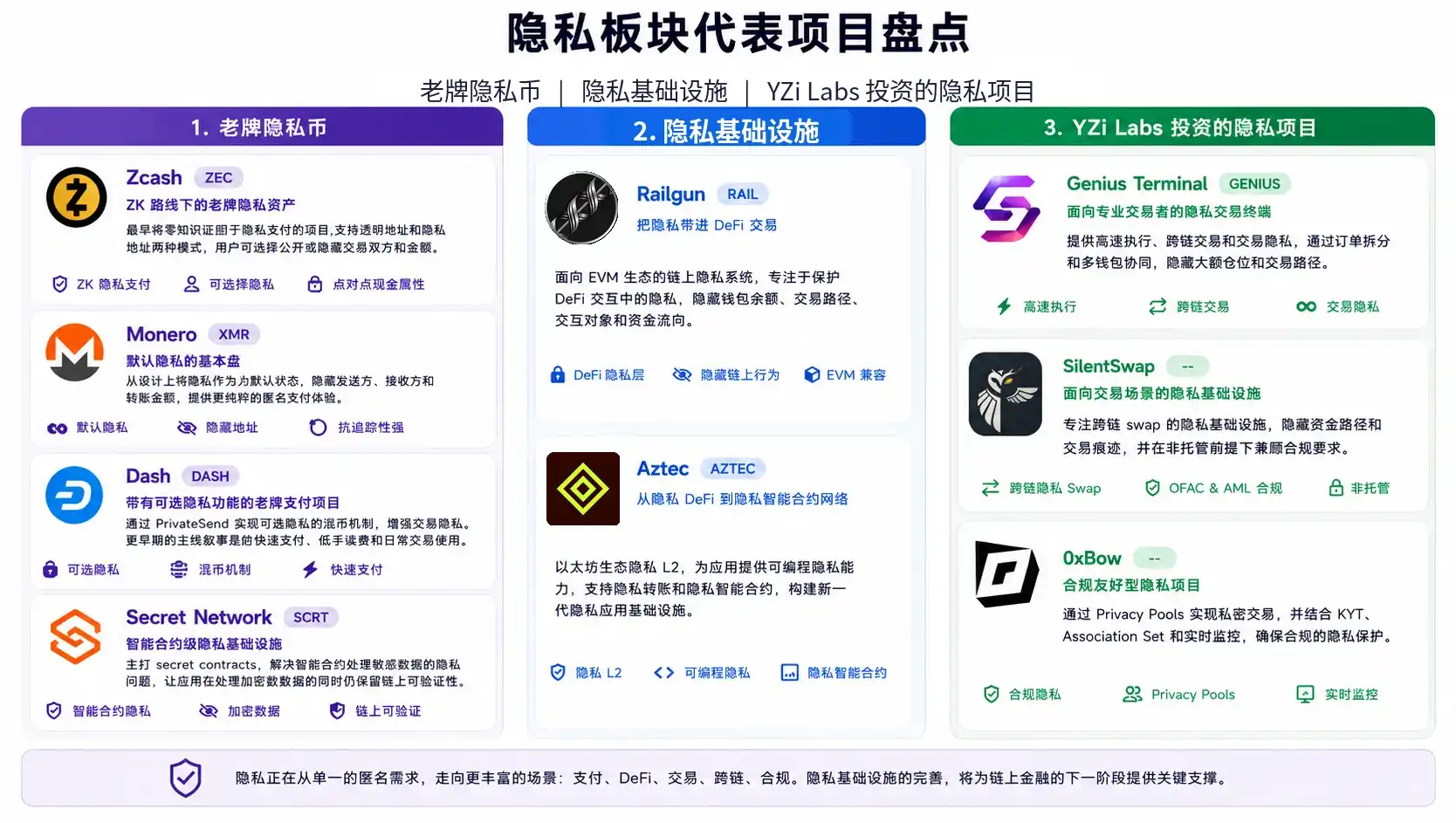
1. Legacy Privacy Coins: Asset and Payment Properties
Zcash (ZEC): Legacy Privacy Asset on the ZK Path
X: @zcash | XHunt Ranking: 13364
Zcash is a representative legacy privacy coin and one of the earliest crypto projects to use zero-knowledge proofs for private payments. Unlike regular public chains where all transactions are publicly viewable, Zcash supports both transparent and shielded (private) addresses.
Users can make public transfers like they would with Bitcoin, or they can hide the sender, receiver, and amount through shielded transactions.
Zcash's official definition is "encrypted electronic cash," emphasizing its properties for private peer-to-peer payments.
💰 Token Performance:
Naval Ravikant once stated on X: If Bitcoin is insurance against fiat currency risk, then Zcash is insurance against Bitcoin's transparency risk.
In terms of price performance, ZEC has been one of the most prominent primary assets in this cycle's privacy sector, rising from around $200 in March to $620.
Monero (XMR): The Default Privacy Baseline
X:@monero|XHunt Ranking: 4812
Monero is another highly representative project among legacy privacy coins, with its core positioning being default-private payments.
Unlike Zcash's optional privacy, Monero is designed with privacy as the default state from the ground up; transactions hide the sender, receiver, and amount.
Default privacy makes it more purist in the direction of anonymous payments, but it also subjects it to long-term higher regulatory pressure and exchange liquidity pressure.
💰 Token Performance:
However, judging from this cycle's market action, XMR's price performance hasn't been particularly outstanding. Although the broader market environment itself isn't strong, compared to ZEC, XMR clearly lacks elasticity.
Dash (DASH): Legacy Payment Project with Optional Privacy Features
X:@Dashpay|XHunt Ranking: 11376
Dash is an early entrant into the market, a legacy crypto project focused on payments. Dash's privacy features are optional, primarily implemented through PrivateSend.
The core idea of PrivateSend is to enhance transaction privacy through a coin mixing mechanism, allowing users to hide fund sources and transaction paths when needed. However, in terms of positioning, Dash is not a pure privacy coin; its earlier main narratives were actually fast payments, low fees, and everyday transactional use.
💰 Token Performance:
From this cycle's action, DASH has seen periodic rebounds, but its overall performance is not as prominent as ZEC's. Its current price is around 43 USDT. While it still carries the labels of a legacy payment project and optional privacy, the market's pricing of it seems more driven by sector rotation rather than a re-pricing of a primary privacy asset.
Secret Network (SCRT): Smart Contract-Level Privacy Infrastructure
X:@SecretNetwork|XHunt Ranking: 3677
Secret Network is an early public chain project focused on smart contract-level privacy, with its core feature being secret contracts. Unlike traditional privacy coins that focus on transfer privacy, it aims to solve data privacy problems at the application layer: Can smart contracts process sensitive data during execution without exposing everything on the public chain?
Secret Network's advantage lies in bringing privacy capabilities to the application layer. For applications like DeFi, NFTs, gaming, identity, and data markets, many scenarios are not suitable for completely public user data. The significance of secret contracts is enabling applications to process encrypted data while retaining on-chain verifiability.
💰 Token Performance:
In terms of price performance, SCRT hasn't clearly benefited from this round of privacy narrative resurgence. Its current price is around $0.08, still in a long-term low range.
2. New-Generation Privacy Infrastructure: Empowering the Application Layer
Railgun (RAIL): Bringing Privacy into DeFi Trading
X:@RAILGUN_Project|XHunt Ranking: 4099
Railgun is an on-chain privacy system for the EVM ecosystem, primarily serving DeFi scenarios. It doesn't aim to create a new privacy payment asset; rather, it hopes to bring privacy features into DeFi trading.
On public chains, users' wallet balances, transaction paths, counterparties, and fund flows can all be traced.
-
For ordinary users, this means asset exposure.
-
For traders, it means strategies could be copied or even targeted.
This is the problem Railgun aims to solve: allowing users to hide their on-chain behavior while participating in DeFi.
It's worth noting that Vitalik recently discussed the underlying problems faced by privacy protocols when talking about the Ethereum Foundation's future direction. He believes that protocols like smart contract wallets and Railgun still need intermediaries to submit transactions to the chain, which itself is a vulnerability.
💰 Token Performance:
RAIL has also clearly benefited from the recent warming of the privacy sector. The RAIL token's market cap has risen from 60M in April to 240M currently.
Compared to high-market-cap primary assets like ZEC, RAIL resembles more of a high-beta play within the privacy sector—easier to rally quickly when the narrative heats up, but with more pronounced liquidity and volatility.
Aztec (AZTEC): From Private DeFi to Private Smart Contract Network
X:@aztecnetwork|XHunt Ranking: 760
Aztec is a privacy L2 in the Ethereum ecosystem, positioned to provide programmable privacy for applications.
It's not a new project. Aztec initially launched zk.money and Aztec Connect, providing Ethereum users with private transfers and private DeFi entry points. However, in 2023, the team chose to shut down Aztec Connect and shift focus to a new private smart contract network.
In late 2025, AZTEC held a public token sale using a Continuous Clearing Auction mechanism, with the public sale price around $0.047.
💰 Token Performance:
From its secondary market performance, AZTEC's overall performance since listing hasn't been particularly strong. Its current price is around $0.025, still below the public sale cost. However, with the resurgence of the privacy sector, AZTEC has also seen a noticeable rebound recently.
3. YZi Labs' Investment Portfolio: Focusing on the Balance Between Transaction Privacy and Compliance
Genius Terminal (GENIUS): Privacy Trading Terminal for Professional Traders
X:@GeniusTerminal|XHunt Ranking: 7845
Genius Terminal is an on-chain trading terminal for professional DeFi users, emphasizing high-speed execution, cross-chain trading, and transaction privacy.
Genius can help users hide large positions and trading paths through order splitting and multi-wallet coordination. Users can complete cross-chain trades within one terminal without frequently switching wallets, bridges, and DEXs.
In January 2026, YZi Labs announced an investment in Genius, calling it a "private high-velocity on-chain trading terminal."
YZi Labs mentioned that Genius's goal is to provide an experience close to that of centralized exchanges in terms of speed, liquidity, and privacy, without sacrificing user ownership and decentralization.
💰 Token Performance:
In terms of secondary market performance, GENIUS has shown obvious short-term elasticity recently. Its current price is around $0.73.
SilentSwap: Privacy Infrastructure for Trading Scenarios
X:@SilentSwap|XHunt Ranking: 78144
SilentSwap is a privacy infrastructure for cross-chain trading scenarios, focusing on private cross-chain swaps. It aims to allow users to hide their fund paths and transaction traces when performing cross-chain swaps, transfers, and bridging assets.
On public chains, cross-chain transactions often expose a lot of information: which chain a user came from, what assets were swapped, the final destination of funds, and whether different addresses are associated. SilentSwap aims to solve this type of privacy leakage in cross-chain transactions.
Another feature of SilentSwap is that it doesn't just emphasize privacy; it also puts compliance among its product selling points. Its website explicitly lists "OFAC & AML Compliant" and states that it holds two legal opinions in the US. This sets it apart from traditional privacy projects that "only emphasize anonymity": it attempts to find a balance between non-custodial, cross-chain privacy, and compliance.
0xBow: Compliance-Friendly Privacy Project
X:@0xbowio|XHunt Ranking: 9376
0xBow is an infrastructure project for on-chain privacy and compliance scenarios, with its core direction being compliant onchain privacy.
Unlike traditional privacy projects emphasizing "untraceability," 0xBow is more concerned with: Can users prove their funds are not mixed with illicit activities while protecting their transaction privacy?
Its core product is Privacy Pools. Privacy Pools support peer-to-peer private transactions while avoiding users' funds mixing with illegal funds. 0xBow monitors deposits entering Privacy Pools and filters them through a Know Your Transaction mechanism. Only funds meeting the criteria enter the Association Set.
Behind this lies 0xBow's Association Set Provider (ASP). ASPs continuously monitor transactions within Privacy Pools, identify suspicious patterns, and support Proof of Association, real-time transaction monitoring, programmable compliance, and modular deployment.
In other words, 0xBow isn't simply creating an anonymous pool; it attempts to make private transactions operate within a compliance framework.
III. Industry Consensus: Privacy is No Longer an "Isolated Narrative"
Aster: Perp DEXs Also Begin Introducing Transaction Privacy
Aster itself is a Perp DEX, but its Shield Mode has already integrated privacy into the derivatives trading experience.
This indicates that privacy needs no longer exist only in transfer scenarios. For on-chain traders, what is truly sensitive is often trade direction, position size, transaction paths, and fund intentions.
Especially in Perp DEXs, if large trades and position changes are exposed in a public environment, they are prone to being copied, targeted, or even front-run.
Therefore, Aster's Shield Mode is essentially not a traditional privacy coin feature; it embeds transaction privacy into the Perp DEX product itself. It reflects a more specific trend: If on-chain derivatives want to continue attracting more professional trading demand, they may need to address not just liquidity and fees but also the issue of exposed trading intent.
Vitalik: Ethereum Also Needs Native Privacy
It's not just the application layer that is starting to value privacy; the Ethereum core roadmap is also beginning to revisit this issue.
Recently, Vitalik also mentioned Ethereum's lack of native privacy capabilities and proposed a set of short-term privacy improvement directions, including Account Abstraction, FOCIL, keyed nonces, and access-layer privacy work like Kohaku. These correspond to censorship resistance, transaction unlinkability, and privacy protection in wallets and chain-reading processes, respectively.
This shows that privacy is no longer just an add-on feature for external applications; it is also being discussed within wallet designs, transaction structures, access layers, and protocol design.
EIP-8182: Ethereum Also Discusses Native Private Transfers
EIP-8182 proposes introducing a standardized private transfer system for Ethereum. Through a shared shielded pool, system contracts, and ZK verification precompiles, it aims to give ETH and ERC-20 transfers native privacy capabilities.
Simply put, it asks: Can private transfers no longer rely on fragmented third-party applications but instead become shared infrastructure at the Ethereum protocol layer?
In the past, privacy on Ethereum was often fragmented. Different protocols had different privacy pools, different entry points, and different anonymity sets, resulting in a non-uniform user experience and diluted privacy effects.
EIP-8182 attempts to push this issue toward the protocol layer: If ETH and ERC-20s can share a common private transfer infrastructure, wallets, applications, and users can all more easily access privacy capabilities.
This also illustrates that privacy is no longer just the narrative of a few specific privacy projects. Whether it's Aster embedding privacy into its Perp DEX or EIP-8182 pushing private transfers toward the Ethereum protocol layer, they essentially point to the same thing:
The more mature the on-chain world becomes, the less privacy resembles a niche feature and the more it resembles part of the next stage of infrastructure.
IV. Conclusion: Finding the Balance Between Transparency and Protection
The privacy sector's return to the market spotlight this cycle appears, on the surface, to be a sector rotation play. However, if we only interpret it as "privacy coins are hot again," we might underestimate the significance of this change. What has truly changed is that the market is beginning to re-examine the boundaries of on-chain transparency.
In the past, the crypto industry often equated transparency with trust, believing that as long as all information is public, the system is more trustworthy. But transparency does not mean all financial behavior should be exposed without reservation. Users' asset balances, transaction paths, position changes, liquidation prices, and strategic intentions are essentially sensitive information. When this information is completely public, transparency can transform from a trust mechanism into a new source of risk.
Therefore, privacy is not the opposite of transparency; it is answering a more practical question: For on-chain finance to continue expanding, what information should be public, and what information should be protected? What will truly matter in the future may not be who can achieve the most complete anonymity, but who can find the balance between transparency, privacy, compliance, and usability.
When on-chain finance was still in the small-scale experimental stage, complete transparency might have sufficed. But if it is to carry larger funds, more complex trades, and more professional participants, privacy ceases to be merely a niche demand and becomes part of the infrastructure for the next stage.