For the First Time in Three Years, the Sixth Bitcoin Core Maintainer Emerges

Odaily星球日报Published on 2026-01-14Last updated on 2026-01-14

Abstract

On January 8, Bitcoin Core appointed developer TheCharlatan as its sixth core maintainer, the first such addition since 2023. Core maintainers hold trusted keys and are responsible for merging code into Bitcoin Core repository and signing official releases, ensuring the software’s authenticity and security. There are now six trusted maintainers, including Marco Falke, Gloria Zhao, Ryan Ofsky, Hennadii Stepanov, and Ava Chow. The role of a core maintainer is compared to an "editor" in the development process—they review and approve code contributions but do not have unilateral power to change on-chain rules. Bitcoin upgrades still depend on broader community consensus. TheCharlatan, a computer science graduate from the University of Zurich, has been contributing to Bitcoin Core since 2018 and has over a decade of experience in crypto development. He is known for his work on improving Bitcoin Core’s verification logic and modularization. His appointment was supported by at least 20 Bitcoin Core developers. The article also highlights the historical context of Bitcoin Core maintainers, noting that Satoshi Nakamoto originally held sole maintainer authority, which was later decentralized. Core maintainers are highly trusted individuals within the community, with significant influence over the project’s development direction.

Original | Odaily Planet Daily (@OdailyChina)

Author | Golem (@web 3_golem)

On January 8, the Bitcoin Core team promoted developer TheCharlatan (X: @sedited) to core maintainer, making him the sixth member to hold trusted keys. The other five core maintainers with trusted keys include: Marco Falke (promoted in 2016), Gloria Zhao (promoted in 2022), Ryan Ofsky (promoted in 2023), Hennadii Stepanov (promoted in 2021), and Ava Chow (promoted in 2021).

This appointment marks the first addition of a trusted key holder since 2023. Over the past decade, only 13 people have been granted this permission, highlighting its importance and the strictness of the selection process.

Bitcoin Core Maintainers: The 'Editors' of Bitcoin Developers

Bitcoin Core is currently the primary development and maintenance team for the Bitcoin mainnet. It is responsible for writing, maintaining, testing, and releasing the majority of the full node software, along with accompanying tools and documentation. Bitcoin Core is non-profit and operates mainly on funding from external companies.

The Bitcoin Core development team consists of 41 members who contribute the vast majority of the project's code. Among them, only 6 developers are granted the status of 'Core Maintainer'—they are the only six people in the world with the authority to merge code into Bitcoin Core and sign the released program files (binaries).
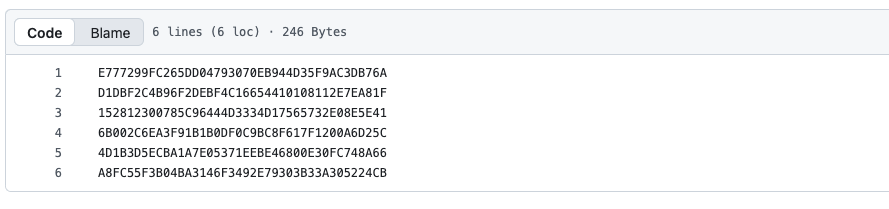
Signatures of the 6 core maintainers

To draw an analogy, Bitcoin Core maintainers are like the 'editors' of the Bitcoin network developers; anyone can contribute code and submit PRs to the codebase, but only the core maintainers have the authority to merge code into the official codebase and sign releases. This is similar to editors reviewing manuscripts, deciding whether developers' code is accepted for publication or returned for modification.

The signatures of Bitcoin Core maintainers ensure security, giving all nodes and users confidence that the release is 'official and unaltered.' However, Bitcoin Core maintainers do not have the direct power to trigger changes to on-chain rules. For example, even if Bitcoin Core maintainers have signed and released program files for a soft fork or hard fork of the Bitcoin network, the actual success of the upgrade depends on adoption and consensus from users and miners, not just the signatures of the Bitcoin Core maintainers.

When Bitcoin was first created, Satoshi Nakamoto was the only core maintainer, with sole authority to change the core codebase. Later, Satoshi passed this privilege to Gavin Andresen, who then passed it to Wladimir van der Laan. This means that for a long time, the power to maintain/change the Bitcoin network code was in the hands of one person. It wasn't until 2022, when Wladimir van der Laan stepped down and became embroiled in litigation with Craig Wright (who claims to be Satoshi Nakamoto), that this power began to be decentralized.

Even so, Bitcoin Core maintainers still play a crucial role. Those who become core maintainers typically have high levels of trust and reputation within the community or have made outstanding contributions to the Bitcoin network.

For example, one core maintainer, Ava Chow, is a transgender female developer. In 2024, when Bitcoin core developer Luke Dashjr wanted to restrict Ordinals transactions at the consensus level, it was she who rejected Luke Dashjr's PR on the grounds of 'no consensus and creating noise,' preventing a potential severe split in the Bitcoin network consensus and becoming an unsung hero.
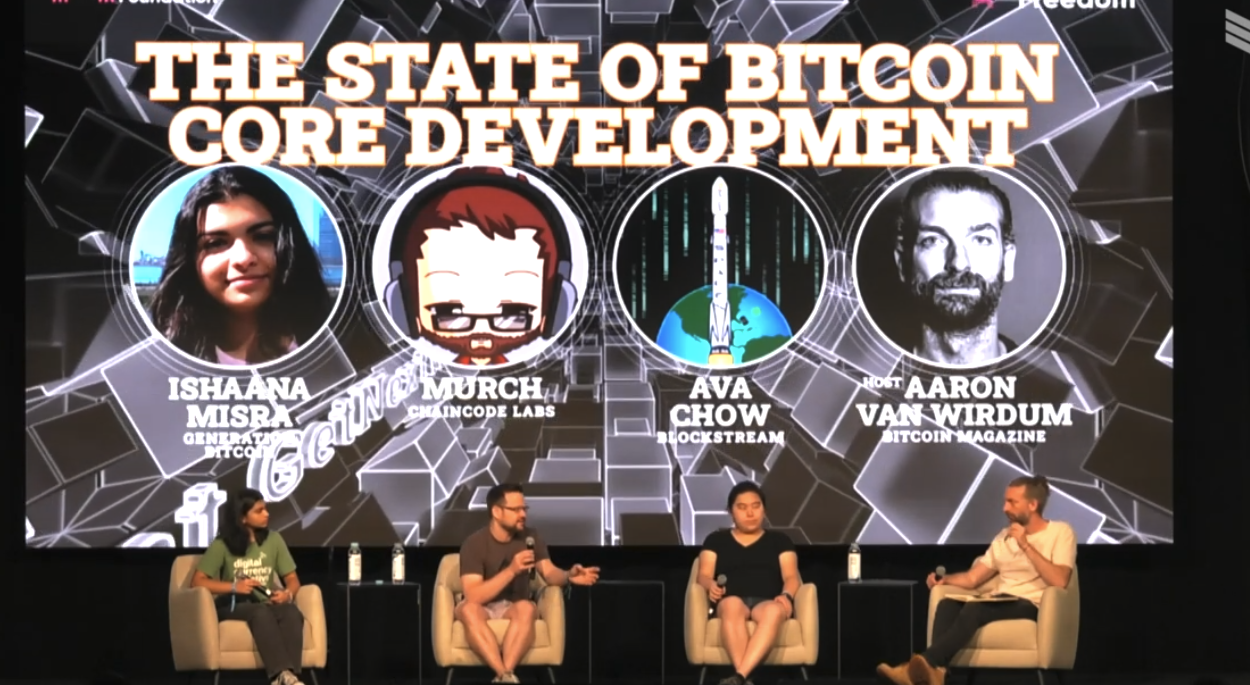
Ava Chow attended Bitcoin 2024 event

For introductions and contributions of other core maintainers, please refer to previous articles(related reading:Who is guarding Satoshi's legacy? A look at the 41-person army behind Bitcoin's trillion-dollar market cap). Next, we will introduce why TheCharlatan became the sixth core maintainer.

TheCharlatan: A Decade of Experience in Crypto Development

TheCharlatan graduated from the University of Zurich with a degree in computer science. He is South African and focuses on reproducibility and the verification logic of Bitcoin Core. In a 2024 blog post, he claimed to have been developing this project for over two years. TheCharlatan's work involves systematically splitting, organizing, and modularizing Bitcoin Core's verification logic, allowing other users to safely reuse it.

TheCharlatan

TheCharlatan is widely popular among Bitcoin Core developers. In the process of promoting him to core maintainer, at least 20 members expressed their approval. When nominating him, glozow praised: 'He is a reliable reviewer with extensive experience in key areas of the codebase, thoughtful about what we deliver to users and developers, and very familiar with the technical consensus process.'
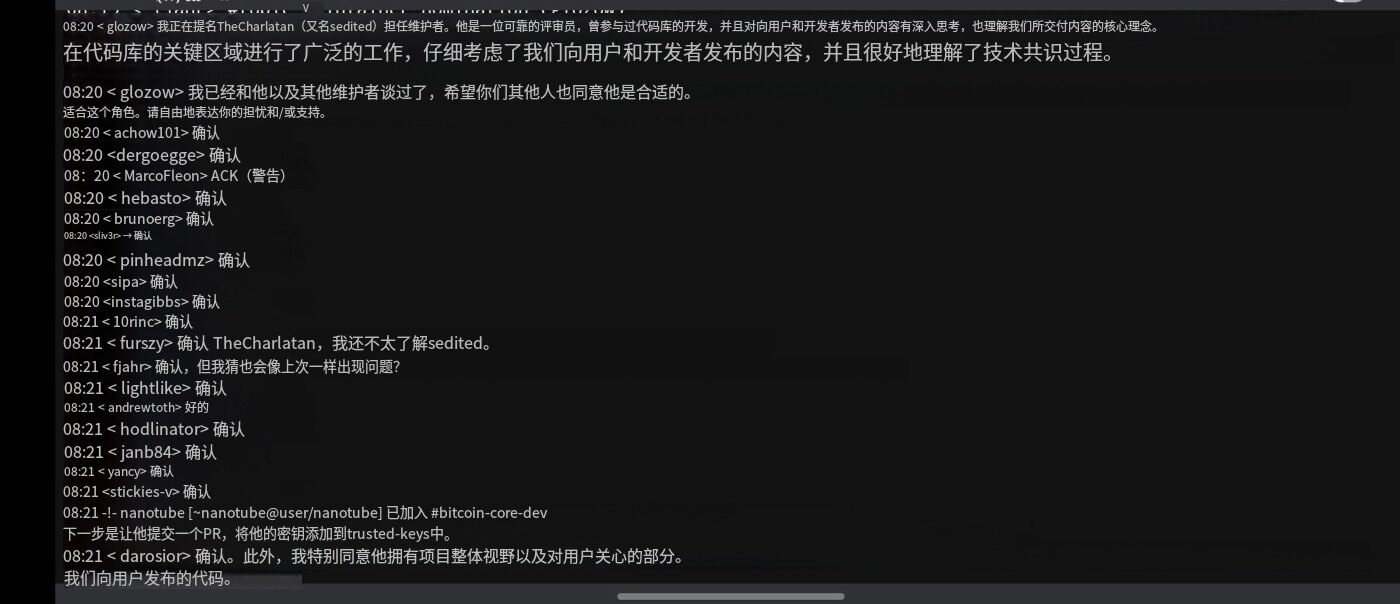
Bitcoin Core core developer group chat content (translated)

According to his GitHub account information, TheCharlatan first started crypto development in 2015 by creating a cryptocurrency price display tool. This tool was a simple Linux desktop widget with built-in price alerts that triggered when set thresholds were reached. His crypto development activities became more frequent after 2017. He began contributing code to Bitcoin Core in 2018, so it can be inferred that TheCharlatan first encountered Bitcoin Core 8 years ago, making him a veteran.

It is also worth noting that in 2021-2022, TheCharlatan contributed to a Farcaster project codebase. This project allowed people to exchange Bitcoin and Monero peer-to-peer with anyone running a Farcaster node.

TheCharlatan does have a 'soft spot' for Monero. In 2020, he researched the potential destruction issues caused by using hardware wallets to transfer Monero and discussed time-lock vulnerabilities in Monero.

Of course, true tech geeks can be somewhat elusive. TheCharlatan often retweets technical posts on platform X but rarely expresses his own opinions (in May 2025, he posted that he hates NFTs even more). However, since June 2025, he has been repeating a tweet every month that says: 'Cash on the internet. No auto-updates.'

I was afraid this might be some kind of secret code among Bitcoin tech geeks or a cultural slogan I wasn't aware of, so I asked AI to explain the meaning of these two sentences. The AI said these two sentences actually express an extreme Bitcoin fundamentalist view:

'True internet-native cash should be as simple, brutal, and immutable as cash. Once you start with automatic updates, governance votes, and frequent rule changes, it's no longer cash; it becomes another centralized/semi-centralized/manipulable 'digital bank account'.'


Trending Cryptos

Related Questions

QWho was recently promoted as the sixth core maintainer of Bitcoin Core with trusted keys?

ATheCharlatan (@sedited) was promoted as the sixth core maintainer of Bitcoin Core on January 8th.

QWhat is the primary responsibility of a Bitcoin Core core maintainer?

ACore maintainers are responsible for merging code into the official Bitcoin Core repository and signing the released program files (binaries) to ensure they are official and unaltered.

QHow many core maintainers with trusted keys are there currently in Bitcoin Core?

AThere are currently six core maintainers with trusted keys in Bitcoin Core.

QWhat significant contribution did Ava Chow make as a core maintainer?

AAva Chow rejected Luke Dashjr's PR to limit Ordinals transactions at the consensus level, preventing a potential severe split in the Bitcoin network consensus.

QHow long has TheCharlatan been contributing to Bitcoin Core development?

ATheCharlatan has been contributing to Bitcoin Core since 2018, making it approximately 8 years of involvement as of the article's context.

Related Reads

Only 153 Venture Capital Firms Invested in July: Is the Crypto VC Industry Experiencing a 'Mass Extinction'?

In July 2026, only 153 unique venture capital firms participated in disclosed crypto funding rounds, marking the lowest monthly count since November 2020. This figure represents an 87% decline from the peak of 1,177 firms in 2022. Overall, the first seven months of 2026 saw crypto projects raise approximately $11.78 billion across 481 rounds. This crypto VC contraction contrasts sharply with the broader venture capital landscape, where global VC investment reached a record $560.4 billion in H1 2026, heavily fueled by major AI company financings. This shift in capital allocation has drawn funds away from the crypto sector. Within crypto, funding is highly concentrated. Trading platforms, prediction markets, and payment sectors absorbed 53% of the total capital. While early-stage deals remain frequent, the largest sums flow to a few late-stage rounds and mergers & acquisitions, which surged to $7.23 billion in Q2 2026. The market is consolidating around top funds like a16z crypto and Dragonfly, which successfully raised new multi-billion dollar funds, while many smaller firms have retreated. Analysts describe this as a "great extinction" for crypto VCs, where capital is becoming more selective, favoring proven business models and assets over early-stage speculation. This raises the bar for project quality, funding efficiency, and viable exit paths.

marsbit14m ago

Only 153 Venture Capital Firms Invested in July: Is the Crypto VC Industry Experiencing a 'Mass Extinction'?

marsbit14m ago

Strategy's Loss in the Second Quarter Reaches $8.22 Billion Amid Bitcoin Decline

Strategy, the largest corporate holder of Bitcoin, reported a net loss of $8.22 billion for the second quarter. This loss was primarily driven by an $8.32 billion unrealized loss on its Bitcoin holdings due to a decline in the asset's price during the period. Despite these paper losses, the company increased its Bitcoin holdings to 843,775 BTC, a 25% growth since the start of the year. As part of a new monetization strategy, Strategy sold approximately $218.4 million worth of Bitcoin, mainly to fund dividends for preferred shareholders, with $216 million of that sold after Q2 ended. The company also built a $3.75 billion cash reserve, which it claims is sufficient to cover over two years of dividend and interest payments, aiming to insulate itself from Bitcoin's volatility while meeting obligations. Following the earnings release, Strategy's stock (MSTR) rose 4.7% in regular trading but corrected slightly after-hours. This pattern reflects how the company's accounting results are heavily tied to Bitcoin's price swings, even as its long-term strategy remains unchanged. The report indicates that Strategy is maintaining its core strategy of accumulating Bitcoin while building a financial buffer. This quarterly loss follows a recognizable pattern, with the company posting significant unrealized losses in previous quarters (e.g., $12.4 billion in Q4 2025 and ~$12.5 billion in Q1 2026) due to fair-value accounting. A key technical shift is its new monetization program, which introduces periodic selling pressure on the market, transitioning Strategy from a pure accumulator to a participant that occasionally adds supply. A critical question remains: how long can the cash reserve cover dividend obligations if a Bitcoin price downturn persists beyond two years?

cryptonews.ru34m ago

Strategy's Loss in the Second Quarter Reaches $8.22 Billion Amid Bitcoin Decline

cryptonews.ru34m ago

Will Terrorist Durov Ban Russian Officials?

Telegram founder Pavel Durov publicly reacted to being labeled a "terrorist" by Russian authorities, stating the designation came after he refused demands for mass surveillance and censorship on the platform. In a Telegram post, he highlighted that this status formally bans him from "publishing information online." Durov concluded with a statement widely circulated: Russian officials "clearly don't understand who can ban whom on the internet." This remark suggests Durov could potentially restrict official Russian government and officials' channels on Telegram, which continue to operate on the platform despite its formal blocking in Russia. The situation parallels previous, slow-moving state directives, like switching officials to domestic cars, contrasted with the current push to migrate all government communication to the Russian-made messenger MAX by 2030. However, reports indicate many officials still use Telegram via workarounds, fearing surveillance on MAX, while alternatives like BiP and KakaoTalk recently became inaccessible in Russia without a VPN. Durov has not specified any immediate actions against state channels. His statement is an initial response, with further developments depending on the authorities' reaction. The dynamic differs from 2020 when Russian regulators lifted a block on Telegram; now, Durov implies control from within the platform itself over the official accounts that persisted through that earlier blockade.

cryptonews.ru34m ago

Will Terrorist Durov Ban Russian Officials?

cryptonews.ru34m ago

DeepSeek V4 Official Version Arrives, New Capabilities Emerge, Value-for-Money King Enters the Fray

On July 31st, DeepSeek officially launched the public API beta for its DeepSeek-V4-Flash model. A key highlight is its performance on multiple Agent benchmark tests, reportedly nearing or even surpassing the level of the V4-Pro preview version from three months ago. Notably, the Flash model achieves this with significantly smaller scale (130B active parameters vs. Pro's 490B), suggesting that post-training optimization and data quality may be as crucial as raw model size. DeepSeek emphasized that the V4-Flash-0731 uses the same model architecture and size as its preview version, with improvements attributed solely to "re-trained post-training." The update also marks the official debut of DeepSeek's self-developed Agent framework, "Harness." The move signals DeepSeek's strategic push to position its cost-effective Flash model as a competitive base for Agent applications—scenarios requiring autonomous planning, tool usage, and complex task execution—where inference speed and cost are critical. By natively supporting OpenAI's Responses API format and adapting for code-generation scenarios, DeepSeek aims not just to be a cheaper alternative but to establish its own ecosystem in the Agent era. This release follows DeepSeek's record-breaking ~$50 billion fundraising round roughly two months prior, underscoring market confidence in its technology and commercialization prospects. The company is reportedly preparing for another funding round at a valuation of approximately $71 billion. The Flash model's advancement represents a step in fulfilling the high expectations that come with this valuation, setting the stage for the impending release of the V4-Pro official version and intensifying competition in the global Agent landscape.

marsbit38m ago

DeepSeek V4 Official Version Arrives, New Capabilities Emerge, Value-for-Money King Enters the Fray

marsbit38m ago

Trading

Spot

Hot Articles

What is $BITCOIN

DIGITAL GOLD ($BITCOIN): A Comprehensive Analysis Introduction to DIGITAL GOLD ($BITCOIN) DIGITAL GOLD ($BITCOIN) is a blockchain-based project operating on the Solana network, which aims to combine the characteristics of traditional precious metals with the innovation of decentralized technologies. While it shares a name with Bitcoin, often referred to as “digital gold” due to its perception as a store of value, DIGITAL GOLD is a separate token designed to create a unique ecosystem within the Web3 landscape. Its goal is to position itself as a viable alternative digital asset, although specifics regarding its applications and functionalities are still developing. What is DIGITAL GOLD ($BITCOIN)? DIGITAL GOLD ($BITCOIN) is a cryptocurrency token explicitly designed for use on the Solana blockchain. In contrast to Bitcoin, which provides a widely recognized value storage role, this token appears to focus on broader applications and characteristics. Notable aspects include: Blockchain Infrastructure: The token is built on the Solana blockchain, known for its capacity to handle high-speed and low-cost transactions. Supply Dynamics: DIGITAL GOLD has a maximum supply capped at 100 quadrillion tokens (100P $BITCOIN), although details regarding its circulating supply are currently undisclosed. Utility: While precise functionalities are not explicitly outlined, there are indications that the token could be utilized for various applications, potentially involving decentralized applications (dApps) or asset tokenization strategies. Who is the Creator of DIGITAL GOLD ($BITCOIN)? At present, the identity of the creators and development team behind DIGITAL GOLD ($BITCOIN) remains unknown. This situation is typical among many innovative projects within the blockchain space, particularly those aligning with decentralized finance and meme coin phenomena. While such anonymity may foster a community-driven culture, it intensifies concerns about governance and accountability. Who are the Investors of DIGITAL GOLD ($BITCOIN)? The available information indicates that DIGITAL GOLD ($BITCOIN) does not have any known institutional backers or prominent venture capital investments. The project seems to operate on a peer-to-peer model focused on community support and adoption rather than traditional funding routes. Its activity and liquidity are primarily situated on decentralized exchanges (DEXs), such as PumpSwap, rather than established centralized trading platforms, further highlighting its grassroots approach. How DIGITAL GOLD ($BITCOIN) Works The operational mechanics of DIGITAL GOLD ($BITCOIN) can be elaborated on based on its blockchain design and network attributes: Consensus Mechanism: By leveraging Solana’s unique proof-of-history (PoH) combined with a proof-of-stake (PoS) model, the project ensures efficient transaction validation contributing to the network's high performance. Tokenomics: While specific deflationary mechanisms have not been extensively detailed, the vast maximum token supply implies that it may cater to microtransactions or niche use cases that are still to be defined. Interoperability: There exists the potential for integration with Solana’s broader ecosystem, including various decentralized finance (DeFi) platforms. However, the details regarding specific integrations remain unspecified. Timeline of Key Events Here is a timeline that highlights significant milestones concerning DIGITAL GOLD ($BITCOIN): 2023: The initial deployment of the token occurs on the Solana blockchain, marked by its contract address. 2024: DIGITAL GOLD gains visibility as it becomes available for trading on decentralized exchanges like PumpSwap, allowing users to trade it against SOL. 2025: The project witnesses sporadic trading activity and potential interest in community-led engagements, although no noteworthy partnerships or technical advancements have been documented as of yet. Critical Analysis Strengths Scalability: The underlying Solana infrastructure supports high transaction volumes, which could enhance the utility of $BITCOIN in various transaction scenarios. Accessibility: The potential low trading price per token could attract retail investors, facilitating wider participation due to fractional ownership opportunities. Risks Lack of Transparency: The absence of publicly known backers, developers, or an audit process may yield skepticism regarding the project's sustainability and trustworthiness. Market Volatility: The trading activity is heavily reliant on speculative behavior, which can result in significant price volatility and uncertainty for investors. Conclusion DIGITAL GOLD ($BITCOIN) emerges as an intriguing yet ambiguous project within the rapidly evolving Solana ecosystem. While it attempts to leverage the “digital gold” narrative, its departure from Bitcoin's established role as a store of value underscores the need for a clearer differentiation of its intended utility and governance structure. Future acceptance and adoption will likely depend on addressing the current opacity and defining its operational and economic strategies more explicitly. Note: This report encompasses synthesised information available as of October 2023, and developments may have transpired beyond the research period.

1.1k Total ViewsPublished 2025.05.13Updated 2025.05.13

What is $BITCOIN

Discussions

Welcome to the HTX Community. Here, you can stay informed about the latest platform developments and gain access to professional market insights. Users' opinions on the price of BTC (BTC) are presented below.

活动图片