FalconX and Interstice Connect Canton with Ethereum, Solana, and Robinhood Chain

cryptonews.ruPublished on 2026-08-18Last updated on 2026-08-18

Abstract

Interstice Digital and FalconX have launched a cross-chain swap engine connecting the Canton Network with Ethereum, Solana, and Robinhood Chain. The non-custodial engine allows users to exchange assets across these four networks without transferring assets to Interstice for safekeeping or having transactions executed on their behalf. FalconX, a leading digital asset broker for institutional investors, provides the liquidity for the engine, bridging institutional markets on Canton with assets and trading activity on public blockchains. Canton is a public blockchain designed for institutional financial markets, featuring privacy and permissioning mechanisms for regulated transactions of tokenized assets. Its ecosystem includes major financial institutions like JPMorgan and Goldman Sachs. The integration aligns with growing institutional adoption of Canton for asset tokenization and blockchain-based settlement. Recent examples include Tradeweb facilitating a real-time on-chain U.S. Treasury trade using Canton and Societe Generale deploying euro and dollar stablecoins on the network for tokenized collateral and settlements.

Interstice Digital, in collaboration with FalconX, has launched a cross-chain swap engine connecting the Canton Network with Ethereum, Solana, and Robinhood Chain.

According to Tuesday's announcement, the non-custodial engine allows for the exchange of assets across the four networks without transferring assets into Interstice's custody or conducting transactions on behalf of users.

FalconX, a leading digital asset broker for institutional investors, provides liquidity for the engine. It connects the institutional markets of Canton with assets and trading activity in public blockchains, enabling users to move tokenized assets between Canton and networks like Ethereum and Solana.

Canton is a public blockchain for the institutional financial market. The network utilizes privacy and permissioning mechanisms for regulated transactions and tokenized assets. Its ecosystem includes major financial institutions such as JPMorgan, Goldman Sachs, and BNP Paribas.

Interstice is a fully owned subsidiary of Everyrealm, backed by investors including a16z Crypto, Coinbase Ventures, Galaxy, and Brevan Howard. The company has not disclosed which assets are supported at launch, nor has it revealed the transaction volume processed through the swap engine.

Related: FalconX Cuts 10% of Staff Amid Prolonged Crypto Market Slump: Report

Canton Expands Activity in Institutional Tokenization

The integration coincides with a growing number of traditional financial institutions using Canton for asset tokenization and blockchain-based settlement.

In July, electronic trading platform Tradeweb conducted an on-chain U.S. Treasury transaction where Franklin Templeton transferred a tokenized treasury security to Virtu Financial in exchange for tokenized cash.

Tradeweb facilitated trade execution and price discovery, while Canton synchronized the settlement between the two assets in real-time. Tradeweb stated this was the first real-time buy-sell transaction of tokenized U.S. Treasuries settled in USDCx—a USDC-backed stablecoin issued on Canton. Other participants included Societe Generale, Digital Asset, and Blockdaemon.

Societe Generale has also issued its euro and dollar-denominated stablecoins on Canton for tokenized collateral, repo financing, and institutional settlements. Visa tested settlements using a private stablecoin on the network.

Other initiatives include a pilot for using Japanese government bonds as collateral involving Mizuho and Nomura, as well as the listing of the S&P Dow Jones Indices iBoxx US Treasuries index on Canton.
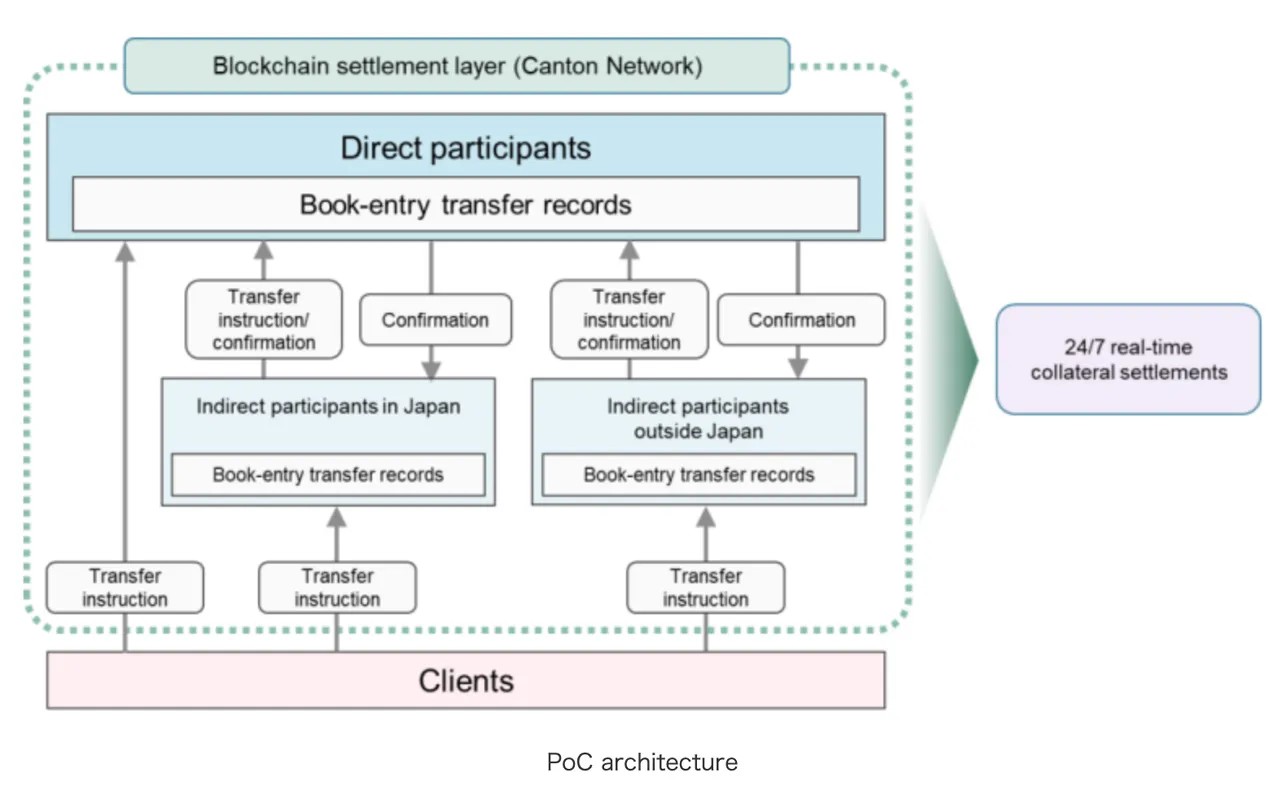
A PoC pilot for managing digital collateral using Japanese government bonds. Source: JPX

Magazine: Solana Fee Revamp Accelerates Token Burning and Raises Costs for Active Users

end-content
Trending Cryptos

Related Questions

QWhat new cross-chain engine did Interstice and FalconX launch, and which networks does it connect?

AInterstice Digital, in partnership with FalconX, launched a cross-chain swap engine that connects Canton Network with Ethereum, Solana, and Robinhood Chain.

QWhat specific feature of the new swap engine eliminates the need for asset custody by Interstice?

AThe new engine is non-custodial, meaning it allows asset swaps between networks without Interstice taking custody of assets or executing transactions on behalf of users.

QWhat role does FalconX play in the new cross-chain swap engine?

AFalconX acts as the liquidity provider for the swap engine and connects institutional markets on Canton with assets and trading activity on public blockchains.

QWhat are some key characteristics of the Canton Network, and which major financial institutions are part of its ecosystem?

ACanton is a public blockchain designed for institutional financial markets, featuring privacy and permissioning mechanisms for regulated transactions and tokenized assets. Major institutions in its ecosystem include JPMorgan, Goldman Sachs, and BNP Paribas.

QWhat was a notable real-world transaction facilitated on Canton Network mentioned in the article?

AIn July, Tradeweb facilitated an on-chain trade of U.S. Treasuries where Franklin Templeton transferred a tokenized Treasury security to Virtu Financial in exchange for tokenized cash, with Canton synchronizing the real-time settlement of both assets in USDCx.

Related Reads

Lei Jun Reports Xiaomi's Q2 Performance, Phone Premiumization Takes Effect, While Automotive and AI Continue 'Burning Cash'

Xiaomi released its Q2 2026 financial results, showing mixed performance. Total revenue was approximately 108.9 billion yuan, down 6.1% year-over-year, while adjusted net profit fell 42.6% to about 6.2 billion yuan. The company's core smartphone business saw a 7.5% decline in revenue to 42.1 billion yuan, primarily due to lower shipment volumes, partially offset by a record high average selling price (ASP) which rose 25.9%. Xiaomi's global smartphone market share held steady at third place. Its AIoT platform connected over 1.16 billion devices, a 17.4% increase. Despite pressures on traditional revenue streams, Xiaomi continues heavy investment in new growth areas. Its innovation segment, encompassing smart electric vehicles and AI, generated 24.9 billion yuan in revenue (up 17.1%), but reported an operating loss of 2.6 billion yuan. Capital expenditure for these businesses reached 2.4 billion yuan in Q2. Vehicle deliveries grew 28.2% to 104,199 units, with cumulative deliveries for the SU7 series surpassing 500,000 units by mid-August. The company also highlighted significant R&D spending of 9.2 billion yuan for the quarter. On the technology front, Xiaomi announced several AI and software developments, including the new Xiaomi HyperOS 4, the "Super Xiaoai 2.0" assistant, and advancements in its MiMo large language model and robotics platform. The company noted its first-generation self-developed chip, the Xuangjie O1, has surpassed one million units shipped across three products, with a new generation chip soon to be released. Management acknowledged that memory price increases impacted low-end phone sales more severely but expects the trend to moderate.

marsbit13m ago

Lei Jun Reports Xiaomi's Q2 Performance, Phone Premiumization Takes Effect, While Automotive and AI Continue 'Burning Cash'

marsbit13m ago

From Minting to Tape-Out: A First-Timer’s Guide to TapeOut

Title: From Mint to Tapeout: A First-Timer’s Guide to TapeOut **Summary:** This guide provides a risk-conscious, step-by-step introduction to TapeOut, a platform where users can mint logic components (NAND, LATCH) and use them to "tape out" on-chain circuits. It emphasizes a fundamental shift in mindset: instead of focusing first on prices or speculation, users should first understand how to use the platform's core functionality. The recommended path begins with preparation: use a separate, low-fund wallet on BNB Smart Chain for experimentation. The first step is to choose a "Processor"—the foundational unit for components and circuits—by examining its details (supply, mintage, creator) rather than chasing trends. If a Processor has remaining supply, users can mint a small number of components. The guide stresses that minting acquires specific components for a specific processor, not a generic asset. For sold-out Processors, trading occurs on an order book market. Users must carefully understand order prices, quantities, and the 1% fee, and always verify transactions on a block explorer. The core "play" experience is in the Canvas, where users can build and test logic circuits without a wallet. Before proceeding to tapeout—the irreversible, on-chain act of finalizing a circuit which consumes components—users must verify their design, component costs, and target processor. After taping out a circuit, the guide encourages users to interact with it, for example by calling its functions via BscScan's read contract feature, completing the "components -> circuit -> verification" loop. It concludes with critical safety checks to perform before any wallet signature, and cautions against misinterpreting demo pages (like the "on-chain BTC miner") as profit-generating services. The goal is to approach TapeOut as a hands-on lesson in on-chain logic, minimizing financial risk while learning its unique mechanics.

marsbit47m ago

From Minting to Tape-Out: A First-Timer’s Guide to TapeOut

marsbit47m ago

Wall Street Analyst Predicts SpaceX Stock Price Drop to $75

A Wall Street analyst from Phillip Securities, Glenn Tumm, has issued a "Sell" recommendation for SpaceX stock (SPCX), maintaining a 12-month price target of $75. This implies a potential 46.6% drop from the current price of $140.50. The bearish outlook is based on the company's significant capital expenditures, reliance on temporary cloud service contracts, and customer concentration in its AI services, suggesting a need for longer-term commitments to support its valuation. This stance contrasts sharply with the broader Wall Street consensus. An average of 31 analysts polled by TipRanks sets a 12-month price target of $232.35, implying 64% upside, with the highest forecast at $800 and the lowest at $75. The report follows SpaceX's impressive Q2 2026 results, where total revenue surged 92% year-over-year to $7.8 billion. Starlink subscriber count doubled to 12 million, driving communications revenue up 66% to $4.3 billion. AI-related revenue skyrocketed 247% to $2.6 billion, fueled by new cloud services and infrastructure deals. Despite the strong earnings, SPCX shares fell over 4% in the last 24 hours, reducing the company's market cap to $1.9 trillion. The stock had initially jumped over 17% post-earnings but faced resistance near $149. The analyst concludes that SpaceX's future trajectory hinges on securing more long-term contracts with its AI and Starlink customers. Success could validate Wall Street's bullish forecasts, while failure may render the recent stock rebound temporary.

cryptonews.ru1h ago

Wall Street Analyst Predicts SpaceX Stock Price Drop to $75

cryptonews.ru1h ago

Trading

Spot

Hot Articles

Discussions

Welcome to the HTX Community. Here, you can stay informed about the latest platform developments and gain access to professional market insights. Users' opinions on the price of ETH (ETH) are presented below.

活动图片