Expert Says There Will Be No Altcoin Season In 2026, Here’s Why

bitcoinistPublished on 2026-03-07Last updated on 2026-03-07

Abstract

According to crypto analyst Matthew Hyland, a traditional altcoin season is unlikely to occur in 2026. His analysis is based on historical patterns showing that recovery from major cycle lows in altcoin dominance typically takes two to three years. Since the most recent low likely happened around October 2025, the next altcoin season is projected for 2027-2028. Despite this, Hyland notes that the broader crypto market may still see significant gains in 2026, with Bitcoin expected to remain the dominant driver of price action. He also highlights that the current market is in a "max opportunity zone" for long-term accumulation. Supporting evidence shows social media discussions about "altseason" have hit a two-year low, which historically acts as a contrarian buy signal. This sentiment trough often indicates that altcoins are at yearly lows, presenting potential buying opportunities before a future rally.

The timing of the next altcoin season is one of the most debated topics in the cryptocurrency market as traders search for signs that capital could soon rotate away from Bitcoin into smaller assets. However, not every analyst believes that the next phase of the cycle will arrive soon.

According to crypto analyst Hyland, investors may still see significant upside in the broader crypto market once Bitcoin turns bullish again, but an altcoin season might not materialize this year.

Why An Altcoin Season In 2026 May Be Unlikely

Crypto analyst Matthew Hyland, who has built a significant following on X for his crypto market takes, recently made a bold declaration: there will be no altcoin season in 2026. In his post on X, Hyland stated that there will likely be no traditional altcoin season in 2026. His reasoning is tied to how long it historically takes for altcoin dominance to recover after hitting major cycle lows.

He explained that the change from the lowest point of altcoin dominance to a full altcoin season market rally typically takes between two and three years. Based on this pattern, the most recent low in altcoin dominance likely occurred around October 2025.
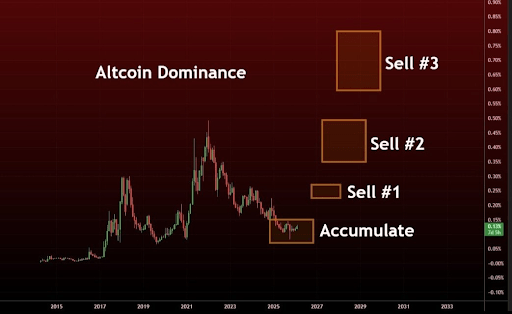
Source: Chart from Matthew Hyland on X

If that timeline holds, the next major altcoin season would be expected sometime between 2027 and 2028. That means that altcoins could still spend much of 2026 in a transition period where Bitcoin keeps being the dominant driving force of price action.

Even though Hyland believes the full altcoin season will not arrive this year, he pointed out that investors may still see substantial upside across the crypto market before that phase begins. Particularly, he noted that the market is currently in the max opportunity zone for long-term crypto accumulation.

AltSeason Hype At Two-Year Low

The most compelling supporting evidence of the current state of the altcoin season and Bitcoin dominance can be seen in crowd behavior. Recent data from the on-chain analytics platform Santiment shows that discussions about an altcoin season have cooled massively across social media platforms.

According to Santiment’s social trends metrics, social mentions of the term “altseason” have dropped to a two-year low. The data tracks the weekly volume of discussions about altcoin season across major social platforms over the past two years.

The chart shows that spikes in social mentions have always appeared around market peaks, when excitement about altcoin rallies is at its highest. However, this kind of sentiment trough has always acted as a contrarian buy signal.

When the crowd stops talking about something, it often means the crowd has given up, and the price action of many altcoins is at yearly lows. That is precisely when the best buying opportunities tend to emerge.

Overall market cap excluding BTC at $963 billion on the 1D chart | Source: TOTAL2 on Tradingview.com

Related Questions

QAccording to analyst Matthew Hyland, why is an altcoin season unlikely to occur in 2026?

ABecause the recovery from the lowest point of altcoin dominance to a full altcoin season typically takes 2-3 years, and the most recent low likely occurred around October 2025.

QWhat is the expected timeframe for the next major altcoin season based on Hyland's historical pattern analysis?

AThe next major altcoin season is expected to occur sometime between 2027 and 2028.

QWhat does the data from Santiment indicate about current social media discussions regarding 'altseason'?

ASocial mentions of the term 'altseason' have dropped to a two-year low, indicating that discussions have cooled massively.

QDespite the prediction of no altcoin season in 2026, what positive outlook does Hyland offer for the crypto market?

AHe states that investors may still see substantial upside across the crypto market and that it is currently in the 'max opportunity zone' for long-term crypto accumulation.

QHow does the article describe the relationship between social media hype about altseason and market peaks?

ASpikes in social mentions of 'altseason' have always appeared around market peaks, when excitement is highest, while low sentiment often acts as a contrarian buy signal.

Related Reads

Crypto Market Makers Are Collectively Seeking Change as Money Becomes Harder to Earn

**Summary: Crypto Market Makers Adapt as Margins Shrink** Leading crypto market maker GSR exemplifies a broader industry shift, moving beyond traditional market-making to become a full-service "Web3 investment bank." Its recent strategic acquisitions—including an SEC-registered broker-dealer, rebranded as GSR Securities—and purchases of token advisory firms aim to create an integrated platform covering token design, fundraising, listing, liquidity provision, and asset management. This includes launching an ETF and investing in tokenization platforms like Libeara, backed by a strategic investment from Standard Chartered's SC Ventures. This transformation is not unique to GSR. Other major players like Keyrock, B2C2, Wintermute, and DWF Labs are also expanding geographically, pursuing regulatory licenses (especially under frameworks like MiCA in the EU), and diversifying into over-the-counter (OTC) trading, asset management, and real-world asset tokenization. The driving force behind this collective pivot is a rapidly changing market. Profits from traditional altcoin market-making are declining due to fewer viable projects, reduced client budgets, increased competition, and smarter, more demanding clients. Simultaneously, regulatory pressures are mounting, making compliance a baseline cost. Extreme market events further expose teams lacking robust risk controls. Consequently, the crypto market-making business model is evolving from one reliant on information asymmetry and volatility to a more institutionalized, regulated, and service-diverse industry. Survival now depends on building systemic capabilities beyond mere liquidity provision.

marsbit51m ago

Crypto Market Makers Are Collectively Seeking Change as Money Becomes Harder to Earn

marsbit51m ago

Market Adjusts Following Google's $84.7 Billion Fundraising, AI Valuations Now Focus on Payback Speed

After Alphabet's announcement of an $84.75 billion equity financing round, market focus for AI investment is shifting from pure growth narratives to capital efficiency and payback periods. The core argument is that AI is being re-priced from a software-like growth story into a heavy-asset infrastructure cycle, requiring massive capital expenditure (CapEx) on chips, data centers, and power grids. While Alphabet's financing itself is not a distress signal—part of it is for administrative purposes like tax obligations on stock compensation—it highlights the enormous capital demands of AI infrastructure. This demand extends beyond tech giants to pure-play AI model companies (like OpenAI, Anthropic), data center REITs, and utilities. Major tech firms are projected to spend heavily on AI data centers in 2026, signaling a broad-based capital cycle the market must absorb. Consequently, valuation logic is changing. Investors are moving away from questions about who has the strongest AI narrative and are now prioritizing clear visibility into orders, stable cash flows, and the cost of capital. This has led to recent pressure on high-multiple AI software and semiconductor stocks, while "picks-and-shovels" hardware, data center, and power assets with firmer near-term demand may see relative support. The key going forward will be monitoring whether rising CapEx guidance across companies is matched by a timely monetization of AI investments into revenue and cash flow. The market's tolerance for high spending depends on demonstrable returns. While the long-term AI thesis remains intact, the valuation framework has fundamentally shifted to emphasize capital discipline and payback speed.

marsbit58m ago

Market Adjusts Following Google's $84.7 Billion Fundraising, AI Valuations Now Focus on Payback Speed

marsbit58m ago

Trading

Spot
Futures

Hot Articles

Discussions

Welcome to the HTX Community. Here, you can stay informed about the latest platform developments and gain access to professional market insights. Users' opinions on the price of S (S) are presented below.

活动图片