Examining if STABLE’s uptrend is sustainable after its latest 5% price hike

ambcryptoPublished on 2026-06-26Last updated on 2026-06-26

Abstract

STABLE has shown notable resilience and strength against a weak broader crypto market, recently surging over 5% to trade around $0.362 while defending key support at $0.33. Its bullish structure is supported by trading above key moving averages, a rising Stochastic Momentum Index, and a significant negative Spot Netflow indicating strong sustained demand, with daily outflows exceeding inflows. However, the uptrend faces sustainability concerns. A persistently negative Price DAA Divergence for seven consecutive days reveals weak network usage and low user engagement, signaling underlying structural weakness. This historically increases the risk of a price correction. While strong demand could propel STABLE to close above $0.36 and challenge the $0.40 resistance, failure to maintain momentum could trigger a pullback toward the $0.32 support level.

While the broader crypto market has shown significant weakness, STABLE has consistently held up. As the market crashed on 24th June, STABLE defended the $0.33-support and climbed to a local high of $0.365.

At the time of writing, STABLE was trading at around $0.362, up 5.5% over the past 24 hours in addition to its 7% weekly gains.

At the same time, the trading volume of the altcoin rose by 25% to $20.8 million, indicating an uptick in market participation.

Why is STABLE holding up?

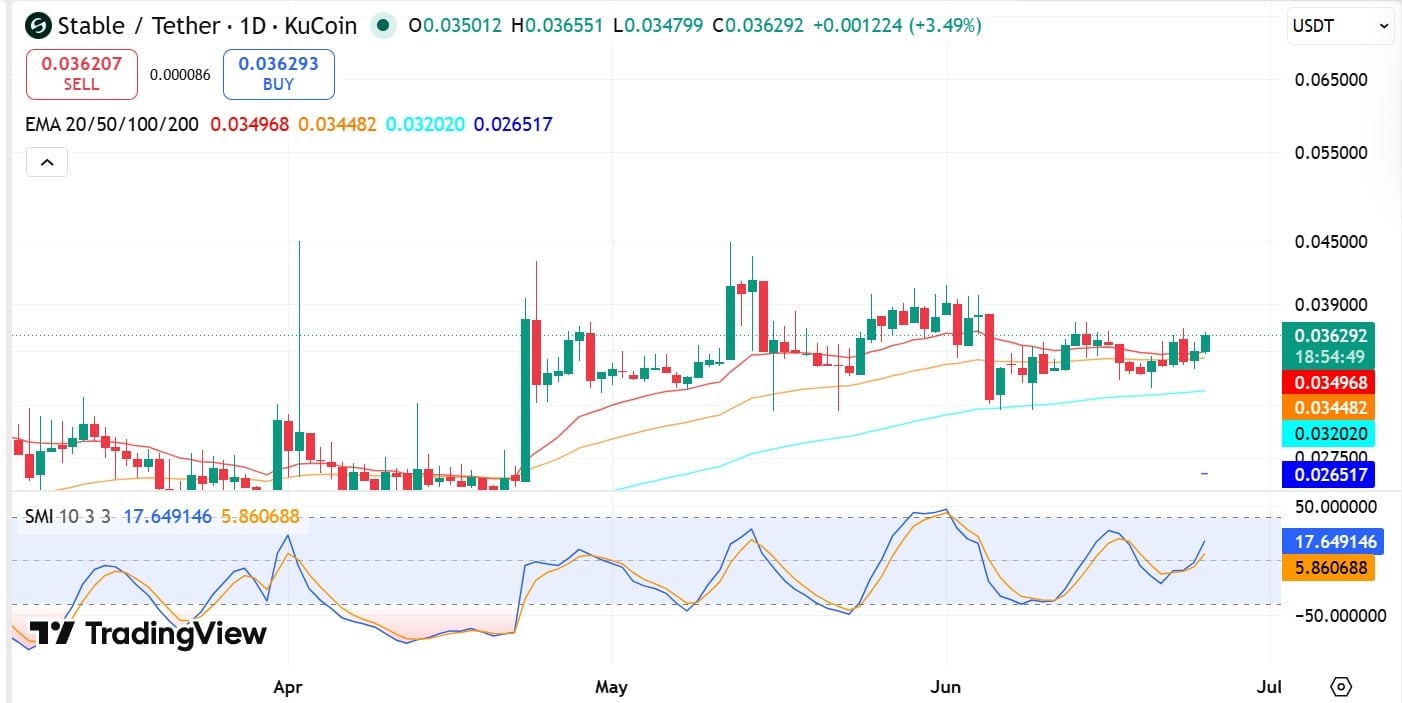
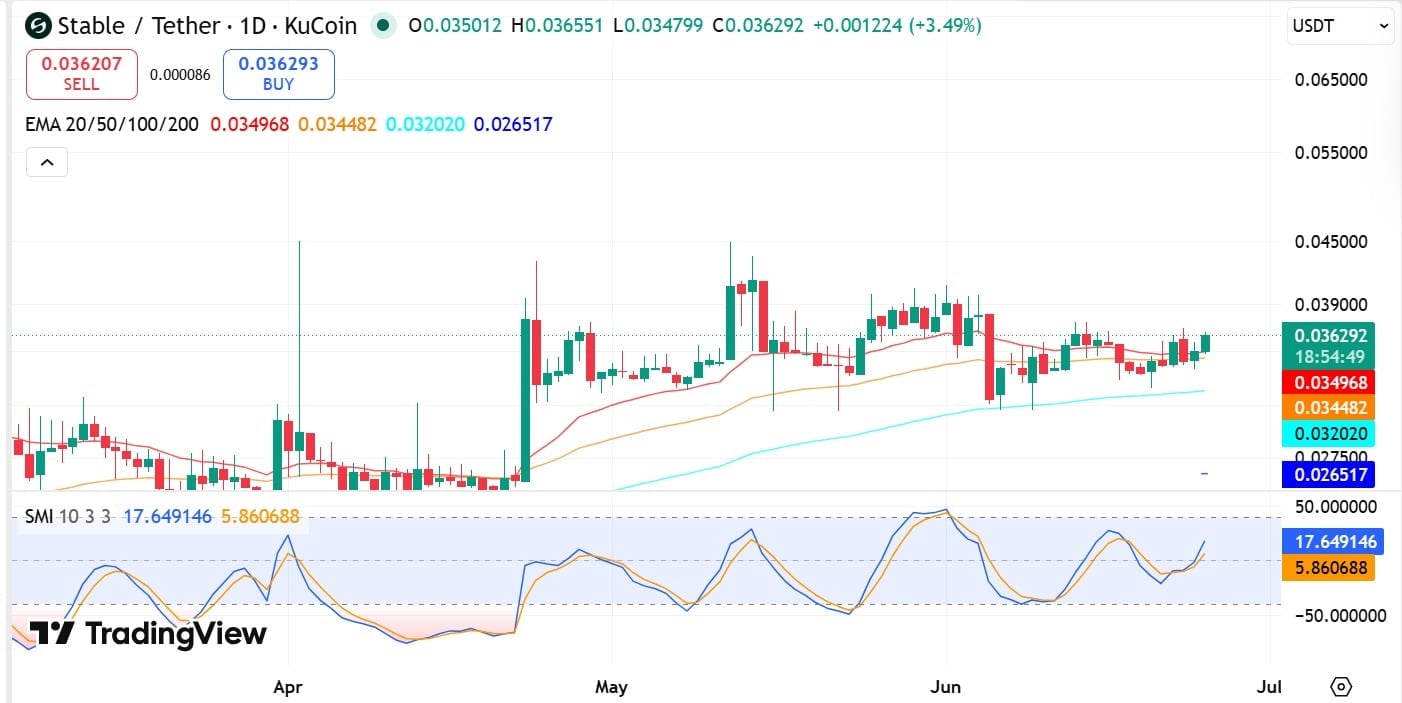
STABLE’s daily charts underlined a strengthening bullish structure. The altcoin jumped above its 20 and 50-day EMAs at $0.349 and $0.344, respectively.

In doing so, the altcoin clearly sat above both its short and long-term moving averages, confirming the trend’s strength on the charts.
Source: Tradingview

The Stochastic Momentum Index further validated these market conditions. The SMI indicator rose to 17, while its signal rose to 7. Although the SMI remained within the bearish zone, its upward trajectory reflected improving momentum and buyer presence.

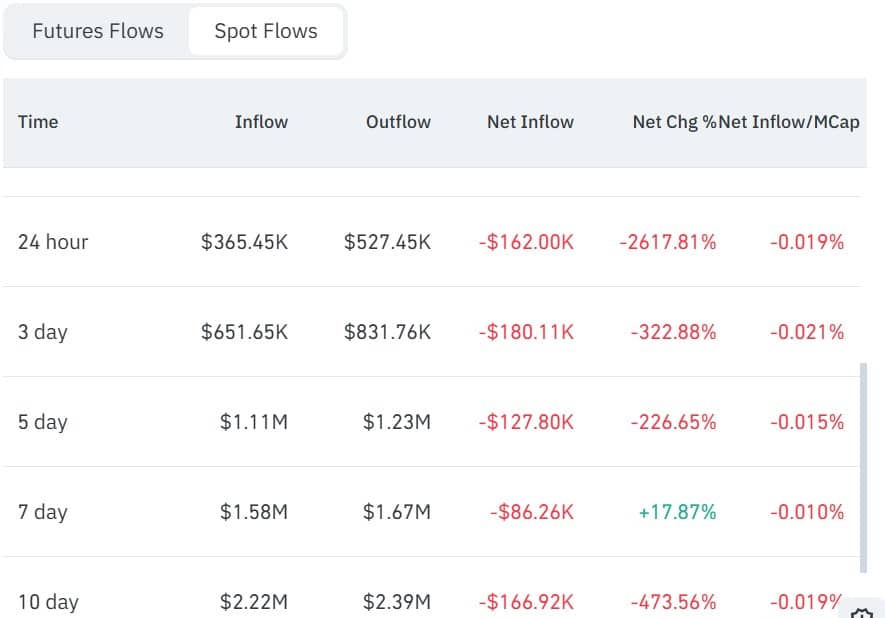
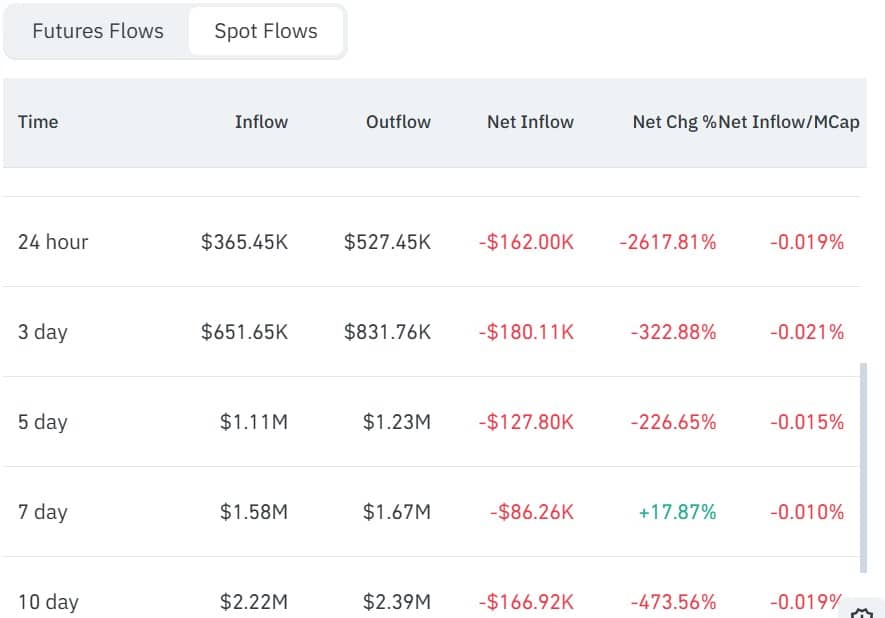
The spot activity further confirmed this point of view. The altcoin’s Spot Netflow extended its stay in negative territory, holding there for seven consecutive days.
Source: Coinglass

That’s not all though as over the last 24 hours, Spot Outflows rose to $527K while Inflows dropped to $365K. As a result, Netflow plunged 2617% to -$162K – A clear sign of sustained demand.

Therefore, it’s suitable to say that the altcoin has recently shown relative strength, largely driven by sustained spot demand.

Is the network’s sustainability of concern?

Although STABLE has been exhibiting some strength, demand-wise, the market did raise some concerns.

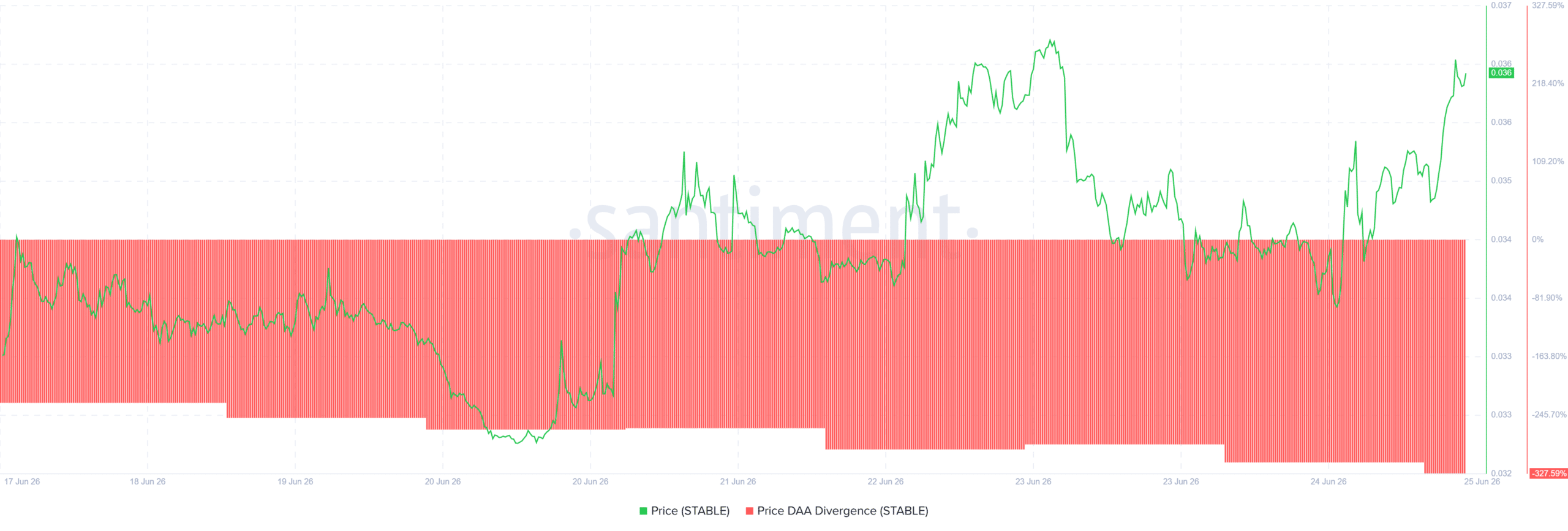
For starters, the network’s usage remains extremely weak. For instance, a look at STABLE’s Price DAA Divergence revealed that the metric has remained negative for 7 consecutive days.
Source: Santiment

A negative DAA Divergence means that Active Addresses have been failing and have not kept up with the price. User engagement often leads to weak network fundamentals, implying the uptrend lacks stronger user participation.

Historically, such structural weaknesses have extensively increased the risk of price correction.

Can the altcoin’s upside momentum hold?

STABLE exhibited relative strength, driven by strong market demand. With upside momentum holding up, the altcoin might be positioned for further gains too.

Therefore, under these conditions, STABLE will close above $0.36 and flip its $0.40-resistance.

However, as was observed, pullback risks remain due to structural weakness. If the bulls’ attempt fails and the price fails to close above $0.36, a retrace will follow.

Another pullback will see the altcoin drop below $0.34 and seek immediate support at $0.32.


Final Summary

  • STABLE surged by 5% and successfully defended $0.33, hiking to a local high of $0.36 amid sustained demand.
  • Altcoin remains structurally weak, with low user engagement posing a risk for another pullback towards $0.32.

Related Questions

QWhat are the key price levels mentioned for STABLE in the article?

AThe article mentions STABLE defending the $0.33 support, climbing to a local high of $0.365, and trading at around $0.362 at the time of writing. It identifies a key resistance level at $0.40 and suggests a potential pullback support level at $0.32.

QWhat technical indicators are cited as evidence of STABLE's bullish structure?

AThe article cites STABLE trading above its 20-day EMA ($0.349) and 50-day EMA ($0.344) as confirmation of a strengthening bullish trend. It also mentions the upward trajectory of the Stochastic Momentum Index (SMI) from low levels, reflecting improving momentum.

QWhat on-chain metric raises concerns about the sustainability of STABLE's uptrend?

AThe article highlights the consistently negative Price DAA (Daily Active Addresses) Divergence for seven consecutive days. This indicates that user engagement (active addresses) is not keeping pace with the price increase, suggesting weak network fundamentals and a risk of correction.

QWhat does the spot market activity data (Netflow) indicate about STABLE's recent demand?

AThe Spot Netflow data shows sustained negative values for seven days, with a significant plunge to -$162K in the last 24 hours due to outflows exceeding inflows. The article interprets this negative netflow as a clear sign of sustained demand, as more tokens are being withdrawn from exchanges than deposited.

QWhat are the potential price scenarios for STABLE outlined in the article's conclusion?

AThe article presents two scenarios: 1) If bullish momentum holds, STABLE could close above $0.36 and challenge the $0.40 resistance level. 2) If the bullish attempt fails and the price fails to hold above $0.36, a pullback could occur, potentially driving the price below $0.34 towards support at $0.32.

Related Reads

Upbit is Anxious: A Hasty Counterattack Aimed at Regaining Stablecoin Market Share

Title: Upbit's Rushed Counterattack to Reclaim Stablecoin Market Share Facing a dramatic shift in South Korea's stablecoin market, leading exchange Upbit launched a promotional campaign from July 26 to August 9, waiving the 0.05% trading fee for stablecoins paired with the Korean Won (KRW) and rapidly listing new stablecoins like RLUSD and USDG. This move is a direct response to its plummeting market share in this sector. Historically a duopoly with Bithumb, the market has been reshaped since October 2025 when Coinone permanently removed fees for USDC trading. By June 2026, Coinone led with 34.8% of stablecoin volume, followed by Bithumb (31.1%) and Upbit (30.1%). This contrasts sharply with the overall crypto market, where Upbit commands 60%. The data shows stablecoin demand is highly sensitive to fees, as users primarily buy them to transfer capital overseas for derivatives trading or forex arbitrage. South Korean exchanges have seen a net outflow of stablecoins for 18 consecutive months, totaling approximately 14.9 trillion KRW, underscoring their role as a cross-border capital conduit. Upbit's limited-time promotion initially boosted its daily stablecoin volume by 162%, but the surge was almost entirely in USDT (98.1% of volume). The newly listed stablecoins saw negligible, fleeting interest. Furthermore, the promotional effect quickly waned in the second week, with volume dropping 33% on weekdays. A concurrent weakening of the KRW also contributed to the trading spike, independent of the fee waiver. The analysis suggests that once the promotion ends, Upbit is unlikely to retain its temporary gains unless it matches Coinone's permanent zero-fee policy, forcing a choice between market share and fee revenue. Upbit's strategic push may be less about immediate profit and more about preparing for future regulatory shifts. With South Korea's *Digital Asset Basic Act* on the horizon, which will regulate KRW-backed stablecoins, and following Dunamu's (Upbit's parent) integration into Naver Financial to build a payment ecosystem, securing a dominant position in the dollar stablecoin distribution channel holds long-term strategic value. However, potential regulatory conflicts could prevent Upbit from listing a future Naver-issued KRW stablecoin, making the current fight for dollar stablecoin flow even more critical.

marsbit2h ago

Upbit is Anxious: A Hasty Counterattack Aimed at Regaining Stablecoin Market Share

marsbit2h ago

Michael Saylor Compares Bitcoin and Gold!

Michael Saylor, founder of MicroStrategy, argues that Bitcoin fundamentally changes how wealth is stored and transferred by transforming digital scarcity into economic value. He describes Bitcoin as the first digital monetary network, combining computers, digital networks, and cryptography. It digitizes monetary assets, allowing their supply to be controlled by public protocols rather than institutions, thus converting economic value into information transmissible over global networks. Comparing Bitcoin to gold, Saylor states that while increasing Bitcoin's supply is harder, its integration with software and transfer is easier. He highlights Bitcoin's proof-of-work mechanism, which ties it to the physical world by consuming real energy to secure the ledger, making past transactions immutable. This creates a shared security system involving miners, energy companies, and investors. Saylor suggests "digital monetary energy" is a more accurate term than "digital gold." He emphasizes that the Bitcoin network is an adaptive ecosystem of miners, nodes, developers, and users. Its core design is intentionally simple, focused on maintaining a secure ledger for scarce digital assets, with complex functionalities built in higher-layer applications. This architecture allows Bitcoin to serve as a foundation for transmitting value and fostering innovation in payments and financial services. Saylor notes Bitcoin's deeper impact lies in creating digital sovereignty, where private keys give individuals permissionless control over their economic power, with ownership verified mathematically, not by institutions. He concludes that while gold's physical scarcity makes it money, Bitcoin's digital scarcity does the same, characterizing Bitcoin as the monetary energy of the digital age.

cryptonews.ru3h ago

Michael Saylor Compares Bitcoin and Gold!

cryptonews.ru3h ago

Trading

Spot
活动图片