Evaluating the $8 trillion risk – Why Bitcoin price is no longer a ‘safe haven’

ambcryptoPublished on 2026-01-19Last updated on 2026-01-19

Abstract

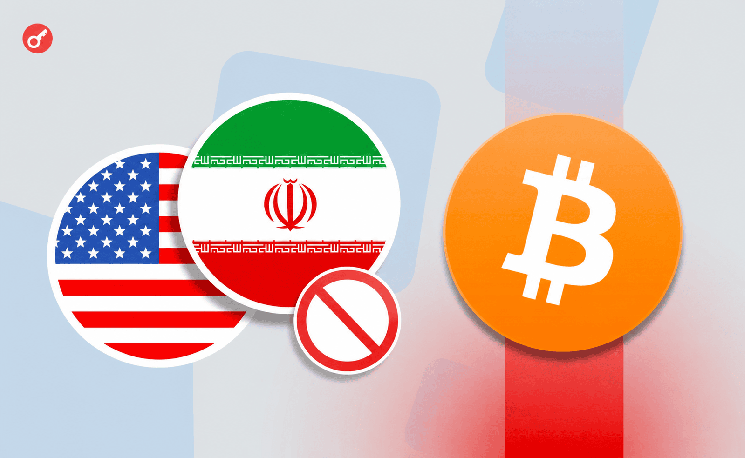
Bitcoin experienced a sharp decline, briefly nearing $92,000, following former U.S. President Donald Trump’s threat to impose new tariffs on eight European countries. The initial 10% tariff, set for February 1, could rise to 25% by June if negotiations fail. Trump administration explicitly linked the tariffs to the potential purchase of Greenland. With U.S. markets closed for a holiday, global markets absorbed the shock: S&P 500 and Nasdaq futures fell, Asian and European indices dipped, and the dollar weakened against safe-haven currencies like the yen and Swiss franc. Gold and silver surged to record highs, while oil prices dropped on growth concerns. Bitcoin later recovered some losses due to bargain buying. The situation remains tense as European investors hold approximately $8 trillion in U.S. assets, and any capital flow shifts could significantly impact markets. Key events to watch include economic data from China, Bank of Japan policy decisions, U.S. economic indicators influencing the Fed, and geopolitical discussions at the upcoming Davos meeting.

Bitcoin fell after U.S. President Donald Trump threatened new tariffs on eight European countries! With U.S. markets closed for the holiday, global markets reacted first, and crypto felt the impact.

Here’s the rundown.

BTC steadies after tariff shock

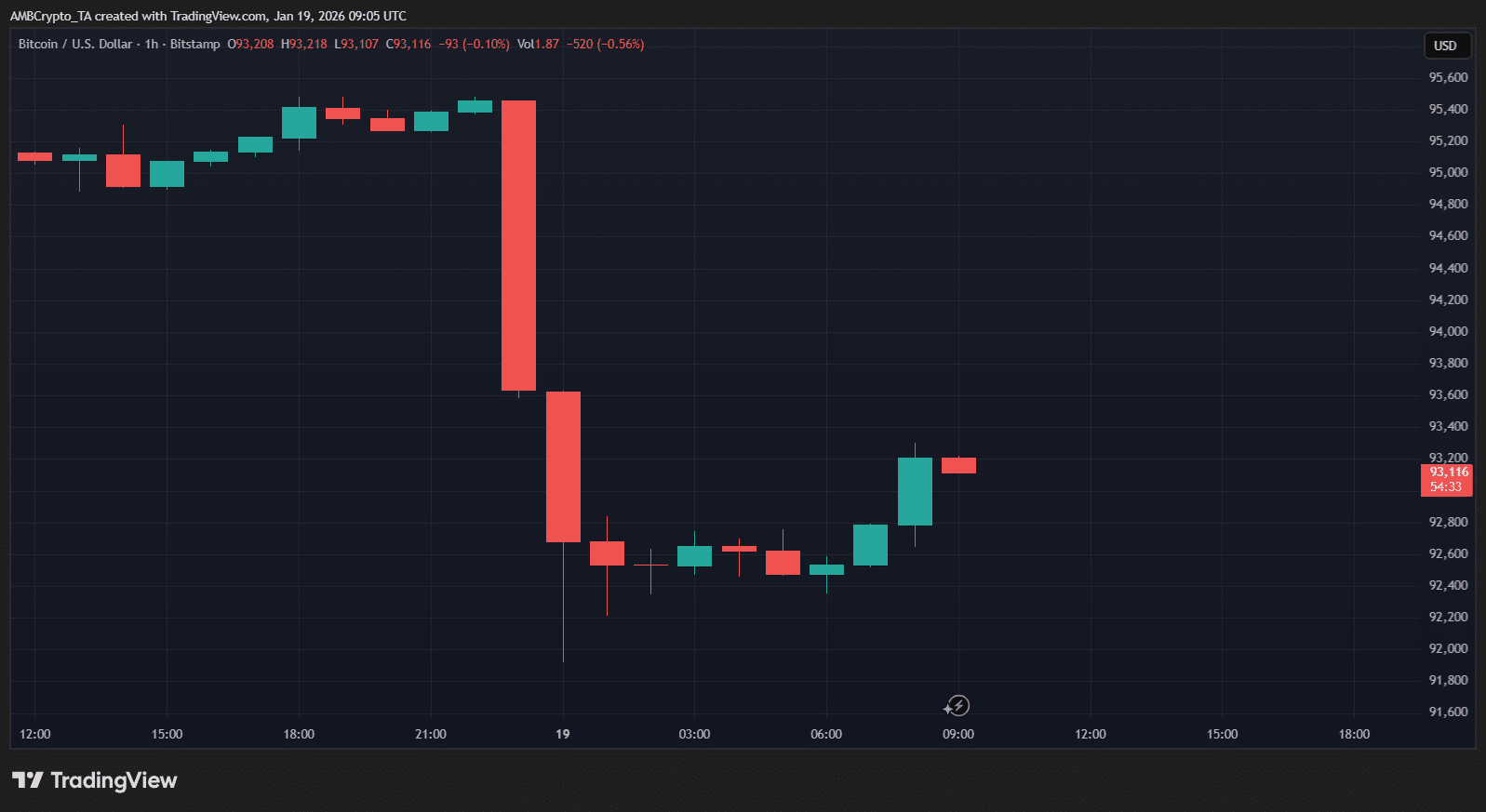
Bitcoin briefly slid close to the $92,000 mark during early Asian trading, a knee-jerk reaction to tariff threats from President Trump. The proposed measures target eight European countries –  Denmark, Norway, Sweden, France, Germany, the Netherlands, Finland and Britain.

Initial level is set at 10% import tariffs for the 1st of February, and a potential increase to 25% by June if talks fail. Further, the President stated,

“This Tariff will be due and payable until such time as a Deal is reached for the Complete and Total purchase of Greenland.”

With U.S. cash markets shut for the holiday, the initial shock was absorbed elsewhere. S&P 500 futures slipped about 0.7%, while Nasdaq futures dropped 1.0% during early Asian hours.

Japan’s Nikkei fell about 1%, while MSCI’s Asia-Pacific index outside Japan went 0.1% lower. European markets also looked dim, with Euro Stoxx 50 and DAX futures both down around 1.1%.

The dollar slipped against other safe-haven currencies, falling about 0.3% against the yen and 0.2% versus the Swiss franc, while the Euro recovered after a dip.

Gold jumped 1.5% to a record, silver was at an ATH, while U.S. crude slipped on growth worries tied to a possible trade clash.

Source: Trading View

Bitcoin [BTC] managed to claw back some losses in the following hours, so bargain buying and steady sentiment kept the boat afloat.

All eyes on capital flows and global data

European investors hold around $8 trillion in U.S. bonds and equities.

A recent Bloomberg report stated that Deutsche Bank’s warnings that any shift could hit markets harder than tariffs themselves. They went so far as to call it a “weaponization of capital.”

There’s more to keep an eye out for. China reports growth data this week, the Bank of Japan is making policy decisions, and U.S. economic figures could influence the next Fed move.

Meanwhile, leaders are heading to Davos as well, where tensions and security issues (including the Greenland dispute) are likely to dominate discussions.

Big days ahead!


Final Thoughts

  • Bitcoin price not out of the dumps yet – $8 trillion in European holdings could change anytime.
  • Watch China, the Fed, and Davos talks; global data and tensions move markets fast.
Next: Litecoin retraces 6.5% – Can whales and ETF inflows lead to a reversal?
Share
  • Share
  • Tweet

Trending Cryptos

Related Questions

QWhat was the immediate impact of President Trump's tariff threats on Bitcoin's price?

ABitcoin briefly slid close to the $92,000 mark during early Asian trading as a knee-jerk reaction to the tariff threats.

QWhich European countries are targeted by the proposed tariffs mentioned in the article?

AThe proposed tariffs target Denmark, Norway, Sweden, France, Germany, the Netherlands, Finland, and Britain.

QAccording to the article, what is the estimated value of European holdings in U.S. bonds and equities that could be at risk?

AEuropean investors hold around $8 trillion in U.S. bonds and equities that could be at risk.

QHow did traditional safe-haven assets like gold and the Japanese yen react to the news?

AGold jumped 1.5% to a record high, and the dollar slipped about 0.3% against the Japanese yen, which is considered a safe-haven currency.

QWhat key events does the article suggest investors should watch that could influence markets in the near future?

AInvestors should watch China's growth data, the Bank of Japan's policy decisions, U.S. economic figures influencing the Fed, and discussions at the Davos meeting, particularly regarding tensions and the Greenland dispute.

Related Reads

Stocks Fell Even More Violently Than Crypto, Where Did the Money Go?

From June to late July 2026, global stock markets, particularly technology and semiconductor stocks, experienced severe declines, with South Korea's KOSPI index facing historic circuit breakers and shedding 40% from its June peak. Key catalysts included SK Hynix's earnings miss despite record profits and competitive pressures from China's CXMT IPO. A global forced deleveraging event unfolded, devastating highly leveraged instruments like the 2x leveraged SK Hynix ETF, which lost over 80% of its value. Surprisingly, Bitcoin showed relative stability during this period, rising roughly 15% from its July low. The article clarifies this wasn't due to an inflow of equity flight capital but because Bitcoin had already undergone a significant correction in May and June, with U.S. spot Bitcoin ETFs seeing record outflows. True safe-haven flows went to gold, severing Bitcoin's short-term "digital gold" narrative. The sell-off is characterized not as an AI story collapse but a liquidity-driven清算 of crowded leveraged positions, potentially halfway through according to some analysts. For substantial capital to return to Bitcoin, the article cites necessary conditions: eased global liquidity pressure, a soft-landing Fed rate cut, and regulatory clarity from the stalled U.S. CLARITY Act. The conclusion is that Bitcoin is not a current safe haven but a pre-cleared asset. Its decoupling from tech stocks highlights its potential future role as a non-correlated asset for institutional portfolios, positioning it favorably for when global capital reallocates post-crisis.

marsbit6m ago

Stocks Fell Even More Violently Than Crypto, Where Did the Money Go?

marsbit6m ago

"The Final Phase Before the New Cycle". What Will Happen to Bitcoin in August

"Bitcoin Faces Crucial Test in August: Experts Predict Consolidation or Further Decline" The price of Bitcoin (BTC) is expected to remain under pressure in August, with experts anticipating either consolidation within a narrow range or a potential drop below $60,000. Despite a double-digit recovery from its July low near $58,000, BTC ended the month trading around $63,500, still roughly 50% below its October 2025 peak of $126,200. Analysts cite several headwinds: a challenging macroeconomic environment with high US interest rates and persistent inflation, which makes fixed-income assets more attractive than speculative ones like crypto. Furthermore, competition for capital is intense, with many investors favoring AI-related stocks. This is reflected in significant outflows from US spot Bitcoin ETFs, with a record $4.5 billion leaving in June and a net outflow of $5.4 billion for the first half of the year. Historically, August is a weak month for crypto, with a median return of -7.49% from 2013 to 2025. Experts also note regulatory uncertainty in the US, particularly the stalled CLARITY Act, as a dampening factor. Despite the bearish near-term outlook, several experts view the current phase as the "last phase before a new Bitcoin cycle" begins, potentially in Q4 2024. This makes it a favorable time for accumulating Bitcoin for the long term. Key price levels to watch are support at $60,000-$61,000, with a break below $58,000 potentially leading to $53,000-$55,000. A move above $67,000 could target $70,000-$75,000, though this is considered a lower probability scenario.

cryptonews.ru12m ago

"The Final Phase Before the New Cycle". What Will Happen to Bitcoin in August

cryptonews.ru12m ago

What Structural Changes Have Occurred in the Cryptocurrency Industry by 2026?

By 2026, the crypto industry is undergoing profound structural shifts, moving beyond price speculation towards deeper integration with the real-world economy. Major changes are driven by four key areas. First, stablecoins, now a $300B+ market, are evolving from crypto-native trading tools into real-world payment and B2B settlement backbones, extending business chains and creating complex accounting and tax obligations. Second, global regulation is maturing. Frameworks like the EU's MiCA are moving from legislation to active enforcement, determining market access. Anti-money laundering rules, such as the Travel Rule, see wider adoption but face enforcement and cross-border challenges. Third, AI Agents are emerging as autonomous transaction entities. Protocols like Coinbase's x402 enable machine-to-machine micropayments using stablecoins, necessitating new frameworks for transaction authorization, tax attribution, and audit trails. Finally, tax transparency is entering an implementation phase. Initiatives like the OECD's CARF, EU's DAC8, and the US Form 1099-DA are shifting reporting burdens to platforms, requiring them to reconcile on-chain data with user identity and tax residency information. Collectively, these trends signify that crypto compliance is becoming foundational infrastructure, requiring consistent data and control systems to meet cross-border operational, regulatory, and audit demands.

marsbit33m ago

What Structural Changes Have Occurred in the Cryptocurrency Industry by 2026?

marsbit33m ago

Trading

Spot

Hot Articles

What is $BITCOIN

DIGITAL GOLD ($BITCOIN): A Comprehensive Analysis Introduction to DIGITAL GOLD ($BITCOIN) DIGITAL GOLD ($BITCOIN) is a blockchain-based project operating on the Solana network, which aims to combine the characteristics of traditional precious metals with the innovation of decentralized technologies. While it shares a name with Bitcoin, often referred to as “digital gold” due to its perception as a store of value, DIGITAL GOLD is a separate token designed to create a unique ecosystem within the Web3 landscape. Its goal is to position itself as a viable alternative digital asset, although specifics regarding its applications and functionalities are still developing. What is DIGITAL GOLD ($BITCOIN)? DIGITAL GOLD ($BITCOIN) is a cryptocurrency token explicitly designed for use on the Solana blockchain. In contrast to Bitcoin, which provides a widely recognized value storage role, this token appears to focus on broader applications and characteristics. Notable aspects include: Blockchain Infrastructure: The token is built on the Solana blockchain, known for its capacity to handle high-speed and low-cost transactions. Supply Dynamics: DIGITAL GOLD has a maximum supply capped at 100 quadrillion tokens (100P $BITCOIN), although details regarding its circulating supply are currently undisclosed. Utility: While precise functionalities are not explicitly outlined, there are indications that the token could be utilized for various applications, potentially involving decentralized applications (dApps) or asset tokenization strategies. Who is the Creator of DIGITAL GOLD ($BITCOIN)? At present, the identity of the creators and development team behind DIGITAL GOLD ($BITCOIN) remains unknown. This situation is typical among many innovative projects within the blockchain space, particularly those aligning with decentralized finance and meme coin phenomena. While such anonymity may foster a community-driven culture, it intensifies concerns about governance and accountability. Who are the Investors of DIGITAL GOLD ($BITCOIN)? The available information indicates that DIGITAL GOLD ($BITCOIN) does not have any known institutional backers or prominent venture capital investments. The project seems to operate on a peer-to-peer model focused on community support and adoption rather than traditional funding routes. Its activity and liquidity are primarily situated on decentralized exchanges (DEXs), such as PumpSwap, rather than established centralized trading platforms, further highlighting its grassroots approach. How DIGITAL GOLD ($BITCOIN) Works The operational mechanics of DIGITAL GOLD ($BITCOIN) can be elaborated on based on its blockchain design and network attributes: Consensus Mechanism: By leveraging Solana’s unique proof-of-history (PoH) combined with a proof-of-stake (PoS) model, the project ensures efficient transaction validation contributing to the network's high performance. Tokenomics: While specific deflationary mechanisms have not been extensively detailed, the vast maximum token supply implies that it may cater to microtransactions or niche use cases that are still to be defined. Interoperability: There exists the potential for integration with Solana’s broader ecosystem, including various decentralized finance (DeFi) platforms. However, the details regarding specific integrations remain unspecified. Timeline of Key Events Here is a timeline that highlights significant milestones concerning DIGITAL GOLD ($BITCOIN): 2023: The initial deployment of the token occurs on the Solana blockchain, marked by its contract address. 2024: DIGITAL GOLD gains visibility as it becomes available for trading on decentralized exchanges like PumpSwap, allowing users to trade it against SOL. 2025: The project witnesses sporadic trading activity and potential interest in community-led engagements, although no noteworthy partnerships or technical advancements have been documented as of yet. Critical Analysis Strengths Scalability: The underlying Solana infrastructure supports high transaction volumes, which could enhance the utility of $BITCOIN in various transaction scenarios. Accessibility: The potential low trading price per token could attract retail investors, facilitating wider participation due to fractional ownership opportunities. Risks Lack of Transparency: The absence of publicly known backers, developers, or an audit process may yield skepticism regarding the project's sustainability and trustworthiness. Market Volatility: The trading activity is heavily reliant on speculative behavior, which can result in significant price volatility and uncertainty for investors. Conclusion DIGITAL GOLD ($BITCOIN) emerges as an intriguing yet ambiguous project within the rapidly evolving Solana ecosystem. While it attempts to leverage the “digital gold” narrative, its departure from Bitcoin's established role as a store of value underscores the need for a clearer differentiation of its intended utility and governance structure. Future acceptance and adoption will likely depend on addressing the current opacity and defining its operational and economic strategies more explicitly. Note: This report encompasses synthesised information available as of October 2023, and developments may have transpired beyond the research period.

1.3k Total ViewsPublished 2025.05.13Updated 2025.05.13

What is $BITCOIN

Discussions

Welcome to the HTX Community. Here, you can stay informed about the latest platform developments and gain access to professional market insights. Users' opinions on the price of BTC (BTC) are presented below.

活动图片