Ethereum Under Pressure As Researchers Issue Critical Report

bitcoinistPublished on 2026-03-08Last updated on 2026-03-08

Abstract

Culper Research has taken a short position on Ethereum, issuing a critical report that questions the network's long-term health. The report argues that the Fusaka Upgrade significantly expanded blockspace, causing transaction fees to drop by nearly 90%, which in turn weakens validator economics and staking rewards. It also alleges that recent transaction growth and new wallet creation are largely driven by spam and address-poisoning attacks rather than genuine adoption, with dusting-related activity accounting for 22.5% of all ETH transactions. Additionally, competition from Solana and reports of Vitalik Buterin selling 19,000 ETH have added to bearish sentiment. Despite these concerns, some commentators note that Ethereum’s design allows for future protocol changes to address economic issues.

Ethereum is facing renewed scrutiny after Culper Research released a sharply critical report outlining its bearish stance on the second-largest cryptocurrency by market capitalization. The reporter argues that the key aspects of the ETH ecosystem and long-term narrative may be weaker than widely believed, prompting the firm to disclose that it has taken a short position against the asset.

Culper Research Outlines Key Risks Facing Ethereum’s Ecosystem

Investment research firm Culper Research has released a critical report, revealing it has taken a short position on Ethereum. The CEO of Coinbureau, Nic, has shared on X that the reporter outlined that structural changes following the ETH Fusaka Upgrade have significantly expanded blockspace, causing transaction fees to collapse by nearly 90%.

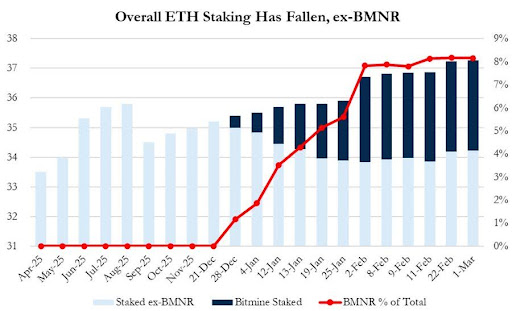
According to the firm, lower fees translate directly into lower validator income, leading to weaker staking economics. Culper further mentions BitMine and argues that the recent rise in transaction activity and active addresses cited as bullish is driven by spam transactions and address-poisoning attacks rather than real adoption.

Source: Chart from Nic on X

The firm also reported that Vitalik Buterin sold around 19,000 ETH as if he knew what was going on. While it is a significant amount, representing roughly 8% of Buterin’s total holdings, it may not necessarily indicate an exit or loss of confidence.

At the same time, Nic highlighted that ETH’s design allows for future protocol changes of rules through coordinated upgrades or forks if any economic issues emerge. This won’t be easy politically or technically, but it’s possible. Nic emphasized that he is not taking sides. However, when a firm publishes a detailed thesis and then puts its money behind it, it is worth understanding the mechanics they’re pointing to.

How Gas-Limit Expansion Linked To Falling Transaction Fees

A crypto commentator and the host of the office space, MartyParty, has also offered insights into the matter. Culper Research has opened short positions in Ethereum, arguing that the network entered what is described as a potential “death spiral.” The firm’s thesis is based on on-chain data spanning from January 2025 to February 2026.

A major focus of the report is wallet growth following the Fusaka Upgrade, and Culper alleges that 95% of new wallet creation during the period is linked to dusting or address-poisoning attacks. The firm further claims that dusting-related activity now accounts for roughly 22.5% of all ETH transactions and more than half of the network’s recent transaction growth.

Furthermore, the firm analyzes the economic effects of gas limit increase on the network, contributing to an estimated 90% decline in transaction fees and 40-50% lower tips per gas. Meanwhile, these dynmics could put pressure on validator economics by reducing overall revenue from network activity.

Beyond internal network changes, competition from Solana has captured growing developer and user activity, and reports about Buterin’s ETH dump have drawn backlash from parts of the ETH community.

ETH trading at $1,986 on the 1D chart | Source: ETHUSDT on Tradingview.com

Related Questions

QWhat is the main argument presented by Culper Research in their report on Ethereum?

ACulper Research argues that key aspects of the Ethereum ecosystem and its long-term narrative are weaker than widely believed, citing issues like collapsing transaction fees, weaker staking economics, and that recent network growth is driven by spam and attacks rather than real adoption.

QWhat specific change does the report link to the 90% decline in Ethereum transaction fees?

AThe report links the 90% decline in transaction fees to the structural changes from the Ethereum Fusaka Upgrade, which significantly expanded blockspace.

QAccording to the report, what is driving the recent rise in transaction activity and new wallets, and what percentage is alleged to be malicious?

AThe report claims the recent rise is driven by spam transactions and address-poisoning attacks, alleging that 95% of new wallet creation is linked to these malicious activities.

QWhat action did Culper Research take based on its findings, and what is the potential risk they describe for Ethereum?

ACulper Research disclosed that it has taken a short position against Ethereum and argues that the network has entered a potential 'death spiral' due to the economic pressures on validators and lack of real growth.

QBesides internal network issues, what external competitor is mentioned as a growing threat to Ethereum?

AThe report mentions competition from Solana, which has captured growing developer and user activity, as an external threat to Ethereum.

Related Reads

TAO is Elon Musk who invested in OpenAI, Subnet is Sam Altman

The article, titled "TAO is Elon Musk who invested in OpenAI, Subnet is Sam Altman," presents a critical analysis of the Bittensor (TAO) project. It argues that Bittensor functions as a decentralized AI marketplace where TAO tokens fund AI research via subnets. However, the author highlights a fundamental flaw: subnet operators have no obligation to return any value, such as AI models or profits, back to the TAO ecosystem or its token holders. This structure is likened to Elon Musk's early investment in the non-profit OpenAI, which later commercialized its technology without returning value to its initial benefactor. The bear case posits that Bittensor is essentially a wealth transfer from crypto speculators to AI researchers ("miners"). Subnets can use TAO incentives for development and then take their successful products elsewhere, leaving TAO holders with diluted tokens from inflation and no captured value. The lack of enforced equity or binding mechanisms means the project relies on a "hope" that subnet tokens maintain value. The optimistic perspective counters that two factors could create a successful, self-sustaining economy: 1) AI's perpetual and massive resource needs could incentivize subnets to stay for continued funding, and 2) crypto has a proven ability to aggregate resources through token incentives, as seen with Bitcoin and Ethereum. The conclusion states that investing in TAO is a bet on a博弈论 (game theory) miracle—that soft incentives alone will be enough to keep the best subnets within the ecosystem and create a flywheel effect. This outcome is possible but represents a highly skewed, low-probability success scenario amidst significant risks of failure.

marsbit11m ago

TAO is Elon Musk who invested in OpenAI, Subnet is Sam Altman

marsbit11m ago

Hermes Agent Guide: Surpassing OpenClaw, Boosting Productivity by 100x

A guide to Hermes Agent, an open-source AI agent framework by Nous Research, positioned as a powerful alternative to OpenClaw. It is described as a self-evolving agent with a built-in learning loop that autonomously creates skills from experience, continuously improves them, and solidifies knowledge into reusable assets. Its core features include a memory system (storing environment info and user preferences in MEMORY.md and USER.md) and a skill system that generates structured documentation for complex tasks. The agent boasts over 40 built-in tools for web search, browser automation, vision, image generation, and text-to-speech. It supports scheduling automated tasks and can run on various infrastructures, from a $5 VPS to GPU clusters. Popular tools within its ecosystem include the Hindsight memory plugin, the Anthropic Cybersecurity Skills pack, and the mission-control dashboard for agent orchestration. Key differentiators from OpenClaw are its architecture philosophy—centered on the agent's own execution loop rather than a central controller—and its autonomous skill generation versus OpenClaw's manually written skills. Installation is a one-line command, and setup is guided. It integrates with messaging platforms like Telegram, Discord, and Slack. It's suited for scenarios requiring a persistent, context-aware assistant that improves over time, automates workflows, and operates across various deployment environments.

marsbit1h ago

Hermes Agent Guide: Surpassing OpenClaw, Boosting Productivity by 100x

marsbit1h ago

Brother Sun "Rights Protection" Stands Up Against the Trump Family, WLFI Is the Real Scythe in the Crypto Circle

The article details the controversy surrounding World Liberty Financial (WLFI), a cryptocurrency project linked to the Trump family. It reports that WLFI allegedly used the DeFi lending protocol Dolomite, whose co-founder is also a WLFI advisor, as a disguised channel to sell tokens by collateralizing around 5 billion WLFI tokens to borrow approximately $75 million in stablecoins. Despite WLFI's claims that the loans were for ecosystem development and posed no liquidation risk, critics argue it was a way for insiders to cash out, shifting risk to retail investors. The piece highlights WLFI's significant price decline—over 66% since its September 2025 launch—and suggests the Trump family and insiders are the main source of selling pressure, as they control nearly 74% of the token supply. It also revisits WLFI’s prior move to blacklist 272 addresses, including those of investor Justin Sun, under the pretext of preventing large-scale sell-offs, which now appears to be an effort to reduce competition for their own sales. Sun publicly accused WLFI of exploiting users, freezing assets, and treating the crypto community as a "personal ATM." WLFI countered by threatening legal action. The author notes that while Sun’s criticism may gain sympathy, a legal battle in the U.S. against the well-connected Trump family would be risky for him. Finally, the article concludes that WLFI exemplifies how powerful elites can exploit crypto’s regulatory gray areas for profit, and urges the community to reject such projects driven more by political privilege than genuine decentralized finance ideals.

Odaily星球日报1h ago

Brother Sun "Rights Protection" Stands Up Against the Trump Family, WLFI Is the Real Scythe in the Crypto Circle

Odaily星球日报1h ago

Trading

Spot
Futures

Hot Articles

Discussions

Welcome to the HTX Community. Here, you can stay informed about the latest platform developments and gain access to professional market insights. Users' opinions on the price of ETH (ETH) are presented below.

活动图片