Ethereum To Follow Netflix’s Trajectory? Expert Breaks Down Some Interesting Similarities

bitcoinistPublished on 2026-04-08Last updated on 2026-04-08

Abstract

Ethereum's current price structure is being compared to Netflix's stock performance between 2003 and 2009 by analyst Crypto Tice. The analysis highlights a similar pattern of prolonged consolidation, with both assets experiencing multiple rejections at a key resistance level—Ethereum near $4,900 and Netflix in its historical range. This repeated testing of range boundaries, now in its sixth interaction for Ethereum, suggests building pressure that historically preceded a major breakout for Netflix. For Ethereum to follow a similar trajectory, it must decisively break above resistance levels at $2,150, $2,350, $3,100, $3,900, and finally $4,900. Critics note fundamental differences, such as Netflix's consolidation occurring during business expansion with growing subscribers and revenue, while Ethereum faces unique challenges like reduced base-layer activity due to Layer 2 networks.

Ethereum’s current price structure is being compared to a phase that once played out in a major stock price, where years of sideways movement and repeated rejections eventually gave way to a powerful breakout above resistance. The comparison, shared by crypto analyst Crypto Tice on X, points out that what looks like long-term stagnation around $2,000 on Ethereum’s chart may be a setup that has appeared before in Netflix’s price history.

A Repeating Structure Inside A Range

Technical patterns have a way of resurfacing across different markets, which is why analysts often study past price behavior of one cryptocurrency to predict how another cryptocurrency could also play out in the future. In many cases, these comparisons stay within the crypto market itself or extend to traditional stores of value like precious metals, where similarities in cycles and investor behavior are easier to justify.

This analysis, however, takes a different approach by stepping outside those usual comparisons. It provides a comparison between Ethereum’s current price structure and the way Netflix, Inc. (NFLX) traded between 2003 and 2009.

The chart highlights a sequence of six distinct interactions with range boundaries in both assets. In Netflix’s case, the price spent years bouncing between support and resistance, forming a compressed structure with multiple failed breakout attempts. Each rejection added to the range but also built pressure over time.

Ethereum’s price action on a multi-year timeframe is showing a nearly identical formation. Since 2021, the Ethereum price has repeatedly pushed into resistance around $4,900, pulled back to support, and returned again for another attempt.

The current price action, which is the sixth interaction, places Ethereum near the lower boundary of the range, which is just the same stage Netflix was before its eventual breakout.
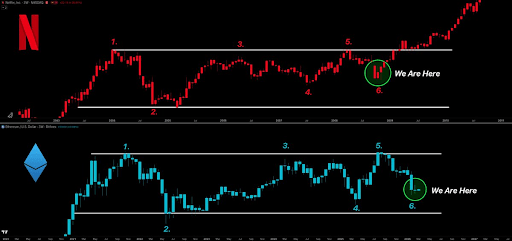
Price Chart Comparison. Source: @CryptoTice_ On X

Pressure Building. What Comes Next?

The structure outlined in the chart ultimately points to one outcome: a breakout rally. This is how Netflix broke out of the resistance trendline in 2009. The important thing for Ethereum now is reclaiming and holding above resistance above $4,900 with conviction. However, there are other intermediate price targets that Ethereum needs to break above before this move. These targets include $2,150, $2,350, $3,100, $3,900, and $4,600.

The analogy, however, is not without its critics. Some comments argue that comparing Ethereum to Netflix ignores the fundamental differences between the two. One comment, for instance, noted that Netflix’s consolidation took place during a period of steady business expansion, with clear growth in subscribers and revenue supporting its long-term trajectory.

Ethereum’s situation, on the other hand, is more layered and has a different economic regime. The rise of Layer 2 networks has moved activity away from the base layer, reducing fee generation at the protocol level. These factors, and many others, introduce unknowns that cannot be represented through chart structure.

ETH price pushes above $2,200 | Source: ETHUSDT on Tradingview.com

Related Questions

QWhat is the main comparison being drawn in the article between Ethereum and Netflix?

AThe article compares Ethereum's current multi-year price structure, characterized by sideways movement and repeated rejections around the $2,000-$4,900 range, to the price action of Netflix (NFLX) stock between 2003 and 2009, which also experienced a long period of consolidation before a powerful breakout.

QAccording to the analyst, what is the potential outcome suggested by the similar chart structure?

AThe similar chart structure ultimately points to one outcome: a breakout rally, similar to how Netflix broke out of its resistance trendline in 2009.

QWhat key price level does Ethereum need to reclaim and hold above for a convincing breakout?

AEthereum needs to reclaim and hold above the resistance level of $4,900 with conviction for a convincing breakout.

QWhat is one fundamental criticism mentioned against comparing Ethereum to Netflix?

AOne criticism is that Netflix's consolidation period was supported by clear fundamental growth in subscribers and revenue, whereas Ethereum's situation is more complex with factors like the rise of Layer 2 networks reducing base layer fee generation, introducing unknowns not represented on a chart.

QWhat are some of the intermediate price targets Ethereum must break before reaching the $4,900 resistance?

AThe intermediate price targets Ethereum needs to break include $2,150, $2,350, $3,100, $3,900, and $4,600.

Related Reads

You Bet on the News, the Pros Read the Rules: The True Cognitive Gap in Losing Money on Polymarket

The article explains that the key to profiting on Polymarket, a prediction market platform, lies not just predicting real-world events correctly, but in meticulously understanding the specific rules that govern how each market will be resolved. It illustrates this with examples, such as a market on Venezuela's 2026 leader, where the official rules defining "officially holds" the office overruled the intuitive answer of who was in practical control. Other examples include debates over the definition of a "token" or what constitutes an "agreement." The core argument is that a "reality vs. rules" gap creates pricing discrepancies that savvy traders ("车头" or "whales") exploit. The platform has a formal dispute resolution process managed by UMA token holders to settle ambiguous outcomes. This process involves proposal submission, a challenge window, a discussion period, and a final vote. However, the article highlights a critical flaw in this system compared to a traditional court: the lack of separation between the arbiters (UMA voters) and the interested parties (traders with financial stakes in the outcome). This conflict of interest undermines the discussion phase, leads to herd mentality, and results in opaque final decisions without explanatory rulings. Consequently, the system lacks a body of precedent, making it difficult for users to learn from past disputes. The ultimate takeaway is that success on Polymarket requires a lawyer-like scrutiny of the rules to identify and capitalize on the cognitive gap between how events appear and how they are contractually defined for settlement.

marsbit3m ago

You Bet on the News, the Pros Read the Rules: The True Cognitive Gap in Losing Money on Polymarket

marsbit3m ago

Will the Fed Still Cut Interest Rates? Tonight's Data Is Crucial

The core debate surrounding the Federal Reserve's potential interest rate cuts is intensifying amid geopolitical conflict and rebounding inflation. The key question is whether high energy prices will cause persistent inflation or weaken consumer demand enough to force the Fed to cut rates. Citigroup presents a bullish case for cuts, arguing that oil supply disruptions from the Strait of Hormuz are temporary and will not lead to lasting inflationary pressure. They point to receding bond yields and oil prices as evidence the market is pricing in a short-lived shock. Citi's data also shows tightening financial conditions, a stabilizing labor market, and healthy tax returns, supporting their view that the path to lower rates remains open. Conversely, Deutsche Bank offers a starkly contrasting, more hawkish outlook. They argue the Fed's current policy is already neutral and expect rates to remain unchanged indefinitely. Their view is based on stalled disinflation progress and a shift toward more hawkish rhetoric from key Fed officials like Waller, who cited risks from prolonged Middle East conflict and tariffs. Other officials, including Williams and Hammack, signaled rates would likely stay on hold for a "considerable time." The market pricing has shifted dramatically, now forecasting zero cuts in 2026. The imminent release of the March retail sales "control group" data is highlighted as a critical test. This metric, which excludes gas station sales, will reveal if high gasoline prices are eroding consumer spending in other areas. A weak reading could support the case for imminent rate cuts, while a strong one would bolster the argument for the Fed to hold steady. This data is pivotal for determining the near-term policy path.

marsbit24m ago

Will the Fed Still Cut Interest Rates? Tonight's Data Is Crucial

marsbit24m ago

The Second Half of Macro Influencer Fu Peng's Career

Fu Peng, a prominent Chinese macroeconomist and former chief economist of Northeast Securities, has joined Hong Kong-based digital asset management firm Bitfire Group (formerly New Huo Group) as its chief economist. This move, announced in April 2026, triggered an 11% surge in Bitfire's stock price. Fu, known for his accessible macroeconomic commentary and large social media following, will focus on integrating digital assets into global asset allocation frameworks, particularly combining FICC (fixed income, currencies, and commodities) with cryptocurrencies for institutional clients. His career includes roles at Lehman Brothers and Solomon International, with significant influence gained through public communication. However, in late 2024, Fu faced temporary social media bans after a controversial private speech at HSBC on China's economic challenges, though he denied regulatory sanctions. He later left Northeast Securities citing health reasons. Bitfire, a licensed virtual asset manager serving high-net-worth clients, seeks to build trust and attract traditional capital through Fu’s expertise and credibility. The partnership represents a strategic shift for both: Fu enters the crypto sector after a traditional finance peak, while Bitfire aims to leverage his macro framework for institutional adoption. Outcomes remain uncertain regarding capital inflows and compatibility within corporate structure.

marsbit1h ago

The Second Half of Macro Influencer Fu Peng's Career

marsbit1h ago

Trading

Spot
Futures

Hot Articles

Discussions

Welcome to the HTX Community. Here, you can stay informed about the latest platform developments and gain access to professional market insights. Users' opinions on the price of S (S) are presented below.

活动图片















