Ethereum Price Outlook Turns Critical After Harvard’s Portfolio Shift From Bitcoin ETFs

bitcoinistPublished on 2026-02-17Last updated on 2026-02-17

Abstract

Institutional flows and weakening momentum are pressuring Ethereum (ETH) at a critical juncture. Harvard University’s endowment reduced its Bitcoin ETF exposure by 21% while initiating a new $87 million position in an Ethereum ETF. ETH trades below the key $2,000 level, with technical structure showing lower highs and lows. A break below $1,900 could trigger further declines toward $1,600–$1,700. Despite bearish price action, on-chain data shows continued accumulation by large holders and record-high weekly transactions with low fees, indicating underlying network strength.

Institutional capital flows and weakening market momentum are converging at a sensitive moment for Ethereum (ETH), placing the second-largest cryptocurrency at a potential turning point.

A major portfolio adjustment by Harvard University’s endowment, combined with declining prices and shifting on-chain signals, has intensified debate over whether the Ethereum price is nearing a bottom or preparing for another leg lower.

Recent regulatory filings show that Harvard Management Company reduced its exposure to Bitcoin exchange-traded funds while initiating its first allocation to Ethereum ETFs. The move comes as ETH trades below the psychological $2,000 level, a price zone that has increasingly acted as resistance rather than support.
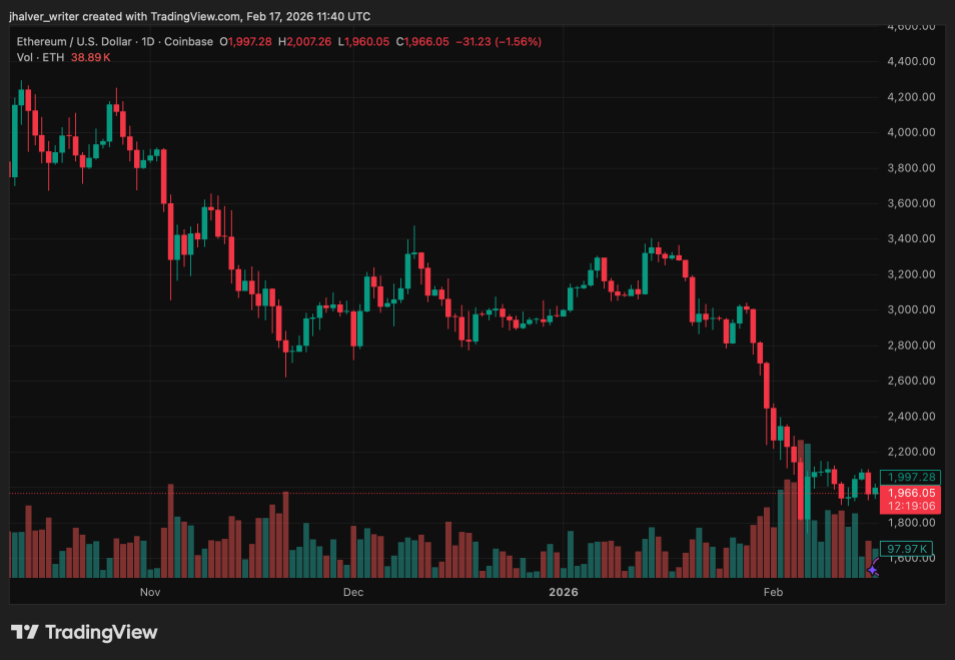
ETH's price trends to the downside on the daily chart. Source: ETHUSD on Tradingview

Harvard’s Crypto Rebalance Signals Institutional Repositioning

During the fourth quarter of 2025, Harvard cut its stake in BlackRock’s Bitcoin ETF by roughly 21%, reducing holdings to about $265.8 million. At the same time, the endowment purchased nearly $87 million worth of shares in BlackRock’s Ethereum Trust, marking its first direct ETF exposure to Ether.

The adjustment occurred amid a broader crypto market pullback, with Bitcoin falling sharply from late-2025 highs and Ethereum declining alongside it. Analysts suggest the change may reflect portfolio rebalancing rather than a straightforward shift in sentiment, potentially tied to unwinding complex institutional trading strategies.

Still, the move aligns with wider institutional behavior. Filings show total ownership of major Bitcoin ETFs declined significantly during the same period, indicating investors may be reassessing risk exposure while exploring alternative crypto allocations.

Despite the shift, cryptocurrency ETFs remain a small portion of Harvard’s $56.9 billion endowment, accounting for less than 1% of total assets.

Ethereum Price Stuck Below Key Resistance

Ethereum price has struggled to regain momentum after a steep sell-off. The asset recently hovered near $1,980 after falling about 40% over the past month and remains far below its 2025 peak above $4,900.

Technically, the market continues to print lower highs and lower lows, keeping the broader trend bearish. Analysts are closely watching the $2,150–$2,200 range, which must be reclaimed to signal a potential reversal. Failure to hold support near $1,900 could expose downside targets between $1,700 and $1,600.

Derivatives data show declining open interest and trading volumes, suggesting traders are reducing risk rather than positioning aggressively for a breakout. ETF flows have also been mixed, with recent net outflows highlighting cautious institutional sentiment in the short term.

On-Chain Data and Network Fundamentals Offer Mixed Signals

While the Ethereum price action remains weak, blockchain data paints a more nuanced picture. Large holders have continued accumulating Ether, with whale wallets adding substantial balances even as prices declined. Accumulation addresses now hold record amounts of ETH.

Network usage has also strengthened. Ethereum recently processed a record 17.3 million weekly transactions while median fees dropped to fractions of a dollar, signaling improved efficiency and sustained user activity.

Meanwhile, Ethereum co-founder Vitalik Buterin reiterated that the network’s long-term value lies in its neutrality and censorship resistance, emphasizing open participation regardless of individual viewpoints. His comments arrive as debates around decentralization and ecosystem direction intensify.

Cover image from ChatGPT, ETHUSD chart from Tradingview

Related Questions

QWhat major portfolio adjustment did Harvard Management Company make regarding cryptocurrency ETFs in Q4 2025?

AHarvard Management Company reduced its stake in BlackRock's Bitcoin ETF by roughly 21% and initiated its first allocation to Ethereum ETFs by purchasing nearly $87 million worth of shares in BlackRock's Ethereum Trust.

QWhat is the current key resistance level for the Ethereum price that analysts are watching?

AAnalysts are closely watching the $2,150–$2,200 range, which must be reclaimed to signal a potential reversal for Ethereum's price.

QDespite weak price action, what positive on-chain signals are present for Ethereum according to the article?

ALarge holders (whales) have continued accumulating ETH, with accumulation addresses holding record amounts. Additionally, network usage has strengthened, with Ethereum processing a record 17.3 million weekly transactions and median fees dropping significantly.

QWhat does the decline in open interest and trading volumes in derivatives markets suggest about trader sentiment?

AThe declining open interest and trading volumes suggest that traders are reducing their risk exposure rather than positioning aggressively for a price breakout, indicating cautious sentiment.

QWhat reason do analysts suggest might be behind Harvard's portfolio rebalancing, rather than a simple shift in sentiment?

AAnalysts suggest the change may reflect portfolio rebalancing tied to unwinding complex institutional trading strategies, rather than a straightforward shift in sentiment.

Related Reads

a16z: AI's 'Amnesia', Can Continuous Learning Cure It?

The article "a16z: AI's 'Amnesia' – Can Continual Learning Cure It?" explores the limitations of current large language models (LLMs), which, like the protagonist in the film *Memento*, are trapped in a perpetual present—unable to form new memories after training. While methods like in-context learning (ICL), retrieval-augmented generation (RAG), and external scaffolding (e.g., chat history, prompts) provide temporary solutions, they fail to enable true internalization of new knowledge. The authors argue that compression—the core of learning during training—is halted at deployment, preventing models from generalizing, discovering novel solutions (e.g., mathematical proofs), or handling adversarial scenarios. The piece introduces *continual learning* as a critical research direction to address this, categorizing approaches into three paths: 1. **Context**: Scaling external memory via longer context windows, multi-agent systems, and smarter retrieval. 2. **Modules**: Using pluggable adapters or external memory layers for specialization without full retraining. 3. **Weights**: Enabling parameter updates through sparse training, test-time training, meta-learning, distillation, and reinforcement learning from feedback. Challenges include catastrophic forgetting, safety risks, and auditability, but overcoming these could unlock models that learn iteratively from experience. The conclusion emphasizes that while context-based methods are effective, true breakthroughs require models to compress new information into weights post-deployment, moving from mere retrieval to genuine learning.

marsbit2h ago

a16z: AI's 'Amnesia', Can Continuous Learning Cure It?

marsbit2h ago

Can a Hair Dryer Earn $34,000? Deciphering the Reflexivity Paradox in Prediction Markets

An individual manipulated a weather sensor at Paris Charles de Gaulle Airport with a portable heat source, causing a Polymarket weather market to settle at 22°C and earning $34,000. This incident highlights a fundamental issue in prediction markets: when a market aims to reflect reality, it also incentivizes participants to influence that reality. Prediction markets operate on two layers: platform rules (what outcome counts as a win) and data sources (what actually happened). While most focus on rules, the real vulnerability lies in the data source. If reality is recorded through a specific source, influencing that source directly affects market settlement. The article categorizes markets by their vulnerability: 1. **Single-point physical data sources** (e.g., weather stations): Easily manipulated through physical interference. 2. **Insider information markets** (e.g., MrBeast video details): Insiders like team members use non-public information to trade. Kalshi fined a剪辑师 $20,000 for insider trading. 3. **Actor-manipulated markets** (e.g., Andrew Tate’s tweet counts): The subject of the market can control the outcome. Evidence suggests Tate’sociated accounts coordinated to profit. 4. **Individual-action markets** (e.g., WNBA disruptions): A single person can execute an event to profit from their pre-placed bets. Kalshi and Polymarket handle these issues differently. Kalshi enforces strict KYC, publicly penalizes insider trading, and reports to regulators. Polymarket, with its anonymous wallet-based system, has historically been more permissive, arguing that insider information improves market accuracy. However, it cooperated with authorities in the "Van Dyke case," where a user traded on classified government information. The core paradox is reflexivity: prediction markets are designed to discover truth, but their financial incentives can distort reality. The more valuable a prediction becomes, the more likely participants are to influence the event itself. The market ceases to be a mirror of reality and instead shapes it.

marsbit3h ago

Can a Hair Dryer Earn $34,000? Deciphering the Reflexivity Paradox in Prediction Markets

marsbit3h ago

Trading

Spot
Futures

Hot Articles

Discussions

Welcome to the HTX Community. Here, you can stay informed about the latest platform developments and gain access to professional market insights. Users' opinions on the price of S (S) are presented below.

活动图片