Ethereum Network Usage Jumps Nearly 45% As Bulls Push to Reclaim Higher Levels
bitcoinistPublished on 2026-01-08Last updated on 2026-01-08
Abstract
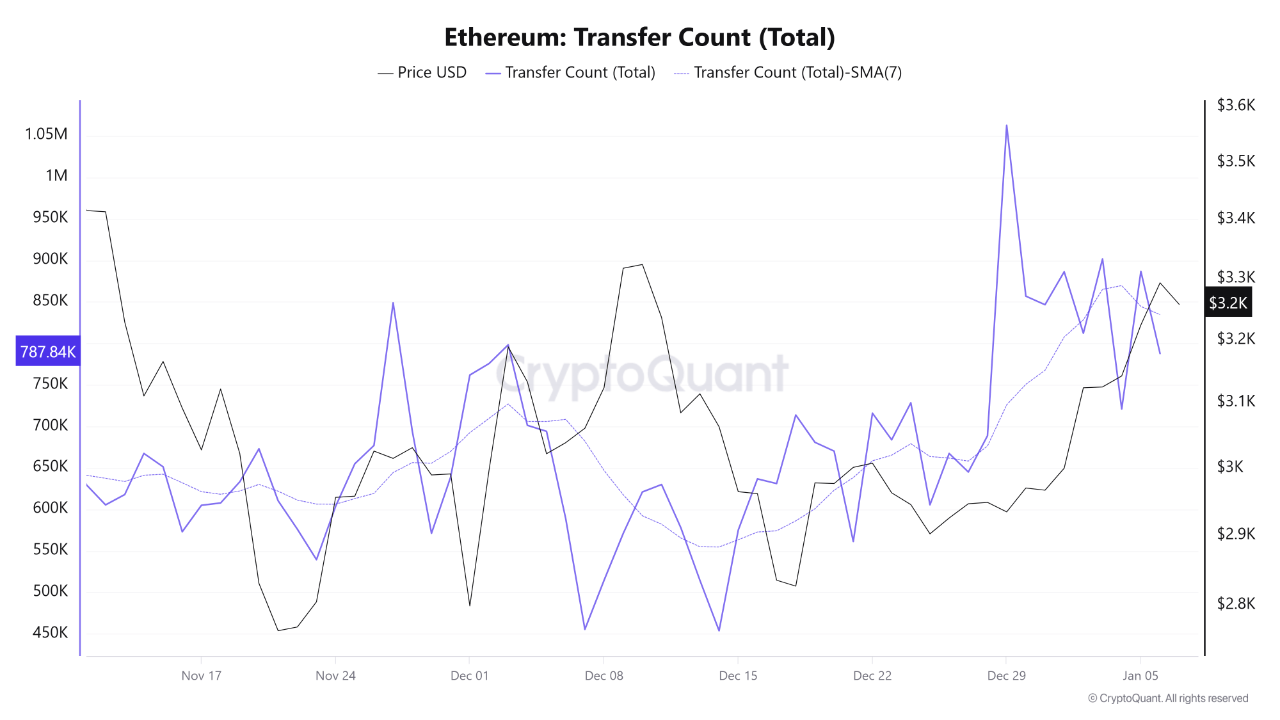
Ethereum network usage has surged nearly 45%, with the 7-day moving average of total transfers rising from around 600,000 to approximately 870,000 transactions, according to CryptoQuant data. This significant increase, which began on December 29 and peaked at 1.06 million daily transactions, indicates a sustained rise in network activity rather than a temporary spike. The growth reflects heightened engagement across Ethereum’s ecosystem, including DeFi protocols, decentralized applications, and NFT marketplaces.
Despite this surge in on-chain activity, Ethereum’s price remains consolidating around the $3,200 level. Bulls are defending this zone as a potential base for recovery, while facing resistance near the $3,300–$3,500 region where key moving averages converge. The sustained increase in transactions suggests strengthening fundamentals and growing demand for ETH as a utility asset, often a precursor to improved market confidence. If the $3,200 support holds, it could pave the way for a push toward higher price levels.
Trusted Editorial content, reviewed by leading industry experts and seasoned editors. Ad Disclosure
Ethereum is attempting to stabilize above the $3,200 level as the broader crypto market shows early signs of relief following weeks of volatility and corrective pressure. While price action remains cautious, bulls are working to defend this zone as a potential base for further recovery. Against this backdrop, on-chain data is beginning to paint a more constructive picture for Ethereum’s underlying fundamentals.
Related Reading: 3,200 Bitcoin In Motion: Galaxy Digital Activity Adds Sell-Side Pressure Risk
A recent CryptoOnchain analysis using CryptoQuant data highlights a notable acceleration in Ethereum network activity. The 7-day moving average of the total transfer count has climbed to approximately 870,000 transactions, a sharp increase from the roughly 600,000 average recorded in the weeks leading up to December 29. This nearly 45% rise in activity suggests a meaningful surge in network usage rather than a short-lived anomaly.
The increase in transfers points to growing engagement across the Ethereum ecosystem, including decentralized applications, DeFi protocols, and broader value transfers. Importantly, this expansion in activity is occurring while price consolidates, a dynamic that often signals strengthening fundamentals beneath the surface.
When sustained, rising on-chain usage can precede periods of improved market confidence, as demand for block space and ETH as a utility asset increases.
Network Activity Establishes a Higher Usage Baseline
The report explains that the current expansion in Ethereum network activity began on December 29, when the daily total transfer count surged to a peak of roughly 1.06 million transactions. While activity has cooled slightly since that extreme reading, the pullback has been notably shallow.
Daily transfer counts have remained consistently elevated, fluctuating near the 900,000 level. This persistence is an important signal, as it suggests the initial spike was not driven by a single event or temporary speculation, but instead marks the formation of a higher structural baseline for network usage.
Ethereum Transfer Count | Source: CryptoQuant
From an interpretation standpoint, a sustained increase in transaction volume is one of the clearest indicators of network health and organic demand. It reflects growing engagement across Ethereum’s ecosystem, including decentralized applications, DeFi protocols, NFT marketplaces, and simple value transfers.
Unlike price-driven metrics, transaction activity captures real usage, making it particularly valuable during consolidation phases.
Historically, periods of rising and stable on-chain activity have often preceded positive price developments. Increased transaction counts imply stronger demand for ETH as a utility asset, since it is required to pay gas fees and interact with protocols.
With ETH currently consolidating around the $3,200 level, the durability of this elevated activity will be critical. If sustained, it could provide a solid fundamental foundation for Ethereum’s next directional move higher.
Related Reading: Binance Liquidity Structure Mirrors Bitcoin Market Conditions Seen Before Previous Rallies – Details
Ethereum Consolidates as Bulls Defend the $3,200 Zone
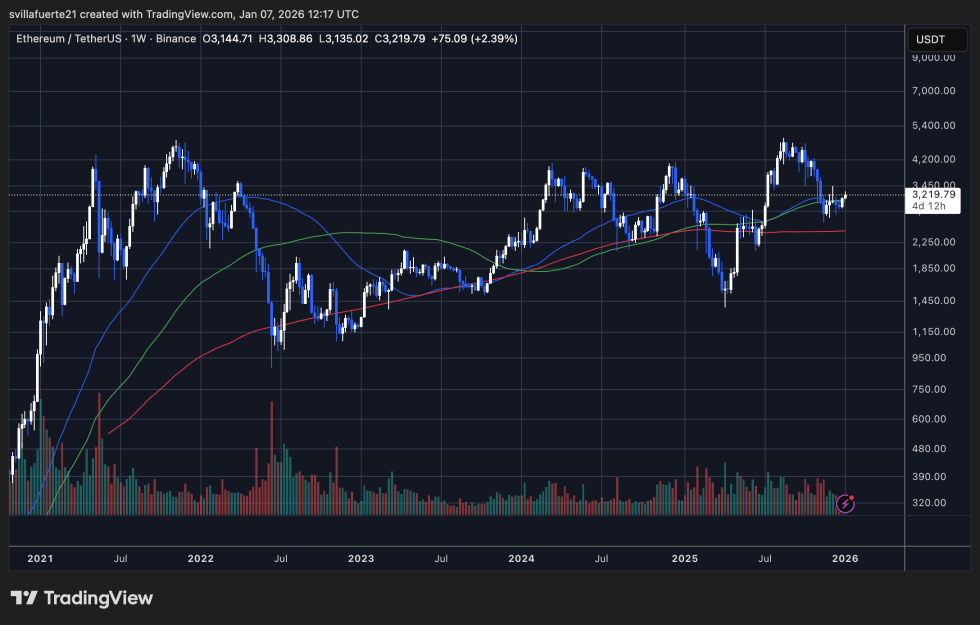
Ethereum’s weekly chart shows a market attempting to stabilize after a volatile correction, with price currently holding just above the $3,200 level. This zone has become a key short-term pivot, acting as a battleground between buyers seeking continuation and sellers defending higher supply. After the sharp rebound from the $1,800–$2,000 region earlier in the cycle, ETH entered a broad consolidation phase, reflecting cooling momentum rather than outright trend reversal.
ETH consolidates around key resistance level | Source: ETHUSDT chart on TradingView
From a structural perspective, Ethereum remains above its long-term moving averages, with the 200-week MA trending upward and providing a solid macro support base well below the current price. However, the 50-week and 100-week moving averages are now converging near the $3,300–$3,500 region, reinforcing this area as a critical resistance cluster.
Related Reading: XRP Shows Signs Of Strength: Market Orders Turn Increasingly Bullish
Trading activity has normalized after prior expansion phases, indicating reduced speculative intensity rather than aggressive distribution. This aligns with a market digesting previous gains while awaiting a new catalyst.
If bulls manage to reclaim and hold above the $3,500 level, the structure would favor a renewed push toward higher highs. Conversely, a loss of $3,200 could expose ETH to a deeper retracement toward the $2,800–$3,000 demand zone, where buyers are likely to re-emerge.
Featured image from ChatGPT, chart from TradingView.com
Editorial Process for bitcoinist is centered on delivering thoroughly researched, accurate, and unbiased content. We uphold strict sourcing standards, and each page undergoes diligent review by our team of top technology experts and seasoned editors. This process ensures the integrity, relevance, and value of our content for our readers.
ShareTweetShareShare
Sign Up for Our Newsletter!
For updates and exclusive offers enter your email.
Sebastian Villafuerte
Follow
Sebastian's journey into the world of crypto began four years ago, driven by a fascination with the potential of blockchain technology to revolutionize financial systems. His initial exploration focused on understanding the intricacies of various crypto projects, particularly those focused on building innovative financial solutions. Through countless hours of research and learning, Sebastian developed a deep understanding of the underlying technologies, market dynamics, and potential applications of cryptocurrencies.
As his knowledge grew, Sebastian felt compelled to share his insights with others. He began actively contributing to online discussions on platforms like X and LinkedIn, focusing on fintech and crypto-related content. His goal was to expose valuable trends and insights to a wider audience, fostering a deeper understanding of the rapidly evolving crypto landscape. Sebastian's contributions quickly gained recognition, and he became a trusted voice in the online crypto community.
To further enhance his expertise, Sebastian pursued a UC Berkeley Fintech: Frameworks, Applications, and Strategies certification. This rigorous program equipped him with valuable skills and knowledge regarding Financial Technology, bridging the gap between traditional finance (TradFi) and decentralized finance (DeFi). The certification deepened his understanding of the broader financial landscape and its intersection with blockchain technology.
Sebastian's passion for finance and writing is evident in his work. He enjoys delving into financial research, analyzing market trends, and exploring the latest developments in the crypto space. In his spare time, Sebastian can often be found immersed in charts, studying 10-K forms, or engaging in thought-provoking discussions about the future of finance.
Sebastian's journey as a crypto analyst and investor has been marked by a relentless pursuit of knowledge and a dedication to sharing his insights. His ability to navigate the complex world of crypto, combined with his passion for financial research and communication, makes him a valuable asset to the industry. As the crypto landscape continues to evolve, Sebastian remains at the forefront, providing valuable insights and contributing to the growth of this revolutionary technology.
Full Profile
Related Posts
Ethereum (ETH) Faces Crosscurrents as Scalability Upgrades Clash With Whale Selling Pressure
3 hours ago
Ethereum Ready To Breakout Against Bitcoin – Analyst Reveals When To Sell
1 day ago
Ethereum Founder Returns With Fix For Major Network Problems Amid Price Rebound
1 day ago
Ethereum Dominates In On-Chain Finance As Network Sees Record Stablecoin Flows – Here’s How Much
1 day ago
Ethereum To Hit $15,000 In 2026 As ‘Wall Street’s Default Chain’: Vivek Raman
1 day ago
Mixed Signals for Ethereum: Technical Milestones and Rising Adoption Offset Market Pressure
QWhat is the percentage increase in Ethereum's 7-day moving average of total transfer count as reported in the article?
AThe 7-day moving average of Ethereum's total transfer count has increased by nearly 45%, rising from approximately 600,000 transactions to around 870,000.
QWhat key price level are Ethereum bulls attempting to defend, according to the article?
AEthereum bulls are attempting to defend and stabilize above the $3,200 price level.
QWhat was the peak daily total transfer count reached on December 29th that marked the start of the activity surge?
AThe daily total transfer count surged to a peak of roughly 1.06 million transactions on December 29th.
QAccording to the technical analysis, what is the significance of the $3,300-$3,500 price region for Ethereum?
AThe $3,300-$3,500 region is a critical resistance cluster where the 50-week and 100-week moving averages are converging.
QWhat does the article suggest is a key indicator of network health and organic demand, unlike price-driven metrics?
AA sustained increase in on-chain transaction volume is a key indicator of network health and organic demand, as it reflects real usage across the ecosystem.
As a major evolution of Ethereum’s account system, AA is designed to address the fundamental security and experience bottlenecks of the “private key equals account” model in the EOA era.
4.5k Total ViewsPublished 2025.12.18Updated 2025.12.18
Ethereum Glamsterdam’s current Devnet-4 has completed multiple EIP tests and is transitioning to Devnet-5; the public testnets (Holesky/Sepolia) are about to be launched.
25.6k Total ViewsPublished 2026.05.21Updated 2026.05.21
Discussions
Welcome to the HTX Community. Here, you can stay informed about the latest platform developments and gain access to professional market insights. Users' opinions on the price of ETH (ETH) are presented below.