Ethereum Needs Better Decentralized Stablecoins, Buterin Says

bitcoinistPublished on 2026-01-12Last updated on 2026-01-12

Abstract

Vitalik Buterin argues that Ethereum needs better decentralized stablecoins, highlighting three key challenges: the need for a stablecoin not solely pegged to the USD long-term due to inflation risks; the necessity of uncapturable oracles to avoid exploitative governance; and the issue of staking yield competing with stablecoins for capital, creating a usability penalty. He suggests potential solutions like reducing staking yields or creating new staking mechanisms without slashing risk. Buterin's comments coincide with broader critiques that Ethereum represents a "contrarian bet" against mainstream VC-backed crypto trends like gambling and centralized finance.

Ethereum needs “better decentralized stablecoins,” Vitalik Buterin said this weekend, arguing that the next iteration has to solve three design constraints that today’s models keep skirting. His comments landed alongside a broader claim from MetaLeX founder Gabriel Shapiro that Ethereum is increasingly a “contrarian bet” versus what much of the venture-backed crypto stack is optimizing for.

Shapiro framed the split in ideological terms, saying it is “increasingly obvious that Ethereum is a contrarian bet against most of what crypto VCs are betting on,” listing “gambling,” “CeDeFi,” “custodial stablecoins,” and “’neo-banks’” as the center of gravity. By contrast, he argued, “Ethereum is tripling down on disrupting power to enable sovereign individuals.”

Why Ethereum Lacks A Decentralized Stablecoin

Buterin’s stablecoin critique starts with what to stabilize against. He said “tracking USD is fine short term,” but suggested that a long-horizon version of “nation state resilience” points to something that is not dependent on a single fiat “price ticker.”

“Tracking USD is fine short term, but imo part of the vision of nation state resilience should be independence even from that price ticker,” Buterin wrote. “On a 20 year timeline, well, what if it hyperinflates, even moderately?”
That premise shifts the stablecoin problem from simply maintaining a peg to building a reference index that can plausibly survive macro regime changes. In Buterin’s framing, that is “problem” one: identifying an index “better than USD price,” at least as a north star even if USD tracking remains expedient near term.

The second issue is governance and oracle security. Buterin argued that a decentralized oracle must be “not capturable with a large pool of money,” or the system is forced into unattractive tradeoffs that ultimately land on users.

“If you don’t have (2), then you have to ensure cost of capture > protocol token market cap, which in turn implies protocol value extraction > discount rate, which is quite bad for users,” he wrote. “This is a big part of why I constantly rail against financialized governance btw: it inherently has no defense/offense asymmetry, and so high levels of extraction are the only way to be stable.”

He tied that to a longer-running discomfort with token-holder-driven control structures that resemble markets for influence. In his view, “financialized governance” trends toward systems that must continuously extract value to defend themselves, rather than relying on a structural advantage that makes attacks meaningfully harder than normal operation.

The third problem is mechanical: staking yield competes with decentralized stablecoins for capital. If stablecoin users and collateral providers are implicitly giving up a few percentage points of return relative to staking ETH, Buterin called that “quite bad,” and suggested it becomes a persistent headwind unless the ecosystem changes how yield, collateral, and risk interact.

He laid out what he described as a map of the “solution space,” while stressing it was “not endorsement.” Those paths ranged from compressing staking yield toward “hobbyist level,” to creating a staking category with similar returns but without comparable slashing risk, to making “slashable staking compatible with usability as collateral.”

Buterin also sharpened what “slashing risk” actually means in this context. “If you’re going to try to reason through this in detail,” he wrote, “remember that the ‘slashing risk’ to guard against is both self-contradiction, and being on the wrong side of an inactivity leak, ie. engaging in a 51% censorship attack. In general, we think too much about the former and not enough about the latter.”

The constraint bleeds into liquidation dynamics as well. He noted that a stablecoin “cannot be secured with a fixed amount of ETH collateral,” because large drawdowns require active rebalancing, and any design that sources yield from staking must reckon with how that yield turns off or changes during stress.

At press time, ETH traded at $3,118.
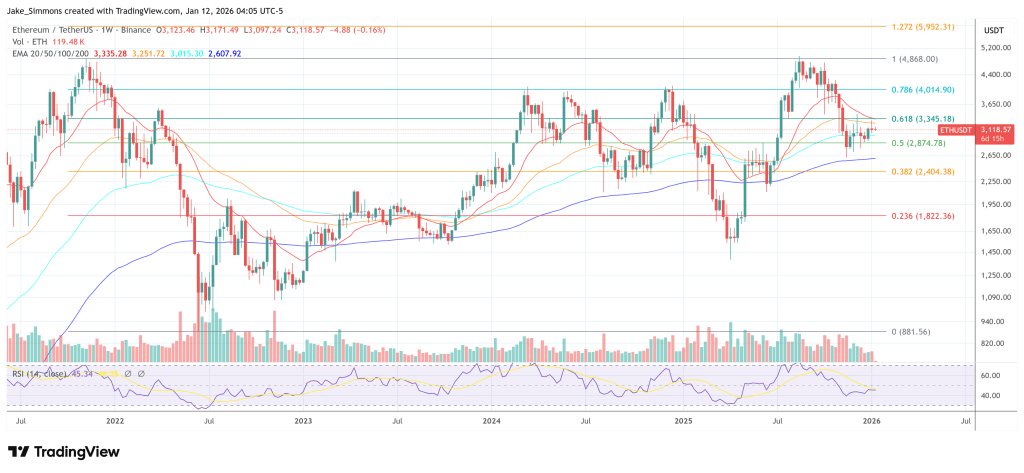
ETH remains between the 0.5 and 0.618 Fib, 1-week chart | Source: ETHUSDT on TradingView.com

Related Questions

QWhat are the three main design constraints that Vitalik Buterin says the next iteration of decentralized stablecoins on Ethereum must solve?

AThe three main design constraints are: 1) Identifying a stable index 'better than USD price' for long-term resilience, 2) Ensuring oracle security that is 'not capturable with a large pool of money', and 3) Solving the mechanical issue where staking yield competes with decentralized stablecoins for capital.

QAccording to Gabriel Shapiro, what is Ethereum increasingly a 'contrarian bet' against?

AAccording to Gabriel Shapiro, Ethereum is increasingly a 'contrarian bet' against what most crypto VCs are betting on, which he lists as 'gambling,' 'CeDeFi,' 'custodial stablecoins,' and 'neo-banks'.

QWhy does Buterin argue that 'financialized governance' is problematic for stablecoins?

AButerin argues that financialized governance is problematic because it has no defense/offense asymmetry, meaning it inherently trends toward systems that must continuously extract high levels of value from users to defend themselves, as the cost of capture must be greater than the protocol token's market cap to be stable.

QWhat two specific risks does Buterin highlight when discussing 'slashing risk' in the context of staking?

AButerin highlights that 'slashing risk' includes the risk of self-contradiction and the risk of being on the wrong side of an inactivity leak, which means engaging in or being affected by a 51% censorship attack.

QWhat is one potential solution Buterin maps out in the 'solution space' for the staking competition problem?

AOne potential solution Buterin maps out is compressing staking yield toward a 'hobbyist level' to reduce its competition with decentralized stablecoins for capital.

Related Reads

From Banning Doubao to Embracing Honor: Why Did WeChat Suddenly 'Change Its Face'?

The article explores the sudden shift in WeChat's strategy towards AI assistants from mobile phone manufacturers, transitioning from strict opposition to active collaboration. For over a year, WeChat fiercely resisted attempts by phone AI assistants (like ByteDance's Doubao in late 2025) to control its features via GUI automation ("simulated clicking"), citing security and data control concerns. This stance created a significant barrier for system-level AI integration. Now, Tencent has initiated A2A (Agent-to-Agent) partnerships with major phone brands like Honor, Xiaomi, OPPO, and vivo. This model allows a phone's system AI (e.g., Honor's YOYO) to parse a user's voice command and send a structured request directly to WeChat's own internal AI agent via secure APIs. WeChat then executes the action (e.g., sending a message) and returns the result. The article attributes Tencent's "change of face" to strategic pressure. While leading in social app usage, Tencent trails rivals like ByteDance and Alibaba in standalone AI app popularity. WeChat, with its vast mini-program ecosystem, is Tencent's key asset for an AI comeback. The upcoming WeChat AI agent aims to handle tasks like booking and payments within the app. However, phone system assistants remain the primary AI entry point for most users. The A2A collaboration allows Tencent to extend WeChat's AI reach to this crucial system layer while maintaining control over its core functions and data. For phone manufacturers, embracing A2A is a pragmatic move. The GUI route proved unviable due to WeChat's blocks. A2A offers a compliant path to integrate a vital service, enhancing their AI assistants' usefulness. It allows them to focus on developing their own AI ecosystems for other services while cooperating on WeChat access. The collaboration is framed as a mutual, strategic necessity: Tencent gains a distribution channel, and manufacturers gain a key functionality. The partnership relies on a "dual authorization" mechanism for security, requiring both user and app consent for each action. While questions about long-term data privacy practices remain, experts note A2A is more secure and compliant than GUI automation. Ultimately, this cooperation is seen as a tentative, calculated truce. Tencent's long-term goal is to make WeChat an AI-powered "service OS." Phone manufacturers aim to make their system AI the central user interface. Their paths may converge or clash in the future, but for now, the A2A deal represents the opening chapter in the battle for the AI-era user入口, driven by necessity and strategic calculus on both sides.

marsbit54m ago

From Banning Doubao to Embracing Honor: Why Did WeChat Suddenly 'Change Its Face'?

marsbit54m ago

On-Chain Figures on the Eve of Kickoff: 1.6 Billion Traded Before the World Cup Even Begins

"On-Chain Numbers on the Eve of the World Cup: $1.6 Billion Traded Before Kick-off" Analysis of on-chain markets before the 2026 FIFA World Cup reveals significant crypto integration into football. The most striking figure is the approximately **$1.6 billion** in total trading volume on the single "World Cup Winner" contract on the Polymarket prediction market platform, accumulated before a single match was played. This represents explosive growth for a sector whose annual volume surged from ~$16B in 2024 to ~$64B in 2025. The ecosystem is maturing beyond speculation. Key developments include: 1) **Infrastructure upgrades** like Polymarket's migration to native, regulated USDC stablecoin for settlements; 2) **Reliable data oracles**, such as Chainlink, being used to resolve real-world match outcomes on-chain; and 3) **Official recognition**, with FIFA appointing its first-ever "Prediction Markets" partner. Over 100 contracts now cover everything from the outright winner to individual match results and even non-sporting risks like venue relocation. This evolution marks a fundamental shift. While crypto firms are absent from FIFA's top-tier sponsor list, the technology has deeply penetrated the tournament's financial and predictive infrastructure through regulated stablecoin settlements, decentralized oracles, and new official partnership categories. The regulatory landscape remains complex and varies by jurisdiction, but on-chain markets for the World Cup are already a multi-billion-dollar reality.

marsbit1h ago

On-Chain Figures on the Eve of Kickoff: 1.6 Billion Traded Before the World Cup Even Begins

marsbit1h ago

From SpaceX's IPO to the Future of Crypto: Which Crypto Sectors Will Host the Trillion-Dollar Narrative?

From the SpaceX IPO, which targets a $750 billion raise at a $1.77 trillion valuation, we can extrapolate capital flow trends relevant to crypto. The focus shifts from speculative narratives to foundational infrastructure and real-world asset (RWA) integration. Key crypto sectors poised to benefit include: 1. **AI Infrastructure**: The narrative is moving from consumer-facing AI applications to underlying, scarce resources like compute power and decentralized GPU networks (e.g., TAO, RENDER, AKT, IO). These protocols are positioning as the essential "picks and shovels" providers for the AI economy. 2. **Real-World Assets (RWA)**: Beyond tokenized treasury bonds, RWA's future lies in on-chain equity and pre-IPO assets like SpaceX. This could democratize access to high-growth assets and reshape global capital flows, benefiting infrastructure projects like ONDO, LINK, and Plume that facilitate issuance, data, and liquidity. 3. **Core Financial Infrastructure**: Stablecoins, payment networks, and DePIN (Decentralized Physical Infrastructure Networks) are critical for settling the future on-chain economy. Their role expands from internal trading tools to foundational layers for global finance, AI systems, and real-world asset networks, leading to potential value reassessment. In summary, the next cycle may prioritize long-term infrastructure value—AI compute, asset tokenization networks, and settlement layers—over short-lived application hype, mirroring the broader market's shift towards funding the foundational systems of the future.

marsbit2h ago

From SpaceX's IPO to the Future of Crypto: Which Crypto Sectors Will Host the Trillion-Dollar Narrative?

marsbit2h ago

Trading

Spot
Futures

Hot Articles

Discussions

Welcome to the HTX Community. Here, you can stay informed about the latest platform developments and gain access to professional market insights. Users' opinions on the price of ETH (ETH) are presented below.

活动图片