Ethereum Institutional Adoption Expands: ETH Held In Corporate Reserves Climbs To New Landmark

bitcoinistPublished on 2026-05-19Last updated on 2026-05-19

Abstract

Institutional demand for Ethereum is rising as corporate reserves of ETH hit a new high of 7.33 million tokens, valued at approximately $16 billion, despite the cryptocurrency's recent sideways and declining price action. This accumulation, representing about 6% of ETH's total supply, signals growing institutional acceptance of Ethereum as a strategic long-term asset. Meanwhile, on-chain data reveals a divergence in investor behavior: small and medium-sized whales are selling their holdings, while large whales are accumulating, potentially positioning for future gains. ETH is currently trading around $2,120, finding support in a buy-wall zone but facing resistance near $2,250.

Ethereum’s sideways price action has continued, but demand for the leading altcoin on the institutional level has not yet cooled down. During this persistent price action, institutions across the sector have been quietly increasing their exposure to ETH, buying more of the altcoin.

Corporate Demand Pushes Ethereum Reserves Higher

A recent report has revealed an underlying persistent demand for Ethereum even as its price continues to face downside pressure. In the face of volatility, institutional investors have continued acquiring ETH as the amount of ETH held in corporate reserves climbs sharply to fresh levels.

According to Crypto Patel, a researcher and on-chain analyst, the number of ETH collectively held in corporate reserves has recently reached 7.33 million ETH, valued at a whopping $16 billion. This figure marks its highest level yet.
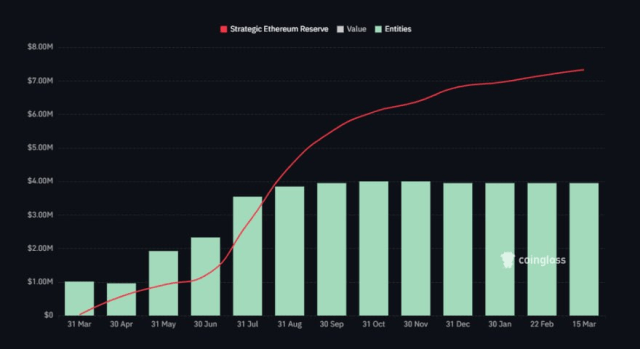
Source: Chart from Crypto Patel on X

The milestone shows that businesses across the crypto and financial sectors are becoming more open to treating Ethereum as a strategic part of long-term treasury and digital asset plans rather than just as a speculative asset. When institutions are buying, it often points to rising confidence in Ethereum and the network’s expanding role across the blockchain sector.

With roughly 6% of ETH’s total supply now sitting on corporate balance sheets, Crypto Patel has labeled this a rapidly growing institutional accumulation. Overall, the increase in corporate ETH reserves underscores ETH’s role as one of the leading assets for long-term investments in the broader and ever-dynamic cryptocurrency sector.

Small And Medium-Sized ETH Whales Are On A Selling Spree

It is important to note that sentiment toward Ethereum is not uniformly bullish. CW, a market expert and verified author at CryptoQuant, has outlined a negative shift in sentiment among small and medium-sized ETH whales.

In the expert’s post shared on the X platform, it is shown that the groups of key investors are steadily offloading their ETH holdings, indicating growing caution amid the current bearish market environment. These investors are likely selling their coins in order to secure more gains and prevent more losses.

While small and medium-sized whales continue to sell their ETH, large whales are doing the opposite as their balance has steadily increased. CW stated that this suggests that large whales are snatching up the coins being sold by these cohorts. In the meantime, this trend could play a critical role in shaping momentum, particularly when large holders begin positioning for potential upside.

Currently, the price of ETH is trading at $2,119, showing a more than 3% decline over the past day. However, after examining its price action on the 4-hour time frame, CW noted that Ethereum has now entered a buy wall zone, which is acting as a key support zone for the altcoin. While ETH is in a buy wall zone, a region where robust demand might promote price stability and possibly spur a recovery, a sell wall has also emerged around the $2,250 price level, which also paints a potential bearish outlook for the token.

ETH trading at $2,120 on the 1D chart | Source: ETHUSDT on Tradingview.com

Related Questions

QAccording to the article, what is the current total value of Ethereum held in corporate reserves?

AThe total value of Ethereum held in corporate reserves is a whopping $16 billion.

QWhat does the milestone of 7.33 million ETH in corporate reserves signify about institutional perception of Ethereum?

AIt signifies that businesses are becoming more open to treating Ethereum as a strategic part of long-term treasury and digital asset plans, rather than just as a speculative asset, indicating rising confidence in Ethereum and its expanding role in the blockchain sector.

QWhat is the contrasting behavior between small/medium-sized ETH whales and large whales as mentioned by CryptoQuant's expert CW?

ASmall and medium-sized ETH whales are steadily offloading their holdings, showing caution. In contrast, large whales are increasing their balances, likely buying up the coins being sold by the smaller cohorts.

QWhat two key price levels, according to the on-chain analysis, are currently important for Ethereum's price action?

AAccording to the analysis, Ethereum is currently in a buy wall zone acting as a key support level. A sell wall has also emerged around the $2,250 price level.

QWhat percentage of Ethereum's total supply is currently held in corporate reserves?

ARoughly 6% of Ethereum's total supply is now held in corporate reserves.

Related Reads

Understanding the New Economic Model of Tokenization

Understanding the New Token Economics Model The commercialization of AI applications is evolving from selling software and subscriptions to selling token call capacity. Tokens, the fundamental unit of information processing for large language models (LLMs), have become the basis for API billing and consumption. With call volumes exploding, tokens themselves are now being traded—procured, routed, split, and resold—forming a new intermediary market. This layer connects upstream LLM providers with downstream developers and enterprises, acting as a global wholesale-to-retail liquidity network. The rise of this business is fueled by a massive surge in China's daily token call volume—growing over a thousandfold from 100 billion in early 2024 to over 140 trillion by March 2026—and significant improvements in domestic LLM capabilities, which are now competitive globally. The core value of token distribution platforms extends beyond simple arbitrage. Key functions include aggregating multiple models (like GPT, Claude, and domestic models such as Kimi and DeepSeek) under a unified API, lowering network and payment barriers, and providing enterprise services like model selection, prompt engineering, and system integration. Profit models are diversifying: (1) resale margins; (2) technical premiums from proprietary inference acceleration (e.g., reducing costs to 1/10 of the industry standard); and (3) enterprise value-added services. High-consumption scenarios like marketing, short-form video, gaming, and e-commerce are primary drivers. Investment opportunities are seen in both companies with strong model capabilities (e.g., Alibaba, Tencent, MiniMax) and those with high-consumption client scenarios (e.g., marketing agencies with overseas reach). However, risks are significant: low entry barriers leading to intense competition, capital requirements and bad debt risks from advance payments, and dependency on policy changes from upstream LLM providers who control API pricing and access.

marsbit32m ago

Understanding the New Economic Model of Tokenization

marsbit32m ago

Farewell to the Copper Era: Understanding the Logic of the AI Silicon Photonics Industry Chain and Key US Stock Players

**Summary: The Era of Silicon Photonics and Key AI Infrastructure Stocks** The article delves into the transition from copper-based interconnects to silicon photonics (SiPh) as a critical enabler for next-generation AI data centers. It explains that copper faces fundamental physical limits—the bandwidth wall, density wall, and power wall—at high data rates (1.6T+), making a material shift essential. Silicon photonics, which integrates components like lasers, modulators, and detectors onto a silicon chip, offers a solution by leveraging mature CMOS manufacturing for cost-effective, high-volume production. A key challenge is that silicon itself is not an efficient light source, making Indium Phosphide (InP) lasers a critical and supply-constrained component. A major industry catalyst was NVIDIA's 2025 GTC announcement, declaring optical interconnects a "standard" from its Rubin platform onward, followed by strategic investments to secure the supply chain. The industry is structured in four key layers: 1. **Foundries:** TSMC leads with its COUPE platform, while Tower Semiconductor (specialized SiPh foundry) and GlobalFoundries are major players. 2. **Core Component Suppliers:** Lumentum is highlighted as the sole volume manufacturer of the crucial 200G/lane EML laser, with orders locked by NVIDIA through 2027. 3. **Module & System Manufacturers:** Coherent holds significant market share, with Chinese manufacturers like InnoLight also noted for scale. 4. **System Integrators:** NVIDIA, Broadcom, and Marvell dominate this layer, setting standards and integrating technology. The article identifies core public investment targets: **NVIDIA (NVDA)** as the ecosystem driver; **Broadcom (AVGO)** and **Marvell (MRVL)** in networking/switching chips; **Lumentum (LITE)** and **Coherent (COHR)** for critical components; and foundries **TSMC (TSM)** and **Tower Semiconductor (TSEM)**. Private companies Lightmatter and Ayar Labs are noted as key IPO candidates. The silicon photonics shift is driving a re-rating of company valuations, moving them from traditional telecom/industrial metrics to premium AI infrastructure multiples. The industry features high barriers to entry (e.g., multi-year lead times for InP laser capacity, complex 3D integration/thermal management, and lengthy customer qualification cycles), suggesting a "winner-takes-most" dynamic. Risks include dependence on hyperscaler capex cycles, potential technology disruption among competing optical approaches (LPO, CPO, OCS, Optical I/O), and a timeline where widespread CPO deployment may not occur until ~2028, with LPO serving as a transitional technology. The conclusion advises that betting on the overall industry trend may be safer than betting on any single company.

marsbit1h ago

Farewell to the Copper Era: Understanding the Logic of the AI Silicon Photonics Industry Chain and Key US Stock Players

marsbit1h ago

Trading

Spot
Futures

Hot Articles

Discussions

Welcome to the HTX Community. Here, you can stay informed about the latest platform developments and gain access to professional market insights. Users' opinions on the price of ETH (ETH) are presented below.

活动图片