Digital Gold, Future Payments, Speculative Choice? Bitcoin's 'Narratives' Collapse One by One at the 'Peak of Faith'

华尔街日报Published on 2026-02-22Last updated on 2026-02-22

Abstract

Bitcoin is facing an unprecedented identity crisis as its core value narratives collapse simultaneously. Despite gaining regulatory support and institutional adoption, its price has plummeted over 40% from its high, erasing more than $1 trillion in market value. The cryptocurrency’s fundamental narratives—digital gold, a payment mechanism, and a speculative asset—are all faltering. As a “digital gold” substitute, Bitcoin failed to act as a safe haven during geopolitical tensions, while gold ETFs attracted significant inflows. In payments, stablecoins are now preferred, with key proponents like Jack Dorsey shifting focus. Meanwhile, speculative interest is moving toward prediction markets like Polymarket, offering faster, leveraged outcomes without Bitcoin’s volatility. Though Bitcoin remains highly liquid and has survived past crises, its relevance is now in question. Without a unifying narrative, it risks a gradual loss of attention, capital, and belief—raising the fundamental question: What is Bitcoin’s purpose when its core stories disintegrate?

Bitcoin is mired in an unprecedented identity crisis. The world's largest cryptocurrency has plummeted more than 40% from its peak, but the real problem is not the price itself, but the simultaneous collapse of the core narratives underpinning its value. When "digital gold" loses to real gold, its payment function loses to stablecoins, and its speculative heat loses to prediction markets, Bitcoin is forced to confront a question it has never needed to answer: Why does it exist at all?
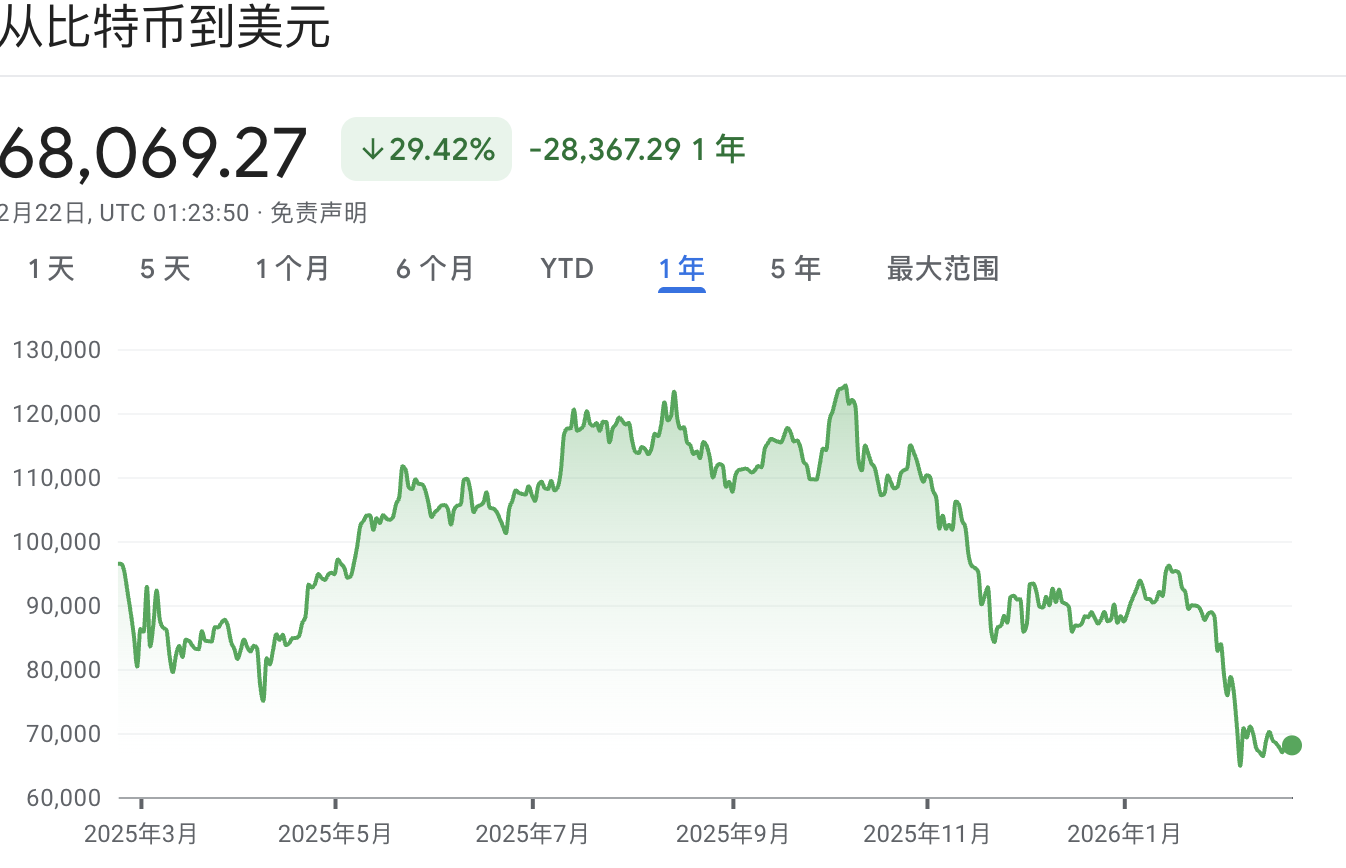
Ironically, this crisis comes after Bitcoin got everything it wanted. Regulatory attitudes in Washington have never been friendlier, institutional adoption has never been deeper, and Wall Street has never been more accepting. But these victories did not prevent a market capitalization evaporation of over $1 trillion. The usual rebound script has failed—the bottom-fishing buyers have disappeared, and the forces that typically drive a rally are now working in reverse.

According to a Bloomberg report on Saturday, unlike stocks or commodities, Bitcoin lacks fundamental support; its value relies almost entirely on belief—on the narratives that persuade new buyers to enter the market. And these narratives are faltering. Retail investors who bought into the Trump-induced rally are now deeply underwater. More critically, Bitcoin now must compete with more alternatives that are "easier to understand and easier to explain to trustees, clients, and boards."

Owen Lamont, Portfolio Manager at Acadian Asset Management, said:

Bitcoin's core story is 'the price goes up,' but we don't have that now. What we have now is 'the price goes down,' and that's not a good story.

Complete Rout on the Payment Battlefield

A clear signal emerged last November. Jack Dorsey, one of Bitcoin's most vocal corporate evangelists for a long time, announced that his Cash App would begin supporting stablecoins. For years, Dorsey treated Bitcoin maximalism as a creed; his pivot sent a signal: the payments race had moved to a new arena.

In Washington, stablecoins have become the focus. The bipartisan-supported Genius Act passed easily, and regulators have openly encouraged infrastructure for dollar-backed tokens. Even within the crypto space itself, Bitcoin is no longer the sole focus. Tokenization, blockchain-driven derivatives, and cross-border stablecoin payments are becoming credible use cases—and none of these require Bitcoin's participation.

"If there's any correlation, stablecoin activity might be related to activity on Ethereum or other chains. Stablecoins are for payments," said Carlos Domingo, co-founder and CEO of the tokenization platform Securitize. "I don't think anyone views Bitcoin as a payment mechanism today."

The Bankruptcy of the "Digital Gold" Narrative

Even after years of "digital gold" hype, Bitcoin has failed the most important macro test. Despite geopolitical tensions and persistent dollar weakness, gold and silver have staged volatile rallies this year, while cryptocurrencies have only fallen. Fund flows confirm this divergence. According to data compiled by Bloomberg, over the past three months, US-listed gold and gold-themed ETFs attracted over $16 billion, while spot Bitcoin ETFs saw outflows of about $3.3 billion. Bitcoin's market cap has shrunk by over $1 trillion.

"People are realizing that Bitcoin is what it has always been—just a speculative asset," said Tom Essaye, President and Founder of Sevens Report and a former Merrill Lynch trader. "Bitcoin is not going to replace gold, it's not digital gold, it doesn't do the same things, it can't provide people with the utility that gold provides. It's not an inflation hedge—frankly, there are better hedges out there where you don't have to worry about volatility. It's not a chaos hedge either."

The digital asset treasury model was supposed to be Bitcoin's corporate identity. Companies like Strategy Inc. hoarded Bitcoin during the bull market and issued stock based on it, creating a self-reinforcing cycle that created billions in market capitalization out of thin air and gave institutional investors a way to express conviction without direct exposure to the asset. It worked for a while. But now the cycle has reversed—and with it, the model's credibility has collapsed. The largest digital asset treasury companies have plummeted over the past year—some falling far more than Bitcoin itself. Many now trade below the value of their holdings.

Speculative Frenzy Shifts to Prediction Markets

Bitcoin's grip on speculative culture is also slipping. Prediction platforms like Polymarket and Kalshi—with binary outcomes, fast settlement, and real-world stakes—are now the new playground for the dopamine hunters who once chased meme coins. This is not a fringe phenomenon: Polymarket's weekly nominal trading volume has soared over the past year. Even Coinbase Global Inc. has added prediction contracts. The dopamine hasn't disappeared; it has just moved.

"Prediction markets are becoming the next big thing for DIY investors who like the speculative nature of crypto," said Roxanna Islam, Head of Sector Research at ETF firm TMX VettaFi. "This could mean less overall interest in crypto." However, she added, "It could also mean a shift towards longer-term, more serious investors."

Furthermore, there is a growing mismatch between how Bitcoin is accessed and how it is traded. Spot ETFs have made buying incredibly easy, but Bitcoin's price is still influenced by offshore derivatives markets, where traders often use 100x leverage. These venues employ automatic liquidation engines: when a position breaches a margin threshold, it is force-liquidated and sold into the order book, instantly triggering chain liquidations that can crash the spot price in minutes. The crash last October fully exposed this mechanism, with billions in leveraged positions liquidated in an instant.

The Divide Between Resilience and Relevance

None of this means Bitcoin is finished. It remains the most liquid digital asset, with deeper order books and broader exchange coverage than any competitor. Spot ETFs have made Bitcoin a permanent fixture in investment portfolios. More importantly, it has survived crises before: the Mt. Gox collapse, the 2022 crash—and many others. Each time, the network survived, and the price began setting new records. Resilience is not meaningless.

"There's always fear, uncertainty, and doubt being spread. There are always problems," said Dan Morehead, founder of Pantera Capital. "I just think people who are skeptical about how important phone-based money is to the world naturally want to find new things to worry about all the time."

The bull case lies not in Bitcoin's narratives being unassailable, but in them not needing to be—they just need to be durable enough to outlast each successive crisis of confidence. So far, history is on their side. According to Bloomberg data, Bitcoin has experienced and recovered from numerous major declines before.

But history also shows that survival and relevance are not the same. Bitcoin's greatest threat is not competitors—it's drift. The slow erosion of attention, capital, and belief that follows when no single narrative holds. The asset remains, the network still runs, but the stories that gave Bitcoin its gravity—digital gold, free money, institutional reserve—are collapsing simultaneously. Whether this is a temporary crisis or a permanent shift is one of the biggest questions in the digital economy era.

"For many, it's like a religion, and religious beliefs are hard to shake," said Michael Rosen, Chief Investment Officer at Angeles Investment Advisors. "It's just not my religion."


Trending Cryptos

Related Questions

QWhat is the core identity crisis that Bitcoin is currently facing according to the article?

ABitcoin is facing an unprecedented identity crisis as its core value narratives—being 'digital gold,' a payment mechanism, and a speculative asset—are simultaneously collapsing, forcing it to confront the fundamental question of why it exists.

QHow has the 'digital gold' narrative for Bitcoin been challenged recently?

AThe 'digital gold' narrative has been undermined as Bitcoin failed key macro tests during geopolitical tensions and dollar weakness, with gold and silver experiencing volatile rallies while Bitcoin declined. Gold ETFs attracted over $16 billion in three months, while Bitcoin ETFs saw outflows of about $3.3 billion.

QWhy did Jack Dorsey's Cash App supporting stablecoins signal a shift in the payment competition?

AJack Dorsey, a long-time Bitcoin maximalist, announced that Cash App would support stablecoins, indicating that the payment race has moved to stablecoins, which are now the focus in Washington with bipartisan regulatory support and are seen as more practical for payments without requiring Bitcoin.

QWhat is replacing Bitcoin as the new playground for speculative dopamine seekers?

APrediction markets like Polymarket and Kalshi, with binary outcomes, fast settlement, and real-world stakes, are becoming the new playground for speculative dopamine seekers, attracting activity that once focused on meme coins and cryptocurrencies.

QWhat does the article suggest is the biggest threat to Bitcoin's relevance, beyond competitors?

AThe biggest threat to Bitcoin's relevance is not competitors but 'drift'—the slow erosion of attention, capital, and belief when no single narrative sustains it, leading to a loss of the stories that gave it gravity, such as digital gold, free money, or institutional reserve.

Related Reads

SemiAnalysis on the Epic Plunge: It's Not Over Yet

SemiAnalysis Weekly discusses the recent sharp correction in the semiconductor market after a historic first half. Analysts Doug O'Loughlin and Dylan note that despite healthy fundamentals, markets like South Korea's KOSPI have plunged 40%, wiping out leveraged retail investors. A core debate focuses on AI demand versus supply constraints. Dylan cites SemiAnalysis's internal use of AI coding agents, leading to a 100x increase in AI spending, as evidence of powerful demand. Doug agrees demand is strong but questions its exact magnitude, calling it a "trillion-dollar question." His primary concern is physical and financial bottlenecks: a shortage of 100,000 electricians in the US, massive $450B in corporate debt issuance by hyperscalers (funded by a shrinking pension pool), and labor/scale limits in regions like Taiwan, where TSMC constitutes 20% of GDP. The conversation covers market dynamics, including the typical semiconductor cycle where over-ordering leads to crashes, China's growing memory capacity, and the potential for older chips like the H100 to lose value as models scale. Politically, AI is seen as a likely scapegoat in upcoming elections, though not a top-tier voter priority. The analysts conclude that while the long-term potential is significant, the scaling path is narrowing. The challenge is matching exponential compute demands with real-world constraints on capital, labor, and permits, risking scenarios where massive investment outpaces near-term revenue generation.

marsbit13m ago

SemiAnalysis on the Epic Plunge: It's Not Over Yet

marsbit13m ago

After Robinhood's Aggressive Entry, Why is PUMP Defying the Trend and Rising?

Amid a prolonged crypto bear market that has strained many projects, Pump.fun stands out by maintaining strong profitability. Despite a major token unlock in mid-July that was expected to cause selling pressure, its native token PUMP has risen nearly 48% over the past month. Analysis shows only a small portion of unlocked tokens were sold, with 92% of investor allocations still held. A buyback-and-burn mechanism has also supported the price, though daily回购 funds have declined by 77.5% from their peak, partly due to a change in tokenomics and lower platform revenue. Pump.fun remains a top revenue generator in crypto, with annualized revenue of around $450 million, ranking just behind giants like Tether and Circle. However, its daily revenue is down about 69% from its all-time high, reflecting dependence on meme coin market cycles. The platform also faces a class-action lawsuit alleging market manipulation and securities violations. New competition has emerged with Robinhood Chain's launchpad, which recently saw higher weekly volume and active addresses than Pump.fun. While Pump.fun's metrics haven't declined yet, it has responded with a new token launch mechanism called BOOST to improve liquidity. This has increased platform activity but raised community concerns about potential exploitation for short-term pumps. Ultimately, Pump.fun's success remains tightly linked to meme coin speculation and broader market sentiment.

marsbit13m ago

After Robinhood's Aggressive Entry, Why is PUMP Defying the Trend and Rising?

marsbit13m ago

China Business Journal Unveils Cryptocurrency Extortion Scheme

China Business Journal, a state-run Chinese newspaper, has issued a warning about scammers using its name to extort cryptocurrency from companies. According to the publication, fraudsters are sending emails impersonating its journalists. These emails threaten to publish damaging information about a company unless a Bitcoin payment is made. The scammers, using Proton Mail addresses, claim to possess compromising material from a secretive investigation. The newspaper's representatives have clarified that it has no involvement with these messages. They emphasized that the publication does not engage in such practices, never demands payment to suppress stories, and does not negotiate in this manner. The editorial team believes the criminals are exploiting the newspaper's authoritative reputation to pressure companies into making hasty decisions under threat of reputational harm. China Business Journal stated it is collecting evidence of this brand misuse, analyzing the fraudulent emails, and preparing materials for law enforcement. It reserves the right to pursue both civil and criminal liability against the scheme's organizers. Companies are urged to carefully verify any communication purportedly from the newspaper, avoid transferring cryptocurrency to unknown recipients, and report such incidents to the authorities. The newspaper confirmed it will continue its own investigation into the matter.

cryptonews.ru49m ago

China Business Journal Unveils Cryptocurrency Extortion Scheme

cryptonews.ru49m ago

Trading

Spot

Hot Articles

Discussions

Welcome to the HTX Community. Here, you can stay informed about the latest platform developments and gain access to professional market insights. Users' opinions on the price of S (S) are presented below.

活动图片