December 19: BTC, ETH, SOL, RTX, ZKP Market Analysis

金色财经Published on 2025-12-19Last updated on 2025-12-19

Abstract

On December 19, analysis of BTC, ETH, SOL, RTX, and ZKP market trends was provided. BTC experienced volatility following favorable CPI data, briefly rising above $89,000 before dropping to around $84,000, resulting in $450 million in liquidations. A whale deposited 5,152 BTC ($445 million) into Binance. The 4-hour chart suggests a potential falling wedge pattern, indicating a possible reversal if it breaks above the $89,000–$90,000 resistance. ETH showed a strong rebound, possibly due to large-scale accumulation after recent negative news. It remains in a downtrend channel but may break out soon. Key resistance levels are $3,030 and $3,150, with support at $2,860, $2,750, and $2,650. SOL has been underperforming, falling below $120. It failed multiple times to break the $145 resistance. A rebound above $123 could target $132–$135. RTX has a total supply of 100 million tokens with an initial circulation of 16.66%. Pre-market price is $1.30. The project having mixed factors—moderate trading volume and unclear advantages. ZKP has a total supply of 1 billion tokens, with an initial circulation of 20.16% priced at $0.175. Significant airdrop supply may cause selling pressure. A Binance contract listing is anticipated. The overall outlook suggests potential recovery after recent declines, with specific entry and exit levels provided for each asset.

Last night's CPI data was favorable for risk assets. After the data was released, Bitcoin briefly surged above 89,000 but quickly dropped to around 84,000. The futures market saw liquidations as high as $450 million.

BTC OG whales deposited 5,152 BTC (approximately $445 million) into Binance. Currently, there are no signs of a halt in the decline or stabilization from the market perspective. However, after the Bank of Japan's interest rate hike was implemented, market panic sentiment is expected to improve.

BTC

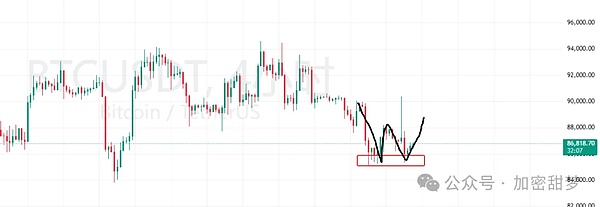
From the 4-hour chart, this decline appears to be a falling wedge pattern, likely the final leg of the drop. It's uncertain whether this pattern will fully form, as the overall trend remains bearish. However, considering the short-term rebound potential, I'm temporarily holding off on short positions and will keep my long positions for now.

Watch the 89,000-90,000 range. If it breaks and stabilizes above this level with strong upward momentum, it's highly likely to confirm the falling wedge pattern, indicating a potential trend reversal.

The current rebound isn't over yet. Keep an eye on the upper resistance line for further analysis.
ETH

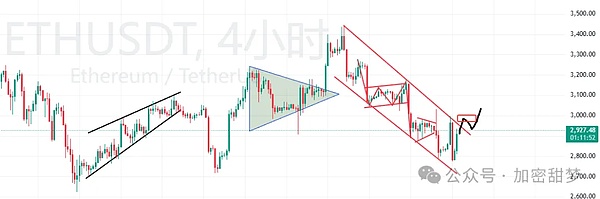
ETH's rebound has been quite strong, possibly due to the resolution of negative news, prompting large funds to start buying in batches. This led to a rapid price rebound. Although it's still within a descending channel, the 4-hour chart shows consecutive golden crosses at low levels, suggesting a likely breakout in the short term.

Key resistance levels to watch are 3030 and 3150. Consider shorting around these levels.

Support levels are at 2860, 2750, and 2650. For medium-term short, target 2500.
SOL

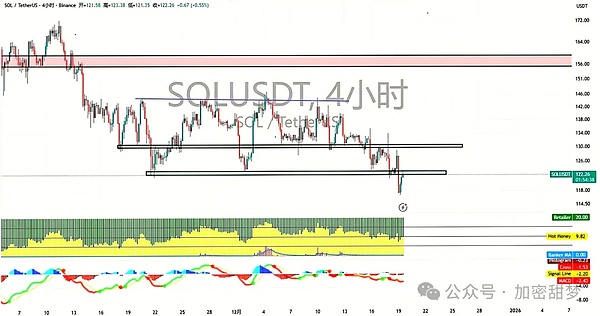
Recently, SOL has been relatively sluggish. Last night, it broke below the 120 mark. During this phase, SOL's performance has been quite weak, failing to break above the 145 resistance three times. The support at 122 was directly broken, indicating selling pressure for some time. If it stabilizes above 123, consider buying long with targets at 132-135.
RTX

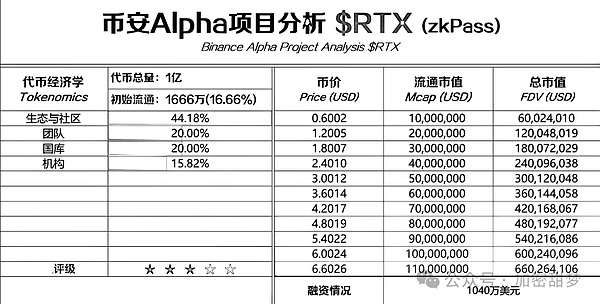
Total supply: 100 million. Initial circulation: 16.66%. Pre-market price: 1.3. Pool price: 1.2.

Pros: 1. Second Aster USD1 trading pair. 2. Community anti-sybil measures, though not as high as 1.33%.

Cons: 1. On-chain TVL is 44 million. 2. The fundraising timing is questionable, with no clear justification for the November fundraising. TVL performance hasn't been strong enough to support the token launch.

The project seems average, with mediocre trading volume and no significant advantages. The pre-market valuation is neither high nor low. Keep an eye on it after launch.
ZKP

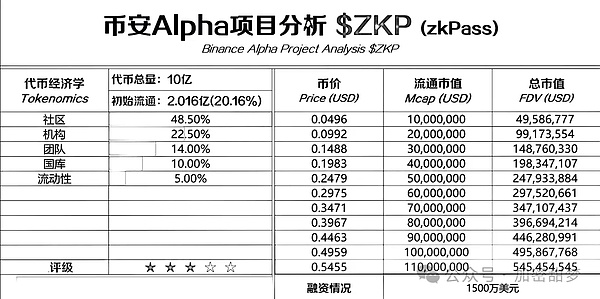
Total token supply: 1 billion. Initial circulation: 201.6 million (20.16%). Pre-market and pool price: 0.175U. Corresponding circulating market cap: $35 million. FDV: $175 million.

Kaito presale: 2%, with half unlocked at TGE. Claims open on the Ethereum network at 20:00. Aspecta key presale: 0.2% of tokens available for exchange within 2 hours of TGE. Additional community airdrops, Kaito sybil airdrops, and Binance BOOSTER 10 million tokens mean there are quite a few scattered tokens outside.

However, the project team hasn't clarified the airdrop quantity, which is quite sneaky. Price maintenance and Binance contract listings shouldn't be an issue. After various airdrops are sold off, consider whether to take a position for a contract listing.
If you find our content helpful, share our public account with your friends! Welcome to follow and stay updated with the latest crypto news! After every crash comes vast opportunities. If you're unsure about future market strategies, follow Tianmeng and contact: RFGH8689


Trending Cryptos

Related Questions

QWhat was the market reaction to the CPI data release according to the article?

AThe CPI data was favorable for risk assets, causing Bitcoin to rise above $89,000 initially, but it was quickly sold off, dropping to around $84,000, with $450 million in contracts liquidated.

QWhat pattern is BTC疑似 forming on the 4-hour chart, and what would confirm it?

ABTC is疑似 forming a falling wedge pattern on the 4-hour chart. It would be confirmed if the price breaks and stabilizes above the $89,000-$90,000 range with strong upward momentum, indicating a potential trend reversal.

QWhat are the key resistance and support levels mentioned for ETH?

AThe key resistance levels for ETH are $3,030 and $3,150, where shorting is suggested. Support levels are $2,860, $2,750, and $2,650, with a bearish target of $2,500 for a波段空 (swing short).

QWhy does the article describe SOL's recent performance as '拉胯' (underwhelming)?

ASOL's performance is described as underwhelming because it failed to break above the $145 resistance three times and recently fell below the $120 support level, indicating sustained selling pressure.

QWhat are the initial circulating supply and FDV (fully diluted valuation) for ZKP?

AZKP has an initial circulating supply of 201.6 million tokens (20.16% of total supply) and an FDV of $175 million based on a pre-listing and pool price of $0.175 per token.

Related Reads

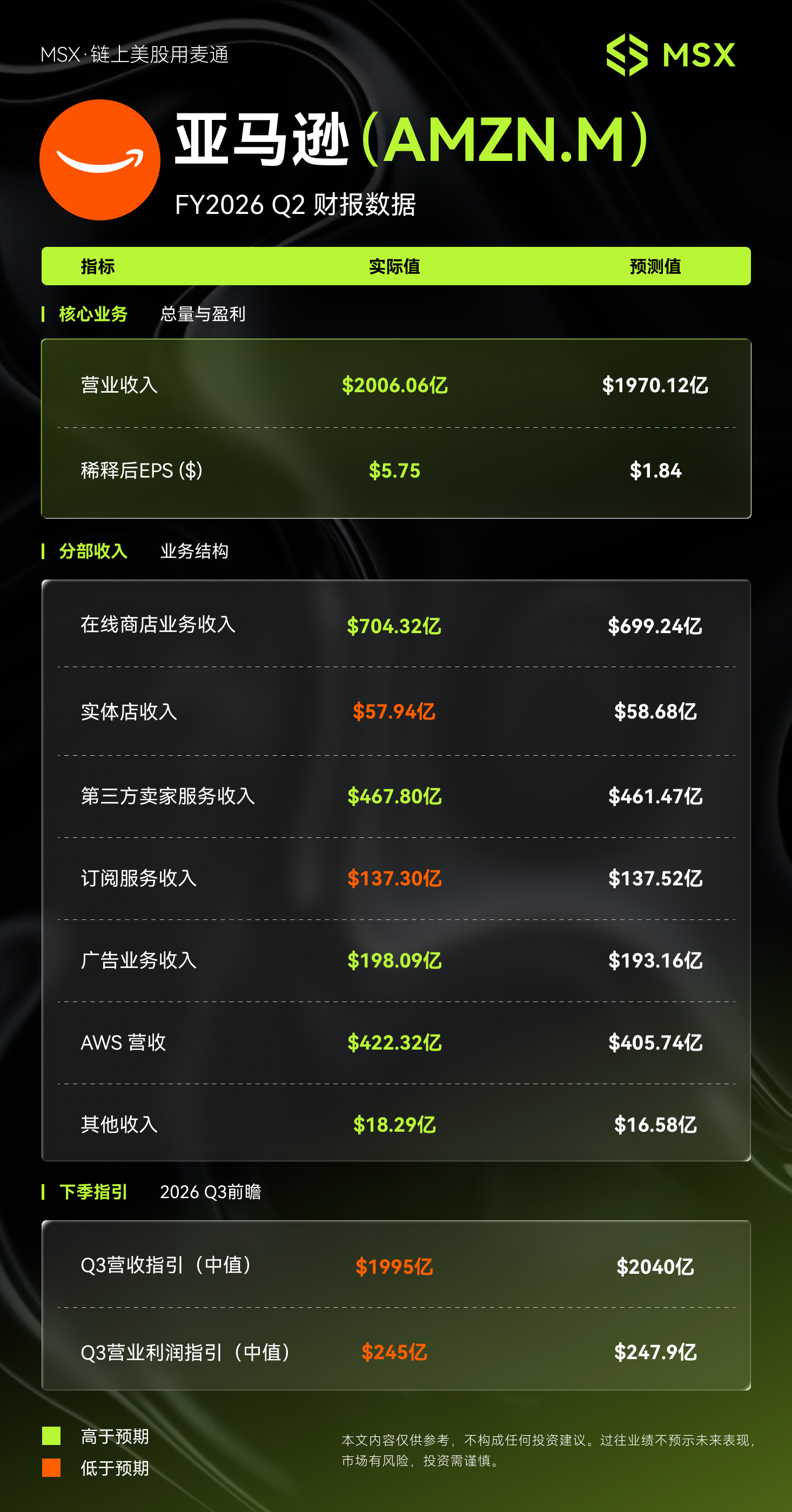
MSX US Stock Daily Insight: Amazon 2026 Q2 Earnings: AWS Records Fastest Growth in Five Years

**MSX Daily US Stock Observation: Amazon's Q2 2026 Earnings: AWS Achieves Fastest Growth in Five Years** Amazon's latest quarterly results exceeded expectations, driven by a strong performance from its cloud computing unit. The company reported revenue of $200.66 billion, surpassing estimates of approximately $197 billion. The key highlight was Amazon Web Services (AWS), which generated $42.232 billion in revenue, surging 37% year-over-year. This marked the segment's fastest growth pace in 18 quarters, indicating robust demand for cloud services. Reported Earnings Per Share (EPS) of $5.75 significantly exceeded the $1.84 forecast. However, this figure included a substantial one-time, non-operating gain of $53.4 billion, primarily from the revaluation of Amazon's investment in AI company Anthropic. Excluding this item, core operating profit was $27.461 billion, a strong increase of 43% compared to the same period last year. Despite the positive results, Amazon provided guidance for the upcoming third quarter that fell short of market expectations. The company's revenue guidance midpoint is $199.5 billion, below the consensus estimate of around $204 billion. Operating profit guidance of $24.5 billion also slightly missed expectations of approximately $247.9 billion. Furthermore, Amazon raised its forecast for full-year capital expenditures to $220 billion, citing rising memory chip costs, which weighed on investor sentiment regarding future profitability. In summary, Amazon's quarter showcased accelerating momentum in its core AWS business. The underlying operational profit growth remains solid. However, cautious forward guidance and increased investment spending present key areas for monitoring in the coming quarters, as the market assesses whether the current growth phase will translate into sustained profit margin expansion.

Odaily星球日报2m ago

MSX US Stock Daily Insight: Amazon 2026 Q2 Earnings: AWS Records Fastest Growth in Five Years

Odaily星球日报2m ago

Cyclical Stock or Growth Stock? Coinbase's Q2 Earnings Report Reveals 'Valuation Disagreement'

Coinbase's Q2 2026 financial results revealed a mixed performance, reigniting debate over whether the company should be valued as a cyclical stock tied to crypto markets or a growth stock with future potential. Total revenue missed expectations at $1.22 billion, down 19% year-over-year. Transaction revenue fell to $599 million, with retail crypto spot trading revenue dropping 30% to $452 million, back to 2023 levels. The company reported a net loss of $359 million, marking its third consecutive quarterly loss. Despite CEO Brian Armstrong's positive commentary on metrics like a 10.3% overall crypto trading market share and 106% growth in prediction markets, the market reacted negatively, with shares dropping over 5% after-hours. A key issue is the decline in core retail trading. While Coinbase touted record market share, this figure includes derivatives and new products. Its traditional crypto spot trading share is likely shrinking. New ventures like prediction markets, while growing, contributed less than $30 million, insufficient to offset the core revenue decline. The valuation debate hinges on perspective. As a cyclical stock, Coinbase remains deeply tied to the crypto bear market, with user attrition and competitive pressures justifying a lower valuation. The company's strategy appears focused on surviving until the next bull cycle. Viewed as a growth stock, however, Coinbase shows promising diversification. Subscription and service revenue reached $555 million, nearly matching transaction revenue. Stablecoin revenue, its second-largest source at $292 million, remains strong through its partnership with Circle. Critically, Coinbase is positioning itself as a leader in the emerging on-chain "agent economy." Over 90% of agent-based stablecoin transactions occur on its Base network, which it believes could handle trillions in future agent transactions. The recent acquisition of Deribit also aims to boost its international derivatives offering. In summary, Coinbase's present struggles are clear, but its future hinges on whether its investments in revenue diversification, stablecoins, and the agent economy can ultimately transform its business model and justify a growth premium.

Odaily星球日报22m ago

Cyclical Stock or Growth Stock? Coinbase's Q2 Earnings Report Reveals 'Valuation Disagreement'

Odaily星球日报22m ago

Global Market Share Survey: Japanese Firms Lead in Semiconductor Materials

Global Market Share Survey: Japanese Firms Lead in Semiconductor Materials According to the 2025 "Major Goods and Services Market Share Survey" by Nikkei, Japanese companies maintain strong positions in semiconductor-related materials. In silicon wafers, Shin-Etsu Chemical ranks first with a 26.3% share, followed by SUMCO at 17.8%. Together, they hold 44.1% of the market, widening their lead over competitors from Taiwan, Germany, and South Korea. In photoresists, Tokyo Ohka Kogyo, JSR, and Shin-Etsu Chemical occupy the top three spots, with a combined share of 60.5%. Despite their strength in materials, Japanese firms have a weaker presence in core semiconductor segments like DRAM and NAND flash memory, where South Korean and U.S. companies dominate. For instance, SK Hynix and Samsung lead in DRAM, while China’s CXMT doubled its share to 6% in 2025. The semiconductor market is projected to grow rapidly, with WSTS forecasting a 90% increase to $1.5112 trillion by 2026. Major players like Samsung, SK Hynix, and Micron are making massive investments to expand capacity. To maintain their edge in materials, Japanese companies must similarly commit to large-scale, risk-taking investments. In contrast, Japan’s automotive sector shows stagnation. Toyota remains the global leader but with only a slight share increase to 12.3%, while Japanese brands are absent from the top five in the EV market. In shipbuilding, Imabari Shipbuilding rose to third place globally with a 7.2% share, benefiting from large container ship deliveries. However, Chinese and South Korean firms dominate the sector, holding the top two positions. Japan aims to revitalize its shipbuilding industry through government and corporate efforts, targeting a near doubling of output by 2035. Addressing labor shortages and adopting advanced technologies like physical AI will be critical for competitiveness.

marsbit46m ago

Global Market Share Survey: Japanese Firms Lead in Semiconductor Materials

marsbit46m ago

Trading

Spot

Hot Articles

What is $BITCOIN

DIGITAL GOLD ($BITCOIN): A Comprehensive Analysis Introduction to DIGITAL GOLD ($BITCOIN) DIGITAL GOLD ($BITCOIN) is a blockchain-based project operating on the Solana network, which aims to combine the characteristics of traditional precious metals with the innovation of decentralized technologies. While it shares a name with Bitcoin, often referred to as “digital gold” due to its perception as a store of value, DIGITAL GOLD is a separate token designed to create a unique ecosystem within the Web3 landscape. Its goal is to position itself as a viable alternative digital asset, although specifics regarding its applications and functionalities are still developing. What is DIGITAL GOLD ($BITCOIN)? DIGITAL GOLD ($BITCOIN) is a cryptocurrency token explicitly designed for use on the Solana blockchain. In contrast to Bitcoin, which provides a widely recognized value storage role, this token appears to focus on broader applications and characteristics. Notable aspects include: Blockchain Infrastructure: The token is built on the Solana blockchain, known for its capacity to handle high-speed and low-cost transactions. Supply Dynamics: DIGITAL GOLD has a maximum supply capped at 100 quadrillion tokens (100P $BITCOIN), although details regarding its circulating supply are currently undisclosed. Utility: While precise functionalities are not explicitly outlined, there are indications that the token could be utilized for various applications, potentially involving decentralized applications (dApps) or asset tokenization strategies. Who is the Creator of DIGITAL GOLD ($BITCOIN)? At present, the identity of the creators and development team behind DIGITAL GOLD ($BITCOIN) remains unknown. This situation is typical among many innovative projects within the blockchain space, particularly those aligning with decentralized finance and meme coin phenomena. While such anonymity may foster a community-driven culture, it intensifies concerns about governance and accountability. Who are the Investors of DIGITAL GOLD ($BITCOIN)? The available information indicates that DIGITAL GOLD ($BITCOIN) does not have any known institutional backers or prominent venture capital investments. The project seems to operate on a peer-to-peer model focused on community support and adoption rather than traditional funding routes. Its activity and liquidity are primarily situated on decentralized exchanges (DEXs), such as PumpSwap, rather than established centralized trading platforms, further highlighting its grassroots approach. How DIGITAL GOLD ($BITCOIN) Works The operational mechanics of DIGITAL GOLD ($BITCOIN) can be elaborated on based on its blockchain design and network attributes: Consensus Mechanism: By leveraging Solana’s unique proof-of-history (PoH) combined with a proof-of-stake (PoS) model, the project ensures efficient transaction validation contributing to the network's high performance. Tokenomics: While specific deflationary mechanisms have not been extensively detailed, the vast maximum token supply implies that it may cater to microtransactions or niche use cases that are still to be defined. Interoperability: There exists the potential for integration with Solana’s broader ecosystem, including various decentralized finance (DeFi) platforms. However, the details regarding specific integrations remain unspecified. Timeline of Key Events Here is a timeline that highlights significant milestones concerning DIGITAL GOLD ($BITCOIN): 2023: The initial deployment of the token occurs on the Solana blockchain, marked by its contract address. 2024: DIGITAL GOLD gains visibility as it becomes available for trading on decentralized exchanges like PumpSwap, allowing users to trade it against SOL. 2025: The project witnesses sporadic trading activity and potential interest in community-led engagements, although no noteworthy partnerships or technical advancements have been documented as of yet. Critical Analysis Strengths Scalability: The underlying Solana infrastructure supports high transaction volumes, which could enhance the utility of $BITCOIN in various transaction scenarios. Accessibility: The potential low trading price per token could attract retail investors, facilitating wider participation due to fractional ownership opportunities. Risks Lack of Transparency: The absence of publicly known backers, developers, or an audit process may yield skepticism regarding the project's sustainability and trustworthiness. Market Volatility: The trading activity is heavily reliant on speculative behavior, which can result in significant price volatility and uncertainty for investors. Conclusion DIGITAL GOLD ($BITCOIN) emerges as an intriguing yet ambiguous project within the rapidly evolving Solana ecosystem. While it attempts to leverage the “digital gold” narrative, its departure from Bitcoin's established role as a store of value underscores the need for a clearer differentiation of its intended utility and governance structure. Future acceptance and adoption will likely depend on addressing the current opacity and defining its operational and economic strategies more explicitly. Note: This report encompasses synthesised information available as of October 2023, and developments may have transpired beyond the research period.

1.1k Total ViewsPublished 2025.05.13Updated 2025.05.13

What is $BITCOIN

Discussions

Welcome to the HTX Community. Here, you can stay informed about the latest platform developments and gain access to professional market insights. Users' opinions on the price of BTC (BTC) are presented below.

活动图片