Curve Founder Calls pump.fun a 'Casino with Scams' and Criticizes Phantom

cryptonews.ruPublished on 2026-08-17Last updated on 2026-08-17

Abstract

Curve Finance founder Mikhail Egorov criticized the Solana ecosystem, calling the pump.fun platform a "casino with scams under the name of memecoins" and the Phantom wallet inconvenient to use. Egorov stated that pump.fun is essentially a casino of memecoin scams. He also negatively assessed Phantom's user experience, describing issues while trying to connect it to a hardware wallet and calling its UX worse than MetaMask's. However, he acknowledged that Solana does a very good job of supporting its ecosystem, though he added that its best examples are "not very good." An X user disagreed with the criticism of pump.fun, arguing the platform merely provides a tool and users decide how to use it, noting a large part of the crypto market operates like a casino on various blockchains. Regarding Phantom, the user suggested it might be one of the best options for average users despite personal non-use. In response, Egorov compared the situation to a common software pattern where initial quality and user support can later lead to developer "laziness" and product deterioration, a phenomenon he observed in both the Ethereum ecosystem and beyond. When asked about his favorite crypto wallet, Egorov named qeth, a project he developed himself using Claude AI. His motivation was dissatisfaction with JavaScript-based wallets, which he felt excessively burdened his laptop and drained its battery.

Curve Finance founder Mikhail Egorov criticized the Solana ecosystem, calling the pump.fun platform a 'casino with scams called memecoins' and the Phantom wallet inconvenient to use.

Mikhail Egorov stated that pump.fun is essentially a 'casino with scams called memecoins'. He also gave a negative assessment of the Phantom user experience.

According to Egorov, he encountered problems while trying to connect Phantom to a hardware wallet. In the end, he managed to do it, but he called the UX worse than MetaMask's.

At the same time, the Curve CEO acknowledged that Solana supports its ecosystem well.

"Solana really does a very good job of supporting the ecosystem, but the best examples, frankly, are not very good," wrote Egorov.

"pump.fun simply provides a service"

An X user under the pseudonym tomi204 disagreed with the criticism of pump.fun. He noted that the platform merely provides a tool, and users themselves decide how to use it. According to him, a significant part of the crypto market is essentially a casino, and this applies not only to Solana but also to Ethereum.

The user also noted that the memecoin market exists independently of pump.fun, and in the absence of this platform, a similar service would likely be created by someone else.

Regarding Phantom, tomi204 added that he personally does not use it, but for the average user, the wallet could be one of the best options.

Egorov replied that such a situation might be common for software. He noted that developers can first make a product well and gain audience support, then start to "get lazy," causing the product's quality to deteriorate.

According to him, this phenomenon can be observed both in the Ethereum ecosystem and outside of blockchains.

Curve CEO Named His Favorite Wallet

When asked about his favorite crypto wallet, Egorov named qeth — a project he developed himself using Claude.

According to him, the reason for creating his own solution was dissatisfaction with JavaScript code, which, in his opinion, excessively loaded his laptop and drained the battery quickly.

end-content

Trending Cryptos

Related Questions

QWhat did the founder of Curve Finance, Mikhail Egorov, call the platform pump.fun?

AHe called pump.fun a 'casino with scams called meme coins'.

QWhy did Mikhail Egorov criticize the Phantom wallet?

AHe criticized Phantom's user experience, stating he had problems trying to connect it to a hardware wallet and called its UX worse than MetaMask's.

QAccording to user 'tomi204', what role does pump.fun play in the ecosystem?

Atomi204 argued that pump.fun merely provides a tool, and it is up to the users to decide how to use it, adding that a significant part of the crypto market essentially operates like a casino.

QWhat is Mikhail Egorov's favorite crypto wallet, and why did he create it?

AHis favorite wallet is 'qeth', a project he developed himself with the help of Claude. He created it due to dissatisfaction with JavaScript code that, in his opinion, overly taxed his laptop and drained its battery quickly.

QWhat did Egorov acknowledge about Solana despite his criticism?

AHe acknowledged that Solana does a very good job of supporting its ecosystem, though he added that 'the best examples, frankly, are not very good'.

Related Reads

Polymarket and Kalshi Give Signals But Do Not Guarantee a Predicted Outcome

Prediction markets like Polymarket and Kalshi are becoming a significant source of information for investors. Their main advantage is that participants stake their own money on specific outcomes, allowing contract prices to be interpreted as market-assessed probabilities. For instance, a YES contract priced at $0.65 on Kalshi suggests an approximately 65% likelihood of an event occurring. However, this is not a pure probability, as it is influenced by liquidity, spreads, fees, capital constraints, and informational differences among participants. A key question arises: does a high probability for an event on these platforms imply that the bitcoin or broader crypto market will follow suit? The answer is no. Prediction markets and crypto markets serve different purposes: the former assesses the likelihood of specific events, while the latter allocates capital and determines asset prices. Betting on an event is not the same as betting on an asset. For example, a signal forecasting a Federal Reserve interest rate cut is relevant, but it may already be priced into crypto markets through futures, options, or spot positions. The crypto price is shaped by existing capital commitments, leverage, liquidity, and the need to close trades, not just expectations. While prediction markets are useful for aggregating information and have shown accuracy in events like political elections, they should not be viewed as direct trading signals for assets like bitcoin. Research involving millions of trades indicates that the calibration of probabilities varies by event category, time horizon, trade size, and platform. Therefore, these markets offer valuable supplementary data but do not guarantee corresponding asset price movements.

cryptonews.ru1m ago

Polymarket and Kalshi Give Signals But Do Not Guarantee a Predicted Outcome

cryptonews.ru1m ago

Broadcom Plunges 20%, What is the Market Afraid Of?

Broadcom's stock price has fallen over 20% from its June high, driven by market fears over a massive off-balance-sheet liability linked to its "AI XPV Platform." This financing structure, established with Apollo and Blackstone, aims to lease AI hardware (featuring Broadcom's custom XPU chips) to clients like Anthropic. Broadcom provides a Residual Value Guarantee (RVG), agreeing to cover potential shortfalls if a client defaults and the resale value of the leased chips is insufficient to repay the SPV's senior debt. While the first deal involves a $290 billion RVG exposure, a Bank of America analysis projects this could balloon to $3.7 trillion in senior debt principal by mid-2029 if the platform scales to its 20GW target. In a worst-case scenario of 100% client defaults, Broadcom's theoretical maximum loss is estimated at $42 billion. This rapid growth of contingent liabilities far outpaces the company's revenue and cash flow, transforming Broadcom from a capital-light chip designer into a de facto financial guarantor for AI infrastructure financing. The core risk lies in the untested residual value of AI chips, which lack a mature secondary market and face rapid technological obsolescence. Credit rating agencies like S&P have flagged the arrangement as a "credit negative," and bond markets have already widened Broadcom's credit spreads, reflecting investor concern. The market's fear is not weak AI demand but rather the unpriced and systemic risks embedded in this new financing model where a semiconductor company's investment-grade credit backs an expanding chain of trillion-dollar AI debt.

marsbit3m ago

Broadcom Plunges 20%, What is the Market Afraid Of?

marsbit3m ago

Glassnode: Consumer Confidence Falls as AI-Related Stocks Rise, Bitcoin Lags Behind

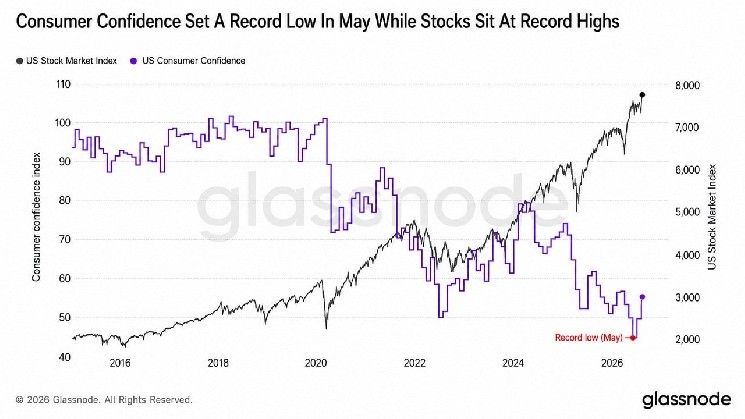
According to Glassnode, consumer confidence remains at one of its lowest levels in a decade, despite two consecutive months of improvement. This has not stopped households from moving money out of cash, as they expect further cost-of-living increases and a broader economic slowdown. The key question is where this capital is flowing. US stocks hit a new all-time high in early August, primarily driven by trading in AI-related stocks rather than a broad market rally. Bitcoin, historically seen as a hedge against declining trust in traditional finance, has not participated in this movement. Spot Bitcoin ETFs saw outflows of $389.7 million in one week, coinciding with rising equity markets—a divergence that aligns with Glassnode's data on capital flows. Bitcoin is currently trading at roughly half its October 2025 peak, stuck in a narrow range. Meanwhile, AI-related trading continues to attract fresh capital from retail traders, hedge funds, and even crypto-native institutional investors, who are redirecting funds into AI stocks and tokens. The macroeconomic backdrop has not been hostile to Bitcoin, with core inflation at a moderate 2.5% in July. However, Bitcoin's muted response to favorable inflation data is seen as a concerning signal, given its supposed role as a hedge against currency debasement. Spot Bitcoin exchange trading volume has fallen to its lowest since 2019, and recent ETF inflows are only a "fraction of any prior accumulation wave," suggesting institutional buying may have paused. This trend extends beyond trading: some Bitcoin miners are repurposing their power contracts and data center capacity for AI workloads. This appears to be a structural shift that could pressure Bitcoin's status as the default destination for capital leaving cash. The fundamental arguments for Bitcoin as a hedge against inflation or scarcity are not invalidated, but their expected impact has not materialized within the timeline anticipated by crypto optimists this summer.

cryptonews.ru4m ago

Glassnode: Consumer Confidence Falls as AI-Related Stocks Rise, Bitcoin Lags Behind

cryptonews.ru4m ago

Trading

Spot

Hot Articles

Discussions

Welcome to the HTX Community. Here, you can stay informed about the latest platform developments and gain access to professional market insights. Users' opinions on the price of SOL (SOL) are presented below.

活动图片