Crypto’s Dark Side: Funds To Suspected Human Traffickers Climb 85% In 2025

bitcoinistPublished on 2026-02-14Last updated on 2026-02-14

Crypto transfers tied to suspected human trafficking networks surged 85% year over year in 2025, according to Chainalysis.

Reports say the total volume reached hundreds of millions of dollars across services that investigators have linked to forced labor operations, prostitution rings, and the sale of child sexual abuse material.

The firm said much of the activity it tracked was concentrated in Southeast Asia, where trafficking networks have been connected to scam compounds and cross-border fraud hubs.

The flows were identified through wallet clustering, transaction tracing, and analysis of services believed to be facilitating exploitation.

Stablecoins Dominate Payment Channels

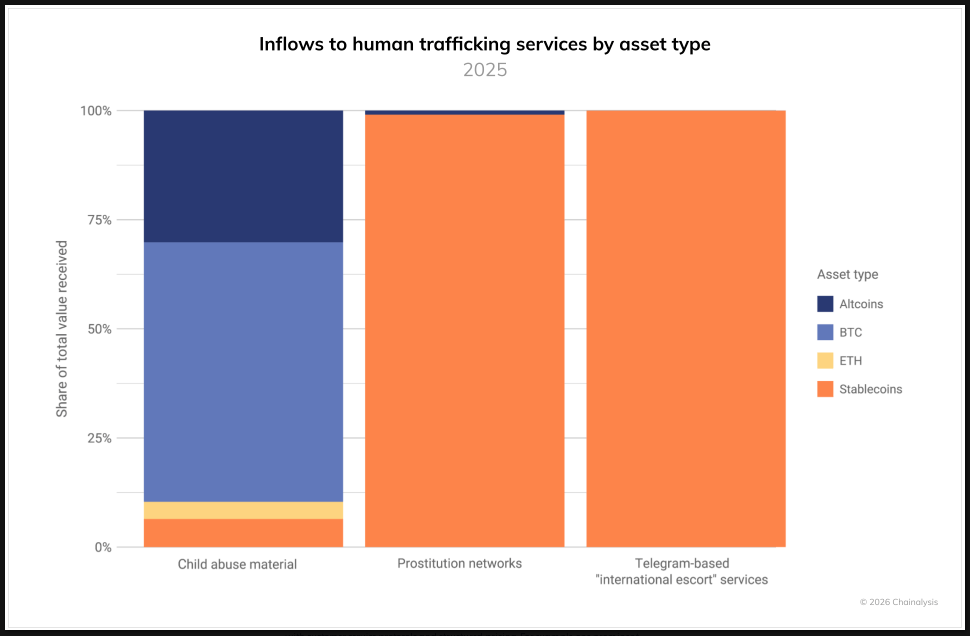
Based on reports, international escort services and prostitution networks operated almost entirely using stablecoins. These tokens were preferred over more volatile cryptocurrencies, allowing operators to receive payments without sharp price swings.

Chainalysis said that labor placement agents — some accused of kidnapping workers and forcing them into scam operations — also relied on crypto to collect and move funds.

Messaging platforms such as Telegram were cited as distribution points for certain services, including escort listings and recruitment ads. Crypto wallets linked to these listings showed repeated payment patterns and connections to broader illicit clusters.

Links To Scam Compounds And Laundering Networks

Reports note that many of the identified wallets were closely aligned with online casinos and Chinese-language money-laundering groups.

Scam compounds, which have drawn global attention for coercing victims into running online fraud schemes, appeared interconnected with trafficking-related payment flows.

In several cases, funds moved between services before being routed toward exchanges or converted into other digital assets.

Chainalysis noted that the convergence of the networks indicated that there is a shared financial infrastructure. Instead of individual operations, the data indicated that there are clusters of wallets that overlap and interact with each other under different categories of illicit activities.

Total crypto market cap currently at $2.27 trillion. Chart: TradingView

Blockchain Transparency As An Investigative Tool

However, Chainalysis asserted that even with the increase in crypto-related trafficking flows, there were advantages to blockchain investigation. For instance, digital assets are permanently recorded and publicly visible, unlike cash.

This record enables compliance and law enforcement to track movement, detect transaction patterns, and recognize suspicious activity.

The firm advised monitoring for large, recurring transfers to labor brokers, wallet clusters active across several illicit service types, and repeated stablecoin conversion patterns.

The exchanges are seen as strategic choke points, where intervention is possible when funds try to re-enter the traditional financial system.

The Chainalysis findings are a reflection of the increased use of crypto currencies in criminal activities and the increased ability to track them.

Chainalysis argues that although digital assets are utilized in these trafficking networks, the transparency of these systems will aid in the disruption of these networks.

Featured image from Pixabay, chart from TradingView

Trending Cryptos

Related Questions

QAccording to the Chainalysis report, what was the percentage increase in crypto transfers tied to suspected human trafficking networks in 2025?

ACrypto transfers tied to suspected human trafficking networks surged 85% year over year in 2025.

QWhich type of cryptocurrency was predominantly used by international escort services and prostitution networks, and why was it preferred?

AStablecoins were the predominant payment method. They were preferred over more volatile cryptocurrencies because they allowed operators to receive payments without sharp price swings.

QWhat specific region did the report identify as a concentration point for the tracked human trafficking activity?

AThe report identified Southeast Asia as a region where much of the tracked activity was concentrated, with trafficking networks connected to scam compounds and cross-border fraud hubs.

QWhat are the three main techniques mentioned that were used to identify these illicit crypto flows?

AThe illicit flows were identified through wallet clustering, transaction tracing, and analysis of services believed to be facilitating exploitation.

QHow does Chainalysis argue that the transparency of blockchain technology can be an advantage in combating these crimes?

AChainalysis argues that blockchain transparency is an advantage because digital asset transactions are permanently recorded and publicly visible, unlike cash. This enables compliance and law enforcement to track movement, detect transaction patterns, and recognize suspicious activity.

Related Reads

Why Are Large-Scale Crypto Conferences No Longer Glamorous?

Why Are Major Crypto Conferences Losing Their Allure? A growing sense of fatigue surrounds large in-person crypto conferences, with many founders and investors now avoiding events they would never have missed just two years ago. While complaints cite declining ROI and information quality, the root causes are more structural. Crypto, global from inception, once relied on these mega-conferences as neutral hubs for essential face-to-face connections. However, their core value has been fragmented. High-quality participants—developers, investors—have largely migrated to smaller, private side-events, leaving main stages for repetitive content already shared online. The main conference often just becomes the excuse for being in the same city, with attendees scrambling between exclusive dinners and micro-events. While these intimate gatherings offer signal-rich conversations, they lose the "serendipitous encounters" of large conferences and can create insular echo chambers, especially as talent concentrates in hubs like New York. Meanwhile, invite-only, high-caliber summits are rising, offering quality and scale but at the cost of accessibility and crypto's early egalitarian ethos. This shift isn't unique to crypto; AI events in San Francisco show a similar trend. The perception of higher-value interactions drives core groups towards smaller, private settings, potentially creating a vicious cycle that drains larger events of their vitality. Yet, a more optimistic view exists. The apparent decline of crypto-centric events may signal industry maturation. Leading projects are now focused outward—on stablecoins for traditional finance, consumer-facing digital banks, or real-world assets. Crypto topics are increasingly integrated into mainstream finance and tech conferences. Just as dedicated "internet conferences" faded, dedicated crypto summits may become redundant as the technology embeds into every sector. The future likely holds far fewer large, inward-looking crypto conferences. The industry has moved past needing frequent self-congratulatory gatherings. True growth lies in engaging with the broader economy. This evolution towards private networking and mainstream integration, for better or worse, is a mark of the industry coming of age.

marsbit6m ago

Why Are Large-Scale Crypto Conferences No Longer Glamorous?

marsbit6m ago

Coin & Stock Compass: Global Listed Companies Net Sold $85.45 Million in BTC Last Week, Strategy's Dollar Reserves Scale Up to $3 Billion (July 14)

Global Public Companies Net Sell $85.45 Million in BTC; Strategy's Dollar Reserves Hit $3 Billion (July 14) Last week saw a significant net sell-off of Bitcoin by global public companies, excluding miners, totaling $85.45 million—a 908.42% decrease from the prior week. Major buyers like Strategy (formerly MicroStrategy) and Japan's Metaplanet were notably absent from the market. However, two companies, Brazil's OrangeBTC and asset manager Strive, made purchases, adding 8 and 18 BTC, respectively. The aggregate BTC holdings of tracked public companies now stand at 1,139,635 BTC, valued at approximately $71.38 billion and representing 5.7% of Bitcoin's circulating market cap. In corporate updates, Strategy announced its dollar reserves have grown by $450 million to reach $3 billion, while its BTC holdings remain at 843,775 coins. Hyperscale Data increased its BTC reserves past 1,000 coins. Strategy will report its Q2 2026 financial results on July 30. Mining firm Cleanspark added 454 BTC, bringing its total to 13,924 BTC. Conversely, BitFuFu sold 184 BTC, Bitdeer maintained zero net BTC holdings after selling its weekly production, and Empery Digital sold 1,400 BTC to fund an AI data center project and repay debt. Overall, public companies purchased 110,000 BTC in Q2 2026, 1.8 times the volume of the previous two quarters combined. In other cryptocurrency-related corporate news, Ethereum treasury company Bitmine increased its ETH holdings by 27,801 coins, with total staked ETH exceeding 4.9 million. Solana-focused company DFDV transferred daily operations of its meme coin DONT to an independent team. BNB treasury company BNB Plus was delisted from Nasdaq for failing to meet the $1 minimum bid price and moved to trade on the OTCQB market under the symbol BNBX. The broader equity markets showed mixed signals. Bank of America warned that bullish investor positioning indicated a potential pullback risk for stocks. In contrast, Morgan Stanley predicted the ongoing earnings season could broaden market gains beyond tech giants. Specific regional highlights included continued foreign investor outflows from South Korean stocks, pressure on US equities, and the upcoming IPO of Chinese memory chip maker ChangXin Memory. Most crypto-linked stocks remained in a downtrend.

marsbit19m ago

Coin & Stock Compass: Global Listed Companies Net Sold $85.45 Million in BTC Last Week, Strategy's Dollar Reserves Scale Up to $3 Billion (July 14)

marsbit19m ago

Why Are Major Crypto Conferences Losing Their Luster?

Why Are Major Crypto Conferences Losing Their Appeal? A growing sense of fatigue surrounds large-scale offline crypto conferences. Participants complain of declining returns and less substantial information, but the root cause is deeper. Initially, these global summits were vital for a decentralized industry without a physical hub, enabling crucial face-to-face connections. However, the value of large main-stage events has been eroded. High-quality developers and investors have migrated to exclusive, invitation-only side events and private dinners. While these offer focused networking, they lose the "serendipitous encounters" of larger gatherings and can create elitist barriers, contradicting crypto's open ethos. This fragmentation triggers a vicious cycle: as key people leave main events, their value diminishes further. Simultaneously, the industry's focus is shifting outward. Leading crypto firms are now engaging with traditional finance and real-world applications like stablecoins, digital banking, and prediction markets. Consequently, crypto-specific topics are increasingly integrated into mainstream financial conferences, making dedicated crypto summits potentially redundant. Looking ahead, the frequency of top-tier crypto conferences will likely decrease significantly. The industry has moved past its inward-looking phase. The migration of quality discourse to private settings and the push for mainstream adoption, while diluting the large conference model, are ultimately signs of the sector's maturation.

Foresight News32m ago

Why Are Major Crypto Conferences Losing Their Luster?

Foresight News32m ago

Trading

Spot

Hot Articles

Discussions

Welcome to the HTX Community. Here, you can stay informed about the latest platform developments and gain access to professional market insights. Users' opinions on the price of S (S) are presented below.

活动图片