Crypto Gets A Seat At Trump’s Science Table — Is This The Regulatory Pivot Bulls Wanted?

bitcoinistPublished on 2026-03-27Last updated on 2026-03-27

Abstract

President Trump has appointed the initial members of the Presidential Council of Advisors on Science and Technology (PCAST), including prominent crypto industry figures. The council members include tech leaders like Jensen Huang (Nvidia) and Mark Zuckerberg (Meta), and is co-chaired by former U.S. CTO David Sacks. Crypto representation comes from Fred Ehrsam, co-founder of Coinbase, and Marc Andreessen, co-founder of a16z, both key architects of U.S. crypto venture capital and market infrastructure. Their inclusion signals a shift from past regulatory hostility toward integrating digital assets into mainstream policy discussions. While not an immediate market catalyst, this move may lead to more predictable regulations, clearer rules for exchanges and stablecoins, and a friendlier stance toward U.S. crypto infrastructure in the long term.

President Donald Trump appointed the first members of his new Presidential Council of Advisors on Science and Technology (PCAST), including notable crypto representatives.

Crypto Gets A Seat At The Table Where It Happens

The White House is finally giving crypto its due place in debates over AI and what comes next in tech. Analyst TylerD brought to attention that The White House announced on Wednesday the 13 initial members of the PCAST, with room to grow up to 24.

The lineup, a convergence point for AI, big tech and crypto, includes marquee tech leaders such as Jensen Huang (Nvidia), Mark Zuckerberg (Meta), Sergey Brin (Google), Larry Ellison (Oracle) and Lisa Su (AMD). The council will be co-chaired by AI and crypto czar David Sacks and David Sacks, former U.S. Chief Technology Officer (US CTO).

Who Are These Representatives?

The crypto names forming the council are not minor ones. We are talking about Fred Ehrsam, the co-founder of Coinbase, one of the largest US centralized exchanges; and Marc Andreessen, who co-founded the VC firm a16z.

Ehrsam left a role as a foreign‐exchange trader at Goldman Sachs in 2012 to launch Coinbase with Brian Armstrong, after the two connected through the Bitcoin subreddit. He served as Coinbase’s first president from 2012 to 2017, helping grow it into the major position it has today, and then stayed on as a board member while becoming a prominent early‐stage investor in the space.

Andreessen has been a prominent bull since his 2014 essay “Why Bitcoin Matters”, and today positions Ethereum and Web3 as core to the next phase of the internet. Through a16z, he has pushed large bets on blockchain, Web3, and AI, and has publicly tied his support for Trump partly to what he sees as a hostile regulatory and banking environment for tech and digital assets under previous policymakers.

Ehrsam and Andreessen, architects of US crypto venture capital and market infrastructure, are now embedded in a body that advises on competitiveness, innovation, and financial plumbing. This is major specially if we compared to previous cycles, where crypto was mostly on the receiving end of enforcement and guidance rather than sitting inside the advisory structure. This signals digital assets moving deeper into mainstream policy discussions, not farther away.

Market implications

The PCAST could eventually translate into more predictable rule‐making, clearer treatment of exchanges and stablecoins, and potentially a friendlier stance toward US‐domiciled crypto infrastructure. In the near term, this is not a “number go up tomorrow” catalyst, but it does strengthens the case for viewing regulatory risk as shifting from pure headwind to a possible moat for compliant players over the next cycle.
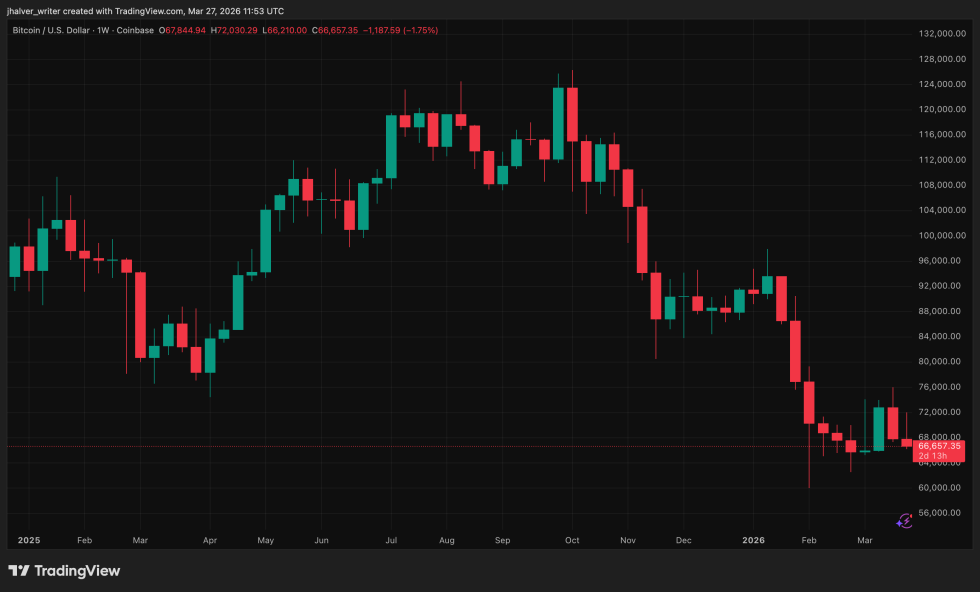
At the moment of writing, BTC’s price crashes under $67k. Source: BTCUSD on Tradingview

Cover image from Perplexity, BTCUSD chart from Tradingview

Related Questions

QWho are the notable crypto representatives appointed to Trump's Presidential Council of Advisors on Science and Technology (PCAST)?

AFred Ehrsam, co-founder of Coinbase, and Marc Andreessen, co-founder of venture capital firm a16z.

QWhat is the significance of having crypto representatives on PCAST council compared to previous regulatory cycles?

AIt signals digital assets moving deeper into mainstream policy discussions, unlike previous cycles where crypto was mostly on the receiving end of enforcement rather than being part of the advisory structure.

QWhat potential regulatory changes could result from crypto's inclusion in PCAST?

AMore predictable rule-making, clearer treatment of exchanges and stablecoins, and potentially a friendlier stance toward US-domiciled crypto infrastructure.

QWhich major tech leaders were appointed to the PCAST alongside crypto representatives?

AJensen Huang (Nvidia), Mark Zuckerberg (Meta), Sergey Brin (Google), Larry Ellison (Oracle), and Lisa Su (AMD).

QWho will co-chair the Presidential Council of Advisors on Science and Technology?

AAI and crypto czar David Sacks and former U.S. Chief Technology Officer (US CTO) David Sacks.

Related Reads

When Doing Cryptocurrency Payment, the First Thing is Licenses, What is the Second?

When launching a crypto payment business, obtaining the necessary licenses is the crucial first step. However, the second, and arguably more critical, step is designing a comprehensive operational framework that forms a coherent business loop. This loop must be clearly understood and executable by all stakeholders: banks, payment partners, exchanges, on-chain analytics providers, regulators, and your internal team. Many projects mistakenly believe a single license permits all operations. Licenses merely grant entry; they don't define how the specific business functions. The real challenge lies in detailing every aspect of the workflow. This involves clarifying the customer base, the flow of fiat and crypto assets, the settlement process, and establishing clear lines of responsibility for risks like AML compliance, sanctions screening, chargebacks, and regulatory inquiries. A robust framework must answer seven core questions: Who are the clients and merchants? Who collects fiat and crypto? Who handles conversion and custody? And who is ultimately accountable for compliance and risk management? Projects often fail not from a lack of licensing, but during due diligence when they cannot convincingly explain these operational details. Therefore, beyond securing licenses, the priority must be constructing a closed-loop system. This system ensures the business model is transparent, risks are managed, responsibilities are delineated, contracts are aligned, and the entire process is comprehensible to partners and regulators. The true competitive edge in crypto payments lies not in acquiring a license quickly, but in integrating licensing, banking, compliance, and operations into a sustainable and executable whole.

marsbit46m ago

When Doing Cryptocurrency Payment, the First Thing is Licenses, What is the Second?

marsbit46m ago

Arthur Hayes Analysis: AI Bubble Nears Burst, Crypto Market Faces Short-Term Pressure

Arthur Hayes argues that the current AI market is a bubble poised to burst, which will exert downward pressure on the crypto market in the near term. The core trigger is rising oil prices due to the US-Iran conflict and a blockade of the Strait of Hormuz. Higher energy costs directly increase the operational expenses of AI data centers, squeezing profit margins for companies like Google, Anthropic, and OpenAI. Hayes predicts that persistent inflation from high oil prices will force Trump, in a bid to win the November election, to turn public sentiment against the AI industry. He may propose regulations and taxes on data centers and AI companies to appeal to voters concerned about costs and job displacement. Such political rhetoric could shatter market confidence. Furthermore, the market is unlikely to healthily absorb the massive concurrent IPOs of SpaceX, Anthropic, and OpenAI, which together seek valuations in the trillions. The combination of soaring energy costs, overwhelming equity supply, and negative political pressure will puncture the AI bubble. Hayes notes that nearly all new USD liquidity since 2022 has flowed into AI, leaving crypto like Bitcoin behind. When the AI bubble bursts, liquidity will contract sharply, pulling down all risk assets, including cryptocurrencies. In response, Hayes's fund, Maelstrom, has sold all AI-related stocks and non-core cryptocurrencies. It maintains core positions in Bitcoin and Ethereum while increasing exposure to energy sector equities, betting on rising oil and gas prices. He expects Bitcoin to bottom after the AI-led market decline, before rallying again with future monetary easing.

Foresight News59m ago

Arthur Hayes Analysis: AI Bubble Nears Burst, Crypto Market Faces Short-Term Pressure

Foresight News59m ago

To C, To B, and the Next Big Thing Called To A

After To C and To B, the Next Wave is To A: Serving AI Agents In a recent quarterly earnings call, Meituan's Wang Xing introduced a new concept: To A (To Agent), signifying that future business services will increasingly target AI Agents as primary clients, not just consumers or merchants. This shift implies that internet giants must now consider how to make their services more appealing for AI Agents to recommend, fundamentally altering traditional distribution logic. This "To A era" is prompting an unusual trend of alliances among major tech companies. Unlike previous competitive battles, firms like Meituan, Tencent, JD.com, Huawei, OPPO, and OpenAI are rapidly forming partnerships. The reason is strategic: as AI Agents become the primary user interface, handling tasks from a single command (e.g., "Book a Japanese restaurant for tomorrow"), the risk for platforms is being bypassed entirely. Companies are positioning themselves within this new value chain. Three primary strategies are emerging: 1. **Super-Entry Points + Service Providers:** Platforms like Tencent's Yuanbao, WeChat, and ChatGPT aim to be the first-stop Agent, integrating various services (food delivery, shopping, travel) from partners like Meituan and JD.com. 2. **Apps as Callable Services:** Companies like Meituan, JD.com, and Uber are ensuring their core services remain accessible and callable by external Agents, shifting from front-end apps to back-end capabilities. 3. **System-Level Agent Entry Points:** Smartphone makers (Huawei, Honor, OPPO) are leveraging their OS-level AI assistants to control the initial user command, redistributing it to relevant service apps. While alliances offer mutual benefit—entry points gain service capabilities, and service providers gain traffic—inherent conflicts of interest exist. A dominant Agent platform could eventually attempt to connect directly with suppliers (restaurants, hotels), bypassing current aggregators like Meituan or Ctrip. Other unresolved challenges include the potential for Agent recommendations to become a new form of paid ranking and unclear accountability for faulty recommendations. The current rush to form alliances is a defensive move by service providers to secure their position before the landscape solidifies. In this To A-driven restructuring, the greatest risk is not losing the race but failing to hear the starting gun.

marsbit1h ago

To C, To B, and the Next Big Thing Called To A

marsbit1h ago

Trading

Spot
Futures

Hot Articles

Discussions

Welcome to the HTX Community. Here, you can stay informed about the latest platform developments and gain access to professional market insights. Users' opinions on the price of S (S) are presented below.

活动图片