Crypto Exodus: Why $60 Billion Just Fled From South Korea

bitcoinistPublished on 2026-03-25Last updated on 2026-03-25

Abstract

South Korea's Financial Services Commission reported a massive outflow of approximately $60 billion in crypto assets to foreign exchanges and private wallets in the second half of 2025, a 14% increase from the first half. This exodus coincides with stricter regulatory measures, including AI-driven tax tracking systems for crypto gains starting in 2027, increased penalties for major exchanges like Upbit and Bithumb, and enhanced cooperation between financial intelligence and credit card companies to monitor cross-border crypto-related payments. While customer deposits on domestic exchanges grew 31% to $5.4 billion, operating profits fell 38% due to declining token prices and tighter oversight. The government aims to curb capital flight and money laundering without completely undermining South Korea's role as a crypto hub.

South Korea’s Financial Services Commission (FSC) has flagged massive crypto outflows to overseas exchanges amidst tougher oversight from regulators.

Inside The South Korean Crypto Report

Around $60 billion (₩90 trillion) worth of crypto assets were moved out to foreign exchanges and private wallets during the second half of 2025, a Wednesday report from the country’s top financial regulator revealed. This represents a 14% increase compared to the first quarter of the year, which saw a $52.2 billion (₩78.9 trillion) outflow.

However, the amount subjected to the Travel Rule (outgoing transactions of ₩1 million or more per transaction by a registered business operator) decreased in a 23%, going from ₩20.2 trillion in the first half of the year to ₩15.6 trillion in the second half.

At the same time, wallet and custody platforms saw a modest uptick in user numbers (779, 20 more than those at the end of June 2025), but the value of assets they hold dropped sharply, partly because benchmark prices for several custodied tokens have fallen.

The number of accounts on South Korean crypto exchanges hit 11.1 million, a 3% increase from June 2025, while customer deposits jumped much faster, surging 31% to about $5.4 billion (₩8.1 trillion). But even with such an expansion, exchanges didn’t end up making more money. The 18 platforms still in operation booked roughly $253.4 million (₩380.7 billion) in operating profit for the second half, a 38% drop from the around $411.2 million (₩617.8 billion) they earned in the first six months.

South Korea Tightens The Crypto Leash: A Recap

This crypto exodus doesn’t necessarily come as a surprise in the light of the latest moves from South Korean regulators, which clearly paint them in crackdown colors. As covered by Bitcoinist earlier this month, the National Tax Service (NTS) announced they are moving ahead with an AI-driven system to track crypto investment gains as they prepare to start taxing virtual asset profits from January 2027. Authorities have also toughen oversight on major crypto exchanges, with Korean giants such as Korbit, Upbit and most recently Bithumb facing penalties and suspensions due to AML and KYC violations.

But that’s not all: last February, authorities signed a new cooperation agreement between the Financial Intelligence Unit (FIU) and nine major credit card companies, working alongside the customs service, to track and block card-based payments tied to illegal overseas crypto foreign-exchange schemes and cross-border fund outflows. Under the deal, officials will combine card-usage records with immigration data to flag suspicious patterns and cut off channels commonly used to move money into unregistered offshore exchanges. This sits on top of the FIU’s broader 2026 AML agenda, which includes expanding the Travel Rule to smaller transactions and tightening oversight of virtual asset service providers.

All points to Seoul wanting to stem capital flight and money laundering without killing Korea’s position as a major crypto hub, especially as they also move to normalize institutional and corporate participation. Tighter AML and cross‐border controls could reduce some offshore liquidity and arbitrage, but may also push sophisticated capital into more opaque channels or DeFi rails.
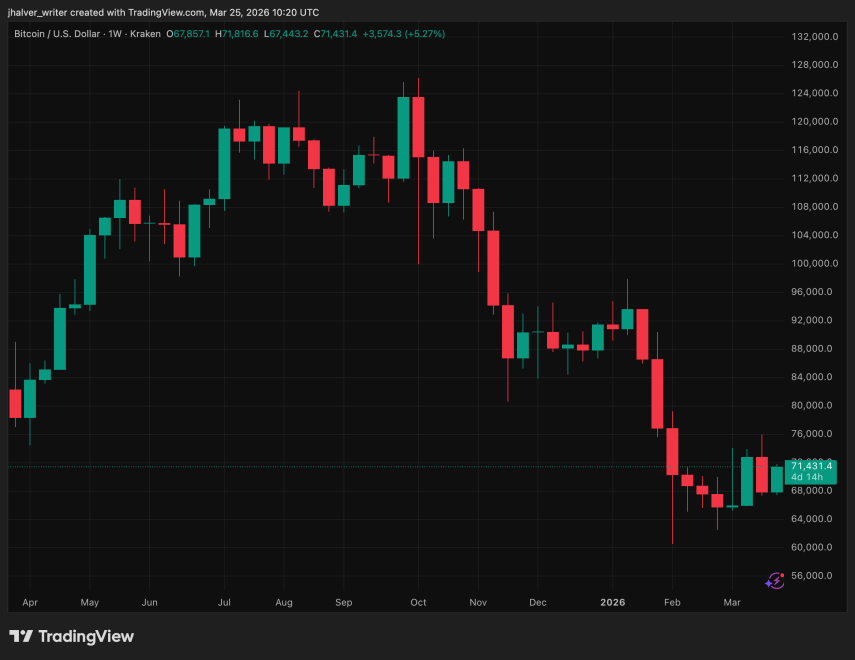
BTC’s price saw a slight recovery, now sitting on $71k. Source: BTCUSD on Tradingview

Cover image from Perplexity, BTCUSD chart from Tradingview

Related Questions

QWhat was the total value of crypto assets moved out of South Korea to foreign exchanges and private wallets in the second half of 2025?

AAround $60 billion (₩90 trillion) worth of crypto assets were moved out.

QHow did the amount subject to the Travel Rule change in the second half of 2025 compared to the first half?

AThe amount subject to the Travel Rule decreased by 23%, going from ₩20.2 trillion in the first half to ₩15.6 trillion in the second half.

QWhat are some specific regulatory actions South Korean authorities have taken to tighten crypto oversight?

AAuthorities are implementing an AI-driven system to track crypto gains for taxation, penalizing major exchanges for AML/KYC violations, and signed a cooperation agreement to track and block card-based payments tied to illegal overseas crypto schemes.

QDespite an increase in user accounts and customer deposits, what happened to the operating profits of South Korean crypto exchanges in the second half of 2025?

AThe operating profits of the 18 platforms dropped by 38%, from about $411.2 million in the first half to roughly $253.4 million in the second half.

QFrom when does South Korea plan to start taxing virtual asset profits, and what tool are they using to track these gains?

ASouth Korea plans to start taxing virtual asset profits from January 2027 and is using an AI-driven system from the National Tax Service to track crypto investment gains.

Related Reads

Dialogue with a Macro Analyst: AI Drains All Liquidity from U.S. Stocks, $40K Bitcoin is the True Bottom

In a recent discussion, macro strategist Luke Groman, founder of FFT LC, presented a sobering analysis of current markets. He argues that while the S&P 500 hits new highs, this is largely driven by just seven AI stocks, which are "sucking all the oxygen and liquidity out of the room." Bitcoin, which he calls the "last working smoke alarm for liquidity," is signaling trouble, having entered a difficult period. Groman explains that the AI boom is fueled by accounting practices that front-load revenue, creating an illusion of high profits while cash is being depleted. He warns this cycle could reverse sharply when construction slows. His base case is that stocks will rise in dollar terms but fall significantly when measured in gold or Bitcoin, highlighting that long-term US Treasury futures have already lost 90% of their value against gold over the past decade. He points to major structural risks, including China's dominance in rare earths—a small commodity market underpinning trillions in tech stock value—and the prolonged closure of the Strait of Hormuz, which he calls a "Suez Moment" for the US. This, combined with a shift towards a "no ticky, no washy" proof-of-work system for settling trade (using gold, not trust), signals deeper systemic distrust. Regarding US debt, Groman notes that historically, all 58 countries that reached a 130% debt-to-GDP ratio defaulted, primarily through inflation. The US crossed this threshold in 2020. He also highlights a contradiction in the AI narrative: if it's as transformative as claimed, it must destroy white-collar jobs, threatening half of US tax revenue—a reality at odds with the "no job loss" messaging from tech leaders. On Bitcoin, Groman sold most of his position near the top and hasn't fully re-entered. Citing technical analysis from Northstar Bad Charts, he suggests a potential bottom around $40,000 could materialize in Q3 or Q4. He concludes that while he may be labeled a doomsayer, his view is simply realistic, grounded in historical precedents and current macro pressures.

marsbit2h ago

Dialogue with a Macro Analyst: AI Drains All Liquidity from U.S. Stocks, $40K Bitcoin is the True Bottom

marsbit2h ago

Trading

Spot
Futures

Hot Articles

Discussions

Welcome to the HTX Community. Here, you can stay informed about the latest platform developments and gain access to professional market insights. Users' opinions on the price of S (S) are presented below.

活动图片