CoreWeave plans $2B note offering to scale AI business while managing dilution

cointelegraphPublished on 2025-12-08Last updated on 2025-12-08

Abstract

CoreWeave plans to raise $2 billion through a private offering of convertible notes due 2031, with an option for an additional $300 million. Proceeds will be used for general corporate purposes and capped-call transactions to reduce potential shareholder dilution. The notes can be settled in cash, shares, or a combination. Founded as a crypto miner in 2017, the company pivoted to AI infrastructure in 2019 and now operates over 33 data centers. The stock fell 9.2% on the news. Separately, CoreWeave's recent $9 billion bid to acquire Bitcoin miner Core Scientific failed after shareholders rejected it. The company stated the acquisition was primarily aimed at securing power capacity for future AI expansion, not a return to crypto.

AI infrastructure provider CoreWeave (CRWV) plans to raise $2 billion through a private offering of convertible senior notes due 2031, with proceeds earmarked for general corporate purposes and for capped-call transactions that could reduce potential future shareholder dilution.

The notes include an option for purchasers to buy an additional $300 million, the company said Monday. They can be settled in cash, shares or a combination of both at CoreWeave’s discretion.

To limit dilution if the notes are ultimately converted into equity, CoreWeave is entering into capped-call transactions. This hedge increases the effective conversion price and provides a degree of protection for existing shareholders while preserving financial flexibility.

CoreWeave was founded in 2017 as Atlantic Crypto, a company that used GPUs to mine Ether (ETH). As the crypto market weakened, it pivoted in 2019 into cloud and high-performance computing services, eventually refocusing its GPU infrastructure on AI workloads.

The company now operates a network of data centers built specifically for AI, and as of this year, reported running more than 33 facilities. It has not said whether proceeds from its latest fundraising will go toward further expanding that footprint.

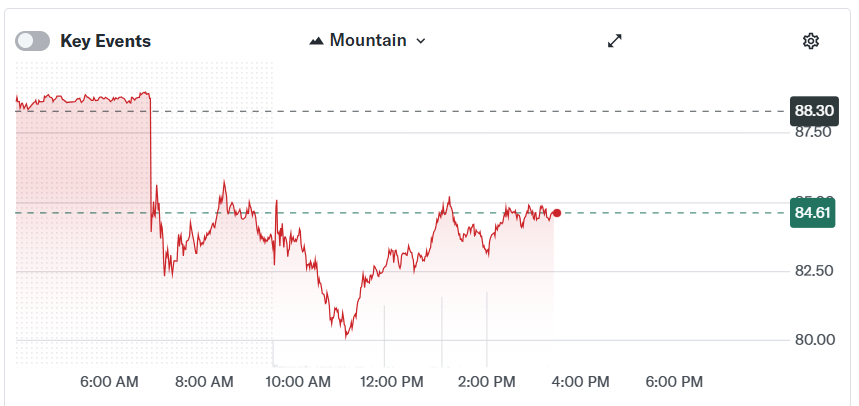
CoreWeave stock reacted negatively to the private note offering, falling as much as 9.2% on Monday. Source: Yahoo Finance

Related: TeraWulf looks to raise $500M as it bets big that AI is new Bitcoin

CoreWeave’s failed takeover bid of Core Scientific

Despite shifting its focus away from digital asset mining as its primary business, CoreWeave recently pursued a $9 billion acquisition of Core Scientific, one of the largest Bitcoin (BTC) mining operators. However, the deal fell through after Core Scientific’s shareholders voted against the proposal.

The attempted takeover fueled speculation about a return to crypto, but CoreWeave has characterized the effort differently.

The company stated that the acquisition aimed to secure access to approximately 1.3 gigawatts of power capacity across Core Scientific’s sites, which could be leveraged for future expansion in AI, cloud computing or other GPU-intensive workloads.

CoreWeave had spent more than a year pursuing Core Scientific, beginning with an initial offer in June 2024 that the miner rejected. As Core Scientific’s stock rose, the price needed to secure a deal also increased, ultimately contributing to the failure of the final proposal when shareholders voted it down.

Related: Crypto Biz: Mining weakness tests Bitcoin’s market cycle

Related Reads

Dalio Warns: AI Boom Shows Signs of a Bubble, Day of Reckoning Will Be the Time of Burst

Ray Dalio, founder of Bridgewater Associates, warns that the current artificial intelligence investment boom shows classic signs of a bubble, which he expects will eventually burst. In a Bloomberg Television interview, he noted that great technological revolutions often lead to capital inflows that create bubbles, making it difficult for investors and companies to calibrate their spending accurately—either overspending to capture market share or underspending and losing their competitive position. This caution comes amid significant rallies in AI-related assets, particularly chipmakers, driven by soaring demand for data centers and high-bandwidth chips, raising debates about overheating valuations. In contrast, Nvidia CEO Jensen Huang recently asserted that investors embracing the AI wave would see "crazy" returns and dismissed concerns over return on investment for data center spending as outdated. Dalio, however, focuses on the risks in the profit realization phase. He argues that bubbles tend to show signs of破裂 when markets transition from investment to the need for tangible returns, describing the burst as a process of converting paper wealth into cash. While acknowledging AI's intrinsic value, he expressed concern over the future profitability of some AI companies, suggesting the market is repeating a familiar pattern. The 76-year-old billionaire, who fully exited Bridgewater in 2025, has a net worth estimated at $21.5 billion according to the Bloomberg Billionaires Index.

marsbit17m ago

Dalio Warns: AI Boom Shows Signs of a Bubble, Day of Reckoning Will Be the Time of Burst

marsbit17m ago

Privacy Coin Crisis of Confidence! ZEC Plunges Over 56% in a Single Day

Zcash (ZEC), a leading privacy-focused cryptocurrency, experienced a severe crash on June 5th, plummeting over 56% in a single day and erasing nearly two months of gains. The flash crash was triggered by the disclosure of a critical zero-knowledge proof vulnerability within Zcash's Orchard privacy pool, which had existed since the pool's launch in May 2022. The flaw theoretically allowed an attacker to forge unlimited ZEC undetectably due to the pool's privacy features. The vulnerability was discovered on May 29th by independent security researcher Taylor Hornby during a proactive audit commissioned by Shielded Labs, utilizing AI-assisted analysis. The Zcash development team responded swiftly, implementing an emergency soft fork to disable Orchard transactions on June 2nd and executing a permanent hard fork fix (NU6.2) on June 3rd. Despite the technical fix, a major crisis of confidence emerged. The core issue is that Orchard's privacy design makes it cryptographically impossible to prove whether the vulnerability was exploited over the past four years, casting permanent doubt on the historical supply integrity of ZEC. While Shielded Labs argues exploitation was unlikely, the inability to provide definitive proof has severely damaged market trust. This sentiment was exacerbated when BitMEX co-founder Arthur Hayes, a prominent ZEC supporter, announced he was selling his entire position. He stated that privacy assets require "perfect security" rather than "probable safety." The combined effect of the disclosure and Hayes's exit ignited widespread panic selling, leading to massive liquidations and significant price decline. Analysts note the event highlights a fundamental tension within privacy coins: the conflict between verifiable supply and cryptographic privacy.

链捕手20m ago

Privacy Coin Crisis of Confidence! ZEC Plunges Over 56% in a Single Day

链捕手20m ago

Trading

Spot
Futures

Hot Articles

Discussions

Welcome to the HTX Community. Here, you can stay informed about the latest platform developments and gain access to professional market insights. Users' opinions on the price of AI (AI) are presented below.

活动图片