Citi builds on Solana: Will SOL become the ‘internet capital market’?

ambcryptoPublished on 2026-02-13Last updated on 2026-02-13

Abstract

Citigroup (Citi) has completed a proof-of-concept for tokenizing traditional financial instruments on the Solana blockchain in collaboration with PwC. The test simulated the full lifecycle of tokenized bills of exchange, exploring how TradFi assets can move onto blockchain in a practical way. Despite recent price volatility and an 11% weekly drop in SOL's value, the network continues to demonstrate strong fundamentals. Solana handles approximately three times more daily transactions than Ethereum and all its Layer 2 networks combined. Its Total Value Locked (TVL) stands at around $6.36 billion, with significant DEX volume of $3.72 billion and perpetual futures volume of $1.45 billion. Notably, SOL spot ETFs saw $8.89 million in weekly inflows despite the price decline, bringing total assets to roughly $674 million, indicating strong long-term investor confidence. As summarized by a researcher from Artemis, Solana leads in users, transactions, developer growth, trading volume, and fees, positioning it to potentially become the "internet capital market." Institutional experimentation and continued capital allocation suggest growing belief in Solana's long-term narrative.

Big names are building on Solana [SOL], while the network pushes out massive transaction numbers even during price dips. So what’s really going on here?

Let’s break it down.

Solana’s big moment

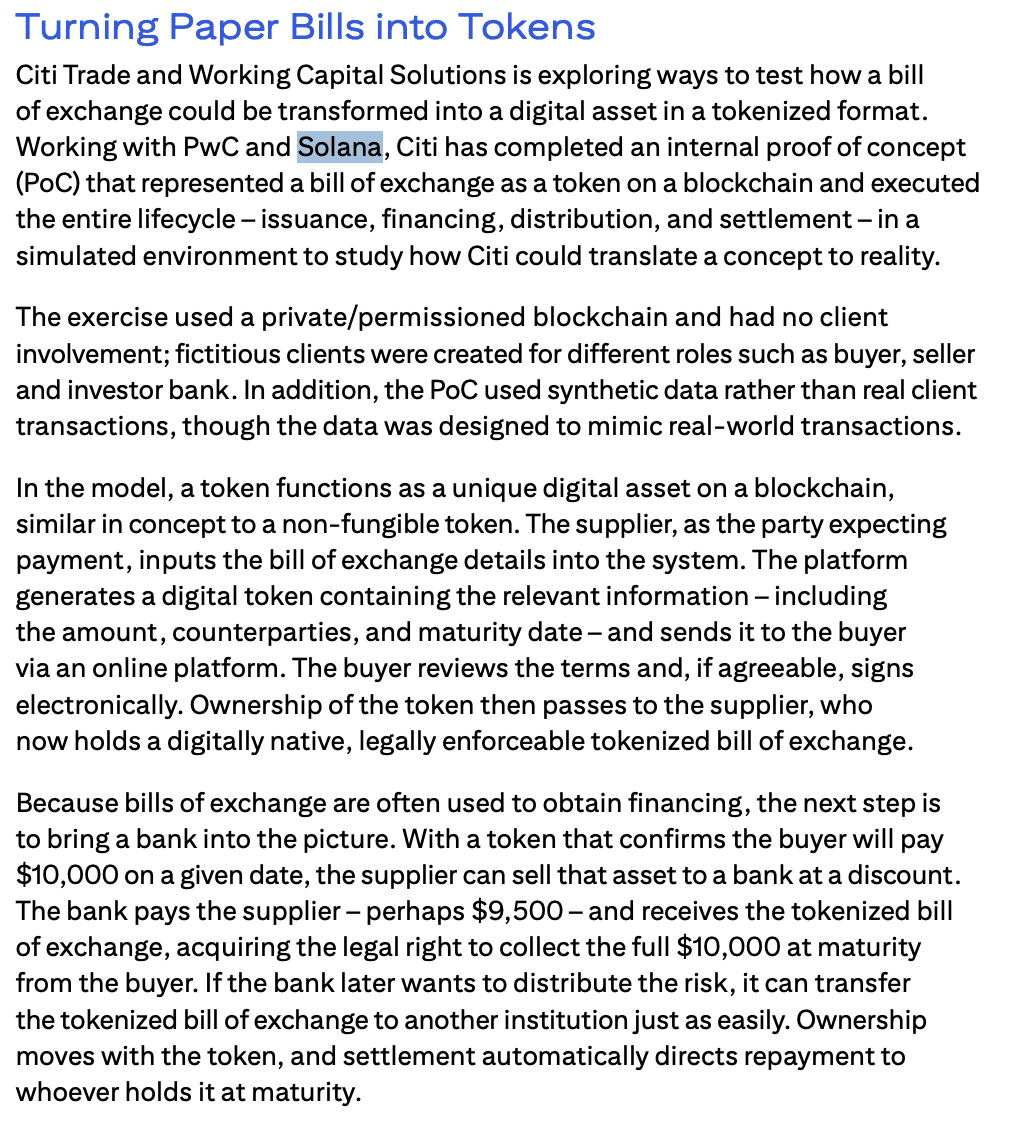
Banking giant Citi has just completed an internal tokenization proof-of-concept using Solana, in collaboration with PwC. The test simulated the full lifecycle of tokenized bills of exchange (from issuance and distribution to settlement) in a controlled environment.

The goal was to explore how TradFi instruments could move onto the blockchain in a real-world way.
Source: X

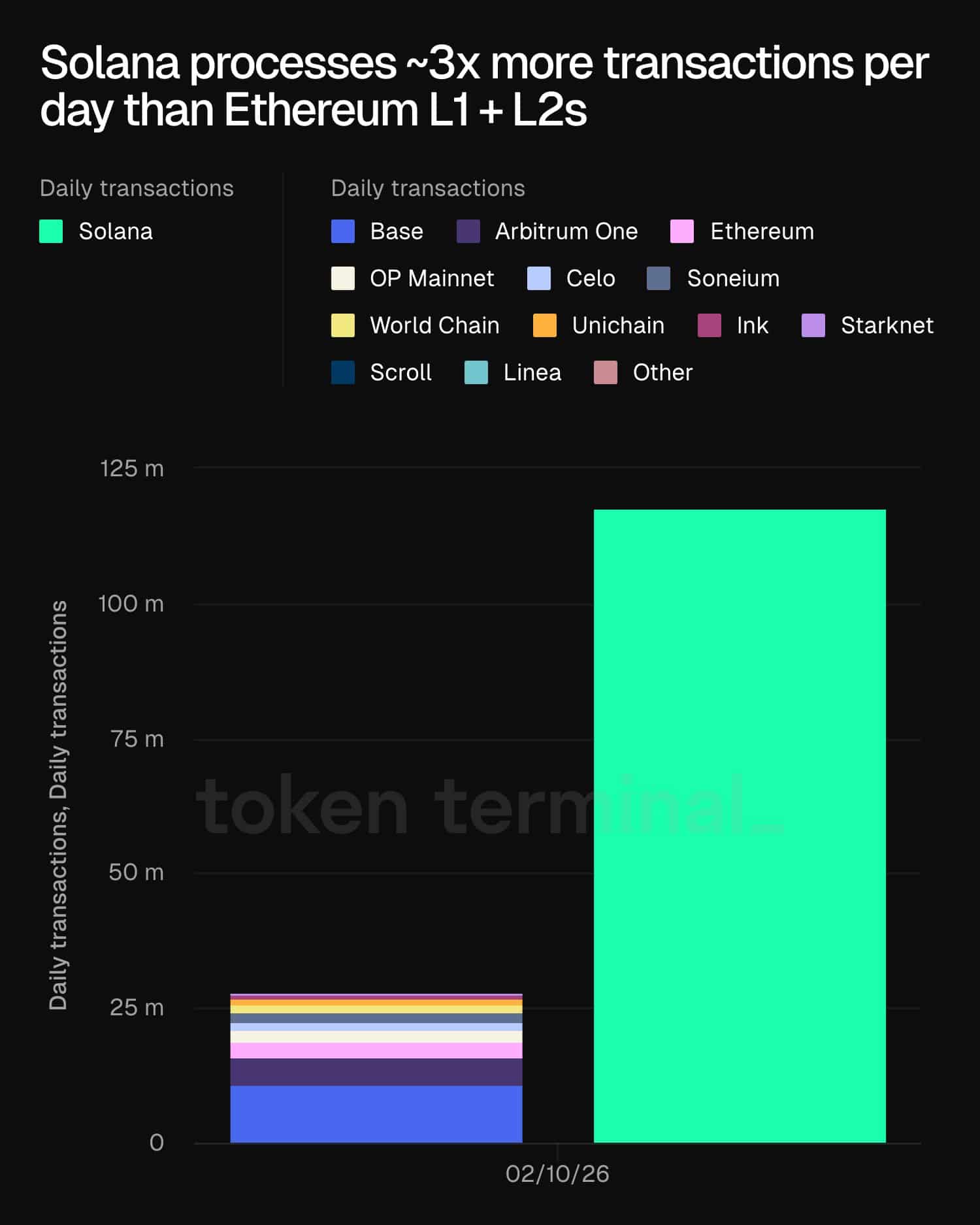
Meanwhile, Solana has been flexing its scale. Recent data from Token Terminal showed that the network handles about 3x more daily transactions than Ethereum [ETH]!
Source: Token Terminal

That lead is on more than Ethereum’s mainnet and all of its Layer 2 networks combined!

Where does Solana stand?

According to DeFiLlama, Solana’s total value locked (TVL) was at around $6.36 billion at the time of writing. While that’s below its late-2025 highs, activity across DEXs was strong with roughly $3.72 billion in DEX volume.
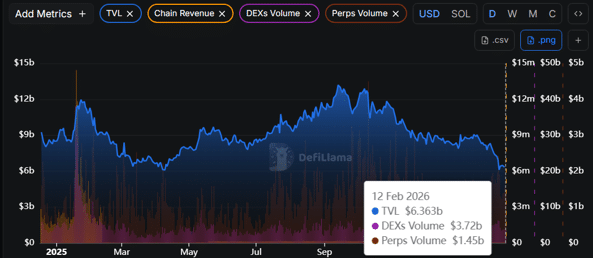
Source: DeFiLlama

Perpetual futures volume is also notable, coming in at about $1.45 billion.
Even though the market has been volatile and SOL’s price has fallen, people are still using Solana. That steady activity is important.

Greater ambitions

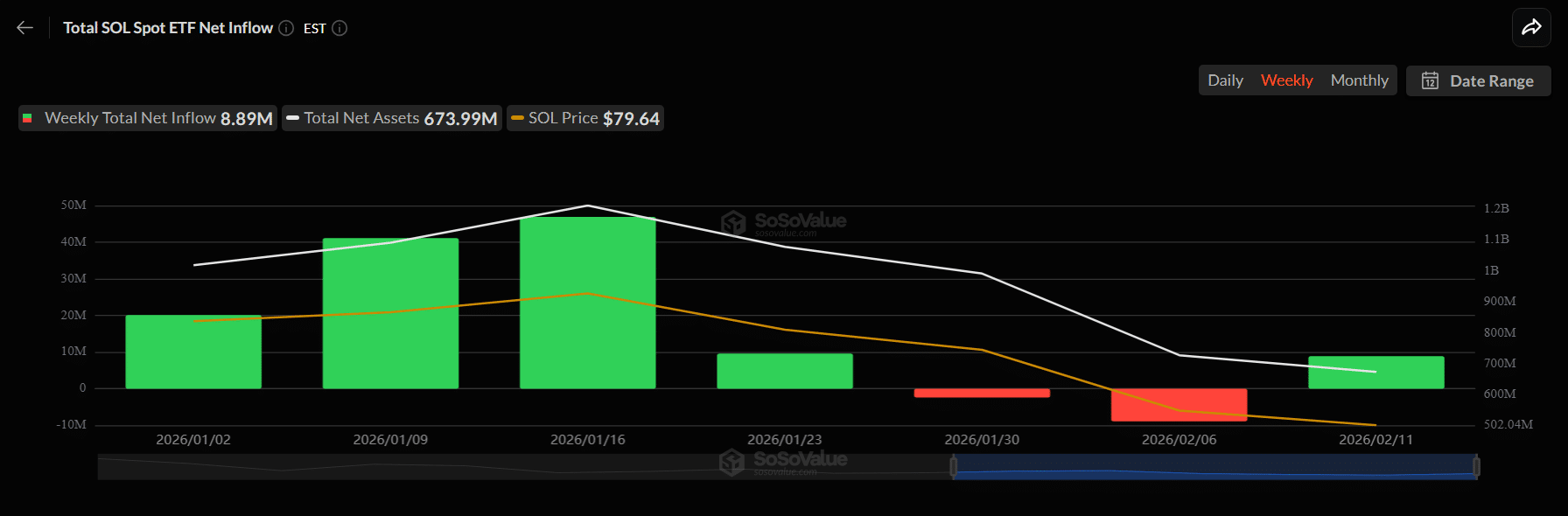
After a few red weeks, SOL spot ETFs recorded $8.89 million in weekly inflows, putting total assets at roughly $673.99 million. This happened even as SOL posted a 11% loss this week!

Source: SoSoValue

It’s becoming increasingly evident that investors are buying into the long-term vision.

That roadmap was summed up by Zheng Jie Lim, Research and Data Engineer, Artemis, who said,

“Solana is number one in users, transactions, developer growth, trading volume, and fees… That’s how Solana becomes the internet capital markets.”

So, institutions are experimenting while investors allocate capital. That combination doesn’t quite happen by accident!


Final Thoughts

  • Citi’s Solana tokenization test and 3x dominance have added to the long-term SOL narrative.
  • $8.89 million in SOL ETF inflows despite an 11% weekly drop means investors are looking beyond the near-future.
Next: HYPE price prediction – Identifying the next liquidity target for traders
Share
  • Share
  • Tweet

Related Questions

QWhat major financial institution recently completed a tokenization proof-of-concept on Solana, and what was the purpose?

ABanking giant Citi, in collaboration with PwC, recently completed an internal tokenization proof-of-concept on Solana. The purpose was to simulate the full lifecycle of tokenized bills of exchange (from issuance and distribution to settlement) in a controlled environment to explore how traditional finance (TradFi) instruments could move onto the blockchain in a real-world way.

QHow does Solana's daily transaction volume compare to Ethereum's, according to Token Terminal data?

AAccording to recent data from Token Terminal, the Solana network handles about 3 times more daily transactions than Ethereum. This lead is over Ethereum's mainnet and all of its Layer 2 networks combined.

QWhat was Solana's Total Value Locked (TVL) and DEX volume at the time the article was written?

AAt the time of writing, Solana's total value locked (TVL) was approximately $6.36 billion, and the activity across DEXs was strong with roughly $3.72 billion in DEX volume.

QDespite a weekly price drop, what positive signal did SOL spot ETFs show regarding investor sentiment?

ADespite SOL posting an 11% loss for the week, SOL spot ETFs recorded $8.89 million in weekly inflows, bringing total assets to roughly $673.99 million. This indicates that investors are looking beyond near-term price volatility and buying into the long-term vision.

QAccording to Zheng Jie Lim of Artemis, how is Solana positioned to become the 'internet capital markets'?

AZheng Jie Lim, Research and Data Engineer at Artemis, stated that 'Solana is number one in users, transactions, developer growth, trading volume, and fees... That's how Solana becomes the internet capital markets.'

Related Reads

The Compounding Crisis in an Era of High Valuations: Is the US Stock Market Facing a New 'Lost Decade'?

This article analyzes the long-term structural risks in US equity markets, challenging the assumption that "time in the market" always ensures positive returns. Drawing on 155 years of historical data, it identifies three prolonged periods—1929-1954, 1966-1982, and 2000-2013—where real buy-and-hold returns were near zero or negative. Collectively, these "lost decades" represent roughly 35% of market history since 1871 and cause not just delayed wealth accumulation but permanent damage to compound growth paths due to the mathematics of recovering from significant drawdowns. Crucially, the authors argue that current conditions mirror historical precursors to such phases. Multiple valuation indicators, including the CAPE ratio (near its 99th percentile), the Buffett Indicator, and Tobin's Q, signal extreme overvaluation, historically associated with lower future 10-year real returns (averaging 3.6%). The paper debunks the common objection to tactical management—fear of missing the "best days" in the market—by showing that the vast majority of these top-performing days occur during bear markets and crises, often adjacent to the worst days. Therefore, avoiding major drawdowns inherently means missing these volatile surges. A key framework proposed involves monitoring market breadth (advance/decline data), which tends to deteriorate before major indices peak, providing an early warning signal. Combined with high valuations, breadth analysis offers a more robust risk-assessment tool. The conclusion for investors and advisors is not a forecast of an inevitable downturn, but a call to move from complacency to preparedness. The empirical evidence suggests that the conditions preceding lost decades are identifiable. A disciplined, adaptive strategy focused on valuation and breadth signals, rather than precise timing, can help protect long-term compounding from permanent impairment.

marsbit2m ago

The Compounding Crisis in an Era of High Valuations: Is the US Stock Market Facing a New 'Lost Decade'?

marsbit2m ago

Farewell to Traditional Bull and Bear Markets, Deciphering the Logic of Today's Bubble Rotation

"Farewell to Traditional Bulls and Bears: Understanding Today's Market Logic of Bubble Rotation" The article draws a parallel between modern financial markets and a meteorological chain of thunderstorms, contrasting it with the past's slower-moving, more predictable 'layered cloud' systems of long bull/bear cycles and gradual sector rotations. The author argues that today's market has undergone a permanent structural shift, creating an environment where discrete, intense thematic bubbles (e.g., AI, GLP-1 drugs, crypto, robotics, quantum tech) sequentially form, swell, and burst. These 'storm cells' are triggered when capital fleeing a dying bubble acts like a meteorological 'cold air wedge,' forcing the warm, moist capital of latent interest in a new sector to rapidly rise and condense into the next speculative frenzy. This new 'convective' market regime is driven by eight fundamental changes: 1. Democratization of speculation via zero-commission trading, gamified apps, and heavy retail participation in instruments like 0DTE options. 2. Permanent, price-insensitive buying pressure from defined-contribution retirement plans (e.g., 401(k)s). 3. Passive investing creating inelastic market participants that amplify momentum, especially into mega-cap stocks. 4. The dominance of multi-strategy funds and high-frequency trading (HFT), weakening price discovery and creating fragile microstructure prone to synchronized sell-offs. 5. Artificially suppressed volatility that eventually erupts in violent spikes. 6. A transformed market index heavily weighted toward long-duration, narrative-driven tech companies instead of stable, cyclical industrials. 7. The total elimination of information delay, accelerating fear-of-missing-out (FOMO) and herd behavior. 8. A persistently loose fiscal and monetary policy environment. These structural shifts are deemed irreversible. The article outlines the common lifecycle of these thematic bubbles: latency, catalyzing event, narrative formation, peak divergence, and rupture—with outflowing capital seeding the next bubble. In this environment, two investor archetypes can thrive: deep domain experts who understand underlying technologies and business models, and disciplined trend-followers. The author concludes that while emotionally challenging, recognizing this new "climate" is crucial. The key is to elevate one's perspective above the immediate storm to see the cyclical chain of bubbles, avoiding being swept away by the emotions of any single thematic frenzy.

Foresight News22m ago

Farewell to Traditional Bull and Bear Markets, Deciphering the Logic of Today's Bubble Rotation

Foresight News22m ago

Michael Saylor's Latest Article: Bitcoin Must Find Balance Between Uniqueness and Universal Value

Michael Saylor outlines four key Bitcoin ideologies shaping its future: * **Bitcoin Maximalists** see Bitcoin as the dominant digital monetary network and a breakthrough in economic empowerment, emphasizing its superior property rights and role as a sound money solution. * **Bitcoin Capitalists** focus on integration, believing Bitcoin must embed into the global economy—through institutions, capital markets, and financial products—to reach its full potential as digital capital. * **Bitcoin Technologists** advocate for continuous protocol improvements in scalability, privacy, and security to adapt to evolving needs and threats, while acknowledging the high bar for change. * **Bitcoin Fundamentalists** guard Bitcoin's core principles of self-custody, decentralization, and censorship resistance, warning against dilution from institutions or risky modifications. Saylor argues that a healthy Bitcoin ecosystem requires a balance of these perspectives. Bitcoin's path forward involves disciplined expansion: preserving its immutable core (Fundamentalist insight), recognizing its dominant status (Maximalist view), integrating with the global economy (Capitalist drive), and enabling careful innovation, primarily in higher layers (Technologist role). The challenge is to maintain Bitcoin's unique properties while making it useful for the world, ensuring it remains Bitcoin as it grows.

Foresight News54m ago

Michael Saylor's Latest Article: Bitcoin Must Find Balance Between Uniqueness and Universal Value

Foresight News54m ago

Trading

Spot
Futures

Hot Articles

Discussions

Welcome to the HTX Community. Here, you can stay informed about the latest platform developments and gain access to professional market insights. Users' opinions on the price of SOL (SOL) are presented below.

活动图片