Chip Stocks 'Hit a Wall,' But the Market Has Not

marsbitPublished on 2026-08-10Last updated on 2026-08-10

Abstract

Chip stocks face volatility, driven by the blowup of an AI hedge fund (Situational Awareness), which briefly dragged the Philadelphia Semiconductor Index down 29%. However, the market has defied concerns, treating the sell-off as a buying signal. Investors injected over $11 billion into semiconductor ETFs in two days, fueling strong rallies in leveraged and non-leveraged funds. This dynamic is part of a broader surge in risk appetite: the S&P 500 hit a record high, high-yield bond funds saw their largest weekly inflow in two years, and Bitcoin ETFs attracted significant capital. Bank of America's Bull & Bear Index has risen to its highest level since 2021. Market strategists note the momentum-driven "tsunami" in buying, though concentration remains in mega-cap tech stocks. Despite the optimism, a key risk persists: elevated Treasury yields, with the 30-year yield near two-decade highs, pose a headwind. A weak July jobs report, however, eased near-term Fed hike fears and supported markets. Analysts suggest the economic backdrop remains solid, with AI infrastructure demand underpinning growth, though potential bottlenecks like power supply could emerge. The prevailing investor psychology is that recent pullbacks have been brief, reinforcing confidence to buy dips, as evidenced by a sharp drop in semiconductor volatility. The overarching narrative is one of resilient money flows toward risk assets despite a lengthening list of worries.

Author: Bu Shuqing

Plunging chip stocks, surging bond yields, and ongoing geopolitical conflicts—Wall Street's worry list keeps growing, yet the flow of funds tells a completely different story.

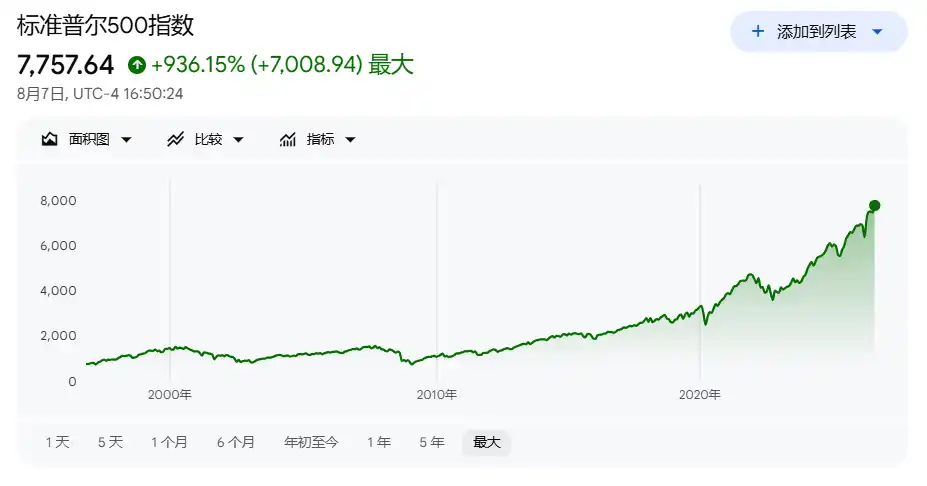
Last week, the S&P 500 hit a new all-time high, the Nasdaq 100 recorded its biggest weekly gain in two months, while high-yield bond funds attracted $4 billion in a single week, the highest inflow in two years, and Bitcoin ETFs saw a net inflow of $500 million over five trading days. Bank of America's Bull & Bear Index climbed to its highest level since 2021, indicating that market sentiment has turned decisively optimistic.
All this happened in the aftermath of the blow-up of AI hedge fund Situational Awareness—founded by the "Silicon Valley Stock God" Leopold Aschenbrenner. The event dragged the Philadelphia Semiconductor Index down 29% from its June high. However, instead of retreating, investors saw the turmoil as a buying signal, pouring more than $11 billion into semiconductor ETFs in just two trading days, subsequently sending those funds soaring.

Chip Plunge Becomes a Buy Signal

The blow-up of Situational Awareness was the most dramatic episode in recent markets. The struggles of this AI-themed hedge fund pulled the Philadelphia Semiconductor Index down 29% from its June peak, triggering sharp volatility in tech stocks.

But the market's reaction defied traditional risk-off logic. According to Bloomberg data, the triple-leveraged Direxion Daily Semiconductor Bull 3X ETF attracted over $2 billion in inflows in just two trading days, subsequently rallying more than 50% over seven sessions.

The two largest non-leveraged semiconductor funds together attracted over $7 billion during the same period, each rising about 16%.

Michael O'Rourke, Chief Market Strategist at JonesTrading, characterized this as a "tsunami" of momentum buying. "The Situational Awareness event created a tactical low for the AI trade, unleashing a massive wave of momentum-chasing behavior," he said. "However, it's worth noting that many investors still prefer concentration in mega-cap stocks, with the Magnificent Seven remaining the primary driver of index gains."

Risk Appetite Heats Up, From Retail to Institutions

What's driving the market isn't just the rebound in chip stocks, but a broad-based influx of funds across asset classes.

Citing Bank of America data, Bloomberg reported that high-yield bond funds saw a net inflow of $4 billion last week, the largest weekly amount in two years; Bitcoin ETFs recorded a net inflow of $500 million in the five trading days through last Thursday, despite Bitcoin's price having traded sideways in a narrow range for months. In the equity market, investors poured over $11 billion into leveraged and non-leveraged semiconductor ETFs combined last week.

Bank of America's Bull & Bear Index subsequently rose to its highest level since 2021. The team led by strategist Michael Hartnett noted that the equity rally has broadened beyond the core tech sector, with strong inflows into high-yield bonds and narrowing credit spreads supporting the optimistic sentiment.

Garrett Melson, a portfolio strategist at Natixis Investment Managers Solutions, believes current market fears are overblown and the fundamentals for risk assets remain solid. He maintains an overweight position in U.S. stocks, focused on large-cap tech, while keeping a low allocation to fixed income but holding some longer duration and selective credit exposure. "Ultimately, economic growth is performing well," Melson said. "Sentiment and positioning can become overextended at times, but this excess heat is localized. Rotation helps digest some of the excess froth while maintaining support for the indices."

The Shadow of High Yields: Bond Market Pressure Lingers

The party in risk assets is not unfolding in a worry-free environment. Although the yield on the 30-year U.S. Treasury fell on four of the past five trading days, it remains near its highest levels in nearly two decades, presenting a persistent background pressure the market cannot ignore.

Analysts are divided on the causes of the elevated yields. Some blame the late-July surge on Fed Chair Kevin Warsh deliberately avoiding clear rate guidance, casting doubt on the central bank's resolve to fight inflation; others argue the bond market movement reflects investor confidence in sustained economic expansion.

Last Friday, data from the U.S. Labor Department showed American employers unexpectedly cut jobs in July, with previous months' figures also revised down. This surprisingly weak jobs report instead boosted stocks, pulling bond yields lower as markets bet the Fed would not be forced to hike rates in the near term.

Lindsay Rosner of Goldman Sachs Asset Management said that as data clarifies, oil prices stabilize, and the full economic picture becomes clearer along with returns on capital expenditure. "Putting together what we're seeing, the economy is still strong, the market is adapting to the current AI supply, and price discovery is happening about what's ahead," she said.

Ayako Yoshioka, Senior Investment Strategist at Wealth Enhancement, cautioned that semiconductors remain the core of AI infrastructure buildout, but as the process advances, bottlenecks could shift towards electricity supply shortages. "Higher yields remain a risk—especially as AI infrastructure construction continues to knock on the bond market's door," she said.

Brief Pullbacks Repeatedly Reinforce Bullish Conviction

Supporting the current market sentiment is a repeatedly proven investor psychology—every pullback is short-lived, every panic is a buying opportunity.

Nathan Thooft, Senior Portfolio Manager at Manulife Investment Management, noted that price corrections have proven time and again to be fleeting, constantly reinforcing investors' psychological fortitude. Those who chose to exit at times of highest uncertainty have paid a price, as the biggest gains often occur precisely during the market's most turbulent moments.

"There still isn't a compelling alternative," Thooft said. "Cash may feel safe, but over the long term, it struggles to outpace inflation and earnings growth akin to stocks. As for bonds, we believe the term premium is still underestimated. Over the past decade, investors who kept waiting for a better entry point have largely been left behind by the market."

The Cboe Semiconductor ETF Volatility Index fell nearly 9 points this week, marking its biggest weekly decline this year, vividly illustrating the rapid repair in market sentiment. Although the worry list continues to lengthen, the direction of the money flow still clearly points toward risk assets.


Trending Cryptos

Related Questions

QWhat were the key contradictory market signals mentioned at the beginning of the article?

ADespite a list of concerns including a slump in chip stocks, surging bond yields, and ongoing geopolitical conflicts, capital flows told a different story. The S&P 500 hit a record high, the Nasdaq 100 posted its biggest weekly gain in two months, high-yield bond funds saw record inflows, and Bitcoin ETFs had significant net inflows, with the Bank of America's bull-bear index reaching its highest level since 2021.

QHow did the market react to the Situational Awareness hedge fund blow-up and the subsequent dip in chip stocks?

AInvestors treated the market turbulence triggered by the AI hedge fund's blow-up as a buying signal. In just two trading days, they poured more than $11 billion into semiconductor ETFs, leading to a sharp rebound. Notably, the triple-leveraged Direxion Daily Semiconductor Bull 3X ETF attracted over $2 billion in two days and surged more than 50% in the following seven sessions.

QAccording to the article, what is the current state of risk appetite among investors?

ARisk appetite has warmed significantly across the board, from retail to institutional investors. This is evidenced by massive inflows into high-yield bond funds, Bitcoin ETFs, and semiconductor ETFs. The Bank of America bull-bear index rose to its highest level since 2021, indicating widespread market optimism.

QWhat are the two main explanations given in the article for the persistently high 30-year US Treasury yield?

AAnalysts are divided. Some attribute the yield surge to Federal Reserve Chair Kevin Warsh's deliberate avoidance of clear interest rate guidance, which raised doubts about the Fed's resolve to fight inflation. Others believe the bond market movement reflects investor confidence in the economy's continued expansion.

QWhat potential risk does the article highlight for the ongoing AI infrastructure build-out, beyond semiconductors?

AThe article suggests that while semiconductors remain core to AI infrastructure, bottlenecks could shift to power supply shortages as the build-out progresses. Furthermore, higher bond yields pose a risk, especially as AI infrastructure construction continues to put pressure on the debt markets.

Related Reads

Chip Design: The 'Cash Flow Restructuring' and 'Capability Leap Window' of 'Institutional Rents'

Chip Design: The "Cash Flow Reconstruction" and "Capability Leap Window" of Institutional Rents The first half of 2026 saw extreme divergence in China's chip design sector. While companies like Jiangbolong and GigaDevice reported massive profit surges, others like StarPower saw sharp declines. This disparity stems not from market cycles, but from a fundamental "institutional rent" transfer—profits were systematically shifted from downstream manufacturers (the payers) to upstream design firms (the recipients) due to supply constraints and policy-driven "domestic substitution" mandates. For decades, China's chip design industry was trapped in a vicious cycle: no revenue without customers, no R&D without revenue, and no competitive products without sustained R&D, leading to perpetual cash flow crises. Crucially, this institutional rent, though distorting short-term competition, has inadvertently broken this deadlock. It has created a "cash flow reconstruction," funneling steady, policy-backed income to design houses for the first time. This generates a critical "capability leap window"—a structural, long-term opportunity (potentially lasting over five years due to prolonged chip shortages and tightening export controls) for companies to invest rents into long-cycle R&D (e.g., automotive-grade, AI chips) rather than short-term speculation. Policy is also evolving from simple procurement subsidies to "ecosystem binding," forcing adoption and integration of domestic chips. Conversely, rent-paying downstream firms face a painful but necessary "market clearing," forced into genuine competition and efficiency drives, which may spur deeper industry collaboration. Importantly, companies like Montage Technology and Fudan Microelectronics show growth based on real technological breakthroughs and market demand, not just policy rents, signaling the potential for independent capability growth. The conclusion is that institutional rent is not an end but a means. The core investment thesis shifts from betting on rent persistence to identifying companies that successfully transform this reconstructed cash flow into proprietary technology and autonomous market viability. While a shakeout is imminent as certain mechanisms reverse, a new generation of technologically independent firms is quietly emerging under the cover of this rent-fueled window.

marsbit37m ago

Chip Design: The 'Cash Flow Restructuring' and 'Capability Leap Window' of 'Institutional Rents'

marsbit37m ago

Karpathy Says It Will Take Another Decade, But This Road Is Already Packed

The article discusses the intensifying focus on **Continual (or Lifelong) Learning** for large language models (LLMs), a capability seen as crucial for developing truly useful "AI colleagues." It references Andrej Karpathy's 2025 assessment that overcoming LLMs' lack of persistent memory and learning might take a decade. The core challenge is **catastrophic forgetting**, where learning new information erases previously acquired skills. Current research diverges into several technical paths: 1. **External Memory Systems:** Storing new knowledge in external databases (e.g., MemGPT, Letta's approach, Karpathy's "LLM Wiki"), akin to enhanced RAG. This is safe but doesn't "internalize" knowledge. 2. **Context Engineering:** Evolving the input context itself into a growing "playbook," as seen in ACE (Agentic Context Engineering), which uses execution feedback to refine instructions without weight updates. 3. **Continual Post-Training:** Carefully updating model weights (e.g., via LoRA) to internalize knowledge, using techniques like Self-Distillation Fine-Tuning (SDFT) to mitigate forgetting. 4. **Continual Pre-training:** Updating the base model with new corpus data, which is compute-intensive and prone to forgetting. 5. **Novel Paradigms:** More radical approaches redefining learning itself. These include models that generate their own training data and update instructions (e.g., SEAL), architectures with nested, multi-timescale learning (e.g., Google's Nested Learning/Hope), and the vision of an "Era of Experience" where AI learns from self-generated interaction data. The article suggests a pragmatic, hybrid future is likely: short-term, mutable knowledge handled by external memory/context, while long-term, solidified capabilities are encoded into model parameters via fine-tuning. While catastrophic forgetting remains unsolved, the field has evolved from a theoretical gap into an active arena with multiple competing approaches and emerging commercial products, all racing to bridge the gap to practical, continually learning AI agents.

marsbit41m ago

Karpathy Says It Will Take Another Decade, But This Road Is Already Packed

marsbit41m ago

U.S. Stocks Trend (August 10): Nonfarm Payrolls Drop by 23K, Inflation Takes Over to Test New Highs

US Stock Market Weekly Review (August 10th): Nonfarm Payrolls Drop by 23K, Inflation Takes Over Testing New Highs Last week, US stocks closed with their strongest weekly gains since mid-April, led by a tech rebound and adjusted rate expectations. The S&P 500 and Dow hit new record closing highs. Weekend developments centered on Strait of Hormuz negotiations, Berkshire Hathaway's capital deployment, and US government funding. The core focus this week shifts to whether incoming inflation data can justify current market pricing for interest rates. The July Nonfarm Payrolls report showed a loss of 23,000 jobs, missing expectations and leading to a decline in September rate hike probabilities. This eased pressure on tech valuations. However, discussions between Iran and Oman on Strait of Hormuz navigation are pending execution, and renewed attacks on energy facilities kept oil prices volatile, with potential implications for inflation. Berkshire Hathaway reported strong earnings and shifted its capital allocation strategy, ending a long streak of net stock sales and making significant new investments, including in Alphabet. The US Senate passed a stopgap funding bill, reducing near-term government shutdown risks. This week's calendar is dominated by key inflation readings (July CPI & PPI), retail sales data, and earnings from AI and tech infrastructure companies like CoreWeave, Lumentum, Cisco, and Applied Materials. The market expects CPI to show a moderation. If inflation data is benign, supporting stable or lower Treasury yields, and corporate earnings remain solid, indices may find further upside. Conversely, a resurgence in inflation or rising oil prices could trigger a swift reversal in interest rate expectations, testing the market's record highs.

marsbit42m ago

U.S. Stocks Trend (August 10): Nonfarm Payrolls Drop by 23K, Inflation Takes Over to Test New Highs

marsbit42m ago

Trading

Spot

Hot Articles

How to Buy CHIP

Welcome to HTX.com! We've made purchasing USD.AI (CHIP) simple and convenient. Follow our step-by-step guide to embark on your crypto journey.Step 1: Create Your HTX AccountUse your email or phone number to sign up for a free account on HTX. Experience a hassle-free registration journey and unlock all features.Get My AccountStep 2: Go to Buy Crypto and Choose Your Payment MethodCredit/Debit Card: Use your Visa or Mastercard to buy USD.AI (CHIP) instantly.Balance: Use funds from your HTX account balance to trade seamlessly.Third Parties: We've added popular payment methods such as Google Pay and Apple Pay to enhance convenience.P2P: Trade directly with other users on HTX.Over-the-Counter (OTC): We offer tailor-made services and competitive exchange rates for traders.Step 3: Store Your USD.AI (CHIP)After purchasing your USD.AI (CHIP), store it in your HTX account. Alternatively, you can send it elsewhere via blockchain transfer or use it to trade other cryptocurrencies.Step 4: Trade USD.AI (CHIP)Easily trade USD.AI (CHIP) on HTX's spot market. Simply access your account, select your trading pair, execute your trades, and monitor in real-time. We offer a user-friendly experience for both beginners and seasoned traders.

4.0k Total ViewsPublished 2026.04.21Updated 2026.06.02

How to Buy CHIP

Discussions

Welcome to the HTX Community. Here, you can stay informed about the latest platform developments and gain access to professional market insights. Users' opinions on the price of CHIP (CHIP) are presented below.

活动图片