Original | Odaily Planet Daily(@OdailyChina)
Author | Azuma(@azuma_eth)
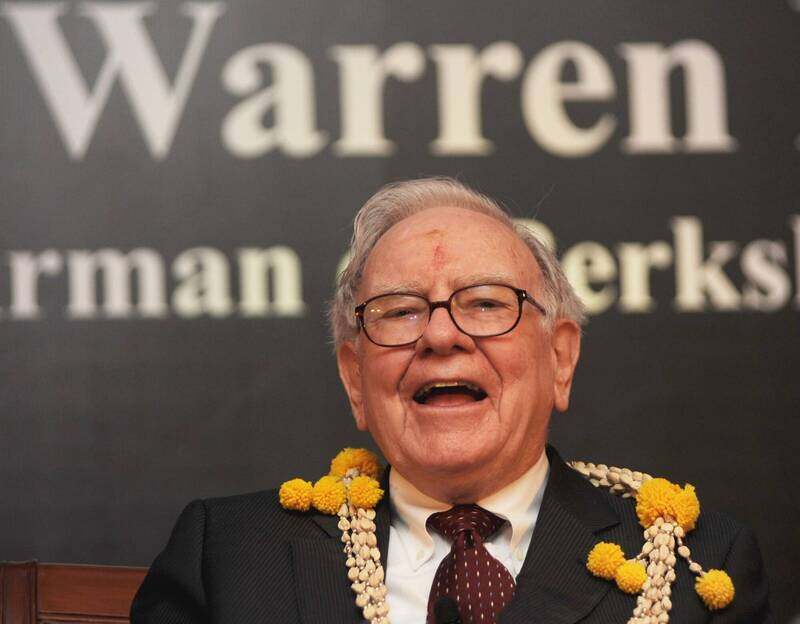
After the US stock market closed on August 9, Beijing time, Berkshire Hathaway announced its financial report for the second quarter of 2026.
The financial report data shows that Berkshire's total revenue for the second quarter of 2026 reached $101.808 billion, an increase of about 10% year-on-year. The net profit attributable to shareholders was $25.667 billion, doubling compared to the same period last year (an increase of about 107%). Both operating profit and net profit significantly exceeded market expectations.
However, the more significant signal in the financial report is that Berkshire Hathaway finally ended a streak of net stock sales lasting over three years (14 quarters) and shifted to net purchases.
With $400 Billion in Cash on Hand, Berkshire Finally Takes Action
Financial report data shows that in the second quarter, Berkshire Hathaway purchased approximately $23.47 billion worth of stocks while selling only $3.69 billion, resulting in net purchases of nearly $19.8 billion, ending the long-standing net selling trend that began in 2023.
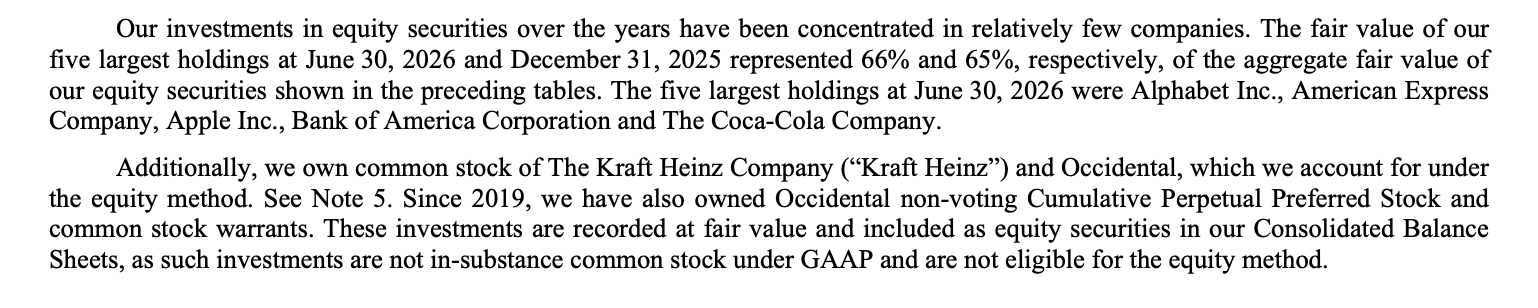
Of greater interest to investors is the allocation of these funds. The financial report disclosed that Berkshire Hathaway's largest single move last quarter was an additional investment of approximately $10 billion in Alphabet (Google's parent company) through a private placement. This officially places Google among Berkshire Hathaway's top five largest holdings by market value – alongside American Express, Apple, Bank of America, and Coca-Cola. As of the end of June, these five holdings collectively accounted for 66% of the stock investment portfolio, indicating that portfolio concentration remains extremely high.
Although Warren Buffett himself has long maintained a cautious stance toward technology stocks, he previously revealed when first building a position in Google that the investment was a joint decision made after consulting with Greg Abel (the current CEO of Berkshire Hathaway, who officially succeeded Buffett on January 1 of this year). Buffett also admitted that missing out on Google early on was a "historic mistake." This later investment, essentially a "make-up purchase," was based on value investment logic, focusing on its search monopoly moat and stable cash flow.
This latest $10 billion increase is an investment decision made under the leadership of the new CEO, Greg Abel – this perhaps indicates that under the new regime with Buffett stepping back and Abel in charge, Berkshire Hathaway's tolerance for and participation in the technological frontier is increasing.
In addition to resuming net purchases in the market, Berkshire Hathaway also conducted its first stock buyback in two years during the second quarter. The financial report disclosed that the company spent a total of approximately $4.527 billion on buybacks last quarter, reaching a single-quarter high not seen since 2021; it added over $3.3 billion more for buybacks in July.
In March of this year, Berkshire Hathaway announced the restart of its stock repurchase program. Abel stated at the time that the buybacks were because management believed the company's stock's "intrinsic value" exceeded its market price.
With the shift in investment and buyback pace, the massive cash reserves that Berkshire Hathaway had accumulated over the long term also began to change. In recent years, one of the company's biggest labels has been a "cash machine." Due to a lack of large-scale opportunities meeting Buffett's investment criteria, the company's cash and short-term U.S. Treasury holdings continued to climb, reaching a historical high of nearly $400 billion by the end of the first quarter of this year.
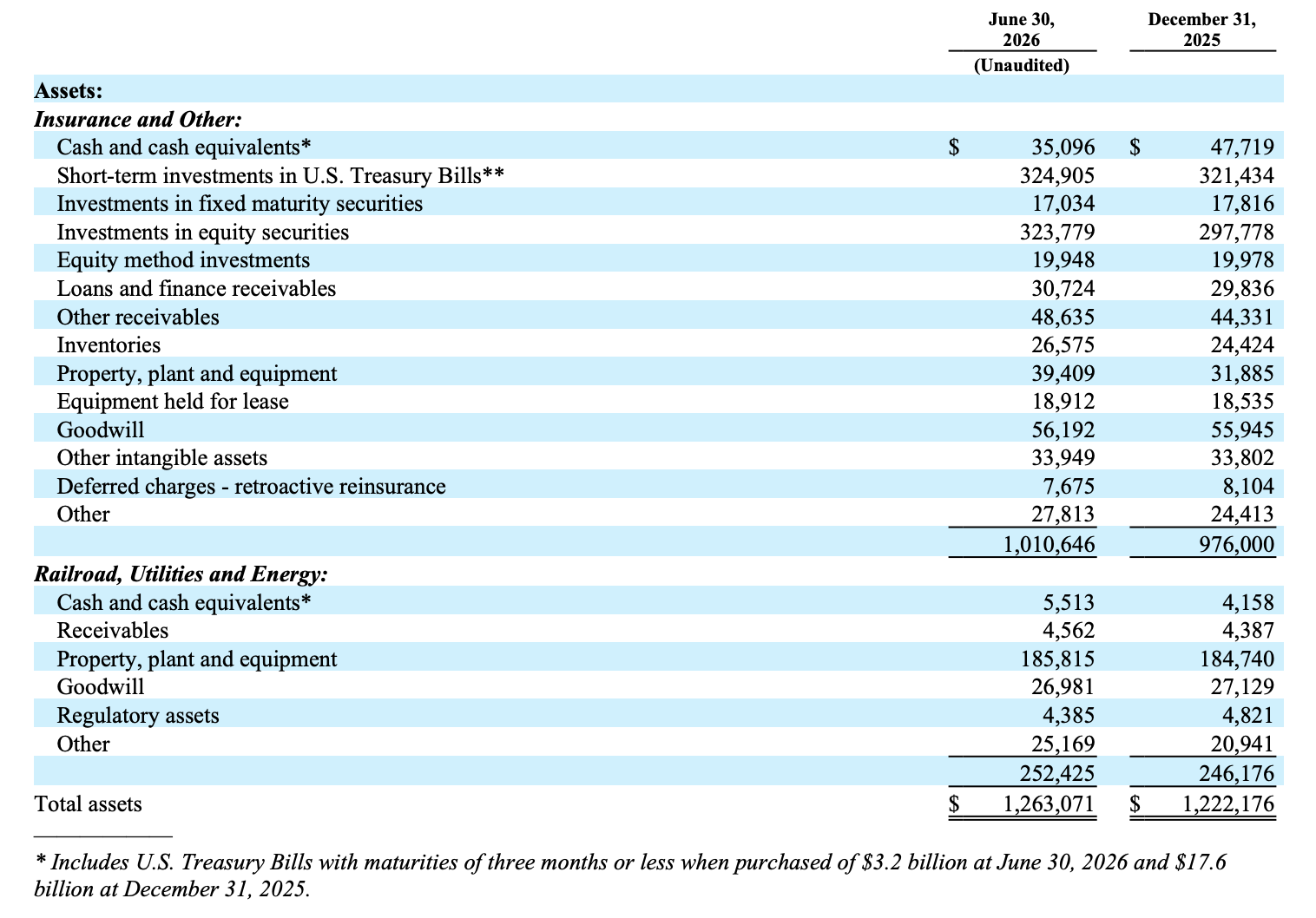
However, as stock purchases, stock buybacks, and industrial acquisitions (primarily for the acquisition of petrochemical company OxyChem and homebuilder Taylor Morrison) unfolded successively, Berkshire Hathaway's cash reserves began to enter a downward trend. As of June 30, Berkshire held approximately $35.1 billion in cash and cash equivalents and about $324.9 billion in short-term U.S. Treasury securities, totaling roughly $364.7 billion. This represents a noticeable decline from the $397.38 billion at the end of the first quarter.
Once Mocked as "Out of Touch," Actually Just Watching Quietly from "the Shore of the Era's Turbulence"
Rewind to the period from 2023 to early 2026.
Over the past few years, the wave of AI technology completely ignited the global capital markets. The chip and semiconductor industry chain, represented by companies like NVIDIA, SK Hynix, Samsung, and Micron, became the most crowded trading sector.
The market was filled with "All in AI" frenzy. Any fund manager not heavily invested in semiconductors was seen as outdated. Meanwhile, Warren Buffett and his Berkshire Hathaway, despite sitting on hundreds of billions of dollars in cash, chose to observe with an almost cold detachment.
Mockery ensued. "Buffett is out of touch with the times," "Value investing is dead," "In the face of the AI revolution, the moat theory is obsolete," "The old man isn't even as good as me"... Doubts like these were endless. People eagerly discussed the semiconductor stocks' surges, often multiplying several or even dozens of times over, and compared them to Berkshire Hathaway's seemingly sluggish stock performance, hastily concluding that this 90-year-old veteran investment master and his designated successor, Abel, had lost their judgment regarding the technological revolution.
But Berkshire Hathaway's choices clearly had their own logic. In the financial report for the second quarter of 2026, Berkshire Hathaway reiterated its iconic warning: "The amount of investment gains/losses in any given quarter is usually meaningless and offers virtually no analytical or predictive value."

This statement, while ostensibly referring to GAAP accounting standards, is actually a reflection of their consistent attitude toward short-term market hype. In the eyes of Buffett and Abel, doubts likely still existed about whether the semiconductor industry could escape its cyclical nature, and uncertainty remained about when the explosive demand for AI hardware would translate into sustainable cash flow.
When the market entered a狂欢 stage and semiconductor company stock prices were elevated, the market environment at that time no longer conformed to Berkshire Hathaway's discipline of "buying wonderful companies at fair prices." Thus, while the market was immersed in FOMO sentiment, Berkshire Hathaway chose the most boring but most DNA-aligned strategy – waiting.
It wasn't until recent months, as semiconductor狂热 suddenly subsided and the previously overhyped targets experienced significant corrections, that investors who had once mocked Buffett for "missing out" suddenly realized their paper gains from chasing semiconductors rapidly evaporated during the pullback. Meanwhile, Berkshire Hathaway's hundreds of billions of dollars in cash not only provided it with unparalleled safety margins but also gave it the confidence to be greedy when others were fearful.
The $19.8 billion in net purchases in the second quarter is a validation of this discipline. It is worth noting that Berkshire Hathaway did not chase the market at its peak; instead, it made large-scale moves only after market volatility and the return of quality asset prices to reasonable ranges.
This is precisely the truth Buffett has practiced for decades – investing is not about who runs the fastest, but about who lives the longest and has the last laugh.