Ceasefire Indefinitely Extended, How Long Will the US-Iran Conflict Continue to Be a Tug-of-War?

marsbitPublished on 2026-04-22Last updated on 2026-04-22

Abstract

President Trump has indefinitely extended the ceasefire with Iran while maintaining a naval blockade of the Strait of Hormuz, stating the truce will last until Iran presents a new proposal and negotiations conclude. The decision follows the collapse of planned peace talks after Iranian representatives refused to attend, calling U.S. conditions unacceptable. Iran has not requested the extension and maintains a firm stance, keeping the strait closed as long as the blockade persists. The prolonged standoff has heightened global market volatility, with oil prices rising sharply. Despite the temporary truce, the lack of a clear diplomatic framework and mutual distrust suggest the situation remains a fragile, unstable equilibrium, with risks of escalation persisting.

Original Title: Trump Extends Iran Ceasefire, Blockade as Peace Talks Stumble

Original Author: Courtney Subramanian and Jennifer A Dlouhy,Bloomberg

Original Compilation: Peggy,BlockBeats

Editor's Note: US President Donald Trump announced an indefinite extension of the ceasefire with Iran just before the agreement was set to expire, while continuing the maritime blockade of the Strait of Hormuz. Trump stated that the US would extend the ceasefire until Iran submits a new proposal, "and regardless of the outcome, until the negotiations conclude"; he also emphasized that without this blockade, "it would be impossible to reach any agreement with Iran."

From a strategic perspective, the US is attempting through the combination of "extending the ceasefire + maintaining the blockade" to avoid an immediate escalation into full-scale war while continuing to pressure Iran to make concessions on nuclear issues and negotiation terms. However, Iran has neither accepted the negotiation conditions nor proactively requested an extension of the ceasefire. Instead, it has maintained a firm response in terms of energy exports and military posture, leading to a stalemate between the two sides on the core issues of "whether to negotiate and how to negotiate."

More notably, this confrontation has begun to spill over into global markets. As a critical channel for global energy transportation, the blockade and repeated reopening of the Strait of Hormuz have not only intensified oil price volatility but also amplified uncertainties in the energy and shipping systems. In the short term, the ceasefire extension provides a certain buffer for the market; but in the medium to long term, in the absence of a clear negotiation structure and basic mutual trust, this passively extended ceasefire resembles a fragile balance that could be broken at any time.

As diplomatic paths continue to be blocked and military deterrence intensifies, the next phase of this conflict will depend on whether the two sides return to the negotiating table or slide toward more intense confrontation.

Below is the original text:

US President Donald Trump announced an indefinite extension of the ceasefire with Iran just before the agreement was set to expire; meanwhile, the US continues to maintain a maritime blockade of the Strait of Hormuz after the collapse of the originally planned peace talks between the two sides.

Trump stated on his social platform Truth Social that Pakistan, as the mediator, requested the US to postpone launching a new round of strikes. The US will extend the ceasefire deadline until Iran submits a new proposal and "regardless of the outcome, until the negotiations conclude." In another post, he also stated that without this blockade, "it would be impossible to reach any agreement with Iran—unless we blow up the rest of their country, including their leaders!"

US Vice President JD Vance was originally scheduled to travel to Pakistan to restart negotiations with Iran, but representatives from Tehran refused to attend, stating that the conditions proposed by the US were "unacceptable." Iran's semi-official Tasnim News Agency stated that there is currently "no realistic possibility" for Iran to participate in negotiations.

A White House official confirmed in a statement that the Vice President's scheduled trip on Tuesday will not take place.

This statement contrasts sharply with Donald Trump's remarks earlier that day. At the time, he stated in an interview with CNBC that if Iran did not meet his conditions, "I expect bombing to occur," and claimed that the US military "is eager and ready to act at any time." In a phone interview on Monday, Trump also stated that if an agreement was not reached, it was "highly unlikely" that he would extend the current ceasefire.

Driven by the news of the ceasefire extension, oil prices rose for the second consecutive day. After accumulating a nearly 9% increase over the previous two trading sessions, Brent crude price is currently around $98 per barrel. In January of this year, oil prices once fell below $60, and in March, they reached a high of $119.50. The average retail price of gasoline in the US is currently about $4 per gallon, compared to about $3 before the war broke out on February 28.

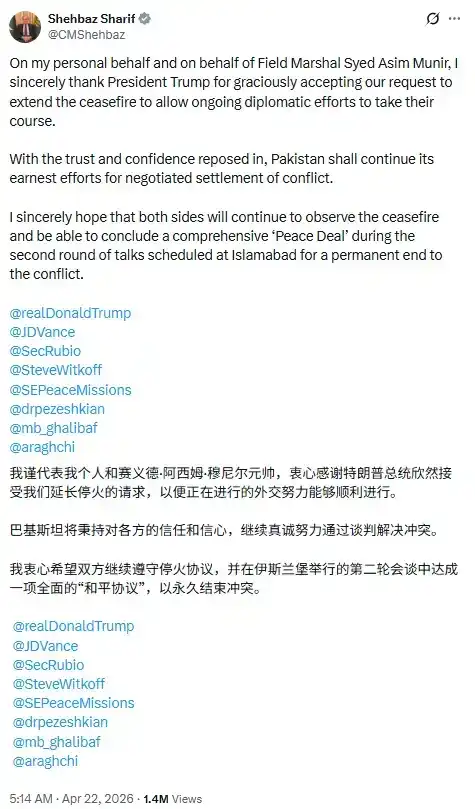
Pakistani Prime Minister Shehbaz Sharif thanked Trump for extending the ceasefire in a statement, "buying time for ongoing diplomatic efforts to proceed smoothly."
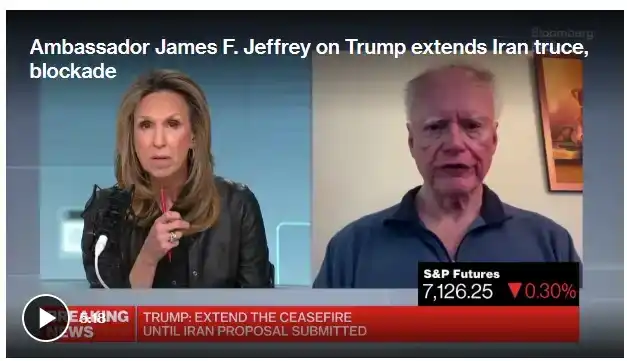
Former US Deputy National Security Advisor and current Philip Solondz Distinguished Fellow at the Washington Institute, James F. Jeffrey, appeared on 'Bloomberg Businessweek Daily' to discuss the ceasefire extension and engaged in a dialogue with hosts Carol Massar and Tim Stenovec.

He posted on platform X: "I sincerely hope both sides will continue to abide by the ceasefire agreement and reach a comprehensive 'peace agreement' in the second round of negotiations in Islamabad, thereby achieving a permanent end to the conflict."
Senior Iranian officials had not responded to Donald Trump's statement by nighttime Tehran time. Iran's semi-official Tasnim News Agency, quoting unnamed sources, stated that Iran did not request an extension of the ceasefire. Simultaneously, the media outlet stated that as long as the US maintains the maritime blockade, Iran will not reopen the Strait of Hormuz.

Iran's semi-official Fars News Agency quoted a statement from the military stating that the Iranian armed forces "are in a state of full combat readiness, with fingers on the trigger."
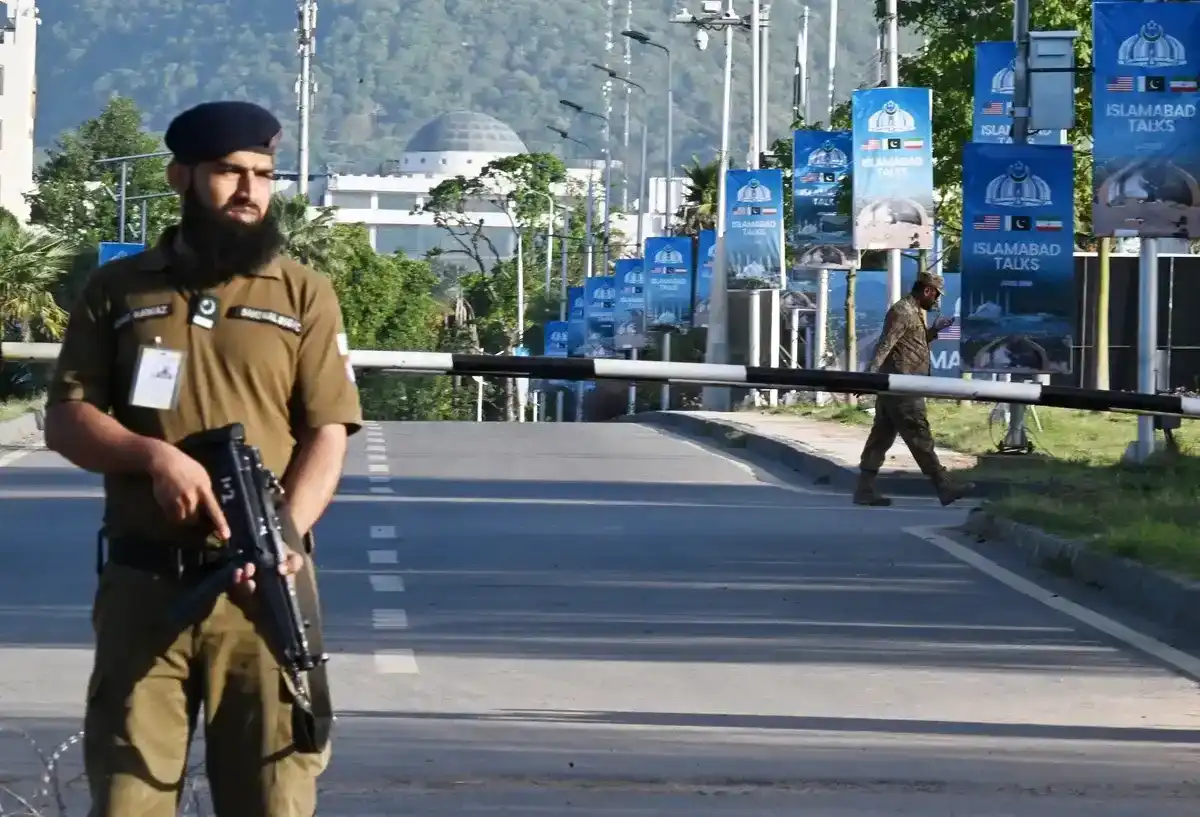
Security personnel guard a checkpoint near the Serena Hotel in Islamabad on April 22. Photo: Aamir Qureshi / AFP / Getty Images.

These developments mark the latest round of back-and-forth between Washington and Tehran since April 7, when the two sides announced a two-week ceasefire. Since then, the two sides have continuously publicly disputed the terms of the agreement and alternately closed and reopened the Strait of Hormuz. Before the war, about one-fifth of the world's oil and liquefied natural gas exports passed through this strait.

According to data intelligence company Vortexa, at least two fully loaded Iranian oil tankers have sailed out of the Persian Gulf this week and breached the US blockade. The company's data also shows that Iran still has the capacity to export oil, with at least 34 oil tankers and gas carriers related to Iran passing through the Strait of Hormuz and navigating past the naval blockade.

The British Navy stated on Wednesday that an Iranian gunboat fired upon a container ship near the Strait of Hormuz, causing "serious damage" to its bridge, but fortunately, there were no casualties.
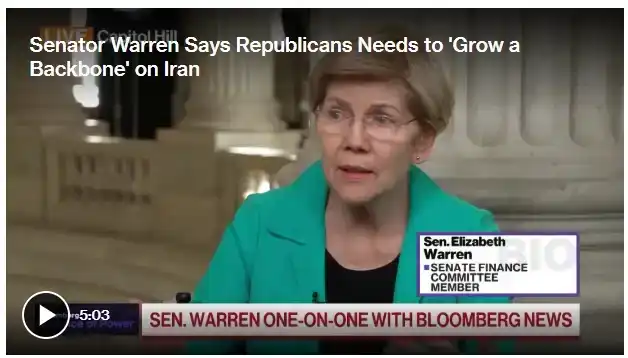
US Democratic Senator Elizabeth Warren from Massachusetts criticized President Donald Trump for lacking a clear plan regarding the Iran conflict. Warren expressed these views on the 'Balance of Power: Evening Edition' program.

The UK and France are convening military planners from over 30 countries for a two-day summit to discuss how to ensure the Strait of Hormuz remains open. British Prime Minister Keir Starmer and French President Emmanuel Macron have been leading the coordination of a plan aimed at keeping the strait open after the Iran war ends, though they have rejected Trump's request for allies to use force to reopen the Strait of Hormuz.

After the initial ceasefire was announced, a round of negotiations took place between the US and Iran but ended in failure. US officials stated that Iran was unwilling to accept restrictions on its nuclear program; while the Iranian side stated that the US had put forward a series of demands that it could not accept.
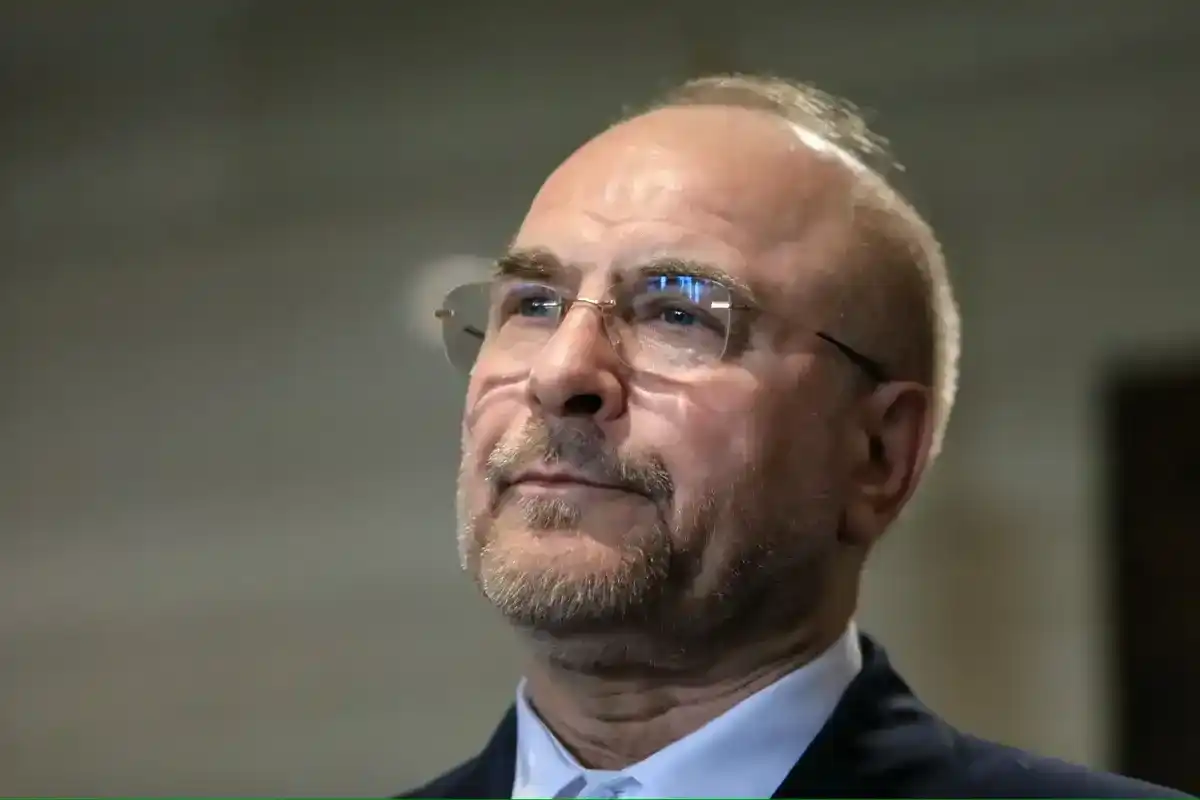
Iranian Parliament Speaker Mohammad Bagher Ghalibaf Source: AFP / Getty Images

Iranian Parliament Speaker Mohammad Bagher Ghalibaf, who led the Tehran delegation in the first round of negotiations, stated on Monday that Iran would not "accept negotiations under the shadow of threat."

Although the ceasefire extension may soothe investor sentiment in the short term, the path to a lasting agreement to end the war remains fraught with uncertainty. This conflict, now in its eighth week, has resulted in thousands of deaths, triggered a global energy crisis, and increased pressure on both sides to find an "exit path."

Donald Trump demands that Iran abandon its pursuit of nuclear weapons and hand over its nuclear materials. Tehran denies having any such intentions and refuses to hand over its enriched uranium.

Alex Vatanka, a senior fellow at the Middle East Institute, stated that Trump has somewhat "painted himself into a corner" because he does not actually want to return to military conflict.

"He made a strategic mistake in thinking that raising his voice and increasing pressure on the Iranians would work," Vatanka said. "This approach doesn't work with this regime. Quiet pressure often works better than public pressure."

Original link

Trending Cryptos

Related Questions

QWhat did President Trump announce regarding the ceasefire with Iran and the blockade of the Strait of Hormuz?

APresident Trump announced an indefinite extension of the ceasefire with Iran and the continuation of the maritime blockade of the Strait of Hormuz.

QWhy did the planned peace talks between the U.S. and Iran fail to proceed?

AThe talks failed because Iran refused to attend, stating that the conditions proposed by the U.S. were 'unacceptable'.

QHow has the situation in the Strait of Hormuz affected global oil markets?

AThe blockade and repeated closures of the Strait of Hormuz have increased oil price volatility and amplified uncertainty in energy and shipping systems, causing Brent crude prices to rise.

QWhat is Iran's current stance on negotiations and the U.S. blockade?

AIran has maintained a hardline response, refusing to negotiate under threat and stating it will not reopen the Strait of Hormuz as long as the U.S. maintains its maritime blockade.

QWhat are the key demands the U.S. has made of Iran in this conflict?

AThe U.S. has demanded that Iran abandon its pursuit of nuclear weapons and hand over its nuclear materials, specifically its enriched uranium.

Related Reads

Saeed Al-Marri: How Tokenization Unlocks New Opportunities for Shipping Funds

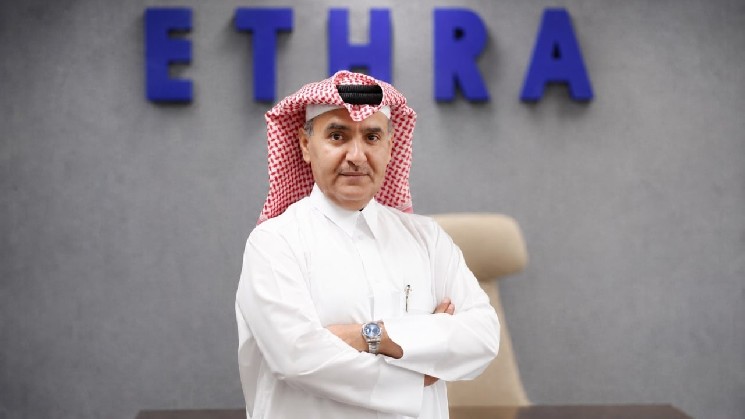
Said Al-Marri: How Tokenization Opens New Opportunities for Shipping Funds For centuries, commercial shipping has been a capital-intensive asset class limited to institutional funds and shipping dynasties. Said bin Saleh Al-Marri, CEO of Ethra Invest and Ethra Ship, aims to break down these barriers by combining Real World Asset (RWA) tokenization with conservative private equity principles. This bridges decentralized finance (DeFi) with the physical realities of global trade. Tokenization allows fractional ownership of ships on a blockchain, giving smaller investors access to previously inaccessible markets. However, Al-Marri warns it is not a regulatory loophole or a cure for asset illiquidity. The core physical risks are isolated in Special Purpose Vehicles (SPVs) for qualified investors. While tokenization enhances transparency and ownership record-keeping, Al-Marri stresses that a liquid secondary market depends on transparent asset valuation and must not interfere with ship operations managed by professionals. Regarding legal enforcement, smart contracts cannot physically seize a ship. Legal recourse still relies on traditional maritime courts, ship mortgages, and flag state laws, with blockchain records needing to mirror legal ownership in the SPV perfectly. Beyond ownership, the industry faces administrative hurdles like paper-based bills of lading. Al-Marri argues the bottleneck is legal and operational standardization, not technology. He advocates for a hybrid model combining digital trade documents and programmable settlements with support from regulated financial institutions, rather than a full crypto replacement for tools like Letters of Credit. A major challenge is decarbonizing the global fleet by 2050. Transitioning to green fuels requires massive upfront investment. Al-Marri emphasizes a conservative, holistic approach to underwriting these projects, evaluating technology, fuel availability, safety, and resale value. Investments must be justified under conservative forecasts, not just optimistic ones. By combining pragmatic risk management with digital infrastructure, leaders like Al-Marri show that the evolution of maritime finance is about mobilizing capital to build a modernized and sustainable global fleet, not just putting ships on a blockchain.

cryptonews.ru8m ago

Saeed Al-Marri: How Tokenization Unlocks New Opportunities for Shipping Funds

cryptonews.ru8m ago

Six Years Later, UNI Finally Welcomes Its Own "Buyback Bull"

After years of debate, Uniswap's UNI token has finally entered a 'buyback bull' phase following the long-awaited activation of its fee-switch mechanism. The UNIfication proposal, executed in December 2025, redirected a portion of protocol fees from select pools and Unichain sequencer revenue into a treasury (TokenJar) dedicated to buying back and permanently burning UNI. Initial market reaction was muted due to modest early burn rates. A significant shift occurred in July 2026 with the launch of Robinhood Chain. Uniswap's immediate deployment there skyrocketed trading volume, making it a top fee-generator. Subsequently, governance votes extended the fee mechanism to v4 pools and Robinhood Chain, causing protocol revenue to nearly triple. Daily funds directed to UNI burns rose sharply, with Robinhood Chain contributing over half. This transitioned UNI's narrative from a governance token to a cash-flow asset backed by a perpetual automatic buyer. UNI's price, which had languished around $2.30 in early June, nearly doubled to approach $4.60 by late July. Analysts credit this to the tangible cash flow from fees rather than mere speculation. Unlike many newer projects where buybacks are offset by large investor unlocks, UNI's six-year history has resulted in a widely distributed and relatively clean supply, allowing the buyback pressure to effectively impact the secondary market. The key test will be whether trading activity, particularly on Robinhood Chain, sustains after its initial gas subsidies expire.

marsbit13m ago

Six Years Later, UNI Finally Welcomes Its Own "Buyback Bull"

marsbit13m ago

Only 153 Venture Capital Firms Invested in July: Is the Crypto VC Industry Experiencing a 'Mass Extinction'?

In July 2026, only 153 unique venture capital firms participated in disclosed crypto funding rounds, marking the lowest monthly count since November 2020. This figure represents an 87% decline from the peak of 1,177 firms in 2022. Overall, the first seven months of 2026 saw crypto projects raise approximately $11.78 billion across 481 rounds. This crypto VC contraction contrasts sharply with the broader venture capital landscape, where global VC investment reached a record $560.4 billion in H1 2026, heavily fueled by major AI company financings. This shift in capital allocation has drawn funds away from the crypto sector. Within crypto, funding is highly concentrated. Trading platforms, prediction markets, and payment sectors absorbed 53% of the total capital. While early-stage deals remain frequent, the largest sums flow to a few late-stage rounds and mergers & acquisitions, which surged to $7.23 billion in Q2 2026. The market is consolidating around top funds like a16z crypto and Dragonfly, which successfully raised new multi-billion dollar funds, while many smaller firms have retreated. Analysts describe this as a "great extinction" for crypto VCs, where capital is becoming more selective, favoring proven business models and assets over early-stage speculation. This raises the bar for project quality, funding efficiency, and viable exit paths.

marsbit34m ago

Only 153 Venture Capital Firms Invested in July: Is the Crypto VC Industry Experiencing a 'Mass Extinction'?

marsbit34m ago

Trading

Spot

Hot Articles

How to Buy WAR

Welcome to HTX.com! We've made purchasing WAR (WAR) simple and convenient. Follow our step-by-step guide to embark on your crypto journey.Step 1: Create Your HTX AccountUse your email or phone number to sign up for a free account on HTX. Experience a hassle-free registration journey and unlock all features.Get My AccountStep 2: Go to Buy Crypto and Choose Your Payment MethodCredit/Debit Card: Use your Visa or Mastercard to buy WAR (WAR) instantly.Balance: Use funds from your HTX account balance to trade seamlessly.Third Parties: We've added popular payment methods such as Google Pay and Apple Pay to enhance convenience.P2P: Trade directly with other users on HTX.Over-the-Counter (OTC): We offer tailor-made services and competitive exchange rates for traders.Step 3: Store Your WAR (WAR)After purchasing your WAR (WAR), store it in your HTX account. Alternatively, you can send it elsewhere via blockchain transfer or use it to trade other cryptocurrencies.Step 4: Trade WAR (WAR)Easily trade WAR (WAR) on HTX's spot market. Simply access your account, select your trading pair, execute your trades, and monitor in real-time. We offer a user-friendly experience for both beginners and seasoned traders.

2.6k Total ViewsPublished 2024.03.29Updated 2026.06.02

How to Buy WAR

Discussions

Welcome to the HTX Community. Here, you can stay informed about the latest platform developments and gain access to professional market insights. Users' opinions on the price of WAR (WAR) are presented below.

活动图片