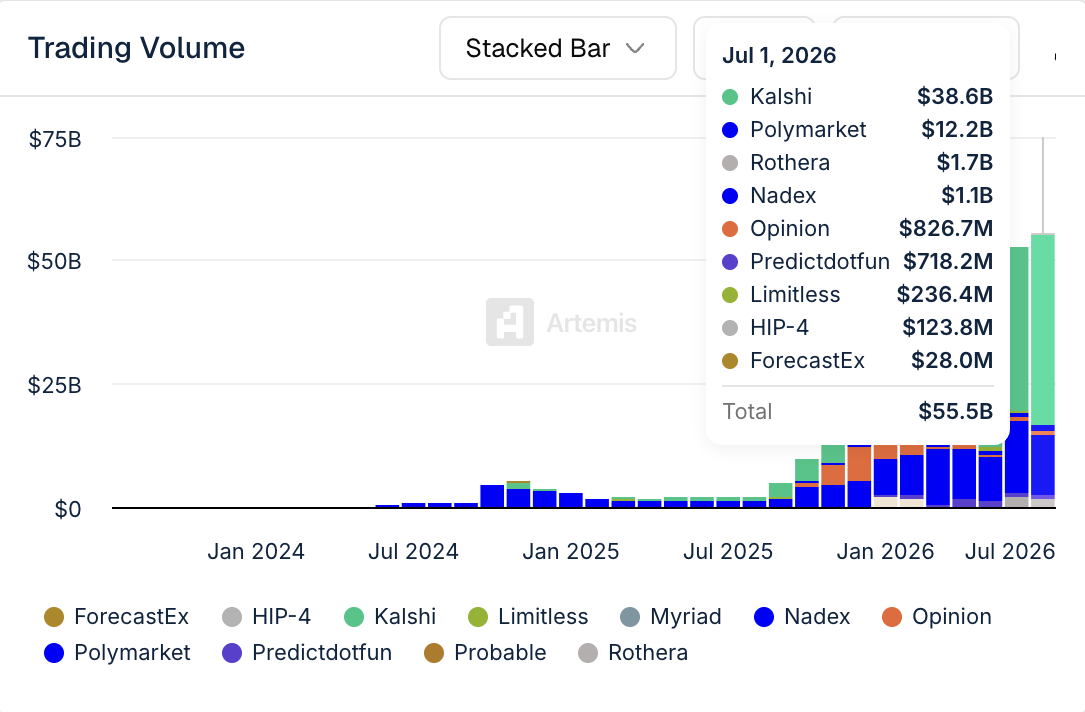
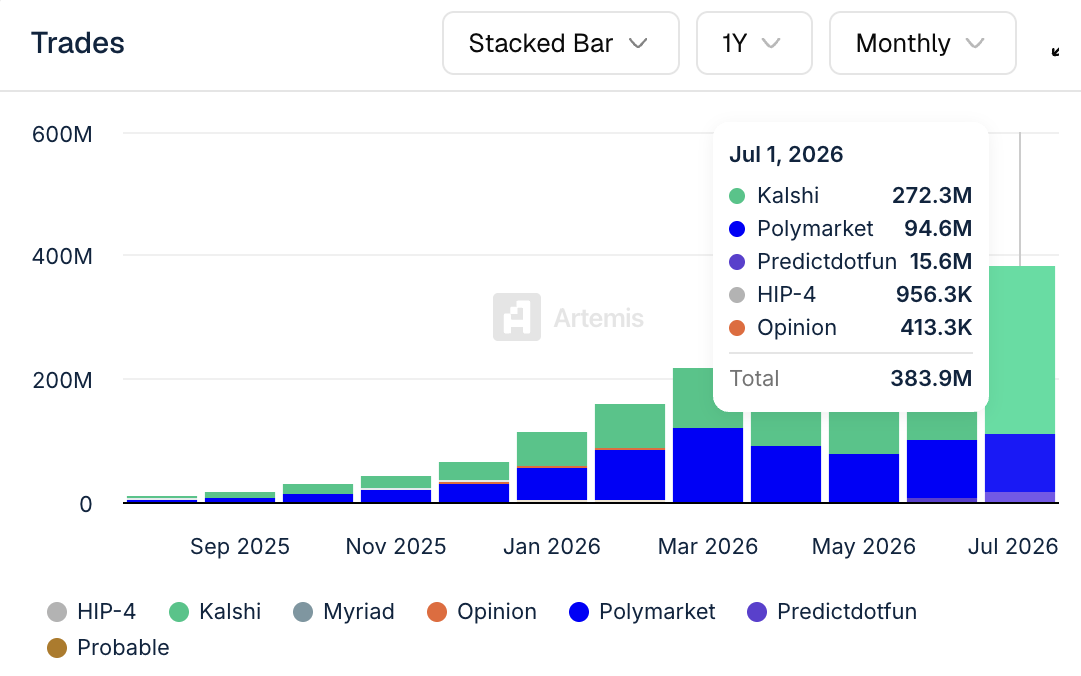
The prediction market sector has been on an upswing since the beginning of the year, and July was the first month where we observed a sharp increase in trading volumes and the total number of transactions. Artemis data shows that this month the prediction market set another monthly record: trading volume in this sector reached $55.5 billion, compared to $52.8 billion in June. As for transactions, 383.9 million deals were made this month versus 332.2 million in the previous month. For the second consecutive month, historical highs in volume and activity were recorded in the same month that featured World Cup playoff matches and the final.
Source: Artemis
The tournament, and particularly the playoff format existing until July, fit perfectly with the product concept. Each playoff match represented a short-term, unambiguous outcome, decided within hours of the game starting. No unresolved questions about betting decisions or election results that were months away. The team either advances or it doesn't. A short-term, unambiguous, and very fast outcome—the perfect structure that attracted millions of traders.
Kalshi's share of the company remained at 70% during the record month
Despite the growth of the entire sector over the last two months, this is a record for Kalshi. The CFTC-regulated platform accounted for $38.6 billion of the $55.5 billion and executed 272.3 million transactions out of the total 383.9 million. Kalshi's share by both metrics is approximately 70%.
Since the beginning of the year, Kalshi's monthly trading volume chart has shown an upward trend and is growing faster than any other platform. July only further solidified this lead. The fact is, while Polymarket also grew over the past two months, its share of the total continues to shrink as the leader grows.
Five platforms below the top two, reaching nine-digit sums
Below the two leaders are smaller venues that are no longer billion-dollar turnover platforms. Rothera earned $1.7 billion, and Nadex earned $1.1 billion, bringing two more platforms close to the billion-dollar mark. Opinion earned $826.7 million, Predictdotfun earned $718.2 million, and Limitless earned $236.4 million. HIP-4 earned $123.8 million, and ForecastEx earned $28 million.
Together, these two paragraphs describe a market that is simultaneously showing two trends. It is consolidating at the top, where Kalshi continues to increase its share, and expanding at the bottom, where five or six venues are now earning nine-digit sums per month. Both trends can develop simultaneously when the overall market is growing so quickly. The real test will come when these trends stop.
The number of transactions paints a slightly different picture of who the users really are. Predictdotfun recorded 15.6 million transactions for $718.2 million, indicating very small average ticket sizes. Kalshi and Polymarket lead in both metrics, but the ratio between dollars and transactions differs quite significantly depending on the market segment, suggesting truly different customer bases rather than competing clones for the same traders.
Weekly trading volume is declining, and this metric is more important than the total July volume
Trading volumes declined after the final, which should surprise no one. A tournament with a resolvable event every few days represents a temporary source of trading opportunities, and when it ends, that source disappears with it.
The useful detail is where the decline stops. Weekly figures remain above the pre-June baseline for now, meaning some of the clients engaged during the World Cup are still trading something else. If this trend persists into August, it means permanent clients were added to the sector during the tournament, not just six-week tenants. If the weekly volume continues to fall back to May levels, July will look like a one-event-driven spike.