Six Years Later, UNI Finally Welcomes Its Own "Buyback Bull"

marsbitPublished on 2026-07-31Last updated on 2026-07-31

Abstract

After years of debate, Uniswap's UNI token has finally entered a 'buyback bull' phase following the long-awaited activation of its fee-switch mechanism. The UNIfication proposal, executed in December 2025, redirected a portion of protocol fees from select pools and Unichain sequencer revenue into a treasury (TokenJar) dedicated to buying back and permanently burning UNI. Initial market reaction was muted due to modest early burn rates. A significant shift occurred in July 2026 with the launch of Robinhood Chain. Uniswap's immediate deployment there skyrocketed trading volume, making it a top fee-generator. Subsequently, governance votes extended the fee mechanism to v4 pools and Robinhood Chain, causing protocol revenue to nearly triple. Daily funds directed to UNI burns rose sharply, with Robinhood Chain contributing over half. This transitioned UNI's narrative from a governance token to a cash-flow asset backed by a perpetual automatic buyer. UNI's price, which had languished around $2.30 in early June, nearly doubled to approach $4.60 by late July. Analysts credit this to the tangible cash flow from fees rather than mere speculation. Unlike many newer projects where buybacks are offset by large investor unlocks, UNI's six-year history has resulted in a widely distributed and relatively clean supply, allowing the buyback pressure to effectively impact the secondary market. The key test will be whether trading activity, particularly on Robinhood Chain, sustains after its i...

Original Author: Eric, Foresight News

During the overall market volatility in June and July, the price movements of most major tokens were lackluster, but UNI performed unexpectedly strongly.

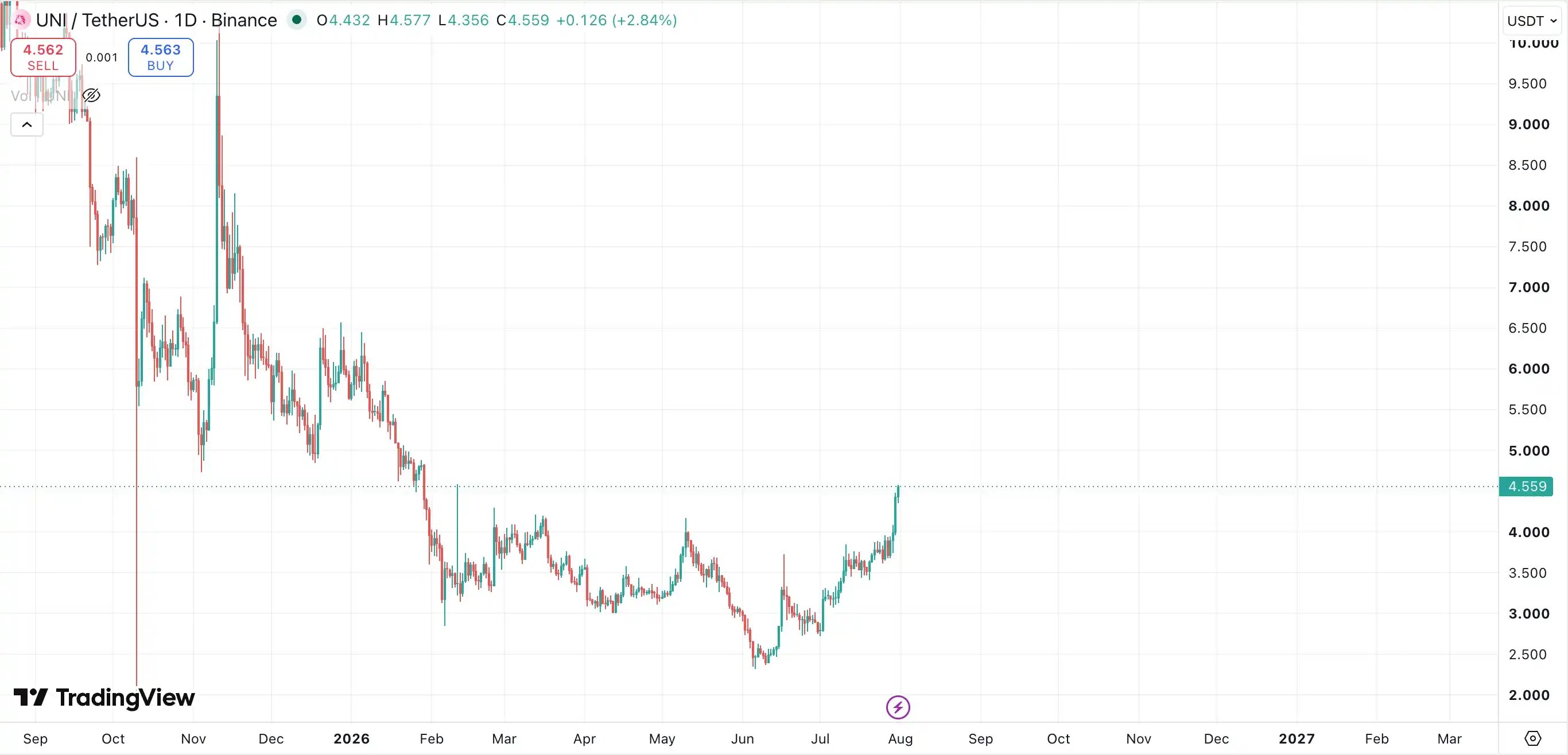
In early June, the price of UNI was hovering around $2.3. By the end of July, it had approached $4.6, nearly doubling in two months. Rewinding to last December, when Uniswap had just passed the long-debated fee switch proposal, UNI rose for only one day before falling alongside the broader market, with little market interest in the leading DEX of the DeFi world.
But the turning point had been set then, though few realized it at the time.

On December 28, 2025, the Uniswap governance proposal UNIfication was officially executed on-chain. The protocol fee switch was activated, diverting a portion of trading fees from Ethereum mainnet v2 pools and some v3 pools to the protocol; sequencer revenue from Unichain, after deducting OP shares and L1 data costs, also flowed into the same fund pool; a one-time burn of 100 million UNI tokens from the treasury served as retrospective compensation for the past years of the "free era"; Uniswap Labs reduced its fees for the frontend, wallet, and API to zero, while receiving an annual 20 million UNI growth budget. All these protocol revenues ultimately converged into a treasury contract named TokenJar, which had only one outlet: buying UNI through the Firepit contract for permanent destruction.

This is what the long-debated "fee switch" truly looked like upon implementation. Since DeFi Summer, the community had debated whether to allocate a portion of trading fees to the protocol, but each vote was stalled by concerns over profit distribution, legal risks, and LP attrition. When it finally passed, the market reaction was quite muted. When the proposal was announced, UNI surged nearly 50% in a few hours, but then declined as the broader market weakened. By March 2026, UNI had fallen below $3.8, ranging sideways around $3 in April and May, and even dropping to $2.3 in early June. The fee switch was turned on, but quietly.
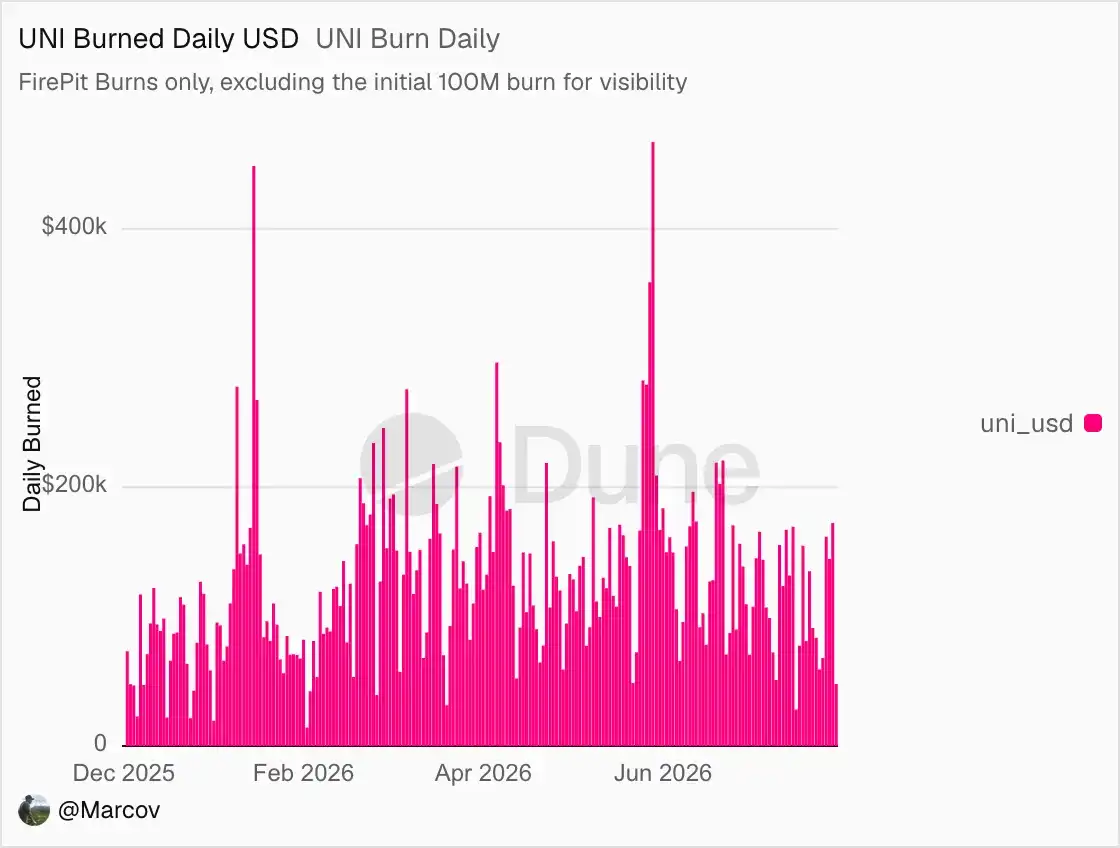
The quietness was due to underwhelming data. According to Dune statistics, in the first 12 days after the fee switch was activated, the cumulative value of burned UNI was only about $800,000, roughly $26-27 million annualized, corresponding to an annual burn of approximately 4 to 5 million UNI tokens. Considering the protocol's annual 20 million UNI growth budget expenditure, this figure held little appeal. By May 2026, cumulative protocol revenue was about $12.3 million, with daily protocol revenue around $73,000. The burn mechanism was operating, but it was more like an engine idling too quietly to be heard.

The change occurred in July. On July 1, Robinhood Chain officially launched, with Uniswap's v2, v3, v4, and UniswapX deployed on the first day. This chain, built for tokenized stocks, pushed Uniswap's daily trading volume to $5 billion within eight days, with cumulative trading volume surpassing $10 billion by July 10. In its first week, Robinhood Chain contributed nearly half of Uniswap's total weekly fees, approximately $11 million. Daily total protocol fees once reached $5.2 million, second only to the two major stablecoin issuers across the entire network. Uniswap founder Hayden Adams called it the most active chain outside of Ethereum mainnet.

Then came the votes. A Snapshot vote from July 7 to 12 decided to extend the fee mechanism to v4 pools, followed by on-chain voting the next week; a temperature check for activating protocol fees on the Robinhood Chain deployment ran from July 10 to 15. On July 27, the v4 fee switch was officially activated. The effect was immediate: according to DefiLlama data, protocol revenue nearly tripled after activation. Daily funds flowing to UNI burns rose from about $114,000 in early July to $325,000, with Robinhood Chain alone contributing $170,000, over half the total, and Ethereum mainnet contributing about $82,000. On the day the news materialized, UNI rose 12%, touching $4.4.

Looking back at this curve, the logic is quite clear. When the fee switch was turned on at the end of last year, the market priced in expectations, and when expectations weren't met, it fell back. But when the burn data climbed from a few hundred thousand dollars per month to a few hundred thousand dollars per day, and when the largest new revenue source by trading volume connected to this burn machine, the market began pricing not expectations but cash flow. For a protocol with annual trading volume in the trillions, token holders previously received nothing. Now, every transaction creates a permanent, automatic buyer for the token. This transformation from a governance token to a cash-flow asset is the core narrative behind this rally.

It's worth noting that buyback-and-burn mechanisms are no longer novel in today's crypto industry. Hyperliquid has a monthly buyback size of nearly $95 million, pump.fun has $35 million, Jupiter uses half its operating income for buybacks, and dYdX, Aave, and Lido are all advancing similar mechanisms. But whether buyback-and-burn works never depends on the mechanism itself, but on the token distribution structure.

UNI is an "old token" that completed its distribution in 2020. Six years have allowed for sufficiently dispersed holdings. There are no massive, pending unlocks in the circulating supply. Approximately $830 million worth of UNI is available for sale on exchanges. The buyback-formed buying pressure genuinely acts on the secondary market. Many new projects also sport buyback-and-burn labels, but the monthly token unlocks for teams and investors far exceed the buyback volume. The burned tokens are just a drop in the bucket against the constant influx of new supply, so prices naturally cannot hold.

This is a rare advantage for old DeFi projects. Having survived long enough, launching early enough, and having sufficiently cleaned-up token distribution allows the buyback-and-burn machine to truly start turning. For UNI, the next question to verify is also specific: Robinhood Chain's gas subsidies are set to expire roughly 90 days after launch. How much trading volume remains thereafter will determine whether this doubling is the beginning of value realization or just another illusion propped up by subsidies.

Related Questions

QWhat is the main reason behind UNI's strong price performance from June to July, according to the article?

AThe article attributes UNI's strong performance to the effective implementation of the 'fee switch' and the subsequent shift from a governance token to a cash-flow asset. The key driver was the significant increase in daily protocol revenue, which funds an automatic buyback and burn mechanism, creating a permanent buyer for UNI. This was amplified by Uniswap's deployment on the new Robinhood Chain, which greatly boosted trading volume and fee revenue.

QWhat is the role of the TokenJar treasury contract and the Firepit contract in the new Uniswap fee mechanism?

AThe TokenJar treasury contract is the central pool that collects all protocol revenue from the activated fee switch (from Ethereum v2/v3 pools, etc.) and sequencer revenue from Unichain. The Firepit contract is its only exit; it uses the funds in TokenJar to buy UNI tokens and permanently burn them, directly linking protocol revenue to deflationary pressure on the token supply.

QHow did the launch of Robinhood Chain impact Uniswap's metrics in July 2026?

AThe launch of Robinhood Chain in July 2026 dramatically increased Uniswap's activity. In its first week, it contributed nearly half of Uniswap's total weekly fees (about $11 million), pushed Uniswap's daily trading volume to $500 million, and helped achieve a cumulative volume of over $1 billion by July 10. After the fee mechanism was extended to it, Robinhood Chain alone contributed over $170,000 daily to the UNI burn, which was more than half of the total daily burn amount at the time.

QWhy does the article claim that buyback/burn mechanisms work better for 'old DeFi projects' like UNI compared to many new projects?

AThe article argues that old DeFi projects like UNI, which launched and distributed tokens years ago (2020 for UNI), have a more favorable token distribution. Their circulating supply is widely distributed with no large, pending unlocks from teams or investors. This means the buyback pressure from protocol revenue acts directly on the secondary market supply. In contrast, many new projects have monthly unlock schedules where newly released tokens for teams and investors often far exceed the amount being bought back and burned, diluting the deflationary effect.

QWhat future challenge or test does the article mention for UNI's current bullish narrative?

AThe article identifies the upcoming expiration of Robinhood Chain's gas fee subsidies (around 90 days after launch) as a key test. The sustainability of Uniswap's trading volume and fee revenue on that chain after the subsidies end will determine whether the recent price increase represents a true 'value discovery' or was merely a temporary illusion propped up by incentives.

Related Reads

Solana Price Forecast for August 2026: Can $19 Million from Morgan Stanley and 330,000 Korean Merchants Break SOL's Triangle?

**Solana Price Forecast for August 2026: Key Catalysts and Technical Setup** As of July 31, Solana (SOL) trades at $73.59, consolidating within a triangle pattern formed between its May peak (~$98) and June low (~$60.29). A decisive breakout from this pattern is anticipated. Key resistance levels are clustered around $74.79 (0.382 Fib), $75.33 (20-day EMA), $76.01 (50-day EMA), and a critical zone near $79 (0.5 Fib & 100-day EMA). Support lies at $73.42, $69.25 (0.236 Fib), and the June low of $60.29. Two major institutional catalysts emerged recently: 1. **Morgan Stanley's MSOL ETF:** Launched July 28, it saw $19.06 million in inflows on its second day—the largest single-day inflow for any US SOL ETF since mid-May. 2. **KSNET Partnership:** The Solana Foundation signed an MoU with South Korean payment processor KSNET (serving 330,000 merchants) to explore integrating Solana Pay for domestic and AI-powered transactions. Historically, August has been volatile for SOL, marked by extreme gains in 2020 and 2021 but otherwise weak performance. The forecast for August 2026 is bifurcated: * **Bullish Case:** An upside triangle breakout, sustained MSOL inflows, and positive momentum from the KSNET news could propel SOL toward the $79 resistance cluster, especially if the CLARITY Act is passed by August 8. * **Bearish Case:** A downside break below $73.42, fading excitement around the new ETF, and stalled regulatory progress could see SOL retest support near $69.25, exacerbated by macro risks.

cryptonews.ru8m ago

Solana Price Forecast for August 2026: Can $19 Million from Morgan Stanley and 330,000 Korean Merchants Break SOL's Triangle?

cryptonews.ru8m ago

AFX Trade Promises to Present "Goodwill Plan" on August 3 Following $24 Million Loss Incident

AFX Trade, a cryptocurrency platform, announced it will present a "goodwill plan" on August 3rd, following a security incident on July 22nd that resulted in a loss of $24.15 million. The company's brief update offered no specific details on compensation for affected users, investors, and employees, only urging calm while the team formulates next steps. The theft occurred from a USDC custody account on Arbitrum, with the stolen funds converted to Ethereum. Blockchain analysts traced the funds to a single wallet. AFX Trade and Arbitrum clarified the exploit targeted a third-party bridge, not Arbitrum's native bridge. An investigation revealed the attack began on July 9th with a social engineering scheme targeting a developer. The attacker then deployed malicious code within AFX's internal JFrog repository and infrastructure, eventually compromising bridge validators to authorize the fraudulent withdrawal. The company stated the exploit leveraged a "trust vulnerability," not a smart contract bug. AFX Trade's head of business development made an offer to the attacker, proposing they keep 30% of the funds as a white hat bounty if 70% is returned. The incident fits a 2026 trend identified by TRM Labs: while the number of crypto hacks hit a record, total losses decreased. However, infrastructure and operational breaches, though fewer, accounted for the majority of financial losses. The AFX breach is classified as an infrastructure incident involving private key compromise.

cryptonews.ru19m ago

AFX Trade Promises to Present "Goodwill Plan" on August 3 Following $24 Million Loss Incident

cryptonews.ru19m ago

Trading

Spot
活动图片