Cathie Wood's June $77M Investment: Are Crypto Stocks a True 'Substitute' for Bitcoin?

marsbitPublished on 2026-07-06Last updated on 2026-07-06

Abstract

In June, Cathie Wood's ARK Invest purchased $77 million worth of publicly traded crypto-related stocks, including Coinbase, Circle, and Bullish, during Bitcoin's worst monthly performance in four years. This aligns with the investment thesis that such stocks offer a compliant way to gain exposure to the crypto cycle without directly holding Bitcoin. However, data analysis reveals significant drawbacks. A group of nine U.S.-listed crypto companies showed 30-day annualized realized volatility between 68% and 90%, nearly double Bitcoin's 37.6%. Over 90 days, Circle's volatility reached 103.6% versus Bitcoin's 37.8%. Drawdowns were also more severe for stocks like Circle (-51.4%) and MicroStrategy (-48.6%) compared to Bitcoin's -36.4% from its January high. Correlation analysis shows most stocks share only a moderate link to Bitcoin. For example, Circle, Robinhood, and Bullish have a 90-day correlation coefficient of just 0.55–0.58 with BTC, meaning only about one-third of their price movement is explained by Bitcoin's action. The rest stems from company-specific risks: earnings, competition, fundraising, and equity dilution. MicroStrategy (MSTR) is the notable exception, acting as a leveraged Bitcoin proxy with a beta of 1.59 and 0.85 correlation. Coinbase offers relatively balanced exposure. Circle exemplifies "crypto-wrapped" corporate risk, with its recent crash tied to stablecoin competition, not Bitcoin. Robinhood's diversified business insulates it from crypto downturns...

Author: Andjela Radmilac, cryptoslate

Compiled by: Luffy, Foresight News

ARK Invest, led by Cathie Wood, purchased a total of $77 million worth of shares in crypto-related public companies in June. According to ARK's daily trading disclosures, during Bitcoin's worst monthly performance in four years, the fund increased its positions by $44 million in Coinbase, $25.25 million in Circle, and $8.2 million in Bullish.

Wood and several institutions have adhered to the same investment logic for years: crypto public companies provide investors with a compliant channel to participate in the crypto industry's cyclical gains without directly holding Bitcoin. However, an analysis of market data by CryptoSlate as of July 2 reveals the significant hidden costs of this stock investment path.

The 30-day annualized realized volatility for nine U.S.-listed crypto companies ranges from 68% to 90%, nearly double Bitcoin's 37.6% volatility. Over a 90-day period, Circle's volatility is as high as 103.6%, while Bitcoin's is only 37.8%. The gap in price drawdowns is also significant: Circle has fallen 51.4% from its high, MSTR is down 48.6%, and Bullish is down 43.6%; meanwhile, Bitcoin has retreated 36.4% from its near $97,000 peak in January, with all declines smaller than those of the aforementioned stocks.
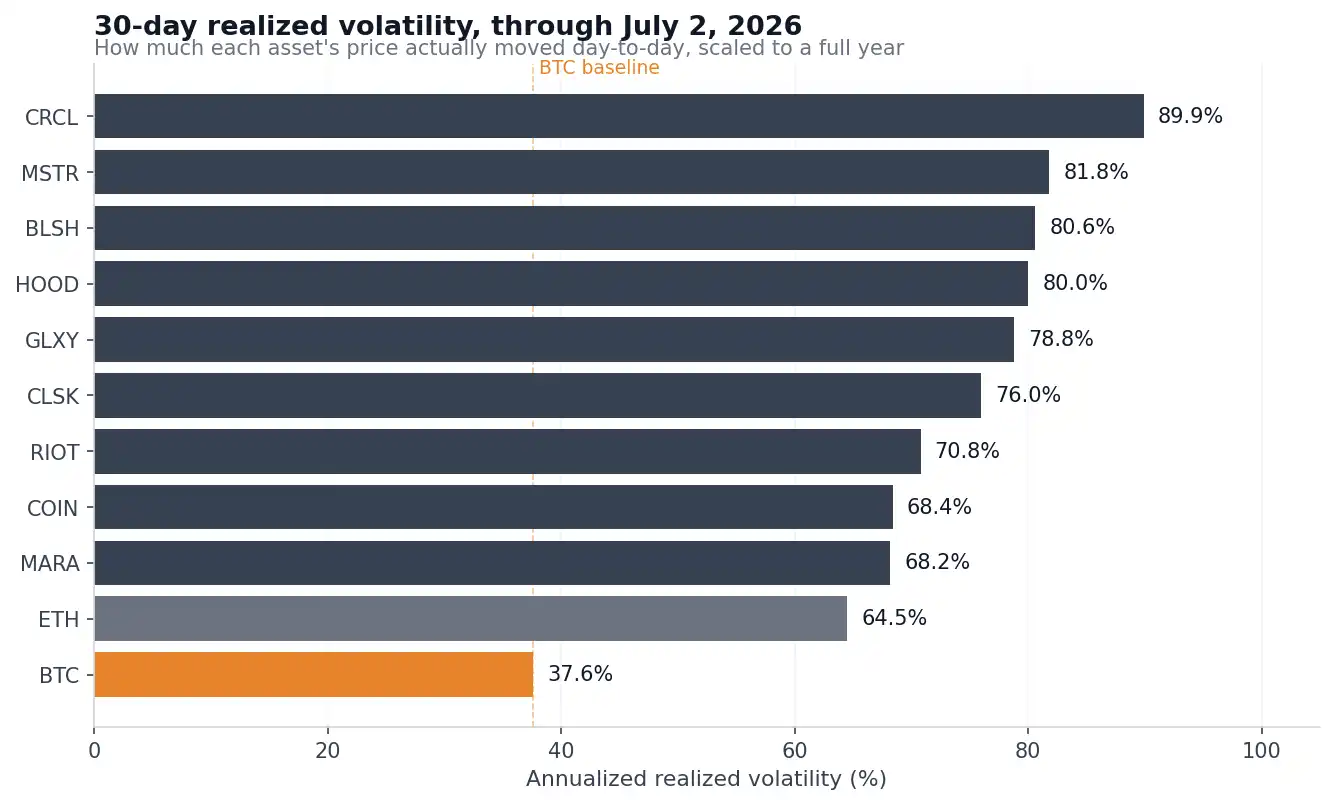
30-day annualized realized volatility of BTC, ETH, and nine U.S.-listed crypto company stocks from January 1, 2026, to July 2, 2026.

Judging by volatility alone, crypto stocks appear to be leveraged Bitcoin. However, correlation data reveals a completely different truth. Over the past 90 trading days, the correlation coefficients of Circle, Robinhood, and Bullish with Bitcoin are only 0.55–0.58 (the correlation range is 0 to 1, where 1 represents perfectly synchronized movements and 0 represents no correlation). This means Bitcoin price fluctuations can only explain about one-third of the volatility in crypto company stocks. The remaining volatility stems entirely from company-specific risks: quarterly earnings reports, industry competition, fundraising activities, share dilution, and more. Investors aiming to gain crypto industry exposure through stocks end up with only partial Bitcoin exposure while additionally bearing a full set of business risks unique to the stock market.

Only One Stock Truly Tracks Bitcoin

The table below shows the correlation of crypto company stocks with Bitcoin from the end of 2025 to the present. Beta represents the percentage change in a stock for every 1% move in Bitcoin.
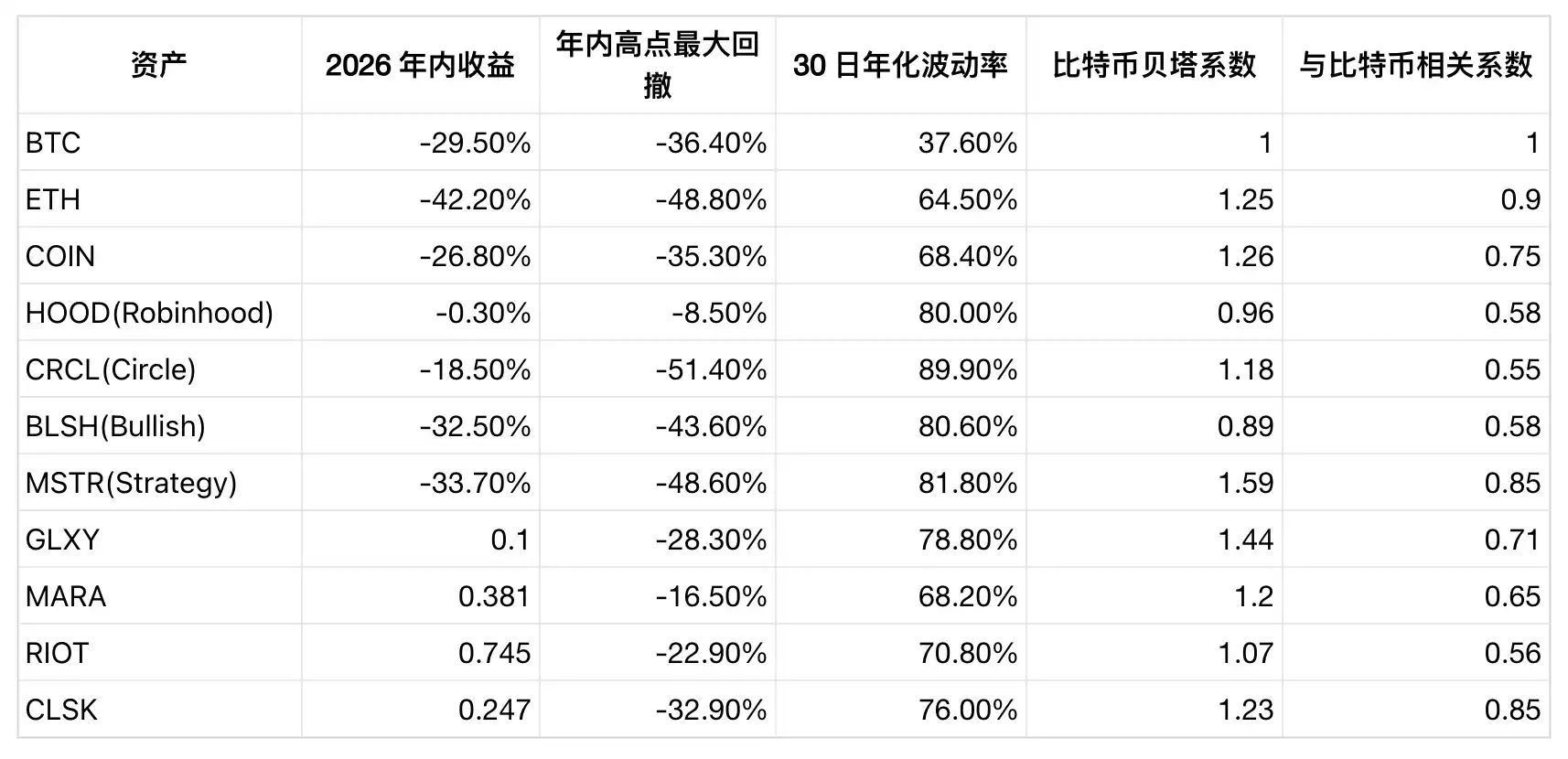
MSTR is the only stock in the entire market that can be considered a Bitcoin alternative. With a beta of 1.59 and a correlation of 0.85, it is essentially an equity tool for holding Bitcoin with leverage. In the recent downturn, its year-to-date decline and drawdown from highs have far exceeded Bitcoin's.

Coinbase is a relatively balanced choice, with a year-to-date decline of -26.8%, slightly less than BTC's. Its beta coefficient is 1.26, and its correlation coefficient is 0.75, making it the second-strongest correlated with Bitcoin within the sector. However, its volatility is still nearly double that of Bitcoin, and its stock price is down 60.6% from its all-time high of $419.78 in July 2025. Losses for investors who bought at that peak are far greater than for those who entered at Bitcoin's historical high in October 2025.

Circle perfectly illustrates 'business risk in crypto clothing.' It has the lowest correlation with Bitcoin in the sector and the highest 90-day volatility. The trigger occurred on June 30: with the official launch of the Open USD stablecoin, backed by a consortium of over 140 companies including Coinbase, Stripe, Visa, Mastercard, and BlackRock, CRCL plummeted 17.5% in a single day. This sharp drop was almost entirely unrelated to Bitcoin's performance, purely a company-specific negative driven by competition for market share in the stablecoin sector.

Robinhood is a counterexample, similarly demonstrating that individual stock performance can be independent of crypto trends. The stock has only declined slightly by 0.3% year-to-date, with a maximum drawdown of just 8.5%. Crypto business is just a small part of its overall brokerage portfolio, which includes stocks, options, and derivatives. Its diversified business has cushioned the decline; conversely, during a crypto bull market, it is unlikely to provide investors with substantial gains from crypto price movements.

Mining company trends are the most anomalous. While Bitcoin fell 29.5% year-to-date, RIOT surged 74.5%, MARA rose 38.1%, and CleanSpark gained 24.7%. The core logic is that mining companies are transforming into AI high-performance computing service providers, signing hundreds of billions in computing power leasing contracts while continuously selling their Bitcoin holdings. Although their daily price movements still follow Bitcoin (beta coefficients are all greater than 1), their annual returns are entirely driven by AI hosting business, decoupled from coin prices.
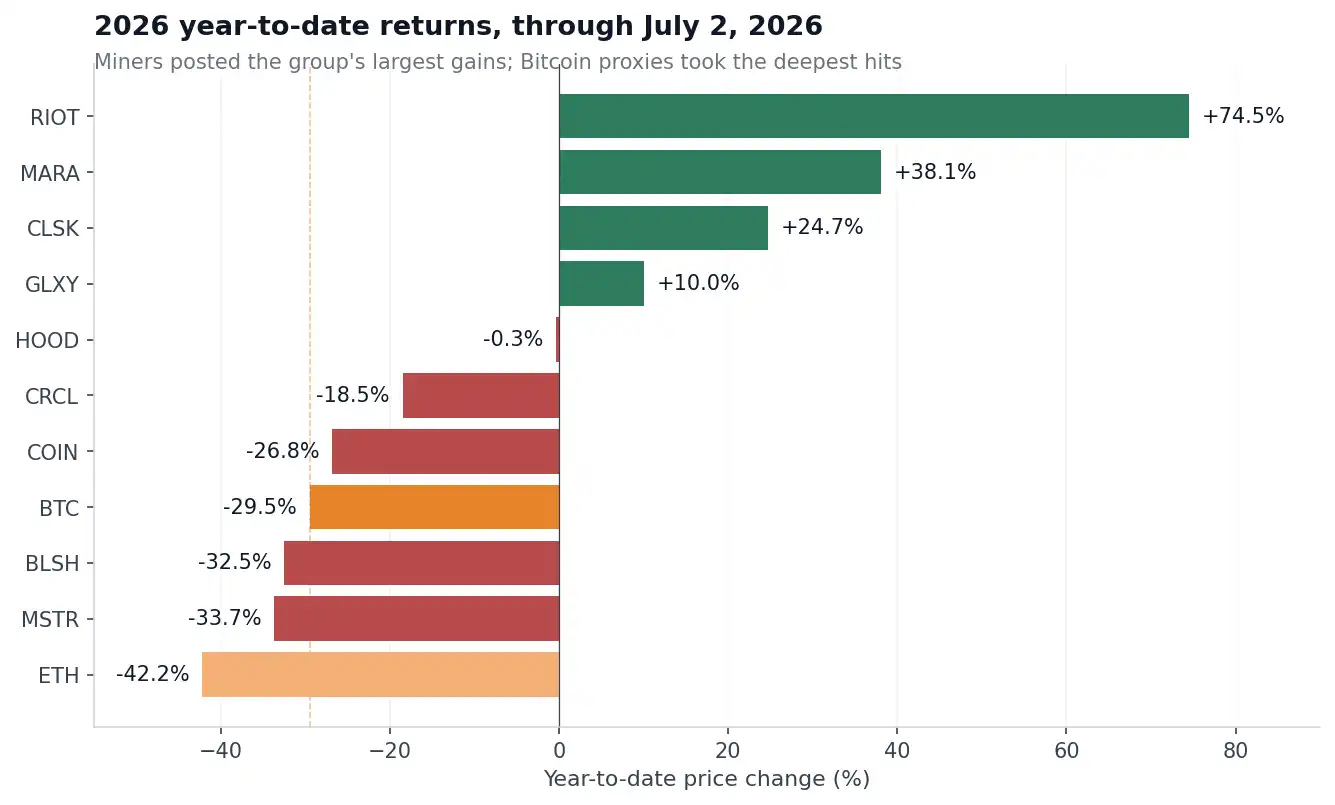
Year-to-date price changes of BTC, ETH, and nine U.S.-listed cryptocurrency stocks.

Bitcoin's own volatility is not insignificant. Volmex's Bitcoin 30-day Volatility Index dropped to a low of 24.5 in late May, peaked at 68.7 in early February, and rebounded to 41.6 in early July. Even so, the volatility of most crypto stocks remains nearly double.

Strategy Case Study: Equity Structure Adds Extra Risk

Holding Bitcoin only requires bearing the risk of price fluctuations; buying shares in crypto public companies adds multiple variables: business operations, equity dilution, disappearing valuation premiums, fundraising pressure, changes in capital structure, and more.

Strategy recently exposed all these risks in a concentrated manner over the past month. At the end of June, its price-to-book ratio (mNAV) fell below 1 for the first time. This metric measures the company's total valuation relative to its net assets. A ratio below 1 means the market values the entire company less than the cash and Bitcoin it holds. According to the June 22 disclosure, Strategy held 847,363 Bitcoins. On the day mNAV fell below 1, these Bitcoins were worth approximately $50 billion.

An mNAV greater than 1 is the foundation of Strategy's entire growth flywheel. In the past, the company could issue common and preferred shares at a premium, raise funds, and continue to acquire Bitcoin, increasing Bitcoin holdings per share. Once mNAV falls below 1, this cycle can reverse and erode shareholder value—issuing shares to raise funds for buying Bitcoin is equivalent to selling existing Bitcoin assets at a discount.

CryptoSlate reported as early as January that Bitcoin-holding companies are divided into those trading at a valuation premium and those at a discount. By the end of June, Strategy's total market capitalization was $29.54 billion, less than half of its peak of over $71 billion in 2024, with all four classes of preferred shares at historical lows.

Strategy announced countermeasures. On June 29, it unveiled a stock buyback plan of up to $1.25 billion and authorized the sale of Bitcoin to supplement liquidity, covering preferred stock dividends and debt interest. In the preceding weeks, on June 1, the company conducted its first Bitcoin sale since 2022, selling only 32 Bitcoins. After the announcement, the stock surged 12.6% in a single day, ending an eight-day losing streak. The world's largest Bitcoin holder needing to sell its holdings in a bear market to secure cash flow is a constraint not encountered when directly holding Bitcoin and is a risk unique to stocks.

This is precisely the backdrop for ARK's contrarian accumulation. On June 25, amidst a collective slump in crypto stocks, Wood's funds bought $3.27 million worth of Robinhood shares in a single day, simultaneously increasing positions in Coinbase, Circle, and Bullish. Wood believes Bitcoin's long-term target price is in the millions of dollars and is currently investing heavily at a discount in crypto public companies that have seen deep corrections since their 2025 highs.

The data reveals the true nature of these companies.

  • Strategy = Leveraged Bitcoin + Equity Dilution Risk;
  • Circle = Stablecoin sector payment company, deeply entangled in market share battles;
  • Robinhood = Comprehensive broker, crypto is just a side business.

Wood's basket purchase of these company stocks is essentially a bet on a combination of different business models, with vastly differing levels of crypto exposure.

Each individual stock has its own investment logic: Coinbase has outperformed Bitcoin year-to-date, Robinhood has maintained its price since the beginning of the year, and the mining sector has led in overall returns. But the core question remains: are crypto stocks really less risky than holding coins directly?

Data from the nine public companies shows that stocks either amplify Bitcoin's volatility or add company-specific operational risks unrelated to coin prices.

The truly strong-performing cryptocurrency stocks this year rely on independent growth businesses like AI computing power, brokerage traffic, and payment products, with Bitcoin being only a secondary influencing factor.


Trending Cryptos

Related Questions

QWhat is the main argument presented in the article regarding cryptocurrency stocks as a substitute for holding Bitcoin directly?

AThe article argues that cryptocurrency stocks are generally not a good substitute for direct Bitcoin exposure. They tend to have significantly higher volatility than Bitcoin and carry additional company-specific risks unrelated to Bitcoin's price movements, such as earnings reports, competition, and financing activities.

QWhich publicly traded company is cited as the most accurate proxy for Bitcoin investment, and what metrics support this?

AMicroStrategy (MSTR) is cited as the most accurate proxy. It has a high correlation of 0.85 with Bitcoin and a beta of 1.59, meaning it acts like a leveraged bet on Bitcoin's price.

QHow does Circle (CRCL) differ from being a simple Bitcoin investment according to the data?

ACircle shows the lowest correlation with Bitcoin among the studied stocks and the highest 90-day volatility. Its stock price is heavily influenced by company-specific factors like competition in the stablecoin market, as evidenced by a 17.5% single-day drop due to the launch of the Open USD stable币, which was largely independent of Bitcoin's price action.

QWhat unexpected trend is highlighted regarding major Bitcoin mining companies in 2026, and what is the driving factor?

ADespite Bitcoin's price decline in 2026, major mining companies like RIOT, MARA, and CleanSpark posted significant gains (e.g., RIOT up 74.5%). This is primarily driven by their successful pivot to becoming AI high-performance computing service providers, securing large compute rental contracts, which has decoupled their performance from Bitcoin's price.

QWhat unique financial risk did MicroStrategy (MSTR) face in June, according to the article, and how did it respond?

AMicroStrategy's market cap to net asset value (mNAV) ratio fell below 1, meaning the market valued the entire company for less than the value of the Bitcoin and cash it held. This threatened its growth model of issuing premium-priced shares to buy more Bitcoin. In response, it announced a $1.25 billion stock buyback plan and authorized selling some Bitcoin to cover obligations, a constraint not faced by direct Bitcoin holders.

Related Reads

Reviewing 8 'Cash Cow' Projects in the Bear Market: The Leader Repurchased $283 Million Worth This Year

This article highlights eight cryptocurrency projects that have demonstrated strong cash-generating capabilities and implemented significant token buyback programs during the bear market of 2026. These projects, dubbed "cash cows," are repurchasing their own tokens, often reducing supply. According to data from Tokenomist, the projects with notable buyback activity from January 1st to June 30th are: Meteora (MET), Pump.fun (PUMP), GMX, Rollbit (RLB), Metaplex (MPLX), Hyperliquid (HYPE), Lighter (LIT), and Aave. Notably, MET's buybacks equaled 71% of its January token supply, while HYPE executed the largest buyback by value at $283 million. Key project summaries include: - **Hyperliquid (HYPE):** The leader by dollar value, its perpetual DEX protocol has repurchased and burned 44 million HYPE tokens (approx. 4.4% of supply) using a significant portion of trading fees, with total buybacks exceeding $1.1 billion since March 2025. - **Meteora (MET):** Its buyback of 336.2 million MET tokens had the greatest proportional impact on its circulating supply, equivalent to 71% of its supply at the start of the year. - **Pump.fun (PUMP):** The popular memecoin launchpad has cumulatively bought back over $400 million worth of PUMP since July 2025, using 50% of net revenue for buybacks and burns since April. - **Aave (AAVE):** Despite facing a major security incident earlier in the year, the lending protocol has continued its buyback program, repurchasing over 200,000 AAVE tokens. Its team is designing a new automated buyback mechanism. - **GMX, Lighter (LIT), Rollbit (RLB), and Metaplex (MPLX)** also have active buyback mechanisms funded by protocol fees or revenues. The article concludes that while token buybacks and burns do not guarantee price appreciation—as market conditions, news, and other factors play a role—these projects stand out for their ability to generate consistent cash flow in a challenging market environment.

marsbit6m ago

Reviewing 8 'Cash Cow' Projects in the Bear Market: The Leader Repurchased $283 Million Worth This Year

marsbit6m ago

Ethereum Sheds Its Load? What Ethereum Supporters Think About the Lean Ethereum Upgrade and the Future Market

Ethereum is back in focus with the announcement of the "Lean Ethereum" upgrade roadmap, described by Vitalik Buterin as Ethereum's third major update. This proposal aims to fundamentally redesign the consensus, data, and execution layers from first principles, striving to make Ethereum **simpler, more secure (quantum-resistant), more verifiable, and more scalable.** The announcement comes amidst a broader restructuring within the ecosystem, including a 20% staff reduction at the Ethereum Foundation and the emergence of new organizations like EthLabs. This has sparked a debate among Ethereum supporters ("E-bizens"). **Optimists** view Lean Ethereum as a critical refocusing on core protocol fundamentals: * **sassal.eth** calls it the ultimate bullish catalyst, envisioning a future where running a node is so lightweight it could be done on a smartwatch, greatly enhancing decentralization. * **Ryan Sean Adams** sees it as Ethereum moving from "narrative expansion" to "protocol hardening," addressing long-term foundational issues like security and scalability. * Analysts like **BITWU** and **蓝狐 (Blue Fox)** frame it as a third-phase evolution towards a "minimal, durable, and credible base layer" designed for the next decade. * **gigi发财猪** interprets the organizational changes as Ethereum "shedding old baggage and forming new teams" for a lighter, more agile approach. * **Xiyu** notes that the roadmap itself provides a much-needed new narrative for market sentiment recovery. **Cautious voices** acknowledge the vision but emphasize execution and market timing: * **Ignas** warns that while the roadmap addresses key community requests, it overlooks tokenomics, and competitors are gaining ground in areas like RWA. Timely delivery is crucial; delays could be bearish. * **Dankrad Feist**, a former Ethereum Foundation researcher, agrees on direction but criticizes the proposed 3-4 year timeline as too slow for the current market pace, especially with AI-aided development available. **In summary,** optimists believe Lean Ethereum reaffirms Ethereum's long-term value proposition as a decentralized world computer, while the cautious argue that its success hinges on faster delivery and tangible results to maintain market relevance. Despite ongoing criticism, the move signals Ethereum's effort to regroup and reclaim initiative at the protocol level.

marsbit53m ago

Ethereum Sheds Its Load? What Ethereum Supporters Think About the Lean Ethereum Upgrade and the Future Market

marsbit53m ago

AI Folding: Fable 5 and GPT-5.6 Are Becoming the Privilege of a Few

【AI Accessibility Gap Widens: Elite Tools Like Fable 5 and GPT-5.6 Are Becoming Privileged】 We are witnessing a growing "AI divide." A stark reality is emerging: a tiny fraction of elites, primarily in tech, are using powerful next-generation models like Fable 5 or the upcoming GPT-5.6, while the vast majority of the public only has access to "toys" - free, limited models equivalent to ChatGPT's basic versions (8B to 30B parameters). This creates a massive experiential chasm and cognitive dissonance. Industry outsiders see AI as overhyped and ineffective, unable to grasp its transformative potential, while insiders leverage these advanced models for a decisive competitive edge. The gap isn't just about model quality but product functionality. Free users get a simple chatbot. Paying elites get integrated workflow systems—capable of creating specialized agents, processing complex data, and handling real-world tasks like management, coding, and planning. Demos showcasing AI planning weddings or building apps feel disconnected from everyday needs like managing bills, groceries, or health. The cost barrier is immense, with reports of engineers spending $1000 daily on Fable 5 inference. Elite users employ sophisticated multi-model workflows, combining different AIs for ideation, architecture, execution, and review, completing complex projects in minutes instead of weeks. This divide extends to critical areas like healthcare, where free models are dangerously unreliable for medical queries. However, some argue that for 90% of common business tasks, mid-tier models like GPT-5.5 are sufficient; the perceived limitation often stems from poor integration and lack of context, not model intelligence. Ultimately, unequal access to cutting-edge AI is creating a new form of social stratification, where the most powerful tools are becoming the exclusive privilege of a few.

marsbit1h ago

AI Folding: Fable 5 and GPT-5.6 Are Becoming the Privilege of a Few

marsbit1h ago

Trading

Spot

Hot Articles

Discussions

Welcome to the HTX Community. Here, you can stay informed about the latest platform developments and gain access to professional market insights. Users' opinions on the price of S (S) are presented below.

活动图片