Cardano Founder Says ‘Leios Is Coming’ As Proposal Heads To DReps

bitcoinistPublished on 2026-05-15Last updated on 2026-05-15

Abstract

Cardano founder Charles Hoskinson announced progress on the Leios consensus upgrade as a ₳27.7 million funding proposal moves toward DRep approval. The proposal seeks to advance Leios from a public testnet prototype to a mainnet-ready release candidate, aiming to increase Cardano's transaction capacity by 10–65x to support its 2030 scaling goals of handling over 27 million monthly transactions. The upgrade enhances, rather than replaces, the existing Ouroboros Praos protocol. The six to nine-month project is structured around development, rigorous testing, and hard-fork enablement, with funding managed via milestone-based disbursements. The proposal acknowledges risks including community readiness, governance dependencies, and potential operational impacts on stake pool operators.

Cardano founder Charles Hoskinson signaled renewed momentum behind Leios, the network’s next major consensus upgrade, as Input Output moved a ₳27.7 million funding proposal toward DRep approval. The proposal seeks to mature Leios from an early public testnet prototype into a mainnet-ready release candidate, positioning the upgrade as a central piece of Cardano’s 2030 scaling strategy.

“Leios is coming,” Hoskinson wrote on X, quoting Sebastian Nagel, who said: “Cardano, if your governance permits, we’ll ship Leios.” The short exchange framed the next phase of Cardano’s scaling roadmap as both a technical delivery question and a governance decision.

Cardano’s Biggest Scaling Bet

The proposal, authored by Carlos Lopez de Lara and Nagel, asks DReps to approve a treasury withdrawal of ₳27,714,342 to fund six to nine months of development. The work is intended to move Leios from its current prototype and testnet phase toward a release candidate suitable for mainnet integration. According to the proposal, each milestone would be independently assured, while undisbursed ada would be returned to the treasury.

Leios is designed to enhance, rather than replace, Ouroboros Praos, Cardano’s existing consensus protocol. The proposal says the upgrade introduces endorser blocks and committee-based validation to increase transaction capacity while preserving Praos’s security model. IO frames the design as a way to scale Cardano without undermining decentralization or making stake pool operations economically unviable.

“Cardano needs a step change in throughput to meet its 2030 ambitions, and Leios is how it gets there. This proposal funds the path from public testnet to a mainnet-ready release candidate — delivering a 10–65x increase in transaction capacity,” the proposal states. “Why this scale matters: Cardano’s 2030 strategy targets growth from roughly 800,000 monthly transactions to over 27 million.”

That 2030 target is a key justification for the funding request. The proposal argues that sustainable utilization at that level would require at least 6x current capacity, while Leios is expected to deliver 10x or more under validated parameter settings. Elsewhere, the accompanying IO article says Leios could support a phased throughput increase from 2x to 30x current capacity on mainnet, with full capacity demonstrated on testnet before broader rollout.

The work is organized around three objectives. The first is a release candidate, including a substantial rewrite of consensus components, implementation of the Leios block structure for the Dijkstra era, conformance testing against the Agda formal specification, and integration into the primary node by the fourth quarter of 2026.

The second is “high confidence,” built through parameter exploration, continuous load testing, adversarial testing, red-team exercises, and an updated threat model. The third is hard-fork enablement, covering client interfaces, technical documentation, SPO and developer workshops, support for adjacent infrastructure such as DB-Sync, Mithril and Blockfrost, testnet hard forks, governance artifacts and contingency procedures.

The proposal is careful to separate work within IO’s control from external dependencies. A mainnet hard fork would still depend on broader ecosystem readiness, governance action submission and a community vote. The document explicitly describes those as risks rather than promises.

Funding would be administered through Intersect’s treasury reserve smart contract framework, with milestone-based disbursements and third-party assurance. The budget allocates ₳23.83 million, or 86%, to development, with smaller portions assigned to infrastructure, security and audits, legal and compliance, ecosystem support, operations, governance and other costs.

The risk section is direct. It identifies community readiness, hard-fork timing, final cardano-node integration and possible governance constraints as factors that could delay or limit activation. It also notes technical limitations, including potential higher operational costs for SPOs, greater chain growth, and high-throughput assumptions tied to adversarial stake conditions.

At press time, ADA traded at $0.2661.
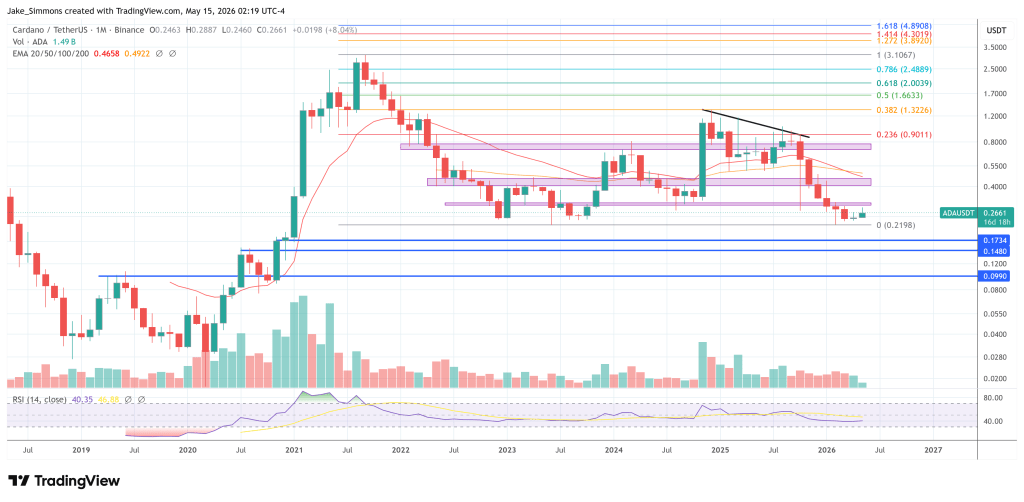
ADA remains below key resistance, 1-monthly chart | Source: ADAUSDT on TradingView.com

Related Questions

QWhat is the purpose of the 27.7 million ADA funding proposal submitted to the DReps for Leios?

AThe purpose of the 27.7 million ADA funding proposal is to mature Leios from an early public testnet prototype into a mainnet-ready release candidate, funding six to nine months of development work to achieve this goal.

QHow does the Leios upgrade aim to improve Cardano's transaction capacity according to the proposal?

AThe Leios upgrade aims to increase Cardano's transaction capacity by 10x to 65x, introducing endorser blocks and committee-based validation to enhance throughput while preserving the security model of the existing Ouroboros Praos consensus protocol.

QWhat are the three main objectives of the Leios development work outlined in the proposal?

AThe three main objectives are: 1) Delivering a release candidate with a rewritten consensus, 2) Building high confidence through extensive testing and security exercises, and 3) Enabling the hard fork through client interfaces, documentation, workshops, and ecosystem support.

QWhat are some of the key risks associated with the Leios activation mentioned in the proposal?

AKey risks include community readiness, hard-fork timing dependencies, final node integration, potential governance constraints, higher operational costs for SPOs, increased chain growth, and high-throughput assumptions tied to adversarial stake conditions.

QWhat is the target for Cardano's monthly transactions by 2030 as cited in the article, and why does it necessitate the Leios upgrade?

ACardano's 2030 strategy targets growth from roughly 800,000 to over 27 million monthly transactions. This necessitates the Leios upgrade because sustainable utilization at that level requires at least a 6x increase in capacity, which Leios is designed to provide (10x or more).

Related Reads

The Revelation from the Raydium Theft Incident: New DeFi Vulnerabilities Lurking in Forgotten Old Contracts

**Raydium Exploit Reveals DeFi's Hidden Risk: Forgotten "Zombie" Contracts** A recent attack on Raydium's deprecated V3 AMM pools resulted in a loss of approximately $1.34 million. The hacker exploited pools that were no longer supported by Raydium's current UI or SDK but remained fully functional and accessible on-chain. This incident highlights a critical, often overlooked category of risk in DeFi: inactive or legacy smart contracts that projects fail to properly decommission. Since March 2025, there have been at least 8 publicly reported attacks targeting such abandoned contracts, with total losses around $10.8 million. Including older pools and deprecated features, the count rises to 10 incidents with roughly $22.5 million in losses. These "zombie contracts" represent a lifecycle management failure rather than a code vulnerability, yet they are typically misclassified under general "code bug" categories in security reports, masking the true scale of the problem. The root cause is that projects often merely document a contract as "deprecated" without taking essential technical steps to secure it: withdrawing remaining assets, disabling external call functions, and implementing ongoing monitoring. These forgotten, under-monitored components become prime targets for attackers. To address this, the industry needs to recognize "zombie contracts" as a distinct risk category and establish standardized decommissioning protocols. Essential steps should include: 1) a formal retirement announcement, 2) removal of all front-end integrations, 3) withdrawal of locked assets, 4) disabling key contract functions, 5) ongoing security monitoring, 6) clear user communication, and 7) a post-mortem analysis. The value of a DeFi project lies not only in its current TVL but also in the security of its historical codebase, which has now become a new attack surface.

Foresight News21m ago

The Revelation from the Raydium Theft Incident: New DeFi Vulnerabilities Lurking in Forgotten Old Contracts

Foresight News21m ago

Robots Begin to 'Consume Data': The Hidden Production Chain from Indian Data Factories to Billion-Dollar Humanoid Robots

Robots have started to 'consume data,' driving the formation of a new industrial supply chain focused on producing training data for embodied AI. Unlike large language models, which are trained on vast internet text corpora, embodied AI models face a 'data desert' in the physical world. This has created a massive demand for first-person perspective video data (Ego Data), captured by workers wearing cameras in places like Indian garment factories. Companies like Neocambrian AI are establishing 'data factories' where workers perform standardized tasks (e.g., sorting clothes, kitchen organization) to generate thousands of hours of video. Research, such as NVIDIA's EgoScale, demonstrates that scaling this human demonstration data predictably improves robot performance, particularly for dexterous manipulation. This has validated a training path combining large-scale human data for pre-training with smaller amounts of robot-specific data for fine-tuning. The value of different data types varies significantly, forming a 'data pyramid.' The base consists of low-cost, large-scale internet and Ego Data. Higher layers include more expensive motion-capture data (e.g., from data gloves), simulation/synthetic data, and the most costly and scarce layer: real robot teleoperation data. This demand has spawned a layered ecosystem of data suppliers: low-cost data factories, motion capture and alignment specialists, robot-native teleoperation service providers, simulation data companies, and platforms aiming for data standardization. Robot companies themselves are adopting a 'layered procurement' strategy: outsourcing generic Ego Data while building in-house capabilities for robot-specific adaptation data and the critical deployment/failure data generated in real-world applications. The industry is shifting focus from hardware and basic mobility to the data pipelines required for general-purpose capability. While parallels exist to data labeling companies like Scale AI in the LLM boom, the physical complexity of robot data—involving action success ambiguity and sim-to-real gaps—requires more integrated solutions for data collection, annotation, and a continuous feedback loop. The race is on to build the data engines that will teach robots to operate reliably in the unstructured real world.

marsbit3h ago

Robots Begin to 'Consume Data': The Hidden Production Chain from Indian Data Factories to Billion-Dollar Humanoid Robots

marsbit3h ago

Spicy Commentary | Michael Saylor's 'Player Talk'; 60-Year-Old Aunt Liquidated After 'Scamming a Young Man'

**"Spicy Commentary": Three Tales of Crypto's Wild Week** This week's "Spicy Commentary" column highlights three dramatic stories from the cryptocurrency world. First, **MicroStrategy's Michael Saylor** addressed the controversy over his company potentially selling Bitcoin. At the BTC Prague event, he clarified, "I never said the company can't sell Bitcoin. I told *you* never to sell *your* Bitcoin." This "do as I say, not as I do" stance was criticized by netizens as peak linguistic gymnastics, noting a history of him previously stating the company would "never" sell. Second, a **bizarre fraud case** emerged from Beijing. A 60-year-old woman, obsessed with getting rich from crypto but unwilling to risk her own savings, posed online as the 20-something "god-daughter" of a high-ranking official. She catfished a young man, convincing him to give her over 200,000 yuan for fabricated emergencies. She then invested all the stolen money into cryptocurrency with 10x leverage, only to lose everything in a market crash. The woman was sentenced to four years in prison for fraud. Finally, a **sobering trader's tale** surfaced on Reddit. A user posted "Tale of a crypto trader," confessing their net worth had plummeted from a peak of $45 million to roughly $17,200, primarily due to holding meme coins too long. The post, described as a crypto "book of confessions," sparked reactions ranging from sympathy to critique about greed, poor risk management, and the perils of treating meme coins as long-term investments instead of taking profits. The column concludes that this week featured masterful rhetoric, elaborate scams, and extreme financial volatility, stitching together another chapter in crypto's unpredictable theater.

Foresight News3h ago

Spicy Commentary | Michael Saylor's 'Player Talk'; 60-Year-Old Aunt Liquidated After 'Scamming a Young Man'

Foresight News3h ago

Tremble Humans, AI Continues Its Accelerated Sprint

Trembling, Humans: AI Continues Its Accelerated Sprint Yes, AI is still rapidly accelerating. While deep learning seemed to stall quickly in its early years, large models after years of development show no sign of hitting their ceiling. At the Zhiyuan Conference 2026, the focus is on enabling AI to move from the digital world into the physical world. Scaling Law remains effective, continuing to drive advancements in both large language models and multimodal models. The industry is now entering a phase of pursuing World Models, though unresolved technical paths and data issues mean this exploration may take 3-5 more years. Concurrently, breakthroughs in Agents are accelerating AI's real-world application in fields like healthcare and meetings. Making Agents truly useful requires key hardware-software co-design, evident from the strong presence of chip vendors at the conference. We stand at a new historical threshold where AI is becoming a foundational force reshaping the world. The first day of the conference highlighted AI's evolution from "knowing how to chat" to "knowing how to work." Scaling Law persists, World Models are the next key battleground, and Agents are transitioning from usable to好用 (user-friendly). Scaling Law is not ending but diversifying. New models like Anthropic's Fable 5 demonstrate scaling through parameter size, synthetic data, and reinforcement learning. Advancements in AI Coding and Agent deployment are enabling a trend of AI self-evolution, potentially allowing AI to take over digital world iterations. World Models represent the next frontier for large models extending into the physical realm, but no current model is truly impressive at solving real-world problems. Technical consensus is lacking, with debates on data sources (video, simulation, real-world). Different approaches are emerging: language-centric, pixel-centric, 3D-structure-centric, and visual-representation-centric models. Zhiyuan Institute is exploring a fifth path: unified latent space modeling fusing language and visual representations, and introduced its own under-development World Model, Physis-v0.1. On the product side, Agents are key to bringing AI into daily life. Since 2025, the "Year of the Agent," products have become more proactive and capable of complex tasks. Zhiyuan showcased four vertical Agents for cardiac diagnosis, autonomous research, meeting summarization, and protein risk discovery. However, technical challenges remain, particularly in context engineering like memory and orchestration. "Harness" – the engineering framework around an Agent – is crucial for maximizing its capabilities by clarifying intent, designing workflows, and incorporating validation and feedback. In summary, AI's breakneck pace continues on multiple fronts: foundational model scaling, the ambitious pursuit of World Models for physical understanding, and the ongoing refinement of practical Agents. The journey from capable to truly reliable and useful AI systems is well underway.

marsbit3h ago

Tremble Humans, AI Continues Its Accelerated Sprint

marsbit3h ago

Trading

Spot
Futures

Hot Articles

Discussions

Welcome to the HTX Community. Here, you can stay informed about the latest platform developments and gain access to professional market insights. Users' opinions on the price of ADA (ADA) are presented below.

活动图片